For storage of about 2–4 weeks, a common rule of thumb is to leave the battery installed with a maintainer if the car supports it. For longer storage, it is commonly recommended to disconnect the negative terminal or remove the battery, especially with high parasitic draw or lithium batteries. Ignore that choice and a healthy battery can sulfate, discharge too far, or freeze in cold weather, which shortens its life or leaves you with a no-start. This guide explains when to leave it in, disconnect it, or remove it, plus how to store lead-acid, AGM, and lithium batteries safely.
Best storage method by scenario


The best storage method depends on how long the car sits, how much current the vehicle draws when off, and the battery chemistry. A short break can often stay in the car. A longer layup, or a vehicle with more parasitic draw, needs more protection from self-discharge and repeated deep cycling.
| Storage duration | Vehicle type | Battery type | Recommended action | Maintainer needed | Risk level |
|---|---|---|---|---|---|
| 2 weeks | Basic gasoline car | Flooded lead-acid | Leave installed if the battery is fully charged and the car is in a dry place | Optional, useful if the battery is older | Low |
| 1 month | Older car with low electronics load | Flooded lead-acid | Disconnect the negative terminal or use a maintainer | Recommended if power is available | Moderate |
| 3+ months | Any passenger car | Flooded lead-acid | Remove the battery and store it on a maintainer | Yes | High if left in place |
| 3+ months | Modern car with high parasitic draw | AGM or flooded lead-acid | Remove the battery or disconnect it and maintain it off the car | Yes | High |
| 2 weeks to 1 month | Outdoor storage, no outlet nearby | Flooded lead-acid | Leave installed only if fully charged; use a solar maintainer if practical | Solar maintainer helps | Moderate |
| 1 month or more | Any vehicle with AGM battery | AGM | Use a maintainer with AGM mode or remove the battery for off-car storage | Yes | Moderate to high |
2 weeks: leave it installed if the charge is full
For a short pause, the battery can usually stay in the car if it starts full and the vehicle does not have a heavy parasitic load. Modern cars can lose starting power after just a week or two parked, so even a short storage period can be long enough for some vehicles to need help. (Consumerreports)
If the car will be parked in a garage and you have power available, a battery maintainer is the cleanest option. It keeps the car ready to drive and avoids repeated low-charge cycling.
1 month: disconnect or use a maintainer
At about a month, the choice shifts. Leave the battery installed only if the car draws very little power when off and the battery starts fully charged. Otherwise, disconnect the negative terminal or connect a maintainer so the battery does not drift into a partly discharged state.
Suppose a sedan sits for five weeks while the owner is away. If the car has an alarm, keyless entry, and other always-on modules, a maintainer is the better call than hoping the battery will recover later. Partly discharged lead-acid batteries age faster.
3+ months: remove and store it on a maintainer
For long storage, removal is usually the safer choice. That keeps the battery away from vehicle parasitic draw and makes charging control easier. A true maintainer is designed to preserve charge, not resurrect a dead battery, so start with a battery that is already healthy and charged.
Long storage without charging support raises the chance of deep discharge. In cold weather, a discharged battery is also more likely to freeze. That can crack the case and permanently damage the battery.
Modern car with high parasitic draw
Cars with many modules, keyless systems, telematics, and security features can drain a battery faster than older vehicles. In that case, leaving the battery installed is usually a poor plan for anything beyond a short break. Disconnecting the battery or removing it is safer for longer storage.
Some vehicles also need a memory saver if you disconnect power. It plugs into the OBD-II port and helps preserve presets and ECU memory on some modern vehicles, but it is not a substitute for a charged battery.
Outdoor storage and cold-weather risk
Outdoor storage adds temperature swings, moisture, and no easy outlet. If the car sits outside, choose a fully charged battery, keep it upright, and use a solar maintainer if the vehicle must stay parked away from power. A cool, dry, ventilated area is still better when you can get one.
A common first-timer mistake is parking a car outside with a battery that is only half charged. That battery is more vulnerable to self-discharge and freeze damage if temperatures drop.
AGM battery storage
AGM batteries need the same core storage rules as flooded lead-acid batteries, but charger compatibility matters more. Advanced maintainers often have modes for AGM batteries. If the charger is wrong for the battery type, the battery may not be held at the right charge level.
AGM batteries are sealed, but they still benefit from upright storage, a stable charge, and a maintainer set to the right mode. For long layups, off-car storage with a maintainer is the safer option.
How to prepare the battery before storage
Before storage, inspect the battery, charge it fully, and place it where temperature and moisture will not work against it. The goal is to store a healthy, upright battery in a place that slows self-discharge and keeps sparks away.
Check case condition, terminals, and leaks
Look for bulging, cracks, corrosion, wet residue, and damaged terminals. A damaged case or active leak changes the plan: do not store a battery that is spilling electrolyte or showing signs of severe swelling. Lead-acid batteries contain sulfuric acid electrolyte, so a leak is not a cosmetic issue.
Charge the battery fully before storage
Store a battery fully charged whenever possible. A partially discharged lead-acid battery sulfates more quickly, and that sulfation can reduce capacity. If the battery is already weak, address that before storage rather than hoping it will recover on its own.
Confirm the battery is stored upright
Store or move the battery upright to avoid spills. That matters for flooded batteries and remains the safest habit for AGM units as well. During charging, hydrogen gas can form, so keep the battery away from flames, sparks, and anything that can ignite gas.
Choose a cool, dry, ventilated location
Pick a cool, dry, ventilated area on a non-conductive surface. A concrete floor is not the main problem; moisture, heat, and poor ventilation are. Keep the battery away from spark sources, heaters, and other ignition risks.
Should you disconnect the car battery?
Disconnect the battery when storage is long enough that parasitic draw matters, but the vehicle does not need the battery removed. Leave it installed when the storage period is short and the battery can stay charged. If you disconnect it, remove the negative terminal first to cut short-circuit risk through the chassis.
When leaving it installed makes sense
Leaving the battery connected can work for short storage, especially if the vehicle sits only a couple of weeks and the battery is on a maintainer. That keeps electronic settings intact and avoids extra handling. It is the simplest option for a short break.
When to disconnect the terminals
Disconnect if the car will sit long enough for the battery to drift down, but you do not want to pull it from the vehicle. Disconnecting can reduce draw from the car’s electronics. It is often the middle ground between leaving it fully connected and removing it.
Why the negative terminal comes off first
Disconnect the negative terminal first. That terminal is black, and removing it first reduces the chance of a wrench touching the chassis while the circuit is still live. Remove the positive terminal after the negative, which is typically red.
Les Schwab says to wait 10 minutes before disconnecting a car battery, and that advice gives some systems time to settle. The exact wait can vary by vehicle, so the owner’s manual still matters.
When a memory saver helps
A memory saver helps when you want to preserve radio presets, clock settings, and some ECU memory during disconnection. It connects through the OBD-II port on some vehicles. Use it as a convenience tool, not as a reason to ignore battery state or storage length.
Should you remove the battery for storage?
Remove the battery when the car will sit for months, when parasitic draw is high, or when charging access is easier off the vehicle. Removal is also the cleaner choice if the battery needs regular maintainer support. For long storage, off-car storage usually lowers the risk of repeat discharge.
When removal is the safer choice
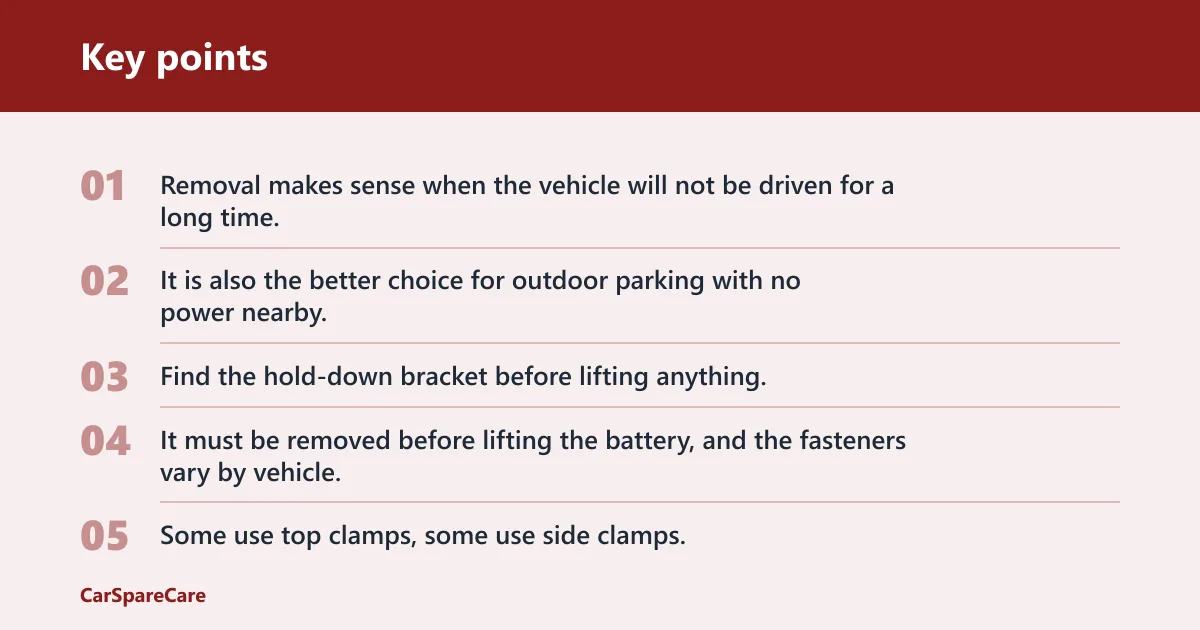
Removal makes sense when the vehicle will not be driven for a long time, especially if the battery is already older. It is also the better choice for outdoor parking with no power nearby, or when the battery type and charger need close control.
How to remove the hold-down bracket
Find the hold-down bracket before lifting anything. It must be removed before lifting the battery, and the fasteners vary by vehicle. Some use top clamps, some use side clamps, and the bolts may be in a tight corner near the tray.
Most battery terminals use 10mm or 12mm nuts, but the exact hardware depends on the car. Use the right tool so you do not round a terminal or drop metal across the posts.
How to lift and carry the battery safely
Car batteries can weigh upwards of 40 pounds, so keep a firm grip and lift straight up from the tray. Avoid tilting a flooded battery. Wear gloves and eye protection, and keep jewelry clear of the terminals and the surrounding metal.
Where to place the battery while stored
Put the battery upright on a non-conductive surface in a cool, dry, ventilated area. Keep it away from flames, sparks, and chargers that are not matched to the battery type. If the battery will sit for more than a short time, connect a suitable maintainer.
How to keep a car battery charged while stored
A battery maintainer is the best option for extended storage because it preserves charge without constant manual attention. A trickle charger can charge slowly, but it requires monitoring and manual disconnection when the battery is full. The difference matters during a long layup.
Battery maintainer vs trickle charger
A maintainer is automatic. Smart maintainers typically turn on and off as needed, and some models have AGM modes or desulfation functions for traditional flooded batteries. A trickle charger is slower and does not manage charge as carefully, so it needs more oversight.
How an automatic maintainer works
When the battery voltage drops, the maintainer adds charge. When the battery is full, it stops or switches to a lower state so it does not overcharge the battery. That behavior is what makes it suitable for extended storage.
Why trickle chargers need monitoring
A trickle charger keeps pushing current at a slow rate, which sounds gentle but still needs attention. If left on too long, it can overcharge or stress the battery. Disconnect it manually when the battery reaches full charge.
When quick-connect pigtails help
Quick-connect pigtails are useful when you plan to connect and disconnect a maintainer often. They can reduce the chance of an underhood spark because you are not reaching across the battery posts each time. They also make it easier to hook up a maintainer without removing the battery.
How to reinstall and recommission the battery
Reinstall the battery in the reverse order of removal, then check the vehicle for warning lights, reset needs, and charging performance. Recommissioning matters because a battery that sat for months can still be weak even if it starts the engine once. The first drive should confirm more than engine cranking.
Reconnect positive first, then negative
Reconnect the positive terminal first, then the negative terminal. That order reduces short-circuit risk while the circuit is still partly open. Make sure the terminals are snug, but do not overtighten them.
Restore settings and check warning lights
Reset the clock, radio, window memory, and any vehicle settings that were lost. If the car has a dashboard warning after reconnection, check the owner’s manual before assuming the battery is fine. Some systems need a short relearn period.
Confirm charging system health after storage
If the battery was stored for months, a healthy alternator still matters. Make sure the car starts cleanly and the battery warning light stays off. If the battery repeatedly loses charge after storage, the issue may be the battery, the charging system, or the vehicle’s parasitic draw.
Watch for signs of a weak battery
Slow cranking, dim lights at idle, and repeated no-starts point to a weak battery or a charging issue. A battery that was stored partly discharged may have lost capacity even if it accepts a charge. Replace it if it cannot hold a full charge after proper charging and rest.
Frequently asked questions
How do I store a car battery without damaging it?
Start with a fully charged battery, then store it upright in a cool, dry, ventilated area away from flames and sparks. For storage beyond a short break, use a battery maintainer rather than letting the battery sit partly discharged. That lowers the risk of sulfation and freeze damage.
How long can a car battery sit unused before it goes bad?
Modern cars can lose starting power after just a week or two parked, especially if the battery is not on a maintainer. A battery may survive longer than that, but repeated discharge while sitting is what shortens its life. The battery’s condition and the car’s draw both matter.
Should I disconnect the battery when storing a car?
Yes, if the car will sit long enough for parasitic draw to matter and you do not want to remove the battery. Disconnect the negative terminal first, then the positive terminal if needed. For short storage, leaving it installed with a maintainer can be the better choice.
Should I remove the battery for long-term storage?
Yes, removal is usually the safer move for long-term storage, especially with a modern car or a battery that already has some age on it. Store it upright, and keep it on a maintainer if possible. That protects it from vehicle draw and helps prevent deep discharge.
How do I keep a car battery charged while stored?
Use a battery maintainer for extended storage. It turns on and off automatically as needed and is designed to preserve charge, not revive a dead battery. A trickle charger can work, but it requires monitoring and manual disconnection when the battery is full.
What is the safest way to store a car battery at home?
Keep it upright in a cool, dry, ventilated spot on a non-conductive surface, away from flames and sparks. If the battery is removed from the car, place it where it cannot tip over. A maintainer is the safest way to keep it charged during storage.
Do I need a battery maintainer for winter storage?
Usually yes, if the car will sit through winter for more than a short period. Cold weather increases the risk from a battery that is already partly discharged. If you cannot use a maintainer, remove the battery and store it fully charged in a protected location.

Hi, I’m Melvin, an automobile engineer with extensive experience in automobile equipment. I currently work for a local automobile firm, where I specialize in the car parts industry. I’ve had the opportunity to collaborate with seasoned inspectors, gaining invaluable hands-on experience that goes beyond just theory.
My passion for automotive care started at a young age, which led me to create CarSpareCare. Through CarSpareCare, I share the knowledge and skills I’ve acquired over the years to help others navigate the world of car maintenance and repairs.
My goal is to provide practical tutorials, essential safety advice, and the latest industry insights so that anyone—whether a beginner or an expert—can confidently tackle their automotive projects.