Yes. Low battery voltage can trigger starting failures, warning lights, weak accessories, and false sensor faults. A resting battery below about 12.4 volts or a cranking drop under 10 volts is generally worth checking further. Ignore it, and you can get no-starts, misdiagnosis, and needless parts replacement. This guide shows the first symptoms, the common false leads, and how to trace the real electrical fault.
How low voltage shows up in car systems

- Accurately measures AC/DC voltage and current.
- Includes data hold and large backlit screen.
- Suitable for automotive and household electrical troubleshooting.
Yes. In a 12-volt system, low voltage rarely stays confined to one part. The starter may slow first, then modules may reboot, lights may dim, and warning messages may appear even though the battery is not the only weak link.
That matters because the same symptom can come from a weak battery, an undercharging alternator, bad terminals, a failing starter, or a parasitic draw after shutdown. If you only replace the battery, the fault often comes back.
What fails first in a 12-volt system
The first problems usually appear in high-current loads. The starter needs a large current burst, so weak voltage shows up there before it shows up in low-demand items like clocks or memory settings. Headlights can dim, then the crank speed falls, then the engine may not start.
Modern control modules can be sensitive too. Low voltage can cause ECU resets, false warning lights, erratic infotainment behavior, or temporary sensor faults when supply voltage drops during cranking.
Why the same symptom can come from different causes
Slow cranking does not automatically mean the battery is bad. A battery with a partial charge can act the same way as a battery with aging plates, loose cable clamps, or a starter that draws too much current.
That is why the voltage reading matters as much as the symptom. Resting voltage, cranking voltage, charging voltage, and overnight loss each point to different faults.
Battery voltage diagnosis table
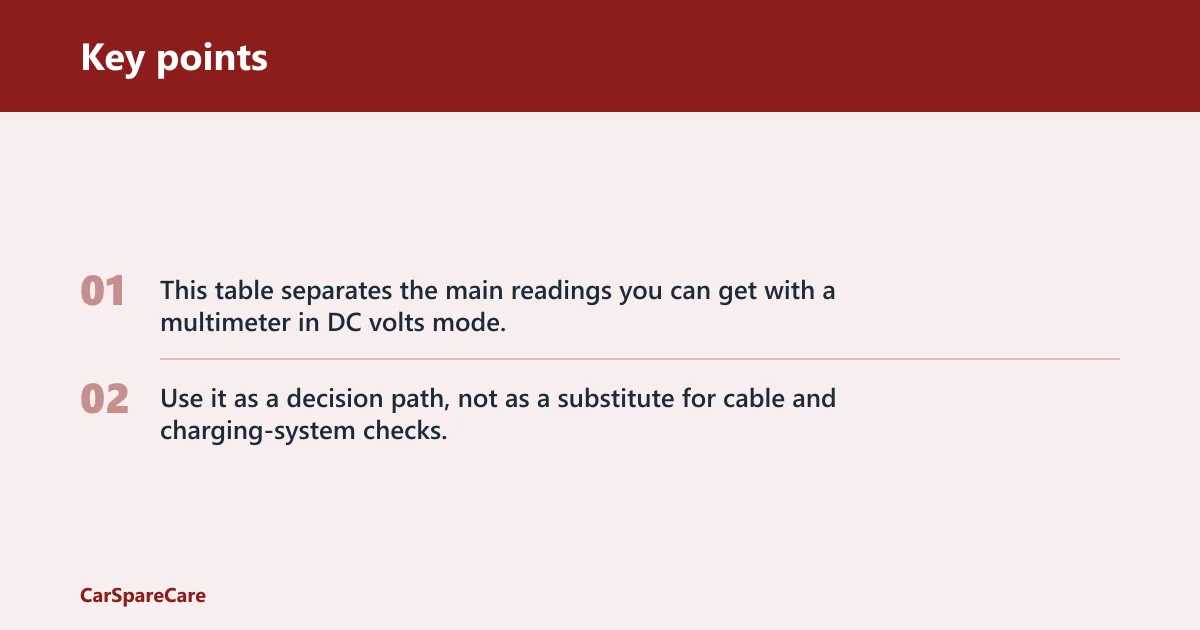
This table separates the main readings you can get with a multimeter in DC volts mode. Use it as a decision path, not as a substitute for cable and charging-system checks.
| Reading or symptom | Likely condition | Next test to run |
|---|---|---|
| 12.6 to 12.8 volts at rest | Fully charged 12-volt battery is likely | Check cranking voltage and charging voltage if symptoms remain |
| 12.4 to 12.5 volts at rest | Partially charged battery; state of charge is below full | Charge the battery, then retest after sitting overnight |
| Below 12.4 volts at rest | Low state of charge, aging battery, or parasitic draw | Inspect terminals, then test charging voltage and overnight drop |
| Below 12.0 volts at rest | Deep discharge risk; battery may be heavily depleted | Charge first, then retest and check for draw or charging faults |
| Drops under 10.0 volts while cranking | Battery weak under load, high resistance in cables, or starter drawing heavily | Load test battery, inspect cables, and evaluate starter current draw |
| 13.5 to 14.8 volts running | Charging system is usually in the normal range for many vehicles | Check for voltage drop at the battery and compare with accessory load |
| Below 13.3 volts running | Possible undercharging, belt issue, wiring fault, or alternator problem | Test alternator output directly and inspect belt, fuse links, and grounds |
| Battery goes flat overnight | Parasitic draw, shorted circuit, or battery self-discharge | Measure key-off current draw in milliamps and isolate the circuit |
What symptoms low voltage causes
Low voltage usually shows up as weak cranking, dim lights, and odd electrical behavior before it becomes a full no-start. The exact symptom depends on whether the battery is merely low, whether the alternator is undercharging, or whether resistance in cables is stealing voltage.
Slow cranking and no-start conditions
A starter motor needs high current. If voltage is low, the motor turns more slowly and the engine may crank with a labored sound or stop altogether. That is why a car can sound weak before it becomes silent.
If the battery voltage is low enough, the starter solenoid may click but not engage strongly. In some cases the engine will start with a jump pack or booster battery, which points to low supply voltage, though it does not tell you whether the root cause is the battery, alternator, or a bad connection.
Dim lights, warning lights, and resets
When voltage falls, lighting output drops and warning lights may appear because modules detect unstable supply. Some vehicles will also set temporary fault codes after a low-voltage crank, then clear them later if voltage returns to normal.
A common first-timer mistake is to treat every warning lamp as a failed sensor. Suppose the battery rests at 12.2 volts and drops to 9.3 volts during cranking. The ABS light, airbag light, and radio reset can all be side effects of that voltage drop, not separate failures.
Infotainment glitches and module faults
Modern cars can show screen resets, clock loss, Bluetooth dropouts, or a blank infotainment unit when supply voltage dips. Control modules may reboot or lose stored settings if voltage sags during start-up or if a poor connection causes a brief interruption.
These symptoms are easy to misread because they can look like software faults. In many cases, though, the electrical system is the real cause and the electronics are only reacting to unstable power.
What causes low voltage in a car?
The main causes are a weak or discharged battery, alternator undercharging, and parasitic draw after shutdown. Corroded terminals, loose clamps, and bad grounds can create the same symptoms by adding resistance and causing voltage drop under load.
Weak battery or low state of charge
A battery can be low simply because it has not been fully charged. Resting voltage is the first clue: around 12.6 volts is fully charged for many lead-acid batteries, while 12.4 volts or less points to a partial charge. Below 12.0 volts usually means a deep discharge.
Repeated deep discharge shortens battery life. Even if the car starts today, a battery that keeps falling to a low state of charge may no longer hold enough reserve for cold starts or short trips.
Alternator undercharging
The alternator should raise system voltage after the engine starts. Many vehicles will show roughly 13.5 to 14.8 volts at the battery with the engine running, though exact targets vary by design and temperature. If charging voltage stays too low, the battery may never recover.
Undercharging symptoms include slow recovery after starting, a battery that keeps going flat, and accessory complaints while driving. If the alternator is weak, a jump start may get the engine running but the problem returns because the battery is not being recharged properly.
Parasitic draw after shutdown
Parasitic draw means electrical current continues to flow when the vehicle is off. Some draw is normal for memory and security systems, but excessive draw can drain the battery overnight and leave the car weak by morning.
Common sources include glove-box or trunk lights, stuck relays, aftermarket accessories, infotainment modules that do not sleep properly, and faulty control units. A draw test measures key-off current in milliamps and helps isolate which circuit stays awake.
Could bad connections be the cause?
Yes. Corroded terminals, loose clamps, and damaged cables can mimic a bad battery because they create resistance between the battery and the vehicle. The battery may be healthy, but the starter and modules still see low voltage.
Corroded terminals and loose clamps
White or green corrosion at the terminals can block current flow. A clamp that feels tight by hand can still be loose enough to create intermittent faults when the engine vibrates or when the starter draws hard.
That often causes symptoms that come and go. The dash may light normally one key cycle, then the next start cranks slowly or loses power to the radio and gauges.
Cable resistance and voltage drop
Voltage drop is the loss that happens across a bad connection or damaged cable while current is flowing. A battery can read 12.6 volts at rest and still fail to start the car if the cable path cannot deliver that voltage under load.
Picture a car that starts fine after sitting all night, then clicks only once after a short stop. If the terminal is loose or the ground cable has hidden corrosion, heat and vibration can make the voltage drop worse during that second start.
Use a simple digital multimeter in DC volts mode. The goal is to compare three conditions: resting voltage, cranking voltage, and charging voltage. That sequence separates battery faults from alternator, starter, connection, and draw problems.
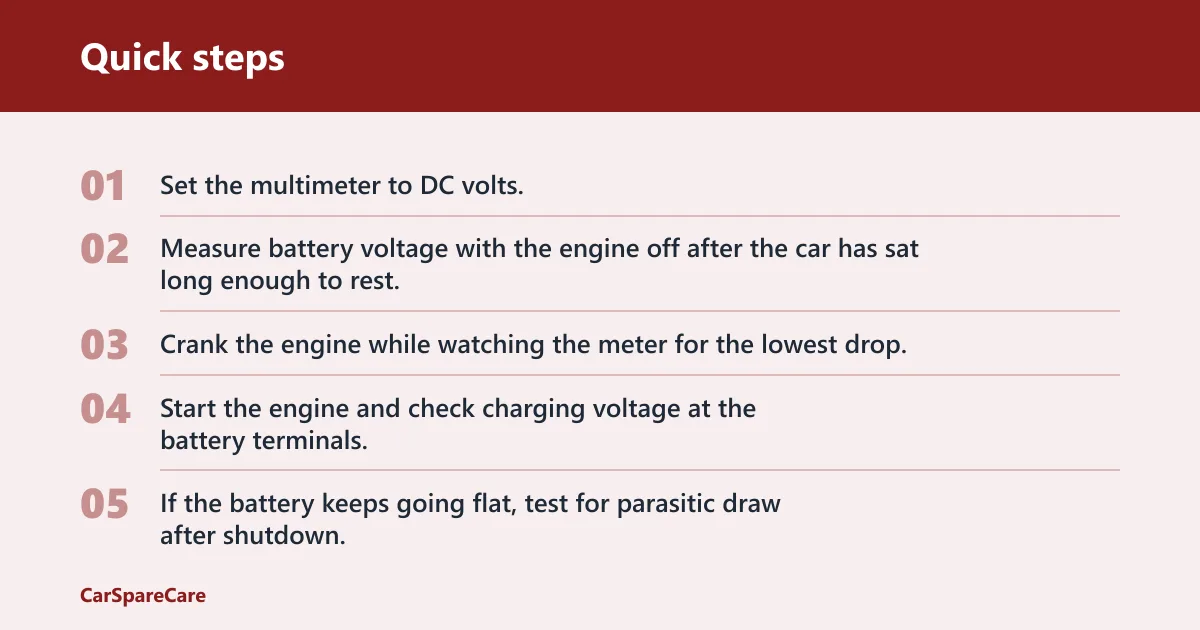
- Set the multimeter to DC volts.
- Measure battery voltage with the engine off after the car has sat long enough to rest.
- Crank the engine while watching the meter for the lowest drop.
- Start the engine and check charging voltage at the battery terminals.
- If the battery keeps going flat, test for parasitic draw after shutdown.
Check resting voltage after the car sits
For the cleanest resting reading, let the car sit with the engine off and accessories off. A resting voltage near 12.6 to 12.8 volts suggests a fully charged battery, while a lower reading points to a partial charge or a drain.
Check voltage while cranking
Watch the meter during startup. If voltage falls below about 10 volts while cranking, the battery may be weak under load, the starter may be drawing too much, or the cables may have too much resistance. That reading is one of the clearest clues in the whole test.
Check charging voltage with the engine running
With the engine idling, measure the battery again. Many vehicles should show about 13.5 to 14.8 volts. If the reading stays near resting voltage, the alternator may not be charging properly, or the circuit between the alternator and battery may be faulty.
What voltage is a car battery bad?
A battery is suspect when its resting voltage is below about 12.4 volts, and it is often considered badly discharged near 12.0 volts or below. A voltage number alone does not prove failure, though, because a low reading can also come from undercharging or a parasitic drain.
If the battery rests low, drops below 10 volts during cranking, and cannot recover after a proper charge, replacement becomes more likely. If charging voltage or cable condition is poor, fix those first.
Frequently asked questions
What car battery voltage is too low
For many 12-volt lead-acid batteries, anything below about 12.4 volts at rest is low, and around 12.0 volts or less is a serious discharge. During cranking, a drop under 10 volts is also a warning sign because the battery may not supply enough current under load.
Can bad car battery cause electrical problems?
Yes. A bad or weak battery can cause dim lights, slow cranking, warning lights, infotainment resets, and false module faults because system voltage falls below what electronics expect. It can also make the starter work harder, which adds more stress to the entire electrical system.
What causes low battery voltage
The most common causes are a battery with a low state of charge, an alternator that is undercharging, or a parasitic draw that drains the battery after shutdown. Loose terminals, corroded cables, and poor grounds can also lower the voltage seen by the starter and control modules.
What causes low voltage in a car: low voltage
Low voltage in a car can come from the battery itself, the charging system, or the wiring path between them. A bad starter can also pull voltage down under load. The best way to separate them is to compare resting voltage, cranking voltage, and charging voltage with a multimeter.
Can low battery voltage cause car problems?
Yes. Low battery voltage can affect starting first, then spread to lights, warning systems, and electronic modules. A car may still run, but the low-voltage condition can create false faults, weak accessories, and intermittent resets until the true cause is fixed.
Can a low battery make the car not start?
Yes. If the battery voltage is low enough, the starter may click, turn slowly, or fail to crank the engine at all. A jump start may get the car running, but the root cause may still be a weak battery, an alternator fault, a bad cable, or a parasitic draw.

Hi, I’m Melvin, an automobile engineer with extensive experience in automobile equipment. I currently work for a local automobile firm, where I specialize in the car parts industry. I’ve had the opportunity to collaborate with seasoned inspectors, gaining invaluable hands-on experience that goes beyond just theory.
My passion for automotive care started at a young age, which led me to create CarSpareCare. Through CarSpareCare, I share the knowledge and skills I’ve acquired over the years to help others navigate the world of car maintenance and repairs.
My goal is to provide practical tutorials, essential safety advice, and the latest industry insights so that anyone—whether a beginner or an expert—can confidently tackle their automotive projects.