A weak battery can overwork an alternator, but it usually does not damage it unless charging voltage stays off for long periods or the alternator is already failing. Replace the battery first if it fails a load test or cannot hold above 12.4 volts after charging. In shop diagnostics, the most common failure chain is a weak or sulfated battery that gets blamed on the alternator, or an overnight draw that keeps both parts in a cycle of repeat boost starts. If you keep driving with the fault, expect repeated jump-starts, dim lights, and eventually a burned-out alternator. This guide explains the failure chain, the warning signs, and how to decide which part to replace first.
How charging load changes with battery state
Usually, not right away. A weak 12-volt car battery raises charging demand after startup, so the alternator must work harder to refill it and support vehicle loads. That extra load adds heat and wear over time. Damage is more likely when the battery is deeply discharged again and again, or when another fault is already stressing the charging system.
How the charging system shares the load
The automotive alternator is the 12-volt charging-system component that converts mechanical energy to electrical energy. It keeps the battery charged and powers the vehicle’s electrical loads while the engine runs. The battery is the cranking power source, and its state of charge affects how much the alternator must replace after startup. The voltage regulator controls alternator output, and most vehicles run around 13.8 to 14.8 volts once charging is stable. That range lines up with common OEM service information and Bosch-style charging diagnostics for conventional 12-volt systems, while smart-charging vehicles may intentionally vary output based on temperature, load, and battery state of charge.
For the battery itself, a healthy lead-acid battery often reads about 12.6 volts at rest when fully charged, and about 12.4 volts is already meaningfully discharged; many Interstate/Clarios battery guides and OEM test procedures use those values as a practical screening point before load testing. A resting-voltage check is only a first pass, though. The better test order is still battery state of charge, then cranking voltage, then charging output, then parasitic draw if the battery keeps going flat.
That split matters. The battery handles the heavy current burst for cranking, then the alternator takes over. If the battery is low, the alternator must supply more current for longer. That is normal for a short period. It is not normal for the system to stay there day after day.
When battery problems can hurt alternator life
The alternator is not built to recharge a deeply dead battery from zero every time you start the car. Repeated deep discharge can keep output demand high, and high output means more heat in the alternator windings, diodes, and voltage regulator. Overheating can shorten component life, especially if the engine bay already runs hot or the battery is small for the load.
Long drive cycles with heavy electrical load make the strain worse. Headlights, cabin blowers, rear defoggers, heated seats, audio amplifiers, and electric cooling fans all draw from charging output. A weak battery plus constant accessory use can keep the alternator near its limit for too long. That is when wear turns into a real failure chain.
Suppose a stop-start SUV with an AGM battery keeps needing jump starts after short trips. The alternator may still test “in range” at idle, but the battery’s low state of charge can keep demand high enough to heat the alternator more than normal. The battery is the first part to check, but do not assume the alternator is healthy until the whole system is tested.
Why the voltage regulator matters
The voltage regulator is the control point that prevents the alternator from overcharging the system. Typical regulated charging voltage is about 13.8 to 14.8 volts in many vehicles, though smart-charging systems can vary that target. OEM service information and SAE-facing charging-system references caution that “normal” is not a single number on late-model vehicles: output may be intentionally lowered during cruise, raised during deceleration, or altered by battery management strategy. If regulation fails high, components can overheat. If it fails low, the battery stays undercharged and the alternator may keep trying to catch up.
That is why charging voltage matters more than a dashboard warning alone. A battery light can point to low output, poor wiring, a slipping belt, or a control-system fault. The alternator itself may be fine, but the regulator command, belt drive, or wiring path may not be.
Could a bad battery fake an alternator fault?
Yes. A bad battery can make a good alternator look faulty because the alternator keeps seeing a low battery and keeps trying to recover it. That can produce dim lights, slow cranking, and repeated jump-starts even when charging voltage is normal. A battery that cannot hold charge after shutdown can also look like an alternator drain when the real issue is the battery itself.
Symptoms that point to the battery first
Use a multimeter before guessing. Around 12.6 volts at rest usually indicates a fully charged battery; about 12.4 volts is already partly discharged. If the engine cranks slowly but charging voltage runs in the normal range once started, the battery is a stronger suspect than the alternator. A battery tester, such as a load tester or conductance tester, helps confirm whether the battery can still deliver cranking power. If the battery fails a load test or voltage recovery is poor after charging, replace the battery before chasing the alternator.
Say your sedan shows 12.6 volts after sitting overnight, then drops to 9.5 volts during cranking and jumps back to 14.2 volts with the engine running. That pattern points to a weak battery or a bad connection, not an alternator that is failing to charge. The next step is a battery load test and a check of the terminals and cables.
Why jump starts can mislead
Jump starts can hide the real fault for a while. Freshly boosted voltage may let the engine start and the alternator may appear to “fix” the problem on the drive home. But if the battery is failing, the next cold start will still be weak. If a parasitic draw is flattening the battery while the car sits, the alternator gets blamed again even though the drain is elsewhere.
Parasitic draw means excess electrical drain when the vehicle is off. It is often measured in milliamps with a multimeter after the car goes to sleep. A bad battery, a bad alternator, and a drain can all cause similar symptoms. Testing order matters.
Weak battery diagnosis table
Use the table below as a first-pass decision guide. It does not replace a battery tester or charging-system test, but it shows where to look first and how urgent the problem is. The most useful rule is simple: replace first only after the failure pattern points there, not just because the part is old or the battery light is on.
| Symptom pattern | Resting voltage | Cranking voltage | Charging voltage | Battery age / condition | Likely cause | Next test | Replace or inspect first | Safe to drive? | Risk of alternator damage |
|---|---|---|---|---|---|---|---|---|---|
| Slow crank, starts after a jump, lights normal once running | 12.2 V or lower | Below 9.6 V | 13.8 to 14.8 V | 3+ years, repeated short trips | Weak battery | Battery load test | Battery first | Maybe for a short trip | Low if fixed soon |
| Battery light on, dim headlights, repeated stalls after driving | 12.4 V or lower | Low and unstable | Below 13.5 V or above 14.8 V | Any | Alternator, regulator, or belt fault | Charging-voltage test | Inspect alternator output, belt, wiring, and regulator first; replace the alternator only after confirming low output with a known-good battery | No, not far | Moderate to high |
| Battery keeps dying overnight, starts fine after jump | Falls again after sitting | Normal after jump | Normal while running | Any | Parasitic draw or battery defect | Parasitic draw test | Battery and draw check; replace the battery first if it fails load testing, then find the draw if the new battery also drops overnight | Yes for diagnosis only | Low unless charging is abnormal |
| Charging seems erratic on a stop-start or AGM vehicle | Variable | Variable | May change by load and temperature | AGM, stop-start, or heavy accessory use | Battery management system strategy or weak battery | Scan data plus battery test | Battery and system test first; check battery registration/coding and scan-tool data before replacing the alternator on BMS-controlled vehicles | Usually yes if no warning lights | Low to moderate |
| Squeal on startup, low output at idle, battery light flickers with accessories on | Any | Any | Low at idle, better at higher RPM | Any | Serpentine belt slip or tension issue | Belt and pulley inspection | Belt and cables first | Limited | Moderate |
What to test before replacing parts
Start with the battery, then check alternator output, then inspect the physical path that connects them. That order prevents guessing. A weak battery can make a good alternator look bad, and a slipping belt or corroded cable can make both parts seem weak. In real-world diagnosis, the failed part is often not the one that gets replaced first; it is the one that failed the system test first.
Battery tester checks
A battery tester measures cranking performance and state of health better than a quick voltage check alone. If the battery cannot pass a load test, replace it before chasing the alternator. That matters even more on AGM batteries used in many stop-start vehicles, because they can lose usable capacity before they fail completely.
Also check battery age. A battery near the end of its service life may still show around 12.6 volts after charging, yet collapse under load. That is the type of fault that causes repeated jump-starts and long alternator recovery times. OEM-style battery testing guidance generally prioritizes load or conductance results over open-circuit voltage alone for exactly that reason.
Multimeter checks
A multimeter gives three useful numbers: resting voltage, cranking voltage, and charging voltage. Resting voltage near 12.6 volts suggests a full battery. Charging voltage around 13.8 to 14.8 volts can suggest the alternator and regulator are working properly in many vehicles. If the charging reading is outside that band, the charging system needs more testing. For the rest of the charging-diagnostics flow, test the charging system before replacing the alternator on a guess.
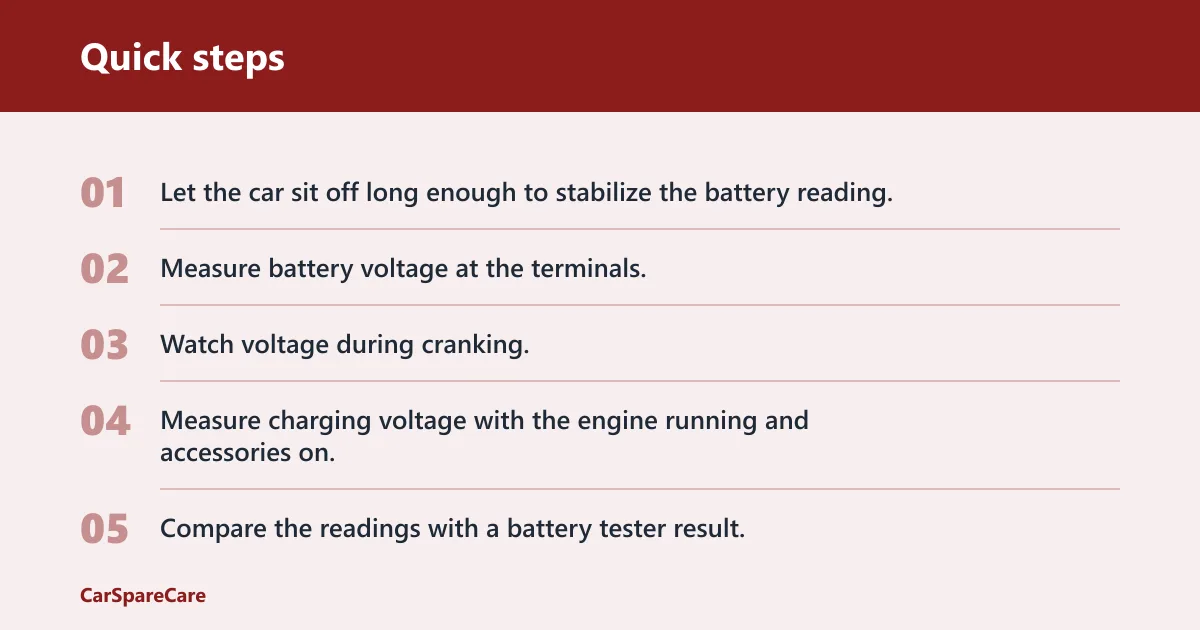
- Let the car sit off long enough to stabilize the battery reading.
- Measure battery voltage at the terminals.
- Watch voltage during cranking.
- Measure charging voltage with the engine running and accessories on.
- Compare the readings with a battery tester result.
Belt, cable, and terminal inspection
Inspect the serpentine belt, tensioner, pulley alignment, battery terminals, and cable ends. The serpentine belt drives the alternator pulley, and slip or wear can reduce output. Loose or corroded terminals can create voltage drop that looks like a weak alternator. Clean, tight connections matter as much as component choice.
A common first-timer mistake is replacing the alternator first when the battery terminals are badly corroded. That can leave the charging problem untouched and the battery still weak. A quick visual inspection can save a costly wrong part.
Parasitic draw check
If the battery keeps going flat after the car sits, test for parasitic draw. A healthy sleeping vehicle should usually draw only a small amount of current, often measured in milliamps. A larger draw can flatten a good battery overnight and make the alternator look guilty the next morning. Fix the drain before blaming the charger.
How smart charging changes the answer
Modern vehicles with a battery management system may not hold a steady charging voltage the way older systems do. The controller can vary alternator output based on battery state, temperature, load, and braking or deceleration. On many newer OEM platforms, that behavior is intentional, so a “low” reading at idle is not automatically a fault if the scan data and battery-state inputs agree.
AGM and stop-start vehicles
AGM batteries and stop-start systems change the diagnosis. These vehicles often ask for deeper cycling and more frequent recharge control, so battery health matters even more. A weak AGM battery can trigger charging behavior that looks abnormal, and a battery management system may delay or alter charging in ways that confuse a quick check. Use scan data and battery-specific testing instead of old assumptions. If the vehicle uses battery registration or coding, verify that step first; an unregistered replacement battery can make a healthy charging system look inconsistent.
Heavy accessory loads make the picture less simple too. Heated seats, defrosters, high-output audio, and electric pumps can pull system voltage around during idle. That does not automatically mean the alternator is bad. It does mean the system needs testing under load, not just at idle with no accessories running.
Frequently asked questions
Can a weak battery damage the alternator?
Yes, but usually only over time. A weak battery increases alternator load after startup, which raises heat and wear. One normal recharge is not the same as repeated deep discharge. If the battery passes a load test and charging voltage is normal, the alternator is less likely to be the first part that needs replacement.
Can a bad battery damage the alternator?
A bad battery can shorten alternator life if it forces repeated high-output charging or frequent jump-starts. The alternator has to work harder to recover a battery that cannot hold charge. That extra work can stress diodes and the voltage regulator, especially in hot conditions or in cars with heavy electrical loads.
Does a weak battery affect the alternator?
Yes. It makes the alternator carry more of the electrical load for longer after the engine starts. That is normal for a short period, but not ideal if the battery keeps falling low. If charging voltage stays between about 13.8 and 14.8 volts, the alternator may still be doing its job properly.
Can a bad battery affect the alternator?
Yes, mainly by changing how hard the alternator must work. A battery that cannot store charge forces the charging system into repeated recovery mode. That does not mean the alternator is faulty by default. It does mean both parts should be tested, along with terminals, cables, and belt condition.
Can a bad car battery damage the alternator?
It can contribute to alternator damage if it keeps the system under heavy load for long periods. The alternator is meant to support the vehicle and top off the battery, not rescue a deeply discharged battery every day. If the battery fails a tester, replace it before the alternator gets cooked by repeated strain.
Can driving with a bad battery damage the alternator?
Yes, if the bad battery keeps forcing the alternator to charge hard for extended periods. It also raises the risk of stalling, tow service, and repeated jump-starts. If the battery light is on, voltage is outside normal range, or the car needs frequent boosts, test the charging system before driving much farther.

Hi, I’m Melvin, an automobile engineer with extensive experience in automobile equipment. I currently work for a local automobile firm, where I specialize in the car parts industry. I’ve had the opportunity to collaborate with seasoned inspectors, gaining invaluable hands-on experience that goes beyond just theory.
My passion for automotive care started at a young age, which led me to create CarSpareCare. Through CarSpareCare, I share the knowledge and skills I’ve acquired over the years to help others navigate the world of car maintenance and repairs.
My goal is to provide practical tutorials, essential safety advice, and the latest industry insights so that anyone—whether a beginner or an expert—can confidently tackle their automotive projects.