Fix the charging or connection fault if the battery is only flat or the posts are dirty; replace it when testing or repeat failure shows internal damage. A wrong call leaves you stranded, wastes money on parts, and can hide alternator faults. This guide covers quick tests, recharge steps, cleaning fixes, and the age signs that mean replacement.
Can you repair a car battery or do you have to replace it?
You can fix the problem around a car battery, but most internal battery failure cannot be reversed. If the battery is merely flat, dirty at the terminals, or affected by a charging-system fault, a charge or cleaning may solve it. If it has sulfation, a dead cell, leakage, or repeat failure, replacement is the right call.
What can actually be fixed
A lead-acid starter battery can sometimes recover after a deep discharge. A 12V battery charger may restore it, and clean battery terminals can fix a poor connection that can look like battery failure. Loose posts, corrosion on the positive and negative posts, and a weak alternator connection are all fixable without replacing the battery.
What points to internal battery failure
Internal damage is different. Sulfation, a dead cell, or leakage can mean the battery has lost some ability to hold a charge. If the battery starts only after a jump start and then dies again, or if it fails to hold charge after a proper charge, the problem is usually inside the battery case.
The quick decision rule
If the battery is under several years old, passes a rest-voltage check after charging, and the terminals were dirty or loose, fix the supporting issue first. If the battery is old, keeps needing jump starts, or fails to hold charge after charging, replace it. A jump start is only a temporary restart method, not a repair.
How do you tell if a car battery is bad or just dead?
A dead battery is often flat but still healthy enough to recover with charging. A bad battery has lost capacity or has internal damage and will not hold charge. The most useful split is simple: check resting voltage, look at the symptom pattern, and see whether the battery fails again after a proper charge or jump start.
Resting voltage with a multimeter
Use a multimeter with the engine off and the battery at rest. A fully charged battery should read around 12.6V at rest. A lower reading can mean discharge, but a low number by itself does not prove failure. Charge the battery, let it rest, then test again. If the voltage drops quickly, the battery is suspect.
What slow cranking and dim lights mean
Slow cranking can be an early warning sign of battery weakness. Dim headlights at idle can indicate a weak battery. Dashboard lights flickering when accessories are used can also signal battery trouble. These symptoms may also come from dirty terminals or a charging problem, so they are clues, not final proof.
When repeat jump starts are the warning sign
Repeated jump starts are a clear sign the battery may be failing. If the engine starts after a jump but the battery goes flat again within a short time, the battery is no longer holding charge well. That pattern is more serious than a single no-start after leaving lights on.

What can a battery charger fix, and what can’t it fix?
A battery charger can recover a flat battery, but it cannot rebuild worn-out plates or repair a dead cell. It is worth trying when the battery was left flat, when a short run time caused the problem, or when the voltage is low but the battery still behaves normally after charging. It will not cure internal damage.
When a 12V charger can bring it back
A 12V charging session can help when the battery simply lost charge from sitting, short trips, or accessory use. A battery that is not deeply damaged may recover after being charged and then retested at rest. That is the point where a charger is useful: it restores charge, then the test shows whether capacity remains.
Charging time ranges by battery condition
A lightly discharged battery may recover after a few hours on a charger. A deeper discharge can take longer. If charging produces a normal resting voltage but the battery still fails under load or dies again soon, the problem is no longer simple discharge. At that stage, charging is only delaying replacement.
Why charging will not cure sulfation or a dead cell
Sulfation coats the plates and limits capacity. A dead cell removes part of the battery’s working structure. Charging may make the battery appear better for a short time, but it will not restore what is physically damaged. If the battery can no longer hold a charge, charging is not a permanent fix.
| Symptom or test result | Likely cause | Best action |
|---|---|---|
| Battery voltage is low, but the car has been sitting or short-trip driving has been common | Surface charge loss or short-term discharge | Charge, then retest at rest |
| Corrosion on the positive or negative posts, or a loose terminal | Poor connection, not necessarily a bad battery | Clean and tighten the terminals, then retest |
| Starts after a jump, then dies again soon | Weak battery or charging-system fault | Charge and test the battery; check the alternator if it keeps going flat |
| Repeated jump starts are needed | Battery near end of life or failed internally | Replace now if the pattern continues after charging |
| Battery will not hold charge after a full charge and rest period | Internal damage, sulfation, or a dead cell | Replace now |
Why won’t my car battery hold a charge?
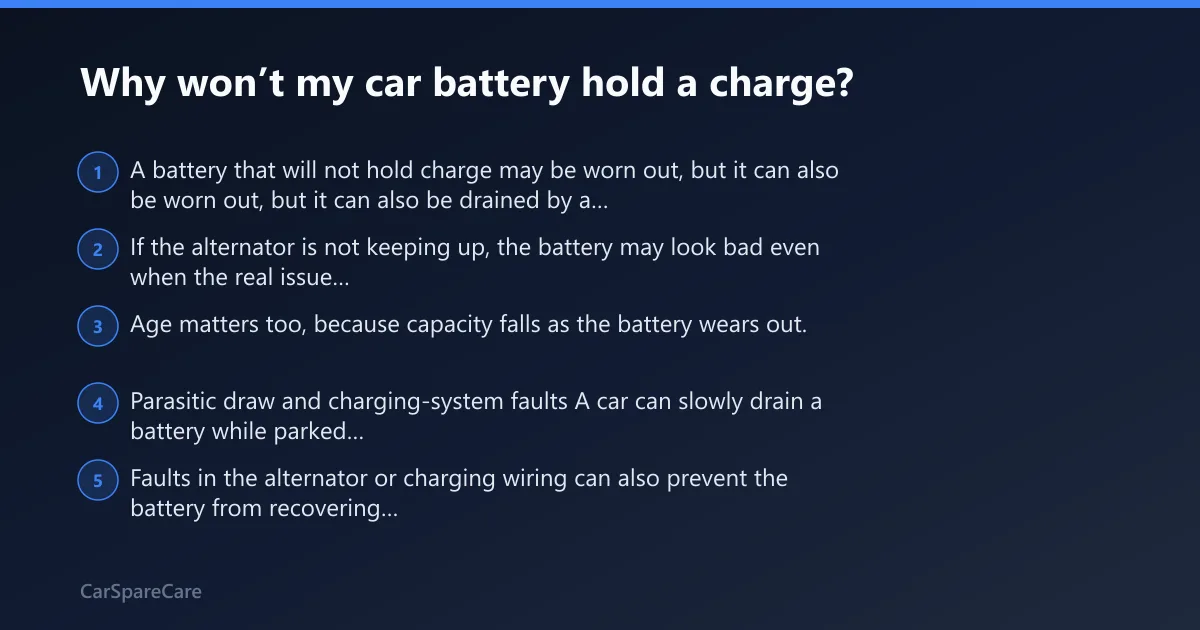
A battery that will not hold charge may be worn out, but it can also be drained by a parasitic draw or a charging-system fault. If the alternator is not keeping up, the battery may look bad even when the real issue is elsewhere. Age matters too, because capacity falls as the battery wears out.
Parasitic draw and charging-system faults
A car can slowly drain a battery while parked if a circuit stays on. Faults in the alternator or charging wiring can also prevent the battery from recovering during driving. If the battery goes flat again after a full charge, the next step is not another jump start. It is a charging-system check.
Alternator problems that look like battery failure
An alternator fault can mimic battery failure because the battery starts the car, then never gets recharged properly. In that case, replacing the battery alone will not solve the problem. If a new or freshly charged battery still dies, the charging system needs testing before more parts are fitted.
Battery age and reduced capacity
Most car batteries last around three to five years. Heat, short trips, and heavy accessory use can shorten battery lifespan. As the battery ages, it may still crank once or twice, then fail under the next load. That is loss of capacity, and it usually means replacement is getting close.
Is it safe to try repairing a car battery myself?
Basic battery checks and terminal cleaning are usually safe if the engine is off, the parking brake is set, and there are no flames nearby. Batteries contain acid and can give off flammable gas, so gloves and eye protection matter. Swollen, leaking, or hot batteries should usually be replaced rather than treated like a simple cleaning job.
Safety gear and workspace basics
Work with the engine off and the parking brake set. Never smoke or use open flames near a battery. Wear gloves and eye protection. Keep tools from bridging the posts. If the battery case is cracked, leaking, or hot, stop there and remove the battery from service.
What you can clean and test at home
You can inspect the battery terminals, clean corrosion, and test resting voltage with a multimeter. The owner’s manual should be checked for battery location and vehicle-specific access steps, because the battery may be under the hood, trunk, or behind a panel. Hidden locations are common and easy to miss.
When the battery should be replaced immediately
A swollen case, acid leakage, or heat after charging points to failure and safety risk. A battery that cannot hold charge after charging, or one that needs repeated jump starts, should not stay in service. At that point, replacement is safer and usually cheaper than more attempts to revive it.
How long should a car battery last, and when is replacement the better call?
Most car batteries last around three to five years, though heat, short trips, and heavy accessory use can shorten battery lifespan. Once a battery is near that age and starts showing weak-start symptoms, replacement becomes the better call if it fails tests, keeps dying, or needs frequent jump starts.
Cost comparison: cleaning, charging, testing, or replacing
Cleaning terminals, charging, and testing are cheap first steps when the battery still seems recoverable. A load test or resting-voltage check can stop a bad guess from wasting money. If those checks show poor hold-charge behavior or repeat failure, replacement usually costs less than chasing the same problem again.
Choosing the right replacement battery and recycling the old one
If replacement is the answer, choose the correct battery for the vehicle’s fit, terminal layout, and required starting power. Then install it safely, reconnect the negative terminal last, and dispose of the old battery through a recycling route. Lead-acid starter batteries should generally not go in household waste.
Frequently asked questions
Can you repair a car battery or do you have to replace it?
You can fix nearby problems such as corrosion, loose terminals, or a flat battery. You cannot repair most internal battery damage. If testing suggests a dead cell, sulfation, or poor hold-charge behavior after a proper charge, replacement is often the right next step.
How do you tell if a car battery is bad or just dead?
A dead battery is usually flat and may recover with a charger. A bad battery fails to hold charge, keeps needing jump starts, or performs poorly after charging. A resting-voltage check and a retest after charging are the quickest ways to separate the two.
Can a weak car battery be recharged instead of replaced?
Yes, if the battery is only flat. A 12V charger can bring back a battery that was left flat by short trips or sitting. If the battery still will not hold charge after charging, or if the car keeps needing jump starts, recharging is not enough.
What are the signs a car battery needs replacement?
Slow cranking, dim headlights at idle, flickering dashboard lights when accessories are used, and repeated jump starts all point toward replacement. A battery that is old and fails to hold charge after charging should also be replaced, especially if the symptoms keep returning.
How long does a car battery usually last?
Most car batteries last around three to five years. Heat, short trips, and heavy accessory use can shorten battery lifespan. If a battery is near that age and is already showing weak-start symptoms, it is sensible to test carefully and plan for replacement if it fails.
When should I replace a battery instead of trying another jump start?
Replace it when the battery needs repeated jump starts, starts only briefly after a jump, or fails to hold charge after charging. Those are signs of internal failure or serious wear. Another jump start may get the car moving, but it will not solve the underlying problem.

Hi, I’m Melvin, an automobile engineer with extensive experience in automobile equipment. I currently work for a local automobile firm, where I specialize in the car parts industry. I’ve had the opportunity to collaborate with seasoned inspectors, gaining invaluable hands-on experience that goes beyond just theory.
My passion for automotive care started at a young age, which led me to create CarSpareCare. Through CarSpareCare, I share the knowledge and skills I’ve acquired over the years to help others navigate the world of car maintenance and repairs.
My goal is to provide practical tutorials, essential safety advice, and the latest industry insights so that anyone—whether a beginner or an expert—can confidently tackle their automotive projects.