
Yes, 14.7 volts can be normal while a car battery is charging, but only if the source and battery type fit the spec. Ignore bad charging voltage and you can overheat the battery, shorten its life, or damage electronics. This guide shows how to tell whether 14.7 volts is from the alternator, a charger, or an overcharging fault.
Is 14.7 volts normal?
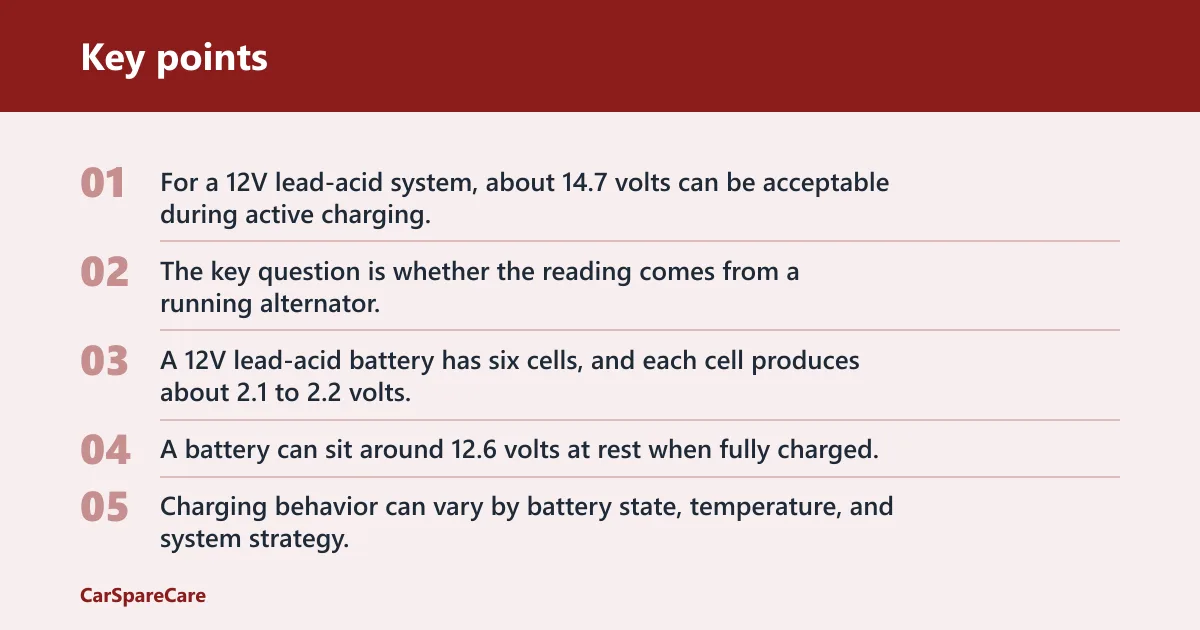


Sometimes yes. For a 12V lead-acid system, about 14.7 volts can be acceptable during active charging, though it is often near the upper end of common charging ranges. The key question is whether the reading comes from a running alternator, a smart charger in bulk mode, or a battery that is already being pushed too hard.
When 14.7 volts is acceptable
A 12V lead-acid battery has six cells, and each cell produces about 2.1 to 2.2 volts. A battery can sit around 12.6 volts at rest when fully charged, but charging needs voltage above that resting level. Charging behavior can vary by battery state, temperature, and system strategy, and a common full-charge target for some charging setups is 14.2 to 14.5 volts.
That is why 14.7 volts is not automatically a fault. It can be close to the top end of a normal charge, especially in cold weather or on a system that uses temperature or sensor control. Battery type matters too. AGM batteries and flooded lead-acid batteries do not always want the same target.
What 14.7 volts means
Do not treat every 14.7-volt reading as the same thing. Charging-system voltage, charger voltage, and float voltage are different numbers with different jobs. A car may show 14.7 volts right after start-up, while a maintainer may later sit near a lower maintenance voltage after the battery fills.
Picture a car that starts cleanly, idles, and shows 14.7 volts for a short time while the alternator rebuilds battery charge. That can be fine. Now picture the same reading with a hot battery, a rotten-egg odor, and crusty terminals. That points away from normal charging and toward overcharge risk.
What should an alternator put out?
An alternator should put out enough voltage to charge the battery while the engine runs, and it must beat the battery’s resting voltage to do that. Normal output is often around 14.2 to 14.5 volts, but charging can occur below 13.8 volts depending on battery state, temperature, and system strategy. A reading much below the expected charging range at fast idle can mean weak charging, bad wiring, or a regulator problem.
Normal running voltage range
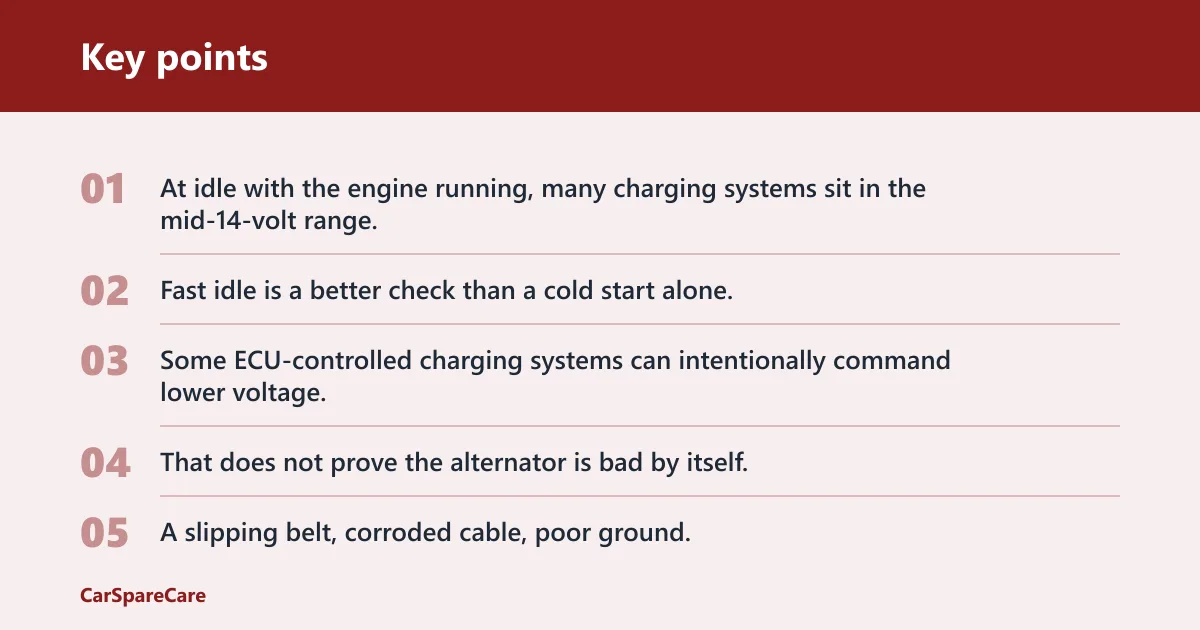
At idle with the engine running, many charging systems sit in the mid-14-volt range. Fast idle is a better check than a cold start alone, because the alternator has had time to stabilize. Some ECU-controlled charging systems can intentionally command lower voltage, including roughly 12.5 volts, under certain conditions.
That does not prove the alternator is bad by itself. A slipping belt, corroded cable, poor ground, or a failing battery can pull system voltage down. A voltmeter gives you the first clue, then a load test separates battery trouble from charging trouble.
When low voltage points to a fault
Voltage below 12 volts at rest is trouble in one source, because a healthy fully charged battery should sit around 12.6 volts at rest. If the engine is running and you still do not get past the charging threshold, the battery is not being replenished. Low charging voltage can show up first as hard starting, dim lights, or slow recovery after cranking.
Suppose a car idles at 12.5 volts with the engine on and accessories off. That may be normal on some ECU-controlled charging systems, but it can also indicate the alternator is not charging the battery, the wiring path is poor, or the regulator is not commanding output.
How the voltage regulator fits
The voltage regulator controls alternator output. It helps prevent overcharging and also keeps voltage from dropping too low. If the regulator fails high, charging voltage can climb above safe limits. If it fails low, the battery may never get a full charge.
That is why the alternator is not judged by voltage alone. You also need to consider battery type, temperature, and whether the system is charging right after start-up or holding a steady value after the battery has recovered.
Can a charger hold 14.7 volts safely?
Yes, a battery charger can hold 14.7 volts safely in a controlled charging stage, but that is different from a car system sitting at 14.7 volts all the time. Smart chargers often use a bulk phase first, then reduce voltage or current as the battery fills. A maintainer then drops to a lower float level.
Bulk stage vs float stage
Battery chargers can use more than one stage. A smart charger may hold a higher voltage while the battery is low, then taper back as the battery approaches full charge.
That lower float level is the key difference. A float charger or maintainer is not trying to finish a full charge fast. It is trying to keep a full battery from drifting down.
Why smart chargers change voltage as the battery fills
Smart chargers reduce current as the battery fills, and many also shift voltage targets as the charge progresses. That keeps heat and gas generation lower than a fixed high-voltage hold.
That distinction matters. A charger at 14.7 volts for a limited stage is one thing. A battery forced to sit near 14.7 volts for long periods without temperature control is another.
How a maintainer differs from a charger
A charger is meant to refill a battery. A maintainer is meant to hold one that is already full. If you are checking a parked car or a stored battery, do not expect the same voltage pattern you would see during active charging. A maintainer should drop to maintenance voltage after the battery reaches full charge.
Battery charging by type
Battery label matters before you judge 14.7 volts. Flooded lead-acid and AGM batteries can have different preferred charging targets. A voltage that looks acceptable for one may be too aggressive for another, especially if the battery is warm or already near full.
Flooded lead-acid
Flooded lead-acid batteries can tolerate charging voltages near the upper end of normal, but they also gas more easily when voltage rises. W8JI describes 14.4 volts as a gassing threshold and says charging voltage must be under 14.7 volts to prevent excessive gassing. Higher voltage can dry electrolyte over time.
That is why a flooded battery that sees 14.7 volts is not an automatic emergency, but it is close enough to the line that temperature, duration, and symptoms matter. If the battery is venting, hot, or losing fluid, treat the reading as suspicious.
AGM
AGM batteries often accept controlled charging well, but they still have limits. A reading of 14.7 volts may be fine during a proper charge stage if the battery label allows it, and the charger or alternator is temperature-compensated. It is less reassuring if the battery is already full and the voltage stays there.
AGM batteries are valve-regulated, so electrolyte loss is harder to spot until damage is done, though they can still vent under fault conditions. That makes symptom checking more important. Heat, swelling, odor, or repeated high-voltage readings deserve attention even if the battery still starts the car.
Why the label matters
The same voltage can mean different things depending on battery chemistry and state of charge. A manufacturer may allow a higher absorption voltage for a specific AGM design, while another battery prefers a lower setting. If the label or manual lists a charging target, use that first.
Battery voltage table
Read the context before deciding. The same 14.7-volt number can be normal charging, a charger bulk stage, or an overcharge warning. Use the table to separate those cases before you change parts or condemn the alternator.
| Reading context | Battery type | Likely meaning | What to do next |
|---|---|---|---|
| Idle with engine running | Flooded lead-acid | Often normal if it settles near the upper charging range; watch for heat or odor | Recheck at fast idle and inspect battery temperature, cables, and terminals |
| Fast idle with engine running | AGM | Can be acceptable if the battery label allows a higher absorption voltage | Confirm spec on the battery and look for stable voltage, not a rising spike |
| Smart charger bulk stage | Flooded lead-acid | Usually normal during active charging | Let the charger move to float or maintenance mode after full charge |
| Float stage | AGM | Too high for most maintainers if it stays there after the battery is full | Check that the charger has switched to maintenance voltage |
| 14.7 volts with hot battery, odor, or corrosion | Flooded lead-acid | Suspicious; possible overcharging or poor regulation | Stop charging and test the regulator, charger, and battery condition |
| 14.7 volts with heat, swelling, or electrolyte loss | AGM | Concerning; sealed batteries can be damaged by excess voltage | Disconnect and verify charging settings and alternator control |
| Battery rests below 12 volts | Any lead-acid type | Battery problem or serious discharge, not a healthy full battery | Charge fully, then load test the battery |
What if the voltage is too high or too low?
Too high means the battery may gas, heat up, lose electrolyte, or corrode terminals. Too low means the battery may never recover from starting loads. In both cases, the first check is the same: confirm where the reading came from, then use a voltmeter and a load test to separate battery fault from charging fault.
Signs of overcharging
Watch for a hot battery, rotten-egg odor, visible corrosion, or electrolyte loss. Those are the warning signs that make 14.7 volts more suspicious. The same source says 14.8 volts would start to be a worry, and 15 volts would be a real concern. At that point, stop assuming the system is fine.
A common first-timer mistake is to see 14.7 volts and keep charging because the number sounds close to normal. If the battery is warm enough that you do not want to keep a hand on it, the chemistry is telling you the charging setup deserves a second look.
Signs of weak charging
If voltage stays below 13.8 volts while the engine runs, the system may not be charging hard enough. A reading much below 14.2 volts at fast idle can point to a weak alternator, bad wiring, or a regulator issue. If the car is hard to start and the resting battery voltage is already below 12.6 volts, the battery may also be weak.
Low charging voltage and low resting voltage are different problems. Low resting voltage means the battery is discharged or failing. Low running voltage means the car is not putting enough charge back into the battery.
What to check first with a meter
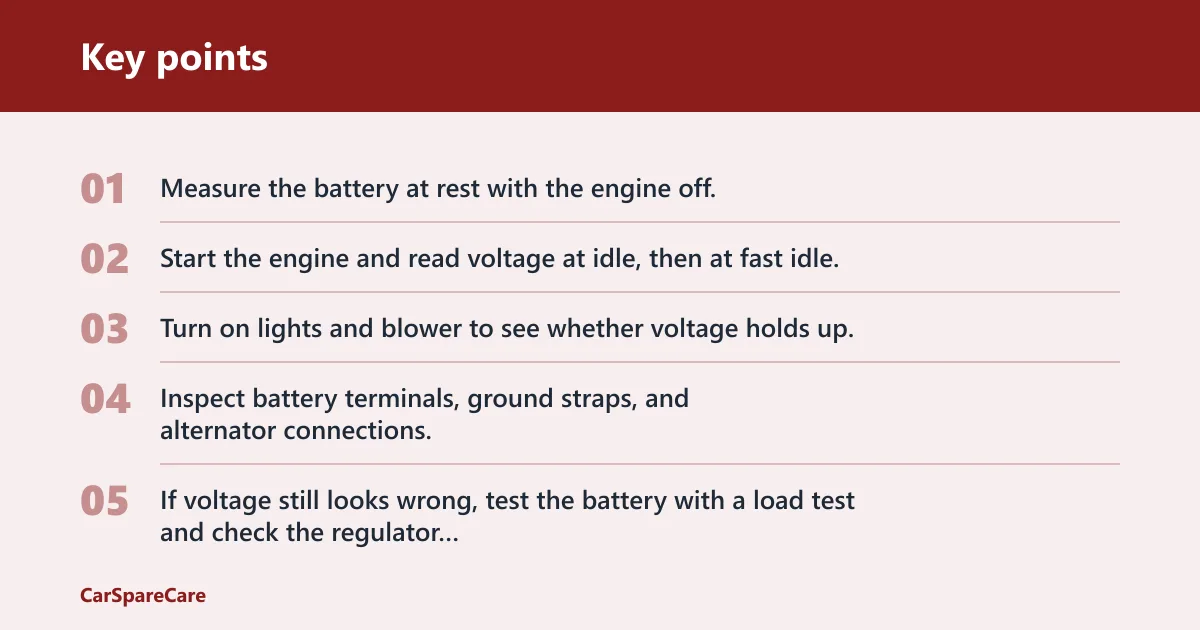
- Measure the battery at rest with the engine off.
- Start the engine and read voltage at idle, then at fast idle.
- Turn on lights and blower to see whether voltage holds up.
- Inspect battery terminals, ground straps, and alternator connections.
- If voltage still looks wrong, test the battery with a load test and check the regulator path.
A simple voltmeter is enough to start. If you need a deeper check, a load test helps show whether a battery is weak even when the alternator is doing its job. That matters because a bad battery can drag the charging system into odd readings.
Frequently asked questions
Is 14.7 volts normal for car battery charging?
It can be. Fourteen point seven volts is near the upper end of normal charging for many 12V lead-acid systems, especially during active charging or in temperature-controlled systems. It is more believable if the reading comes from a charger bulk stage or a modern alternator, not from a battery that is already hot and full.
When is charging voltage too high for a car battery?
Charging voltage is too high when it pushes the battery toward excess gassing, heat, or electrolyte loss. The same source describes 14.4 volts as a gassing threshold and says charging voltage must be under 14.7 volts to prevent excessive gassing. If you see 14.8 volts or 15 volts, the reading deserves attention.
What voltage should a car alternator put out while running?
Normal alternator output is often around 14.2 to 14.5 volts while the engine is running. Charging can occur below 13.8 volts depending on battery state, temperature, and system strategy. If the reading stays much below the expected charging range at fast idle, the alternator, wiring, or voltage regulator may be weak or failing.
Is 14.7 volts bad for AGM or lead-acid batteries?
Not always. AGM and flooded lead-acid batteries can tolerate different charge targets, so the label matters. Fourteen point seven volts may be fine during a controlled charge stage, but it is more worrying if the battery is full, hot, or showing signs of gassing, corrosion, or fluid loss.
Why does my car show 14.7 volts after starting?
That can happen because the alternator is rebuilding charge after start-up. Right after cranking, the system may sit near the upper charging range until the battery recovers. It is less reassuring if the voltage stays there indefinitely, especially if the battery is hot or the regulator is known to be faulty.
What charging voltage is needed to fully charge a 12V car battery?
A useful charging range is 14.2 to 14.5 volts, and charging only happens when voltage rises above the battery’s resting level. A fully charged battery can sit around 12.6 volts at rest. If charging voltage is too low, the battery may never reach full charge even though the car still runs.
Can a battery charger hold 14.7 volts safely?
Yes, if that voltage is part of a controlled charging stage and the charger later reduces to float or maintenance voltage. Smart chargers change output as the battery fills. A maintainer should not sit at a high charging voltage forever.
What happens if a car battery charges above 14.5 volts?
Above 14.5 volts, the risk of gassing, heat, and electrolyte loss rises. The same source says 14.7 volts is the ceiling to prevent excessive gassing, and 14.8 volts would start to be a worry. If the battery is hot, smells of sulfur, or shows corrosion, treat the charging system as suspect.

Hi, I’m Melvin, an automobile engineer with extensive experience in automobile equipment. I currently work for a local automobile firm, where I specialize in the car parts industry. I’ve had the opportunity to collaborate with seasoned inspectors, gaining invaluable hands-on experience that goes beyond just theory.
My passion for automotive care started at a young age, which led me to create CarSpareCare. Through CarSpareCare, I share the knowledge and skills I’ve acquired over the years to help others navigate the world of car maintenance and repairs.
My goal is to provide practical tutorials, essential safety advice, and the latest industry insights so that anyone—whether a beginner or an expert—can confidently tackle their automotive projects.