Yes, a 12V car battery can be charged from a home inverter if the inverter can supply enough AC power for the charger and the charger matches the battery; a 10A charger typically needs about 150–300W of inverter capacity, with extra headroom. Bad sizing wastes power, trips the inverter, or charges too slowly to recover a weak battery. This guide explains when inverter charging makes sense, when it is inefficient, and how to size the inverter-charger pair without guessing.
What you’ll need and inverter size guidance
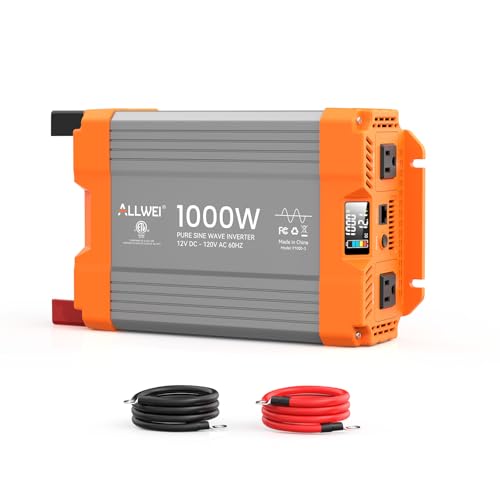
A home inverter can run a standard 12V battery charger by converting DC input to AC, but only if the inverter’s continuous rating and surge rating cover the charger’s real AC draw. That draw is often higher than the charger’s amp label suggests, especially during bulk charge and startup.
This setup makes sense when you already have a battery-backed DC source, a portable power station with AC output, or an inverter tied to another 12V battery bank. It is a poor choice when the inverter is small, the battery is badly damaged, or wall power is available.
What you’ll need
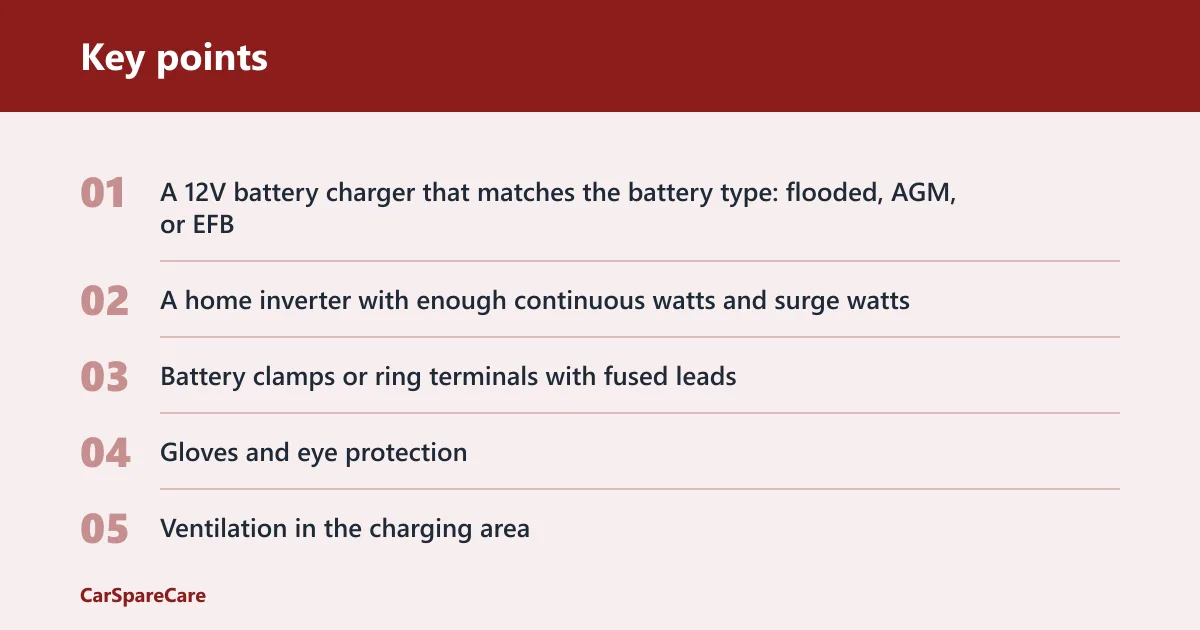
- A 12V battery charger that matches the battery type: flooded, AGM, or EFB
- A home inverter with enough continuous watts and surge watts
- Battery clamps or ring terminals with fused leads
- Gloves and eye protection
- Ventilation in the charging area
- Manuals for both the inverter and charger
Inverter charger size table
| Charger label | Typical AC input draw | Minimum inverter capacity | Practical buffer | Pure sine wave? | Do not attempt |
|---|---|---|---|---|---|
| 4A smart charger | 60–120W | 150W continuous, 300W surge | Use 250W or more | Recommended | Swollen, frozen, leaking, or cracked battery |
| 6A smart charger | 90–180W | 200W continuous, 400W surge | Use 300W or more | Recommended | Swollen, frozen, leaking, or cracked battery |
| 10A smart charger | 150–300W | 300W continuous, 600W surge | Use 500W or more | Strongly recommended | Deeply discharged battery below about 10V with no response |
| 15A smart charger | 225–450W | 500W continuous, 1000W surge | Use 750W or more | Recommended | Frozen, swollen, or leaking battery |
A charger’s advertised amp rating does not tell the full story. AC input wattage matters more, because inverter losses usually take 10% to 20% of the energy and add heat.
How to set it up
- Place the battery and inverter in an open area with moving air, far from sparks, flames, and loose items.
- Connect the inverter to its DC source with the correct fuse size and cable gauge from the inverter manual.
- Plug the charger into the inverter before attaching the battery clamps, so the charger boots under stable AC power.
- Check polarity on the battery posts: positive to positive, negative to negative.
- Start the charger and confirm the inverter stays within its continuous watt rating.
- If the charger has rate settings, pick the lowest practical amp setting for a small battery and a moderate setting for a normal car battery, then recheck battery voltage after 30 minutes.
How long will charging take?
Charge time is not fixed. It depends on battery capacity in amp-hours, how far the battery has discharged, charger output, and how fast the charger tapers near full charge. A 50Ah battery at 50% state of charge needs far less energy than an 80Ah battery that is nearly flat.
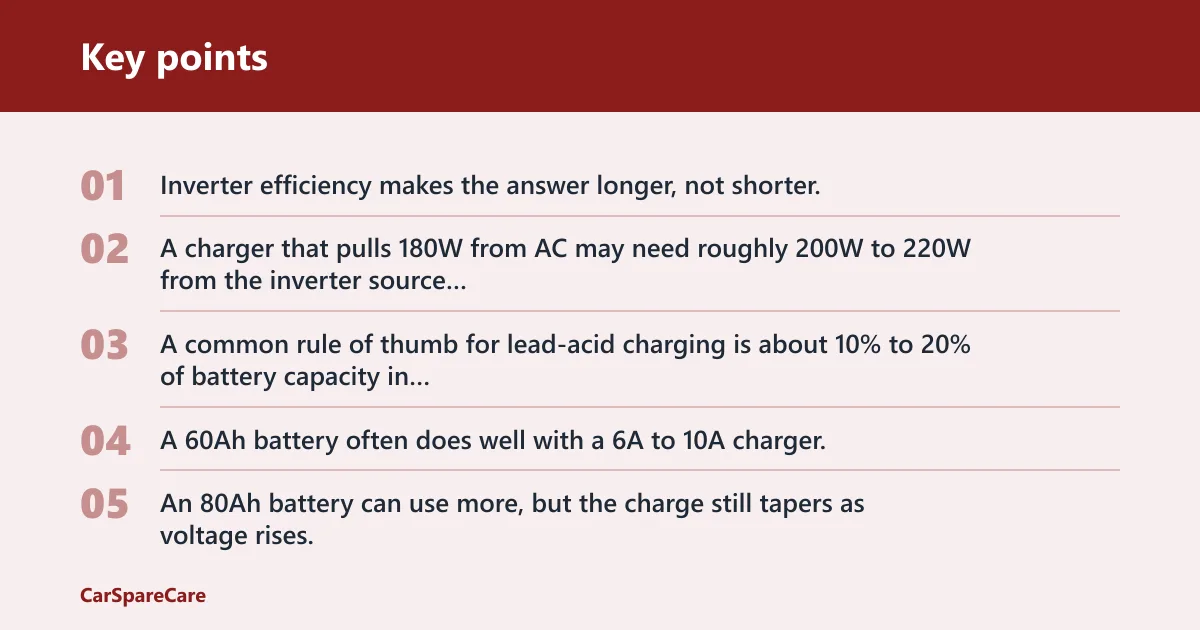
Inverter efficiency makes the answer longer, not shorter. A charger that pulls 180W from AC may need roughly 200W to 220W from the inverter source after conversion losses, so runtime from a backup battery drops faster than many DIY drivers expect.
Battery size and charge rate
A common rule of thumb for lead-acid charging is about 10% to 20% of battery capacity in amps for a normal charge, unless the charger is a smart model that limits current by design. A 60Ah battery often does well with a 6A to 10A charger. An 80Ah battery can use more, but the charge still tapers as voltage rises.
Say your battery is a 70Ah AGM and reads 12.1V after resting. A 10A smart charger may bring it up faster at first, then slow down near full. That taper is normal. It is not a fault in the charger or inverter.
When a generator or wall outlet is faster
If wall power is available, use it. A direct AC outlet skips inverter losses and usually gives the charger its full rated input. During an outage, a generator can be better than a small inverter if the generator’s continuous watt rating is comfortably above the charger load and other house loads.
Is it safe to use an inverter with a charger?
Yes, if you use proper ventilation, fuse protection, correct polarity, and a charger that matches the battery type. It is not safe to improvise with bare leads on AC, undersized cables, or a battery that is swollen, frozen, cracked, or leaking. Lead-acid batteries can vent hydrogen gas and can spark at the wrong moment.
Safety checks before charging
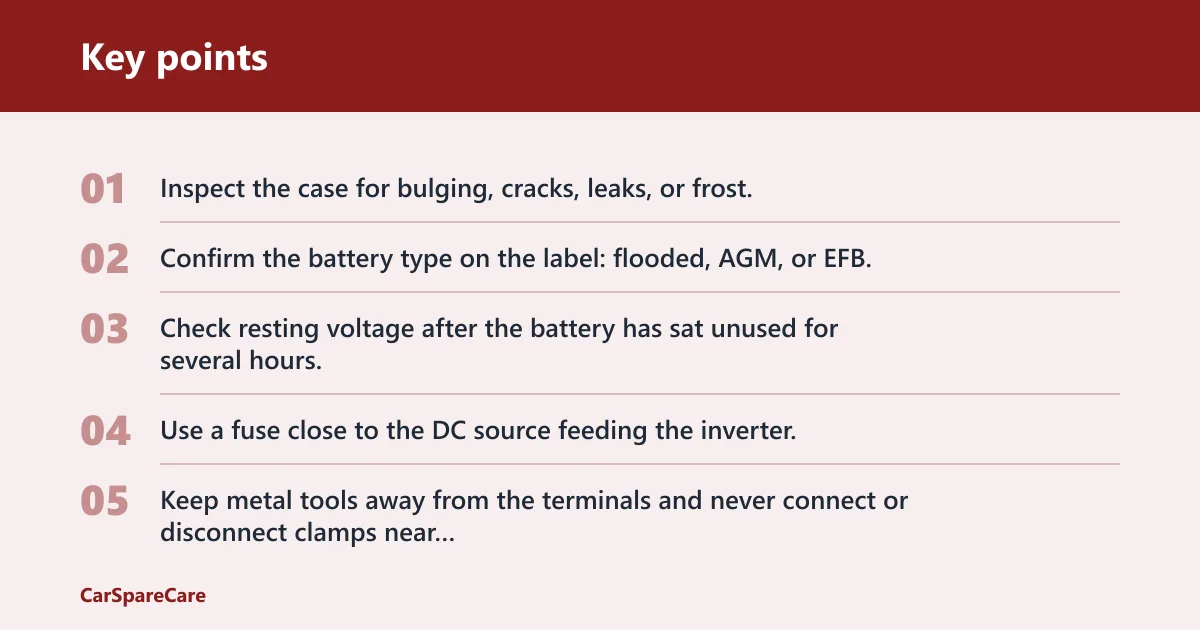
- Inspect the case for bulging, cracks, leaks, or frost.
- Confirm the battery type on the label: flooded, AGM, or EFB.
- Check resting voltage after the battery has sat unused for several hours.
- Use a fuse close to the DC source feeding the inverter.
- Keep metal tools away from the terminals and never connect or disconnect clamps near sparks.
Pure sine wave inverters are the safer default for smart chargers. Modified sine wave units can make some chargers run hot, buzz, or report an error. A simple resistive charger may work on either type, but many modern multi-stage chargers behave better on pure sine wave power.
If the inverter overheats, reduce the charger load at once and let both units cool. A charger that repeatedly trips the inverter often means the inverter is too small, the surge rating is too low, or the source battery cannot sustain the load.
Common mistakes
A common first-timer mistake is sizing by charger amps alone. A 10A charger can still draw well over 100W from AC, and the inverter must handle that continuous load plus startup surge. Another mistake is assuming any inverter that powers on is good enough. It may still fail under load.
Suppose a charger is rated at 15A but the inverter is only 300W continuous. The charger may start, then trip the inverter during bulk charging. The result is wasted time, repeated resets, and extra heat.
- Using an inverter that is too small for the charger’s AC draw
- Ignoring modified sine wave limits with smart chargers
- Charging a battery with physical damage
- Assuming a full charge means the battery is healthy
If that did not work, check the charger’s label for input watts, not just output amps. Then compare it with the inverter’s continuous rating and add at least 25% headroom. If the charger still trips, the next step is a larger pure sine wave inverter or a direct wall outlet.
When should you replace the battery?
Replace the battery instead of trying to rescue it if it is swollen, leaking, frozen, or has a damaged case. Replace it if it will not accept charge, drops voltage quickly after charging, or fails a load test. Severe sulfation and failed cells often mean the battery is near end of life.
Flooded, AGM, and EFB batteries age differently, but the warning signs are similar. A battery that reads normal voltage after charging and then falls fast under load is a strong sign of internal wear, not an inverter problem.
Frequently asked questions
Can you charge a car battery with a home inverter?
Yes, if the inverter can handle the charger’s continuous watt draw and startup surge.
What size inverter do I need to charge a car battery?
A 4A to 6A charger usually needs roughly a 150W to 300W inverter with some surge room. A 10A charger is better matched with a 300W to 500W inverter. Larger chargers need more, and pure sine wave is the safer choice for smart models.
Is it safe to use an inverter with a battery charger?
Yes, if the setup has fresh air around it, proper fusing, and correct polarity. Keep the charger and battery away from sparks, and use a battery that is intact and not frozen, swollen, or leaking. Read both manuals before switching anything on.
Will an inverter damage my car battery or charger?
The inverter itself usually does not damage either device, but an overloaded or modified sine wave inverter can make a smart charger behave badly. The bigger risks are heat, nuisance shutdowns, and incorrect charging if the battery type setting does not match the battery.
Can a 12V car battery charger run from a home inverter?
Yes. A standard AC-input 12V charger is the intended load for this setup. Check the charger label for AC input watts or amps, then compare that number with inverter continuous watts and surge watts. The charger must fit both numbers.
Can you charge a car battery while the power is out?
Yes, if the inverter is powered by another DC source, such as a battery bank or a proper backup system. If that source is weak, the charger may run only briefly. A generator or direct wall outlet is usually faster and more efficient.

Hi, I’m Melvin, an automobile engineer with extensive experience in automobile equipment. I currently work for a local automobile firm, where I specialize in the car parts industry. I’ve had the opportunity to collaborate with seasoned inspectors, gaining invaluable hands-on experience that goes beyond just theory.
My passion for automotive care started at a young age, which led me to create CarSpareCare. Through CarSpareCare, I share the knowledge and skills I’ve acquired over the years to help others navigate the world of car maintenance and repairs.
My goal is to provide practical tutorials, essential safety advice, and the latest industry insights so that anyone—whether a beginner or an expert—can confidently tackle their automotive projects.