Solar panels can maintain a 12V car battery, but a 5W–20W panel usually only offsets self-discharge, while about 30W–100W is a practical range for parked vehicles; a dead battery generally needs charger support. Too little solar lets the battery keep dropping, which can leave you with no start and a sulfated battery. This guide explains when solar can maintain, slow discharge, or recover a battery, and when it is too small to help.
This guide is part of our Car battery maintenance guide series.
When solar charging works and when it falls short
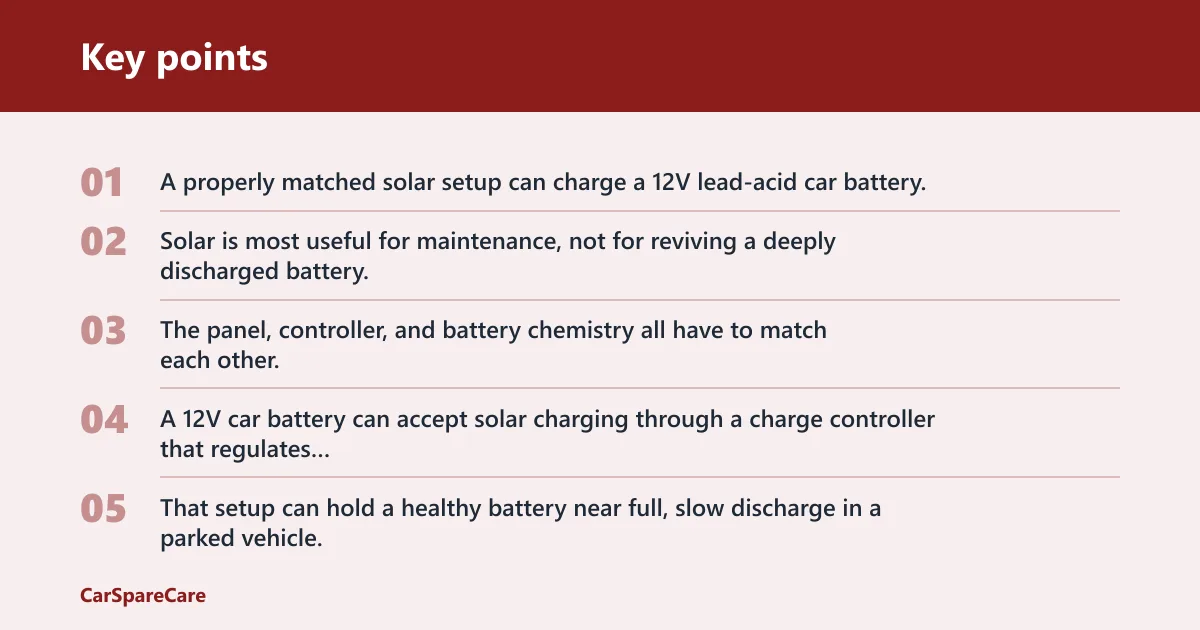


A properly matched solar setup can charge a 12V lead-acid car battery, but it usually does so slowly and works best when the battery already has some charge. Solar is most useful for maintenance, not for reviving a deeply discharged battery. The panel, controller, and battery chemistry all have to match each other.
What solar can do for a 12V battery
A 12V car battery can accept solar charging through a charge controller that regulates voltage and current. That setup can hold a healthy battery near full, slow discharge in a parked vehicle, or top up a battery after light use. It is slower than a mains charger because solar output rises and falls with sun angle, cloud cover, and season.
Think of solar as low-current support. If the battery is already near full, the panel may hold it there. If the battery is down a bit, solar can bring it back over time. If the battery is deeply discharged, the panel may not deliver enough usable current to recover it on its own.
When solar is enough and when it is not
Solar is enough when the battery only needs maintenance or a gentle recharge. It is not enough when the battery voltage has dropped so low that the controller cannot begin a normal charging cycle, or when the vehicle has a heavy parasitic drain. In those cases, a proper charger or battery recovery tool is the better first step.
Why charging speed depends on battery state
Charging speed depends on state of charge because a near-full battery accepts less current than a partly discharged one. A low battery may take more current at first, then slow down as voltage rises. That is why a solar panel can look effective on one battery and disappoint on another with the same wattage.
What size solar panel do you need?
The right panel size depends on whether you want maintenance or recovery. Small panels can hold a battery up against self-discharge, while medium panels are better for slow replenishment after short trips or storage. If you want a realistic answer, start with the battery’s condition, then choose wattage and controller size around that goal.
Typical wattage ranges and what they can achieve
For a stored or infrequently used vehicle, 5W–20W often works as a maintainer when the battery is already healthy. Around 30W–50W is generally more realistic for slow recharge or for offsetting modest parasitic draw. Panels in the 60W–100W range give more margin, especially if the vehicle sits outside and sunlight is inconsistent.
A common first-timer mistake is expecting a small portable panel to refill a battery that has already been pulled down hard by interior lights or repeated no-start attempts. That setup may slow the loss, but it often will not restore enough charge to crank the engine reliably.
Why cloudy weather changes the result
Cloudy weather cuts panel output, sometimes sharply. A panel rated at one wattage in full sun may deliver much less on an overcast day, so real charging time stretches out. That is why a setup that barely maintains a battery in good sun can fail to keep up with discharge in poor weather.
For planning, treat cloudy-day output as a reduced-output case, not the normal case. If a panel only barely covers the vehicle’s standby drain on clear days, it may lose ground after two or three dull days in a row.
How panel voltage and controller size affect setup
Panel wattage is only part of the picture. The panel’s voltage has to fit the charging setup, and the controller has to be rated for the panel’s output. A controller that is too small can limit current, while a mismatched panel can charge badly or trip protection too early.
Solar battery outcomes by wattage
This table gives a practical view of what common panel sizes can do on a 12V car battery. It assumes a charge controller is installed and the battery is a common flooded, AGM, or gel lead-acid type. Cloud cover, panel angle, wiring losses, and battery condition can shift the result. The wattage ranges below are aligned with lead-acid charging stages and real-world solar derating expectations from battery and solar guidance: healthy batteries can be maintained near float voltage, while deeply discharged batteries often need charger-assisted recovery rather than panel-only charging.
| Panel wattage | Estimated daily output in good sun | Estimated daily output in cloudy conditions | Starting battery state-of-charge band | Typical parasitic-draw scenario | Likely outcome |
|---|---|---|---|---|---|
| 5W–20W | About 20–80 Wh/day, roughly 1.5–6.5 Ah/day on a 12V system | Often closer to 5–30 Wh/day, roughly 0.4–2.5 Ah/day | Healthy battery, roughly 80%–100% SoC | Very light standby load, such as clock memory or low-draw alarm memory | Maintenance only; may hold charge, but may not keep up with more than a small continuous draw |
| 30W–50W | About 120–200 Wh/day, roughly 10–16.5 Ah/day | Often closer to 30–90 Wh/day, roughly 2.5–7.5 Ah/day | Partly discharged, roughly 60%–80% SoC | Moderate parasitic load, such as alarm plus modules, dashcam parking mode, or short-storage losses | Slow recharge or strong maintenance; can recover a modest discharge, but clouds or shade can erase the margin |
| 60W–100W | About 240–400 Wh/day, roughly 20–33 Ah/day | Often closer to 60–180 Wh/day, roughly 5–15 Ah/day | Lower but still usable charge, roughly 40%–70% SoC | Higher parasitic load, repeated short trips, or a vehicle that sits for longer periods outdoors | Better slow-recharge option with more margin; still not a quick fix for a battery that is already near flat |
| Any small panel under about 30W | Usually not enough for meaningful recovery if the battery is heavily discharged | Cloudy output is often too low to overcome self-discharge and vehicle standby draw | Deeply discharged, roughly below 40% SoC, or voltage too low for normal charging to begin | Any sustained draw beyond simple memory loads, especially with several dull days in a row | Insufficient recovery; may slow further discharge, but usually cannot restore starting capability on its own |
State-of-charge thresholds for safe expectations
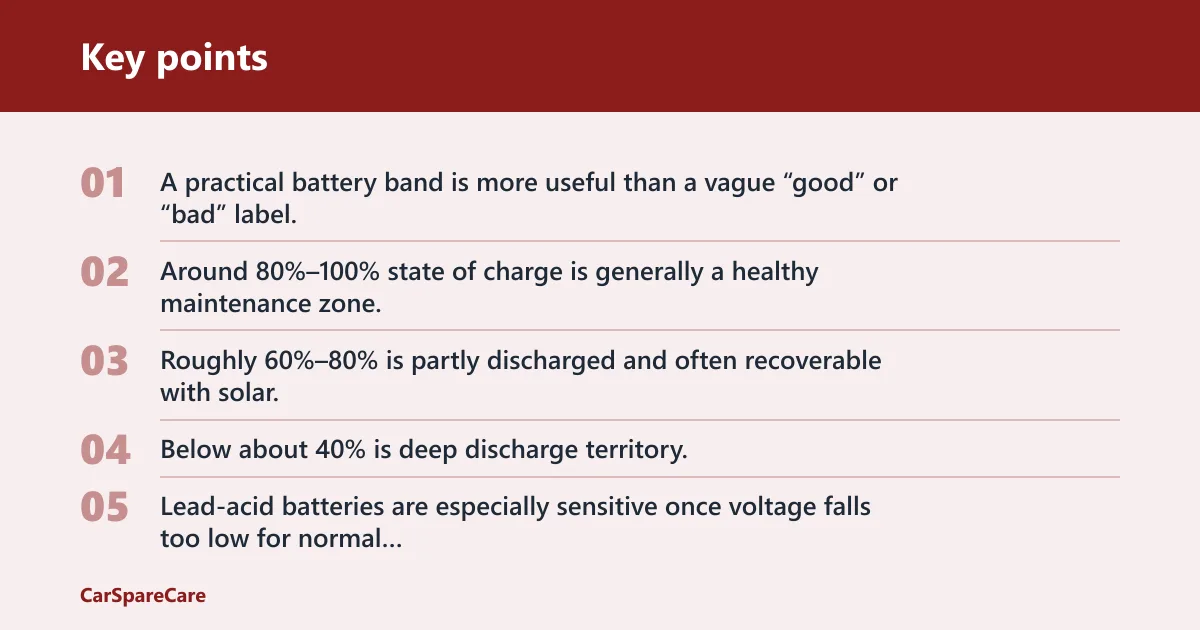
A practical battery band is more useful than a vague “good” or “bad” label. Around 80%–100% state of charge is generally a healthy maintenance zone. Roughly 60%–80% is partly discharged and often recoverable with solar. Below about 40% is deep discharge territory, where manufacturer-specific voltage limits and charger behavior matter more than panel wattage alone.
Lead-acid batteries are especially sensitive once voltage falls too low for normal charging stages to begin. At that point, a solar controller may wait for the battery to rise before it can regulate properly, and some batteries will need a dedicated charger to wake them up first.
Cloudy-day derating and low-voltage limits
If the battery is already weak, cloudy-day output can push a borderline setup below useful output. That is why owners sometimes see a panel maintain a battery in summer but fail in winter or during a run of overcast days. The battery’s starting voltage matters as much as the panel rating.
For planning, assume a cloudy day can cut useful output enough that a setup sized only for fair-weather maintenance may not keep up. That does not mean the panel is useless; it means the panel must be sized for both the vehicle load and the weather pattern you actually have.
Do you need a charge controller?
Yes. A solar charge controller is needed to regulate charging and prevent overcharge. It also helps manage charging stages so the battery does not sit at an unsafe voltage for too long. Direct panel-to-battery charging is not the right approach for a car battery.
PWM vs MPPT
PWM controllers are simpler and often used in smaller maintenance setups. MPPT controllers extract more usable power when panel voltage and battery voltage do not match well, especially in larger systems or less ideal light. Either type still has to be sized for the panel output.
Use the controller as part of the charging system, not as an optional accessory. Without it, the battery can be overcharged on strong sun and undercharged when conditions change. Both are bad outcomes for a lead-acid battery.
What happens without regulation
Without regulation, voltage can drift too high as sunlight changes. That can drive excess gassing in flooded batteries and shorten battery life. It can also produce unstable charging, which is a poor fit for AGM and gel batteries that need a tighter charging profile.
Which battery types work best?
Flooded, AGM, and gel batteries can all be charged from solar if the controller profile suits the chemistry. Flooded batteries are usually the most forgiving. AGM batteries often accept charging well, while gel batteries are less tolerant of the wrong voltage and need a careful profile. If you are comparing battery chemistry, the charge profile matters as much as capacity or brand.
Flooded lead-acid
Flooded batteries are common in many cars and are well suited to solar maintenance when ventilation is available. They can handle typical charging stages, but they do vent gas during charging, so the area should not be sealed up tight. Check water level only if the battery design allows it.
AGM batteries
AGM batteries also work with solar, but they are less forgiving of poor regulation than a basic flooded battery. They usually do well with a controller that follows a proper charging profile. If the voltage is too high for too long, AGM batteries can age faster.
Gel batteries
Gel batteries need the most caution. They do not like aggressive charging or excessive voltage, so the controller settings matter more here than in a basic flooded setup. If your battery is gel, confirm the charger or controller has a gel-compatible mode before you leave it connected.
Some commercial chargers are built for multiple battery types. For example, one charger is designed for both 6-volt and 12-volt batteries, can be used on gel, flooded, AGM, and lithium-ion batteries, and is presented as suitable for marine, powersport, RV, and deep-cycle batteries. Another uses a four-step charging program with initialization, bulk charge, absorption mode, and float mode, and is described as unable to charge a battery from dead. These features are useful, but they do not turn a small solar panel into a fast recovery system. (Thedrive)
How long does solar charging take?
Solar charging usually takes much longer than a wall charger because panel output changes throughout the day. A healthy battery may be maintained continuously, while a partly discharged one may take many hours or more than a day of good sun. A deeply discharged battery may need a separate charger first.
Why solar is slower than a wall charger
A mains charger can deliver steady power. Solar cannot. Panel output rises and falls with light, temperature, angle, and shade, so charging time is uneven. That is why solar works well for parked vehicles and poor mileage patterns, but less well for a battery that needs a quick turnaround.
Bulk, absorption, and float stages
Charging normally moves through bulk, absorption, and float. Bulk brings the battery up as far as the available current allows. Absorption fills the battery more gently near the top of charge. Float then holds it without pushing it too hard. Some maintainers also include an initialization stage or a repair mode.
One battery maintainer in the market is described as having a five-year warranty and using a four-step charging program with initialization, bulk charge, absorption mode, and float mode. It is also described as a trickle charger and as a way to keep a car battery lasting longer. That kind of device is aimed at maintenance, not jump-starting.
Why a dead battery may need a different charger first
If the battery is too low, the solar controller may not see enough voltage to begin normal charging. That is where a dedicated charger with low-voltage recovery is useful. One charger is described as able to recharge batteries as low as zero volts, and another is described as unable to charge a battery from dead. Those are very different jobs.
Solar maintainer or jump starter?
A solar battery maintainer is the better choice for parked or infrequently used vehicles that already have a usable battery. A jump starter is for getting the engine started after the battery has fallen too low to crank. If the battery is truly flat, a maintainer is usually not enough on its own.
When a maintainer is the better choice
Choose a maintainer when the vehicle sits for days or weeks, or when you are trying to offset a small parasitic drain. This is the right tool for keeping a battery near full, not for recovering a battery that has already failed to start the car several times.
When you need recovery help instead
If the battery is below recovery threshold, start with a proper charger that can handle deep discharge or zero-voltage conditions if the manufacturer allows it. After the battery is back in range, a solar maintainer can help keep it there. Solar alone is the wrong first tool for a flat battery.
How parked vehicles change the decision
Parked vehicles are the best solar use case because the load is predictable. If the vehicle has a dashcam, alarm, or other parasitic draw, size the panel for that drain plus a margin for cloudy days. If the vehicle is stored indoors or under heavy shade, solar may not be practical at all.
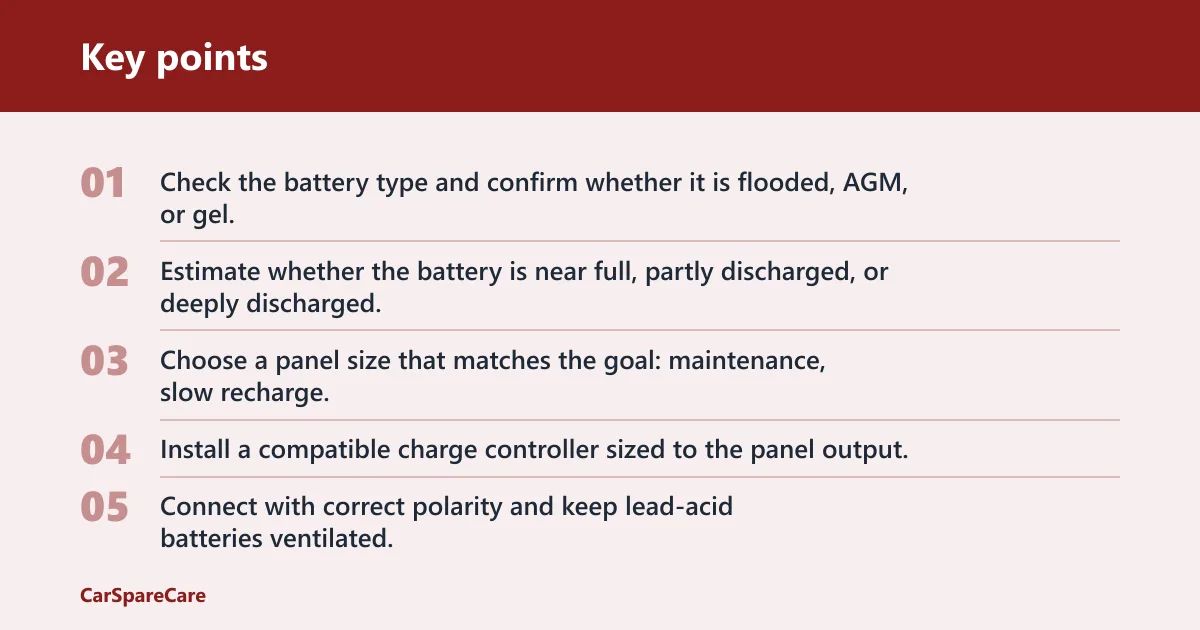
- Check the battery type and confirm whether it is flooded, AGM, or gel.
- Estimate whether the battery is near full, partly discharged, or deeply discharged.
- Choose a panel size that matches the goal: maintenance, slow recharge, or recovery support.
- Install a compatible charge controller sized to the panel output.
- Connect with correct polarity and keep lead-acid batteries ventilated.
- Check the setup at regular intervals during the first charging day.
Picture a car that sits outside with a 20W panel and a healthy battery. The setup may keep pace with self-discharge and a small alarm load. Now change only one variable: the car sits through three cloudy days in a row. The same panel may no longer hold the battery level, so the battery slowly slips downward.
Suppose a sedan has an AGM battery that reads low after a month of storage. A 50W panel may help, but it may take a long stretch of sun to do the job, and it may never get there if the battery is too far down. In that case, a real charger is the safer first step, then solar maintenance after recovery.
Can you charge a 12v car battery with a solar panel?
Yes, a 12V car battery can be charged with a solar panel if the panel, controller, and battery chemistry are matched correctly. The key is to treat solar as a slow charging source, not a fast rescue method. It works best for maintenance and light recharge, not for a battery that is already far below usable voltage.
Frequently asked questions
Can you charge a car battery with solar panels?
Yes, but only with the right setup. You need a solar panel, a charge controller, and a battery that is not too far discharged. Small panels are mainly for maintenance, while larger panels can slow recharge. Deep discharge usually needs a proper charger first.
How do you trickle charge a car battery with a solar panel?
Use a solar panel with a controller designed for 12V lead-acid charging, then connect it with correct polarity to the battery. Trickle charging is really maintenance charging, so the goal is to hold voltage in a safe range, not to replace a full charger or jump starter.
How long does a solar panel take to charge a car battery?
It depends on panel wattage, sunlight, and the battery’s starting state of charge. A near-full battery may only need maintenance, while a partly discharged battery can take many hours or more than a day. A dead battery may not recover from solar alone.
What size solar panel do I need to charge a car battery?
For maintenance, 5W–20W is often enough for a healthy parked battery. For slow recharge, 30W–100W is more practical. If the battery is deeply discharged or the weather is poor, even a larger panel may not be enough without charger support.
Can I leave a solar panel on a car battery overnight?
Yes, if the panel is connected through a proper charge controller and the battery is in good condition. The key point is controller and backflow protection, not night-time solar generation. Without regulation, leaving a panel connected is not a safe idea, especially on a fully charged battery.
Can a solar panel charge a dead car battery?
Sometimes, but not reliably. If the battery is only moderately low, solar may bring it back slowly. If it is deeply discharged, the panel may not provide enough voltage or current to start the process. In that case, use a proper charger first.

Hi, I’m Melvin, an automobile engineer with extensive experience in automobile equipment. I currently work for a local automobile firm, where I specialize in the car parts industry. I’ve had the opportunity to collaborate with seasoned inspectors, gaining invaluable hands-on experience that goes beyond just theory.
My passion for automotive care started at a young age, which led me to create CarSpareCare. Through CarSpareCare, I share the knowledge and skills I’ve acquired over the years to help others navigate the world of car maintenance and repairs.
My goal is to provide practical tutorials, essential safety advice, and the latest industry insights so that anyone—whether a beginner or an expert—can confidently tackle their automotive projects.