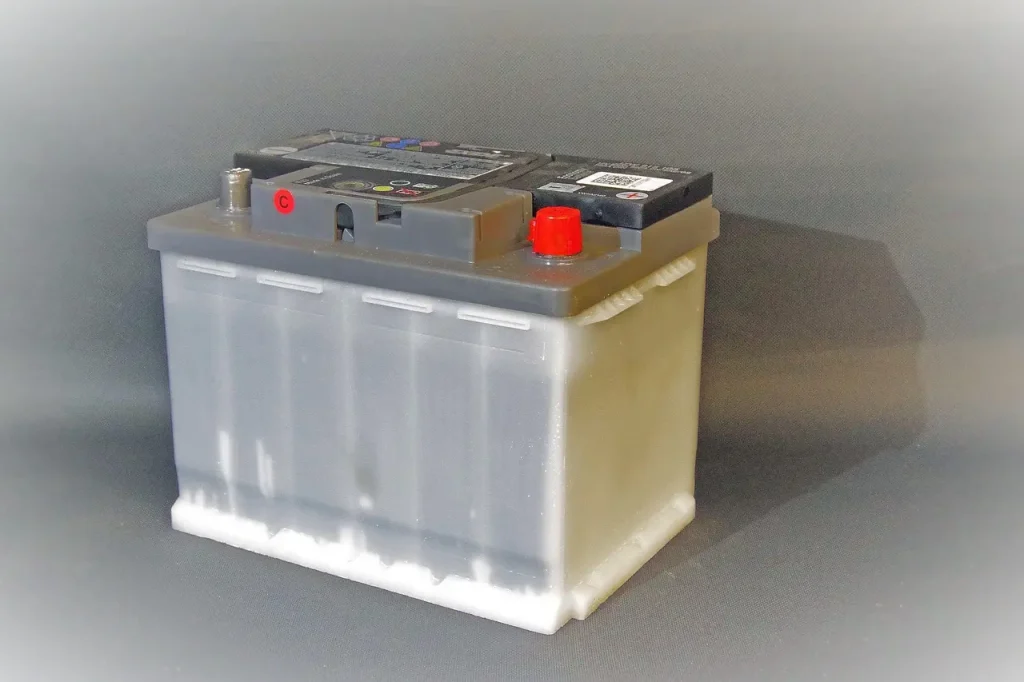
A bad battery can cause rough starts and stalling, especially when voltage is low or drops during cranking. Ignore it, and you can misread an alternator fault or a corroded terminal, then keep replacing parts that do not fix the fault. This guide shows a fast voltage check to separate battery, alternator, and connection problems in under 10 minutes.
Why low battery voltage causes drivability problems
Yes, but usually at idle or low speed, not as a clean highway shutdown. A weak 12-volt car battery can starve the ECU, fuel pump, ignition coils, and spark plugs of steady voltage, so the engine may rough-start, misfire, or stall when electrical demand is highest and engine speed is lowest.
A healthy battery stores starting current and helps keep system voltage steady. When voltage sags, the ECU can misread sensors or trim fuel wrongly, and the fuel pump may lose pressure. Modern cars depend on many microprocessors, so marginal voltage can create drivability faults before the battery is fully dead.
Battery diagnosis matrix
Use this matrix to match the symptom to the next check. The goal is not to guess the failed part. It is to decide whether the next reading points to battery capacity loss, alternator undercharging, or resistance at the terminals or cables.
| Symptom | Likely battery fault | Likely alternator fault | Likely connection fault | Next test to run | Expected voltage range |
|---|---|---|---|---|---|
| Rough start | Weak capacity or age-related loss | Less likely unless charging is poor after start | Loose clamp or cable resistance | Multimeter while cranking | Stay at or above 9.6 volts |
| Stall at idle | Possible, if battery voltage sags with low idle speed | Common if charging stays below target | Possible intermittent drop at the terminals | Check running voltage at the battery posts | About 13.8–14.8 volts running |
| Stall after jump start | Bad battery can be the root cause | Check if the engine dies again once the donor pack is removed | Possible if jump clamps bypass a bad connection | Repeat running voltage test after removing the jump source | Should remain in the charging range |
| Dim lights at idle | Weak battery can expose the problem | Strong alternator suspect if voltage is low at idle | High resistance in grounds or positive cable | Measure voltage at idle and with lights on | Hold near 13.8–14.8 volts |
| Battery light on | Possible if the battery is not being replenished | Very possible undercharging fault | Possible if the belt, terminals, or wiring are poor | Check charging voltage and belt drive | Below charging range points to a fault |
| Corroded terminals | Battery may be fine | Not the first suspect | Likely white, green, or bluish buildup | Inspect and clean terminals, then recheck voltage | Resting voltage can look normal, but drop under load |
Say your sedan starts with a slow grind on a cold morning, then idles roughly for 20 seconds before settling down. That pattern fits a battery-led voltage sag more than a pure fuel problem, so the next check is cranking voltage at the posts, not a parts swap.
A common first-timer mistake is blaming the battery for a rough idle after a cold morning start, then overlooking corroded cable connections. If the clamps are loose or crusted with white or bluish buildup, the jump pack can hide resistance long enough to make the battery look guilty.
What voltage should you see?
With the engine off, a healthy, fully charged 12-volt battery typically reads around 12.6 volts, and a healthy battery should read 12.6 volts or higher. With the engine running, the alternator should raise voltage to roughly 13.8–14.8 volts. If those numbers miss badly, the next step changes.
Resting voltage with the engine off
Start with the engine off and the car parked long enough for surface charge to settle. A reading around 12.6 volts is the baseline you want. If it is much lower, the battery may be discharged, sulfated, or simply worn out after the typical 3–5 years seen in many batteries, depending on climate and driving habits.
Resting voltage alone does not prove capacity. A battery can show a decent open-circuit reading and still collapse under load, which is why a load test matters when the symptom is rough start or a brief stall.
Charging voltage with the engine running
Once the engine is running, check the battery posts again. The alternator should bring system voltage into the 13.8–14.8-volt range, and 13.7–14.7 volts is also a common charging target. If the number stays near resting voltage, the alternator is not charging properly or the circuit has too much resistance.
If the running voltage is low and the battery light is on, suspect undercharging first. That fault can mimic a dead battery because the battery never gets enough charge to support the ECU, fuel pump, and ignition system at idle.
What a low reading means
A resting reading below about 12.4 volts points toward a discharged or weak battery. A cranking drop below roughly 9.6 volts can cause misfires or shutdown, because the ECU and ignition system may not get stable power during engine start. If the engine dies right after startup, that low-voltage path is worth checking before anything else.
Picture a compact car that starts after a jump, idles for a minute, then dies when the headlights and rear defogger are switched on. That pattern points toward either an undercharging alternator or a weak battery that cannot buffer the added electrical load.
Battery, alternator, or connection fault?
Separate the three by looking at where voltage fails. A battery fault often shows up during cranking or right after start. An alternator fault shows up with the engine running. A connection fault can appear in either place because resistance in the cable path causes an intermittent drop that the meter may only catch under load.
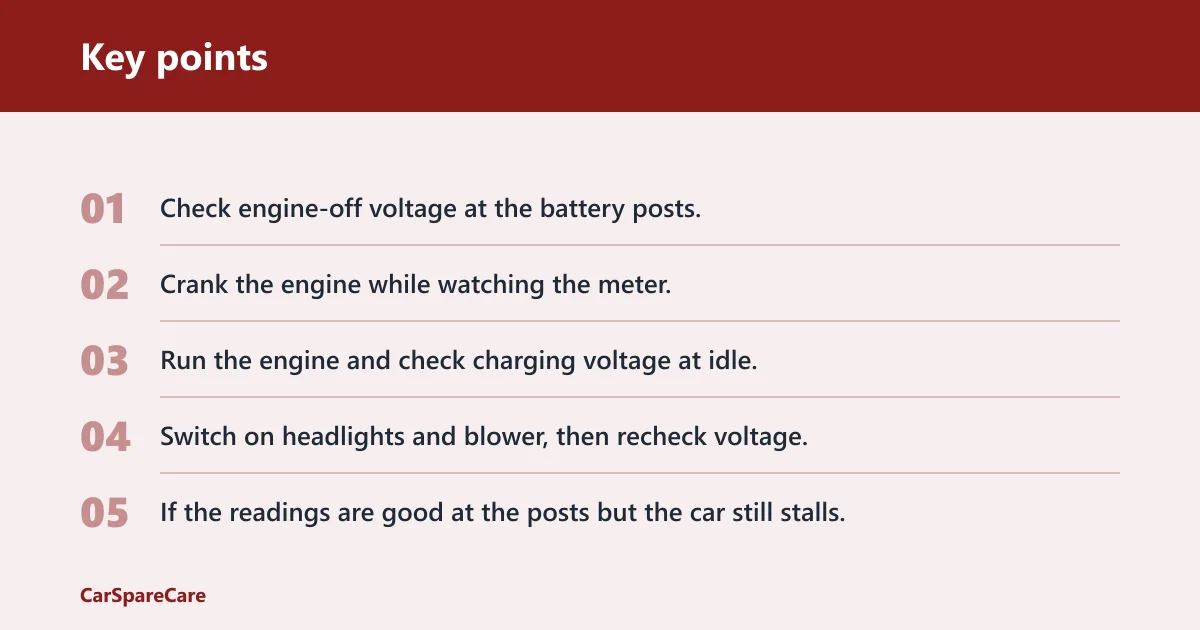
How to separate undercharging from capacity loss
- Check engine-off voltage at the battery posts.
- Crank the engine while watching the meter.
- Run the engine and check charging voltage at idle.
- Switch on headlights and blower, then recheck voltage.
- If the readings are good at the posts but the car still stalls, inspect the terminals and grounds for resistance.
If the engine-off number is low, charge the battery and retest. If the battery charges but the engine still cranks slowly or stalls at idle, a battery load tester is the next useful tool. A professional battery tester applies a load that mimics starting conditions, which can reveal capacity loss that a simple resting check misses.
How corroded terminals create resistance and voltage drop
Corrosion on battery terminals often appears as white, green, or bluish crust. That buildup raises resistance, so the battery can seem fine at rest while the starter, ECU, or fuel pump sees a lower effective voltage under load. Loose clamps do the same thing, and they can fail only when the engine shakes at idle.
Do not stop at visual inspection. Clean and tighten the terminals, then repeat the same voltage tests. If the symptom vanishes after the connection is corrected, the battery may have been blamed unfairly.
Where the load tester fits
A load tester belongs after you confirm the basic charging numbers. It helps answer a narrow question: can the battery still deliver current when the starter demands it? That matters because a weak battery can look acceptable at 12.6 volts and still fail under load, especially if the engine stalls after a jump start or during a cold crank.
The result should guide the next move. Good running voltage with poor load performance points to battery replacement. Poor running voltage points more toward alternator or wiring trouble.
Can low voltage cause rough running?
Yes. Low voltage can upset the ECU, fuel pump, and ignition system enough to create rough running before the car stalls. The ECU needs stable voltage to run sensors and fueling correctly, while the fuel pump and ignition coils need a steady supply to maintain pressure and spark.
ECU voltage sensitivity
Modern ECUs are sensitive to voltage dips because they depend on steady power and clean sensor signals. If voltage sags during crank or at idle, the ECU may command the wrong fuel amount or lose an input long enough to cause a stumble. In severe cases, it can shut down and restart poorly.
Fuel pump and ignition effects
The electric fuel pump is especially vulnerable to low voltage. Reduced pump speed means lower fuel pressure, which can mimic a clogged filter or failing pump. A weak battery can contribute to misfires and rough running, especially during repeated short starts.
One common pattern is a car that starts, shakes briefly, and clears as the alternator takes over. That does not rule out the battery; it may mean the battery is the weak link that exposed an ignition or fueling system already operating near the edge.
Stop-start and ECU-heavy cars
Stop-start vehicles and ECU-heavy cars often show battery weakness sooner. They ask the battery to restart the engine often, run more modules while idling, and maintain memory and control systems with less margin. Marginal voltage can trigger odd drivability symptoms before a classic no-start appears.
Repeated short trips can hide the fault because the alternator never gets much time to replenish the battery. The car may seem fine on one drive and stall at the next stoplight. If that pattern appears, do not assume a single jump start fixed the problem.
If the car stalls at idle, the battery light comes on, and the running voltage sits below the charging range, avoid extended driving. A tow is safer than trying to nurse an undercharged system home, especially if the battery is old, the terminals are corroded, or the stall repeats after restart.
Frequently asked questions
Can a bad battery cause a car to stall while driving?
It can, but that is less common than stalling at idle or right after a jump start. A bad battery usually causes low-voltage problems first, and the alternator can sometimes keep the car running for a while. If it stalls while driving, check charging voltage and connections immediately.
Can a weak battery cause rough starts or slow cranking?
Yes. Slow cranking is one of the clearest battery symptoms, especially when the engine turns over reluctantly in the morning. If voltage falls below roughly 9.6 volts during cranking, the ECU and ignition system may struggle enough to create a rough start or brief misfire.
How do I tell if it’s the battery or alternator?
Check voltage with the engine off and then running. Around 12.6 volts off points to a charged battery, while about 13.8–14.8 volts running points to normal alternator output. If the off reading is low and the running reading is normal, suspect the battery. If both are low, suspect charging trouble.
Why does my car stall at idle or stoplights?
Idle stalls often point to low voltage because battery-related stalling almost always shows up at idle or low speeds. At idle, the alternator produces less margin, so a weak battery, corroded terminal, or undercharging alternator can show itself first. Recheck voltage with accessories switched on.
Can corroded battery terminals cause stalling?
Yes. White, green, or bluish corrosion adds resistance, and loose clamps can interrupt current flow. That can make the battery seem weak even when the battery itself is serviceable. Clean and tighten the terminals, then repeat the voltage test before replacing parts.
What voltage should a car battery read when off and running?
With the engine off, a healthy, fully charged battery typically reads around 12.6 volts. With the engine running, the charging system should raise voltage to roughly 13.8–14.8 volts. If the running number stays near 12.6 volts, the alternator is not doing its job.
Should I replace the battery after a jump start if stalling continues?
Not automatically. If stalling continues after a jump start, first check charging voltage and terminal condition. A jump can get the engine running even when the real problem is undercharging or a bad connection. Replace the battery only after the load test or voltage checks point that way.
What other problems can mimic a bad battery stall?
An alternator fault, corroded cables, a loose ground, or a failing fuel pump can all look like battery trouble. ECU issues and ignition faults can also create similar symptoms, especially if low voltage is part of the chain. That is why the next voltage test matters more than the symptom alone.

Hi, I’m Melvin, an automobile engineer with extensive experience in automobile equipment. I currently work for a local automobile firm, where I specialize in the car parts industry. I’ve had the opportunity to collaborate with seasoned inspectors, gaining invaluable hands-on experience that goes beyond just theory.
My passion for automotive care started at a young age, which led me to create CarSpareCare. Through CarSpareCare, I share the knowledge and skills I’ve acquired over the years to help others navigate the world of car maintenance and repairs.
My goal is to provide practical tutorials, essential safety advice, and the latest industry insights so that anyone—whether a beginner or an expert—can confidently tackle their automotive projects.