
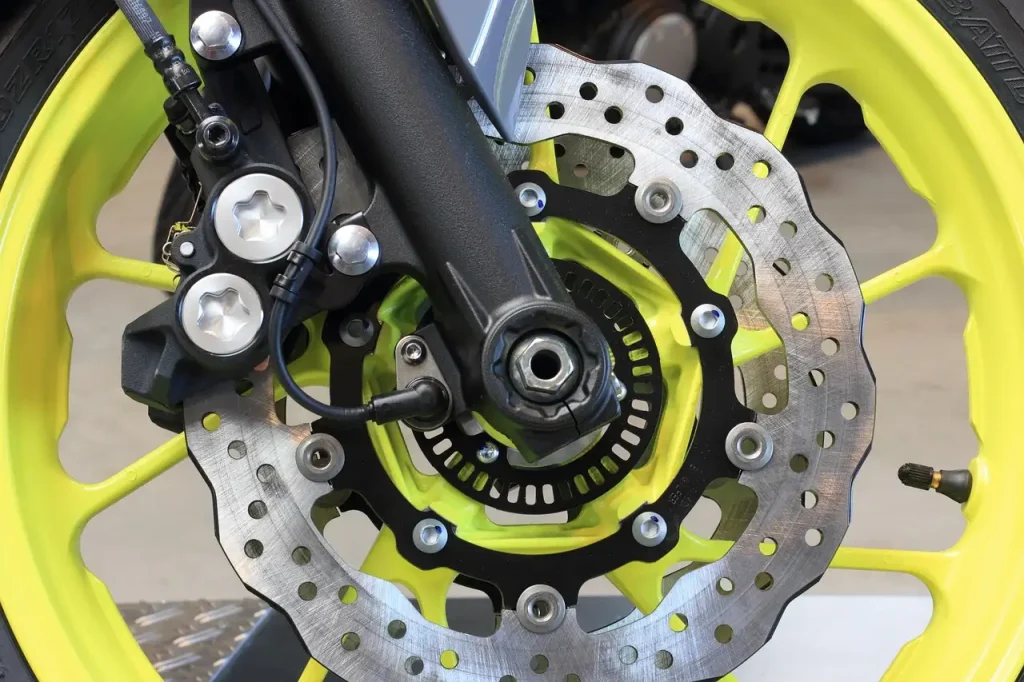
A faulty ABS wheel speed sensor can show one wheel with implausible or zero speed on a scan tool while the others read normally; if the reading jumps, drops out, or changes with wheel movement, check the wiring, tone ring, or bearing next. Ignoring it can leave ABS, traction control, and stability control disabled, and misdiagnosis wastes time and parts. This guide shows a simple decision tree to separate sensor failure from wiring faults, damaged encoder rings, and failing wheel bearings.
ABS wheel speed sensor basics

An ABS wheel speed sensor reads wheel speed and sends that signal to the ABS computer. The same part may be called an ABS sensor or wheel speed sensor. It is usually mounted near the wheel hub or steering knuckle, where it can read a toothed reluctor ring or a magnetic encoder.
That signal does more than feed the ABS system. Many vehicles also use it for traction control and stability control, so a bad signal can light several warning lamps at once. The ABS warning light does not name the failed part by itself; you need codes and live data to identify the fault.
What the sensor does
The sensor watches wheel rotation and reports speed to the ABS control unit. When one wheel slows too fast, the module can modulate brake pressure to prevent lockup. If the signal is missing, unstable, or implausible, the system may disable ABS and related stability functions.
Where it sits on the vehicle
Wheel speed sensors are mounted close to the wheel, usually at the hub or steering knuckle. That location makes them vulnerable to water intrusion, corrosion, road debris, broken brackets, and wiring strain from steering or suspension movement.
Reluctor ring and magnetic encoder systems
Some vehicles use a toothed reluctor ring that the sensor reads as the wheel turns, while Others use a magnetic encoder built into the wheel bearing or hub. Those two designs fail in different ways, and that matters when you diagnose a warning light.
Say your front-left ABS light comes on after a pothole strike, and the scan tool shows that wheel dropping to zero only when you turn left. That pattern points first to wiring stretch, connector damage, or hub movement, not an automatic sensor replacement.
Which warning lights matter most?
Start with the light pattern, because it changes the urgency. An ABS light alone means the ABS system needs diagnosis, but standard braking may still work. If the red brake warning light comes on with abnormal pedal feel, stop driving and inspect the brakes before anything else.
ABS light only
An ABS warning light can come on from a bad wheel speed sensor, but it does not prove the sensor is the fault. The car may still stop normally in standard braking, while ABS assist is disabled. That is a diagnosis cue, not a reason to guess at the part.
ABS plus traction or stability lights
When ABS, traction control, and stability control lights appear together, a wheel speed signal problem is high on the list. Many vehicles use the same wheel speed data for all three systems, so one failed input can trigger several warnings at once.
Red brake warning light and pedal feel
A red brake warning light changes the situation. If it appears with a soft pedal, a sinking pedal, or poor braking feel, stop driving and inspect the hydraulic brake system. That warning is more serious than an ABS light by itself.
ABS diagnosis matrix
This matrix helps separate a bad sensor from wiring, encoder, and hub faults before you buy parts. Use an ABS scan tool rather than only a basic engine code reader, because a basic reader may not access the ABS system. Compare live wheel speed readings while the vehicle is moving slowly and while the suspension is turned or loaded.
| Symptom | Likely fault | Quick check | Next step |
|---|---|---|---|
| ABS light only | Bad sensor, open wiring, corroded connector, dirty or damaged reluctor ring, failed encoder, or hub play | Read ABS codes and compare live wheel speeds; inspect the sensor connector and loom near the wheel | Repair wiring or hardware first, then retest before replacing the sensor |
| ABS plus traction or stability lights | Wheel speed signal fault affecting multiple systems | Check which wheel shows zero, dropout, or implausible speed on the scan tool | Trace that wheel’s sensor circuit, ring, or encoder before replacing modules |
| Low-speed unintended ABS pulsing | Cracked reluctor ring, rust scale, debris, damaged magnetic encoder, or wheel bearing play | Road test at parking-lot speed and watch the live data from the offending wheel | Inspect ring or encoder condition and check hub looseness |
| Intermittent wheel-speed dropouts | Broken wire inside insulation, loose connector pin, sensor gap change, or bearing movement with integrated encoder | Wiggle-test the loom while watching live data; turn the steering and load the suspension | Repair the circuit or replace the hub assembly if the encoder is built in |
What scan data tells you
Read ABS codes, not just engine codes. A scan tool that can read the ABS control unit is the starting point. Once you have codes, use live wheel speed readings to compare all four wheels and see which one disagrees.
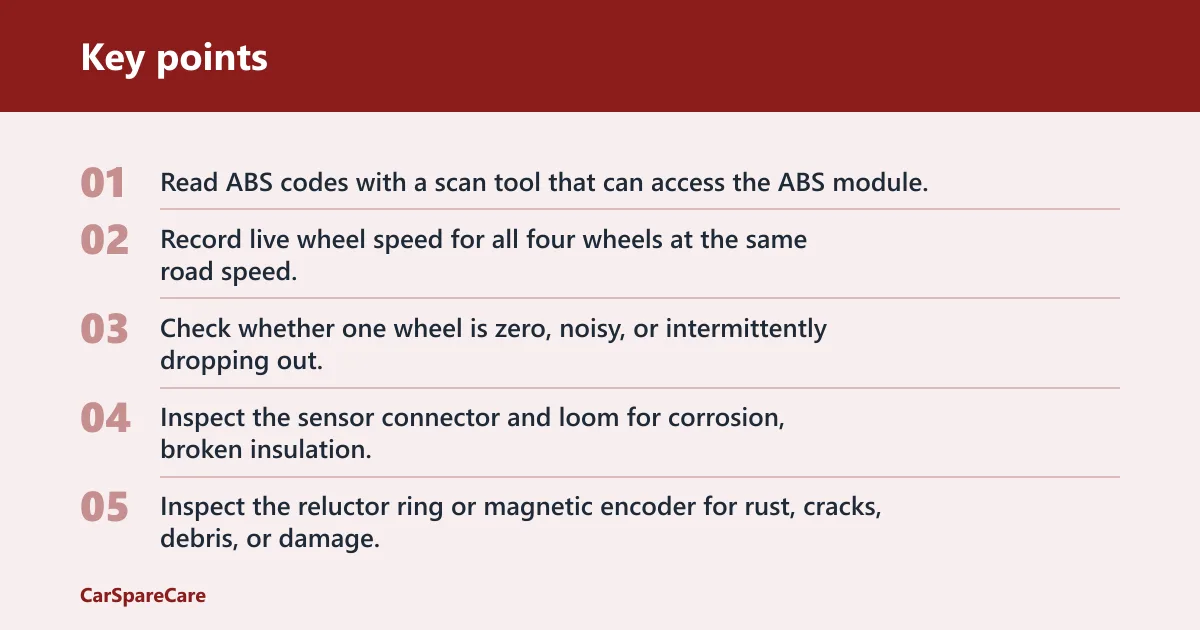
A dead signal is usually obvious: one wheel stays at zero or drops out completely while the others move together. An intermittent fault is trickier. The speed value may spike, fall to zero, or react when you turn the wheel, tap the loom, or drive over bumps.
How to spot a bad sensor pattern
A failed sensor often shows a fixed zero, a noisy signal, or a speed that does not match the other wheels at the same road speed. If the reading changes only when the loom moves, the fault may be wiring rather than the sensor itself.
How to spot a ring or encoder pattern
If the signal looks fine at a standstill but fails at low speed or while turning, look closely at the reluctor ring or magnetic encoder. Rust, debris, cracked teeth, or a damaged encoder surface can disturb the signal only in certain wheel positions.
- Read ABS codes with a scan tool that can access the ABS module.
- Record live wheel speed for all four wheels at the same road speed.
- Check whether one wheel is zero, noisy, or intermittently dropping out.
- Inspect the sensor connector and loom for corrosion, broken insulation, or stretched wiring.
- Inspect the reluctor ring or magnetic encoder for rust, cracks, debris, or damage.
- Check hub or bearing play before replacing a sensor on encoder-equipped vehicles.
Could wiring or the hub be the real fault?
Yes. Damaged wiring, a corroded connector, a bad reluctor ring, a damaged magnetic encoder, or a loose wheel bearing can all mimic a failed ABS sensor. Do not replace the sensor until you have checked the circuit and related hardware.
Connector corrosion and damaged wiring
Look for green corrosion in the connector, bent pins, broken clips, chafed insulation, and wires stretched near the steering knuckle. A wire can fail inside the insulation and still look intact from the outside, which is why wiggle-testing matters during live data checks.
Reluctor ring rust, cracks, or debris
A toothed reluctor ring can lose signal quality if rust swells between teeth, a tooth chips, or debris blocks the sensor gap. That can produce low-speed ABS pulsing or a wheel speed dropout that looks like a sensor fault on the scan tool.
Wheel bearing play with an integrated encoder
Some vehicles use a magnetic encoder built into the wheel bearing or hub. If the bearing has play, the encoder gap can change enough to corrupt the signal. In that case, a new sensor will not fix the problem.
Picture a rear wheel that shows normal speed most of the time, then drops to zero when the car hits a speed bump. If the loom tests fine and the hub has noticeable play, the bearing or integrated encoder deserves priority over the sensor.
Why does ABS activate at low speeds?
Low-speed ABS pulsing can be normal on loose gravel, snow, or a rough surface where a wheel briefly slows or locks. It can also signal a fault. The difference is the road condition, the repeatability, and the scan data from the wheel that misbehaves.
When it is normal behavior
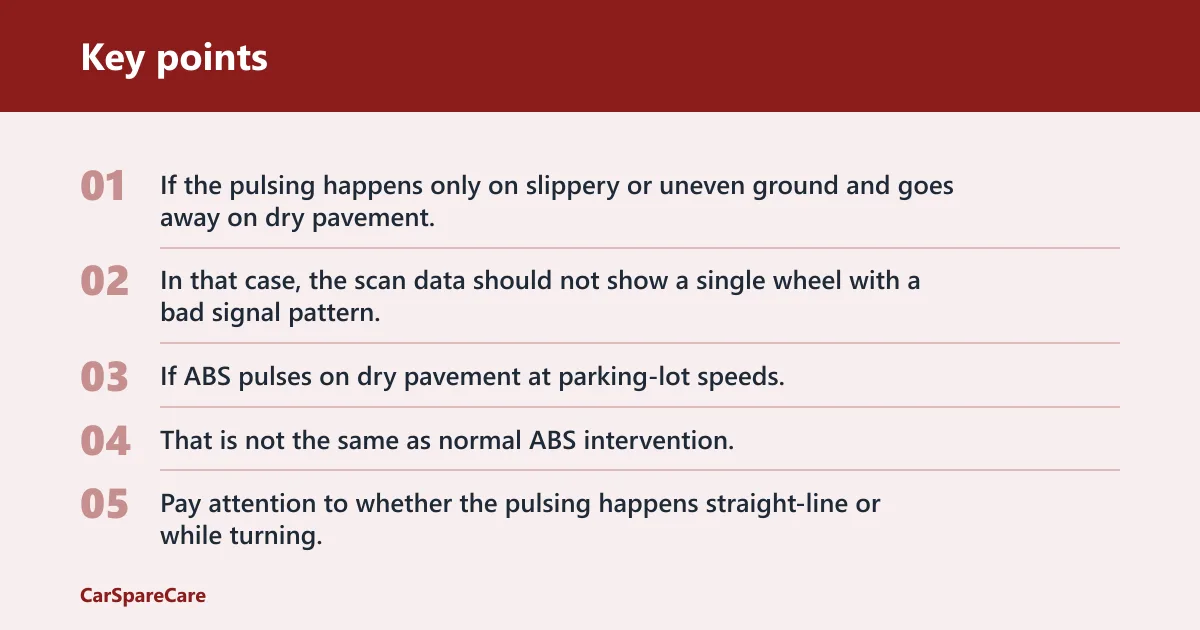
If the pulsing happens only on slippery or uneven ground and goes away on dry pavement, the system may be reacting as designed. In that case, the scan data should not show a single wheel with a bad signal pattern.
When it points to a fault
If ABS pulses on dry pavement at parking-lot speeds, especially if the same wheel position seems to trigger it repeatedly, that can point to a damaged ring, encoder, sensor gap issue, or bearing play. That is not the same as normal ABS intervention.
Road-test clues that matter
Pay attention to whether the pulsing happens straight-line or while turning. A fault that appears during turns often tracks with loom movement, wheel bearing movement, or a hub-mounted encoder issue. A fault that repeats at the same speed often points to a distorted signal source.
Replacement cost by failure mode
Sensor replacement cost is estimated at about $234 to $310 in the U.S. That is only the sensor-side repair. If the problem is a wiring repair or a hub or bearing assembly with an integrated encoder, the cost usually changes because the failed part is different.
Sensor only
If the sensor is confirmed bad and the rest of the circuit is sound, expect the sensor-only repair to sit near the stated $234 to $310 estimate. That assumes the sensor can be replaced without extra hub or bearing work.
Wiring repair
A wiring repair can be lower or higher than a sensor replacement depending on whether the fix is a connector repair, a short harness section, or a harder-to-reach section near the wheel. The key point is that replacing the sensor alone will not cure a broken wire.
Hub or bearing assembly with encoder
If the encoder is built into the wheel bearing or hub, the repair may require replacing the assembly instead of the sensor. That is usually the more expensive path, but it is the correct one when bearing play or encoder damage is the real fault.
Frequently asked questions
How to tell if an ABS wheel speed sensor is bad
Use an ABS scan tool and compare live wheel speeds. A bad sensor often shows zero, implausible speed, or intermittent dropouts while the other wheels read normally. If the signal changes when you move the loom or turn the wheel, check wiring, connector condition, and the hub or ring next.
Does wheel speed sensor affect ABS?
Yes. Wheel speed sensors send wheel speed information to the ABS computer, and a bad signal can trigger an ABS warning light. The ABS light does not prove the sensor is the only fault, so you still need codes and live data before replacing parts.
What does ABS wheel speed sensor do?
It measures wheel rotation and sends that data to the ABS module. The system uses that information to control brake pressure during lockup prevention, and many vehicles also use the same signal for traction control and stability control.
How does ABS wheel speed sensor work?
Depending on the vehicle, the sensor reads either a toothed reluctor ring or a magnetic encoder built into the wheel bearing or hub. As the wheel turns, the ABS computer interprets the changing signal as wheel speed and compares all four wheels.
Can a bad ABS sensor cause the ABS light to come on?
Yes. A bad ABS sensor can turn on the ABS warning light. It may also trigger traction control or stability control warnings. The light tells you the system needs diagnosis, but it does not identify the exact failed part by itself.
Can I drive with the ABS light on?
Standard braking may still work when only the ABS light is on, but the ABS system needs diagnosis. You should drive carefully, avoid hard braking if possible, and stop driving if the red brake warning light appears with abnormal pedal feel.

Hi, I’m Melvin, an automobile engineer with extensive experience in automobile equipment. I currently work for a local automobile firm, where I specialize in the car parts industry. I’ve had the opportunity to collaborate with seasoned inspectors, gaining invaluable hands-on experience that goes beyond just theory.
My passion for automotive care started at a young age, which led me to create CarSpareCare. Through CarSpareCare, I share the knowledge and skills I’ve acquired over the years to help others navigate the world of car maintenance and repairs.
My goal is to provide practical tutorials, essential safety advice, and the latest industry insights so that anyone—whether a beginner or an expert—can confidently tackle their automotive projects.

