

Yes, you can use TruFuel in your car, but it’s generally not recommended for everyday driving. TruFuel is a specialized, ethanol-free fuel designed for small engines like lawnmowers and chainsaws. While it won’t immediately harm your car, it’s significantly more expensive and offers no real benefit over standard gasoline. This guide will explain why and when you might consider it, and what to know before you fill up.
Ever found yourself staring at a can of fuel and wondering if it contains the magic potion for your car? It’s a common thought, especially when you’ve got some leftover from your lawn equipment. You might be looking at that bright red can of TruFuel and asking yourself, “Can I use TruFuel in my car?” It’s a natural question, and one many drivers ponder. Cars and small engines both run on gasoline, so it seems like a reasonable substitution, right? Well, the answer is a bit nuanced. While it won’t instantly break your engine, using TruFuel in your car isn’t the best idea for most situations. Let’s break down what TruFuel is, how it differs from regular car gasoline, and what you need to know to make an informed decision. We’ll cover everything from its intended use to potential (though unlikely) scenarios where it might cross your mind, and ultimately help you understand why sticking to your car’s recommended fuel is usually the smartest path.
What Exactly is TruFuel?
TruFuel is a brand that offers pre-mixed, ethanol-free gasoline specifically engineered for small engines. Think of your lawnmower, chainsaw, leaf blower, or even older motorcycles. These are the kinds of machines TruFuel is designed to keep running smoothly. The key feature that sets it apart is its ethanol-free nature. Ethanol is an alcohol-based additive often blended into regular gasoline. While it can boost octane and reduce emissions in some applications, it can also cause problems for the sensitive fuel systems of small engines. TruFuel eliminates this concern by providing a pure gasoline blend that stays fresh longer and is less likely to gum up carburetors or damage fuel lines.
The primary benefits of using TruFuel in its intended applications include:
- Ethanol-Free Formula: This is the biggest selling point. Ethanol can attract water, leading to corrosion in fuel systems. It can also degrade rubber and plastic components over time, causing leaks and costly repairs. For small engines, which often sit for long periods, ethanol-free fuel is a lifesaver.
- Longer Shelf Life: TruFuel is formulated to remain stable and usable for extended periods, often up to five years. This is crucial for tools that aren’t used daily. Regular gasoline, especially with ethanol, can degrade and lose its potency much faster.
- Consistent Performance: By using a carefully controlled blend, TruFuel aims to provide reliable and consistent fuel for small engines, reducing the chances of sputtering or stalling due to fuel issues.
- Convenience: It’s ready to use right out of the can, often pre-mixed with the correct oil ratio for 2-stroke engines. This saves you the hassle of measuring and mixing fuel and oil yourself.
Understanding these points is crucial because it highlights that TruFuel is a premium product designed for very specific needs. This specialization is what makes us ask if it’s suitable for our cars.
Can I Use TruFuel In My Car? The Direct Answer
The short answer is: Technically, yes, but it’s usually not a good idea.
Your car’s engine is designed to run on standard automotive gasoline, which is typically a blend of gasoline and ethanol (usually E10, meaning 10% ethanol). Most modern cars are perfectly happy with E10 fuel. Some vehicles, particularly flex-fuel vehicles, can even run on higher concentrations of ethanol like E15 or E85. Auto manufacturers have designed their fuel systems to be compatible with these blends. TruFuel, being pure gasoline without ethanol, is also chemically compatible in the sense that your car’s engine will combust it. It won’t cause immediate, catastrophic damage like putting diesel in a gasoline car would.
However, there are several important reasons why you shouldn’t make a habit of using TruFuel in your car:
- Cost: TruFuel is significantly more expensive than regular gasoline. You’re paying a premium for the ethanol-free formulation and the added stability. Pouring this expensive fuel into a large car tank would be incredibly wasteful.
- Octane Rating: Check the octane rating on the TruFuel container. While some TruFuel products might have an octane rating sufficient for your car, many are formulated for the moderate octane needs of small engines (often around 87-90 octane). Performance cars or cars that require premium fuel might not perform optimally (or could potentially suffer long-term effects, though this is less common with pure gasoline) on a lower octane. Always refer to your car’s manual for its specific octane requirement.
- No Performance Benefit: Unlike high-octane fuel that can enhance performance in specific engines, running pure gasoline in a car designed for E10 offers no measurable performance advantage. Your car expects a certain chemical composition, and removing ethanol doesn’t magically boost horsepower or fuel economy.
- Ethanol’s Role: While ethanol can cause issues in small engines, it also plays a role in standard automotive gasoline. It acts as a detergent, helping to keep the fuel system clean, and can contribute to cleaner combustion in modern engine designs. Removing it entirely might miss out on these benefits in a system engineered to use it.
Think of it like this: you wouldn’t feed your horse gourmet steak when it’s perfectly healthy eating its specialized horse feed. The steak is food, but it’s not the right, cost-effective, or optimal nutrition for the horse.
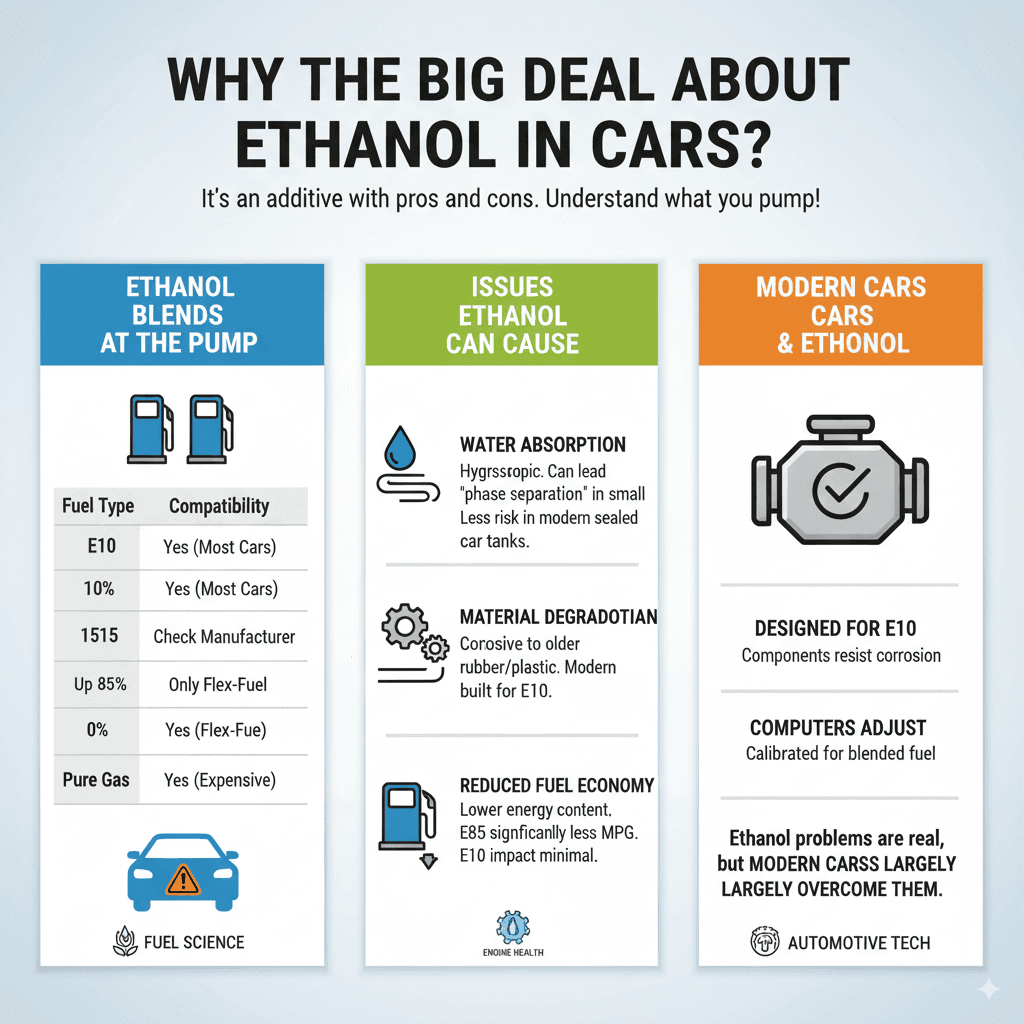
Why the Big Deal About Ethanol in Cars?
Ethanol in gasoline has been a topic of discussion for years. It’s an additive mandated in many regions to help reduce certain emissions and to support the agricultural industry. While it has its benefits, it also has drawbacks, particularly when compared to pure gasoline.
Understanding Ethanol Blends at the Pump:
Most gasoline pumps in the United States offer blends like E10 (10% ethanol) and sometimes E15 (15% ethanol). Flex-fuel vehicles (FFVs) can typically run on E85 (up to 85% ethanol). It’s important to know what your car is rated for. You can usually find this information on a sticker inside your fuel filler door or in your owner’s manual. The U.S. Department of Energy provides resources on fuel economy and different fuel types:
U.S. Department of Energy – Ethanol
| Fuel Type | Typical Percentage of Ethanol | Compatibility with Most Cars |
|---|---|---|
| E10 | 10% | Yes |
| E15 | 15% | Generally No (check manufacturer) |
| E85 | Up to 85% | Only Flex-Fuel Vehicles |
| Pure / Ethanol-Free Gasoline | 0% | Yes, but often unnecessary and expensive. |
The issues ethanol can cause, which are critical for small engines but less so for modern cars, include:
- Water Absorption: Ethanol is hygroscopic, meaning it attracts and holds water. In small engines, this water can lead to phase separation, where the ethanol and water sink to the bottom of the fuel tank, leaving the gasoline at the top. This can cause poor running or no-start conditions. Modern car fuel tanks are usually sealed, and larger volumes of fuel mitigate this risk.
- Material Degradation: Ethanol can be corrosive to certain types of rubber, plastic, and sealants used in older fuel systems. While most modern car components are designed to withstand E10, some older vehicles (pre-1990s) might have issues. TruFuel’s lack of ethanol eliminates this concern, but again, modern cars are built with ethanol compatibility in mind.
- Reduced Fuel Economy: Ethanol has lower energy content than pure gasoline. This means that vehicles running on higher ethanol blends (like E85) will generally experience lower miles per gallon compared to using regular gasoline. For E10, the impact is usually minimal and often offset by emissions benefits. Using ethanol-free fuel in a car designed for E10 won’t significantly improve MPG because the engine’s computer is calibrated for E10.
So, while the problems associated with ethanol are real, modern car designs have largely overcome them. This is why your everyday car gasoline is a blend.
When Might You Consider Using TruFuel in Your Car? (Rare Scenarios)
Let’s be clear: these are edge cases and not recommended as a regular practice. However, understanding them can help answer your question comprehensively.
1. Emergency Situations Where Only TruFuel is Available
Imagine you are stranded in a very remote area, your car is running on fumes, and the only fuel available is TruFuel. In such a dire emergency, assuming the octane rating is appropriate for your vehicle (check the can!), you would likely use it to get to safety. The priority is to move the vehicle, and the potential minor downsides of a single tank of ethanol-free fuel would be far outweighed by the need to escape danger or reach a proper fueling station.
Always check your vehicle’s manual and the TruFuel packaging for octane compatibility in such a situation. Most cars require at least 87 octane. TruFuel products often are labeled with their octane rating.
2. Restoring or Storing a Classic / Vintage Car
This is a more plausible, albeit still niche, scenario. If you are working on a classic car whose fuel system components (rubber fuel lines, seals, etc.) are known to be sensitive and are original or period-correct, you might opt for ethanol-free fuel to prevent degradation during storage or slow restoration periods. In this case, TruFuel’s ethanol-free nature is advantageous. However, for regular driving, many classic car owners opt for specialized ethanol-free gas stations that are becoming more common, or they use fuel additives designed to protect against ethanol if they must use standard gasoline.
It’s crucial to research the specific fuel system materials of your vintage vehicle. Resources like the Hagerty insurance company often have articles and forums dedicated to classic car maintenance and fuel compatibility.
3. Certain Performance or Modified Engines
Some highly modified engines, particularly those built for specific racing applications or with very sensitive tuning, might benefit from a consistent, pure fuel source without the variances that can come with ethanol blends. However, these are typically custom-blended race fuels, not off-the-shelf consumer products like TruFuel, and would have performance-oriented octane ratings.
4. A “Just In Case” Scenario for Small Engines
This isn’t about your car, but it’s often the mindset that leads to the question. If you have a can of TruFuel for your lawnmower and your car is on “E,” you might be tempted. But as we’ve established, the cost-benefit analysis quickly shows it’s not practical for your car.
How to Check Your Car’s Fuel Requirements
Before you even consider alternative fuels, you need to know what your car needs. This is fundamental to good car care.
1. Consult Your Owner’s Manual
This is your car’s bible. It will explicitly state the recommended fuel type, octane rating, and any restrictions (like ethanol content). Look for sections on refueling or fuel specifications.
2. Check the Fuel Door or Cap Sticker
Most modern vehicles have a sticker inside the fuel filler door or on the fuel cap indicating the required octane rating and often mentioning whether the vehicle is designed to run on E10, E15, or is a flex-fuel vehicle. This is a quick reference guide.
3. Understand Octane Ratings
Octane measures a fuel’s ability to resist knocking or pinging in the engine. Regular gasoline is typically 87 octane. Mid-grade is usually 89-90, and premium is 91-93 octane. Using fuel that is too low in octane for your engine can lead to knocking, reduced performance, and long-term engine damage. Using a higher octane than recommended generally provides no benefit in a car not designed for it.
Here’s a simple table to help:
| Octane Rating | Common Use | When to Use |
|---|---|---|
| 87 | Regular Unleaded | Most standard cars, SUVs, and minivans. |
| 89-90 | Mid-Grade Unleaded | Cars recommending it, or as an option for some vehicles that might benefit from slightly higher octane. |
| 91-93 | Premium Unleaded | High-performance cars, turbocharged engines, or vehicles that specifically recommend premium fuel to avoid knocking. |
For TruFuel, ensure the product you’re looking at meets or exceeds your car’s minimum octane requirement if you were to consider it in a rare situation. However, again, it’s designed for smaller, less demanding engines.
Potential (Minor) Downsides if You Did Use TruFuel Regularly
While not catastrophic, here are some things you’d likely encounter if you made TruFuel a habit for your car:
- Higher Fuel Costs: As mentioned, this is the most obvious downside. A full tank could cost $30-$50 more than comparable gasoline.
- Potential for Knocking (if low octane): If you’re using a TruFuel product with an octane rating lower than what your car requires (e.g., using

Hi, I’m Melvin, an automobile engineer with extensive experience in automobile equipment. I currently work for a local automobile firm, where I specialize in the car parts industry. I’ve had the opportunity to collaborate with seasoned inspectors, gaining invaluable hands-on experience that goes beyond just theory.
My passion for automotive care started at a young age, which led me to create CarSpareCare. Through CarSpareCare, I share the knowledge and skills I’ve acquired over the years to help others navigate the world of car maintenance and repairs.
My goal is to provide practical tutorials, essential safety advice, and the latest industry insights so that anyone—whether a beginner or an expert—can confidently tackle their automotive projects.

