

For hot-weather car maintenance, check coolant level, oil, tires, battery, and A/C before the first real heat wave. Pull over at once if the temperature gauge hits red, steam appears, or coolant leaks. Skipping these checks can turn a weak hose or fan into overheating, tire blowouts, dead batteries, and repair bills that climb fast on commute or trip days. This guide lists what to inspect, what to ignore, and when a symptom is an emergency for summer driving, towing, and stop-and-go traffic.
Why hot weather changes car maintenance
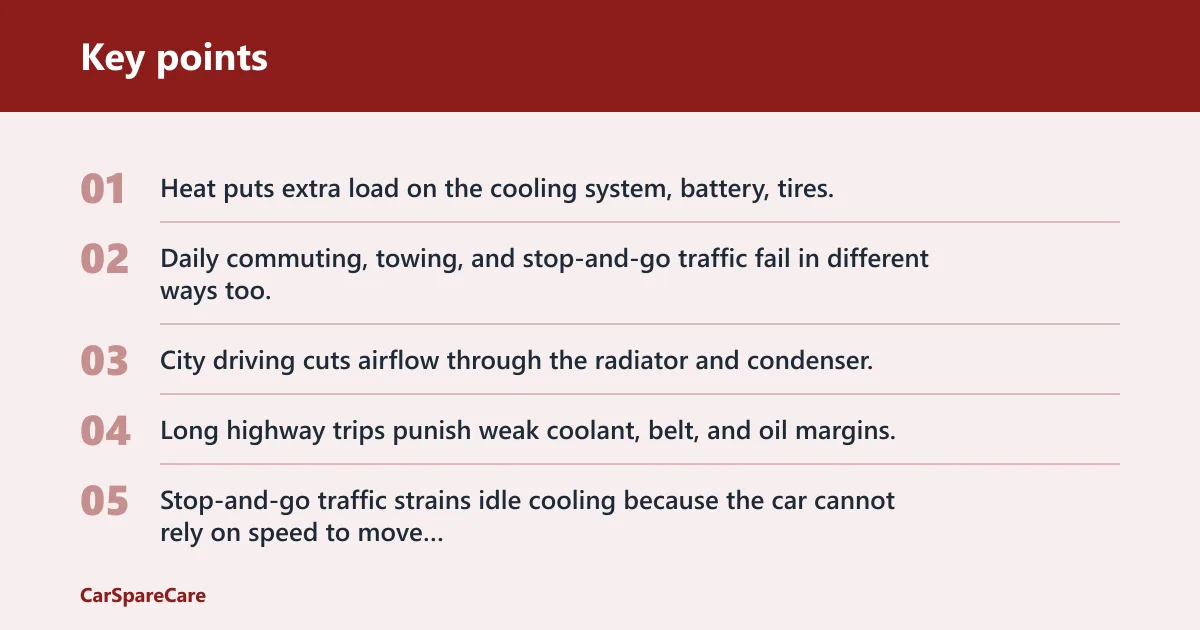
Heat puts extra load on the cooling system, battery, tires, and cabin comfort system at the same time. Daily commuting, towing, and stop-and-go traffic fail in different ways too. City driving cuts airflow through the radiator and condenser. Towing adds load. Long highway trips punish weak coolant, belt, and oil margins.
Why commuting, towing, and stop-and-go traffic raise risk differently
Stop-and-go traffic strains idle cooling because the car cannot rely on speed to move air through the radiator. Towing adds heat from the engine and transmission. Commuting often means short trips, so worn parts have less time to show symptoms before a hotter afternoon makes them worse.
What should you check before summer driving?

Start with coolant, oil, tires, battery, and the spare. Check them before the first real heat wave, not after the gauge climbs. If you do only one pass, make it a cold-engine fluid check, a tire-pressure check before driving, and a quick look for corrosion, cracks, and leaks.
Coolant and antifreeze
Check coolant only when the engine is cold. Most vehicles use an overflow reservoir that you can inspect without opening the radiator cap. The level should sit between the min and max marks. Use the mix ratio in the owner’s manual; many systems call for a 50/50 mix of antifreeze and water. Low coolant, crusty residue, a sweet smell, or damp hose ends point to a leak.
Engine oil
Park on level ground, switch off the engine, and wait a few minutes so oil drains back to the pan. Pull the dipstick, wipe it, reinsert it fully, then read the level again. Keep it between the min and max marks. In heat, the correct viscosity matters because too-thin oil can thin further and too-old oil can oxidize and darken faster.
Battery and terminals
Heat speeds battery aging even if winter gets more blame. Open the hood and look for white or green corrosion on the terminals, loose clamps, or a swollen case. Slow cranking, dim lights at idle, and repeated jump-start needs are common signs that a load test is due. Age matters too; many batteries last for a few years, depending on climate and use.
Tires and spare
Check tire pressure when the tires are cold, before you drive. Heat raises PSI after the car is in motion, so a tire that looks slightly high after a highway run may still have started at the right cold pressure. Inspect tread depth, sidewall cuts, bubbles, and uneven wear. Do not forget the spare; a flat spare is not a spare.
- Check the coolant reservoir when the engine is cold.
- Read the oil level on level ground with the dipstick.
- Measure tire pressure before driving and compare it to the door-jamb placard.
- Inspect the battery terminals for corrosion and looseness.
- Confirm the spare tire has air and the jack tools are present.

How do you keep a car cool in hot weather?
Use shade, cut interior heat buildup, and keep cabin airflow moving. A sunshade lowers dashboard and steering-wheel temperatures. Parking under cover helps more than cracking a window. Clean airflow matters too; a clogged cabin air filter can make the A/C feel weak even when the compressor is working normally.
Sunshades, parking shade, and interior temperature control
A reflective sunshade can reduce dashboard and seat heat, which helps protect plastics and upholstery from drying and fading. Park in shade when possible, especially for long stops. Window tint rules depend on jurisdiction, so check local limits before adding film. Keep in mind that legal tint still needs to meet visibility rules.
Cabin air filter and vent airflow
A restricted cabin air filter can cut vent flow and make the system seem underpowered. In dusty summer conditions, replacement may be due sooner than the usual interval suggests. Weak airflow from the vents, musty odor, or a blower that seems loud but ineffective can point to a filter issue rather than a refrigerant problem.
Picture a sedan parked in full sun for two hours at 95°F. A sunshade and shade parking can reduce the initial cabin heat load, but a clogged cabin filter can still leave the driver feeling hot because the vents cannot move enough air across the evaporator.
How do you spot cooling problems before they become an emergency?
Watch for temperature spikes, weak idle cooling, and airflow blockage around the radiator and condenser. A fan that fails at idle can hide a problem until traffic slows. Steam, a rising gauge, coolant smell, or a sudden “hot” warning means the problem has moved past routine monitoring.
Radiator and cooling fan checks at idle and low speed
With the engine warm and the A/C on, the cooling fans should cycle as needed. If the car runs fine at road speed but overheats in traffic, fan operation deserves attention. Debris between the condenser and radiator can block airflow. Leaves, bugs, and road grit matter more in summer.
Overheating warning signs that mean stop driving
Pull over immediately if the temperature gauge enters the red, steam appears, or you see coolant spraying or pooling. A warning light plus loss of power or a sweet smell from under the hood is not a “keep going” signal. Shut the engine off and let it cool before checking anything.
What do A/C problems and engine overheating tell you?
Weak cabin cooling can come from simple airflow restriction, low refrigerant, or a compressor fault. Engine overheating is different and more urgent. If the car cools poorly at idle but better on the highway, think airflow, fans, condenser blockage, or a weak belt drive before assuming the refrigerant charge is the only issue.
Refrigerant leak symptoms
Warm air that never turns cold, especially after a period of normal cooling, can point to low refrigerant from a leak. Oily residue around A/C fittings, hissing after shutdown, or a compressor that cycles rapidly may fit that picture. Low refrigerant is not something to ignore, because repeated loss can damage the system.
Compressor and condenser basics
The compressor moves refrigerant through the system, and the condenser rejects heat at the front of the car. If condenser fins are bent or packed with debris, the system cannot shed heat well. That is why idle cooling can drop in traffic even when the A/C seems acceptable at speed.
How should you inspect belts and other heat-sensitive parts?
Look at the serpentine belt for cracks, glazing, frayed edges, and squeal. Heat speeds rubber wear. On some vehicles, that belt drives the water pump or alternator, so a belt problem can become a charging or cooling problem quickly. Older cars and turbocharged engines carry more heat stress and deserve closer checks.
Serpentine belt cracks, glazing, and squeal
A glazed belt can look shiny. Cracks across the ribs, missing chunks, or chirping at start-up are warning signs. If the belt slips, the alternator may not charge well and the water pump may not move coolant properly on some layouts. Replace worn belts before a summer trip, not after a roadside stop.
Older cars, turbocharged engines, and higher-heat stress
Older cooling hoses, brittle seals, and tired radiators have less reserve when ambient temperatures climb. Turbocharged engines run hotter by design, so neglecting coolant or oil quality is a mistake. Heat is less forgiving when the system already works near its limit.
Should you wash a car in hot weather?
Yes, but timing matters. Hot panels dry soap and rinse water too fast, which can leave water spots and streaks. Wash early in the morning, in shade, or after the car cools down. Avoid letting soap dry on paint, trim, glass, or black plastic. That is where spotting and residue show first.
Water spotting and soap drying risks
Minerals in hard water can leave spots when rinse water flashes off in heat. Soap residue can also dry on clear coat and trim before you can rinse it away. A common first-timer mistake is washing in full sun at midday, then chasing dried streaks with a dry towel and scratching the finish.
Paint and trim care after washing
Use clean towels, rinse one section at a time, and dry promptly. If the surface is hot, rinse it first to cool the panel. Avoid aggressive scrubbing on black trim because heat makes it look dull faster. Finish by checking rubber seals and plastic trims for residue.
Hot weather readiness matrix
This matrix gives a practical triage guide. It separates monitorable issues from stop-driving symptoms and helps you decide whether the fix is basic driveway work or a mechanic-level repair. When in doubt, treat overheating, steam, and coolant loss as urgent.
| Symptom | Likely cause | Immediate action | Safe-to-drive status | DIY or mechanic-level fix |
|---|---|---|---|---|
| Coolant level low in reservoir | Leak, evaporation from failed cap, or overdue service | Top up only with correct mix after engine cools; inspect hoses and reservoir | Short, careful drive only if level returns to normal and no leak is active | DIY inspection; mechanic if leak source is unclear |
| Temperature gauge climbs in traffic, then falls at speed | Weak fan, blocked condenser fins, or airflow restriction | Turn off A/C, turn heater on full, and move out of traffic if possible | Not ideal for continued driving; get help soon | Mechanic-level if fan or blockage repair is needed |
| Steam from hood | Boil-over, hose failure, or serious coolant loss | Stop immediately and shut the engine off | Unsafe to drive | Mechanic-level |
| Battery cranks slowly in heat | Battery aging or terminal corrosion | Clean terminals if accessible; arrange a load test | May start today, but failure risk is rising | DIY cleaning; replacement may be mechanic- or parts-store-level |
| A/C blows weakly at idle but better on the road | Condenser airflow issue, weak fan, or restricted cabin filter | Check cabin filter and front-end blockage | Usually safe to drive if engine temperature stays normal | DIY filter and debris check; mechanic if refrigerant or fan fault suspected |
| Tire looks low after sitting in heat | Underinflation, puncture, or temperature-related PSI change | Measure cold pressure and inspect for damage | Drive only after correcting pressure and confirming no puncture | DIY if it is a simple inflation issue; mechanic or tire shop for damage |
How do you prepare your car for hot weather?
Check fluids, tires, battery condition, belt wear, and cooling airflow before the hottest weeks arrive. Confirm coolant level only when cold, keep the oil at the proper mark, and make sure the spare is ready. If the car is older, turbocharged, or used for towing, shorten the inspection interval.
How do you protect your car in hot weather?
Protect the cooling system, battery, tires, and interior materials. Use the right coolant mix, maintain proper tire pressure, and inspect the belt before long trips. Sun protection accessories reduce cabin heat and limit UV wear on dashboards, seats, and trim.
Does hot weather affect car performance?
Yes. Heat can reduce cooling reserve, raise intake temperatures, increase battery aging, and make weak A/C or fans more noticeable. Turbocharged engines and heavily loaded vehicles feel it sooner because they start with less thermal margin. If performance drops with rising temperature, that is a clue, not a coincidence.
Why do cars overheat in hot weather?
Cars overheat in hot weather when the cooling system loses reserve. Common causes include low coolant, a failing fan, blocked condenser fins, a worn belt, or a leak that worsens under heat and traffic load. Stop-and-go driving makes the problem show up faster because airflow drops at idle.
Does hot weather affect car engines?
Yes. High ambient temperature raises cooling demand and can expose weak hoses, tired coolant, and oil that is near the end of its useful life. Engines with turbochargers or old cooling parts are more vulnerable. If the gauge moves higher than normal, treat it as a warning.
Is it normal for my car to overheat in hot weather?
No. A healthy cooling system should handle hot weather without entering the red. A small rise in gauge position can happen under heavy load, but steam, warning lights, or repeated overheating are not normal. That usually means a fault in airflow, coolant, belt drive, or a leak.

Hi, I’m Melvin, an automobile engineer with extensive experience in automobile equipment. I currently work for a local automobile firm, where I specialize in the car parts industry. I’ve had the opportunity to collaborate with seasoned inspectors, gaining invaluable hands-on experience that goes beyond just theory.
My passion for automotive care started at a young age, which led me to create CarSpareCare. Through CarSpareCare, I share the knowledge and skills I’ve acquired over the years to help others navigate the world of car maintenance and repairs.
My goal is to provide practical tutorials, essential safety advice, and the latest industry insights so that anyone—whether a beginner or an expert—can confidently tackle their automotive projects.

