

Signs your car battery is failing before winter include slow cranking, dim lights, repeated jump-starts, a swollen case, or battery age over 3 to 5 years. Test it before the first freeze, and replace it if it fails. Ignore those signs and you risk a no-start morning, extra tow costs, and a charging-system fault hiding behind the battery. This guide shows the early warning signs, the best winter diagnosis order, and how to decide between testing, replacement, or a charging-system inspection.
Why cold weather exposes weak batteries
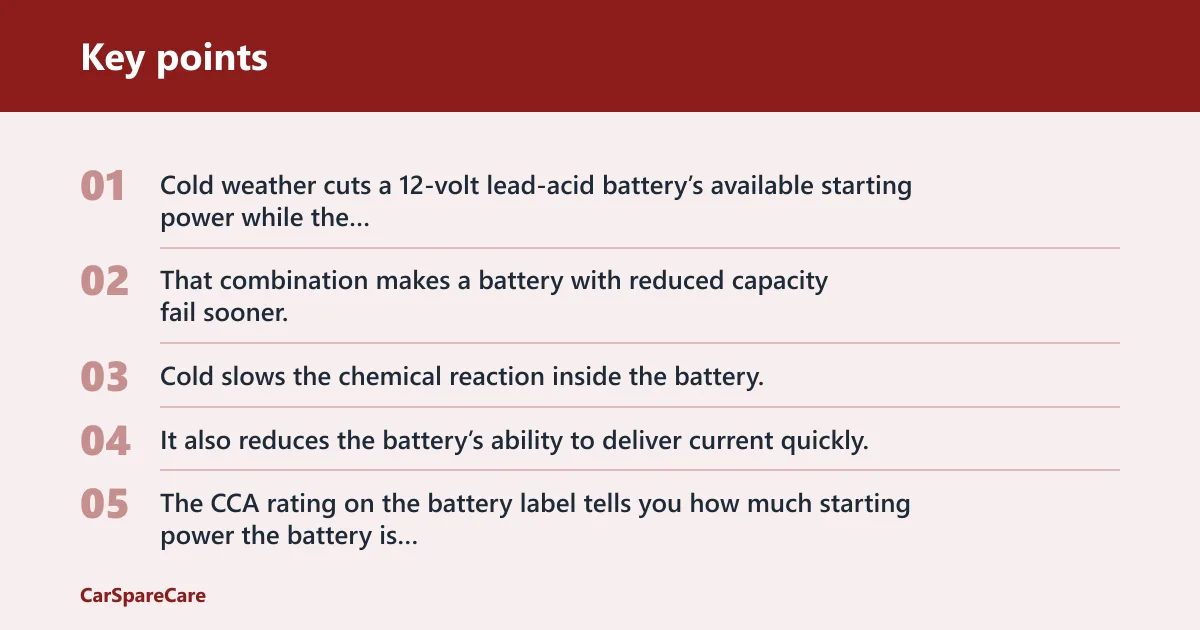


Cold weather cuts a 12-volt lead-acid battery’s available starting power while the engine oil thickens and the starter needs more effort. That combination makes a battery with reduced capacity fail sooner, even if it still seemed fine in mild weather.
What cold does to cranking power
Cold slows the chemical reaction inside the battery. It also reduces the battery’s ability to deliver current quickly, which is why cold cranking amps, or CCA, matters more in winter than in summer. The CCA rating on the battery label tells you how much starting power the battery is designed to provide in cold conditions.
Why older batteries fail first
Battery age matters because capacity and cranking ability decline over time, even without obvious warning. A common replacement window is about 3 to 5 years, and the risk tends to rise as temperatures fall. A battery that is merely “okay” in autumn can become weak enough to fail after the first hard freeze.
How short trips make the problem show up sooner
Short trips do not give the alternator much time to recharge the battery after startup. Repeated short drives, long parking periods, and heavy accessory use can leave the battery partially charged. That is especially hard on a battery that is already aging or has been jump-started recently.
What are the first signs my car battery is failing?
The earliest signs are usually slow cranking, clicking, dim lights, repeated jump-start dependence, or an intermittent no-start after sitting. Those symptoms matter more if they show up on cold mornings or after the car has been parked overnight, because that points to reduced reserve power.
Slow cranking on cold starts
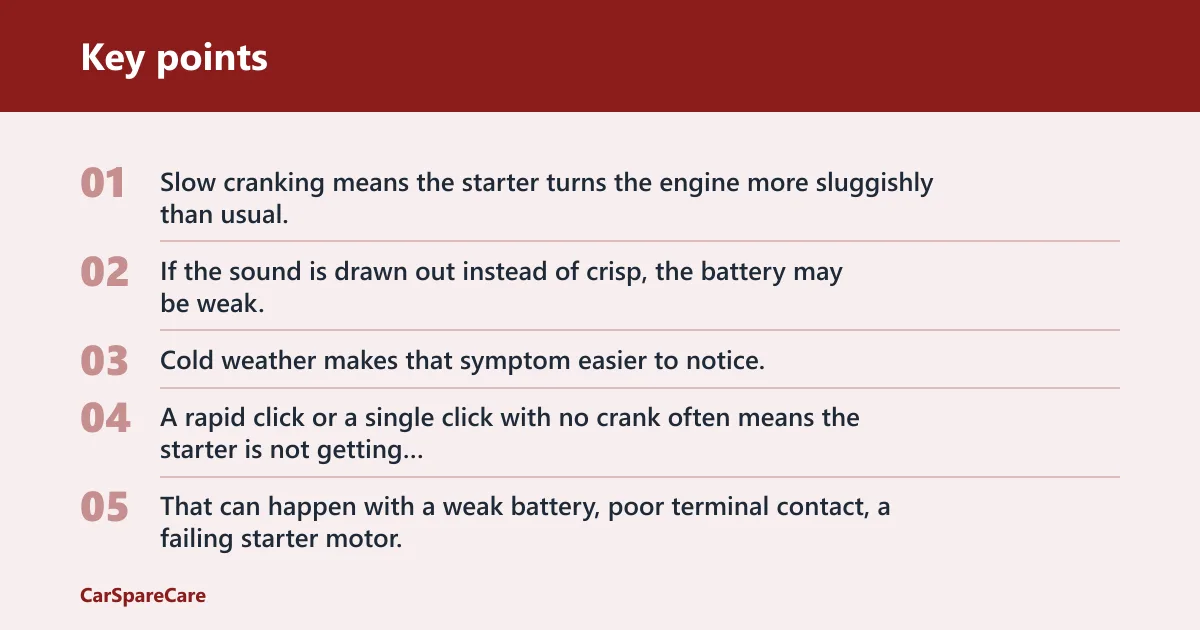
Slow cranking means the starter turns the engine more sluggishly than usual. If the sound is drawn out instead of crisp, the battery may be weak, the terminals may be resisting current, or the starter may be drawing more power than it should. Cold weather makes that symptom easier to notice.
Clicking instead of normal engine turnover
A rapid click or a single click with no crank often means the starter is not getting enough current. That can happen with a weak battery, poor terminal contact, a failing starter motor, or a bad connection in the cables. A click alone does not prove the battery is bad.
Dim lights and intermittent electrical behavior
Headlights that dim during cranking, interior lights that sag, or accessories that flicker can point to low battery output. If the lights seem normal with the engine off but collapse when you try to start, the battery or the cables are prime suspects. If the lights brighten once the engine runs, the alternator may be involved.
Repeated jump-starts or a no-start after sitting
A battery that needs frequent jump-starts is already showing a high failure risk. If the car starts after a jump but goes weak again after sitting overnight, that can mean the battery cannot hold charge, the alternator is not restoring it, or parasitic drain is flattening it while the car is off.
Say your sedan starts after a jump in the afternoon, then struggles again the next cold morning after sitting for 10 hours. That pattern points more toward a weak battery, a charging issue, or a drain than toward a random one-time fluke.
Battery age and winter risk
Age is one of the clearest replacement clues before winter. Once a battery reaches 3 to 5 years, its failure risk rises sharply in cold weather, even if the car still starts on most days. If the battery has also needed recent jump-starts, treat it as a near-term replacement candidate.
When age is enough reason to replace now
If the battery is over 3 years old and already shows slow cranking, repeated jump-starts, or dimming lights, replacing it before the first freeze is often recommended. That is especially true for vehicles that park outside, see short trips, or carry high electrical loads such as heated seats, defrosters, and infotainment systems.
How recent jump-start history changes the decision
One jump-start after leaving the dome light on is not the same as a battery that needs help every few weeks. Frequent jump-starts mean the battery may be near the end of its life, the charging system may be weak, or the car may have a parasitic drain. In winter, that history raises the urgency.
Battery terminals checklist
Before replacing parts, inspect the battery terminals. Corrosion, loose clamps, or a poor cable fit can cause slow cranking and intermittent no-starts that look like battery failure. Clean, tight connections matter because a battery cannot deliver full current through a bad contact.
Check for corrosion on both posts
Look at the positive and negative posts for white, blue, or green buildup. Corrosion increases resistance and can block current flow during starting. If the buildup is heavy, clean it safely and recheck the starting behavior before buying a battery.
Look for loose or damaged connections
Try to move each terminal clamp by hand with the engine off. It should not wobble. A loose clamp can cause a no-start, flickering electrical power, or a sudden cut in cranking. Inspect the cable ends too; damaged strands or swollen cable ends can create the same symptoms.
Confirm cable fit before replacing parts
A battery may be blamed when the real issue is a loose terminal nut or a cable that does not seat properly on the post. Tight, clean, secure connections are a basic winter check. If the connections are solid and the symptoms persist, move on to testing.
What voltage means a weak battery?
With the engine off, open-circuit voltage can estimate state of charge, but it does not prove the battery’s health. A fully charged 12-volt battery often reads about 12.6 volts or a little higher after resting. Around 12.2 volts is partially discharged, and about 12.0 volts is weak.
How to read open-circuit voltage with a multimeter
Let the car sit with the engine off so surface charge settles, then measure across the battery posts with a multimeter. Use the resting reading as a quick check of charge level. That number helps, but it is only one piece of the diagnosis because a battery can read acceptable voltage and still fail under load.
Why voltage alone can miss a failing battery
A battery with decent open-circuit voltage may still collapse during cranking if its internal capacity is weak. That is why a battery load test is more useful than voltage alone. A load test checks whether the battery can deliver power under demand, which is the real winter question.
When low voltage points to discharge, not failure
If the voltage is low after the car has sat, the battery may simply be discharged. That can happen after short trips, long storage, or a light left on overnight. If a recharge restores normal behavior and the battery passes a load test, the problem may be use pattern rather than battery failure.
Winter battery checklist
This checklist helps you choose the next step before the first freeze. Use the symptoms, age, and usage pattern together. One weak clue can justify testing, but multiple clues can justify replacement or a charging-system inspection.
| Check point | What you see | What it suggests | Next action |
|---|---|---|---|
| Symptom severity | Slow crank, click, dim lights, or no-start | Possible weak battery, starter, or charging issue | Test now |
| Battery age | 3 to 5 years or older | Higher winter failure risk | Test now; replace if symptoms are present |
| Recent jump-start history | More than one jump in recent weeks | Battery, alternator, or drain concern | Inspect charging system |
| Short-trip use | Mostly short drives or long parked periods | Possible undercharge | Test now |
| Visible terminal corrosion | White, blue, or green buildup; loose clamp | Poor contact may mimic battery failure | Clean and retest |
| Battery warning light | Light stays on or comes and goes | Charging-system fault possible | Inspect charging system |
Decision tree: test now, replace now, or inspect the charging system
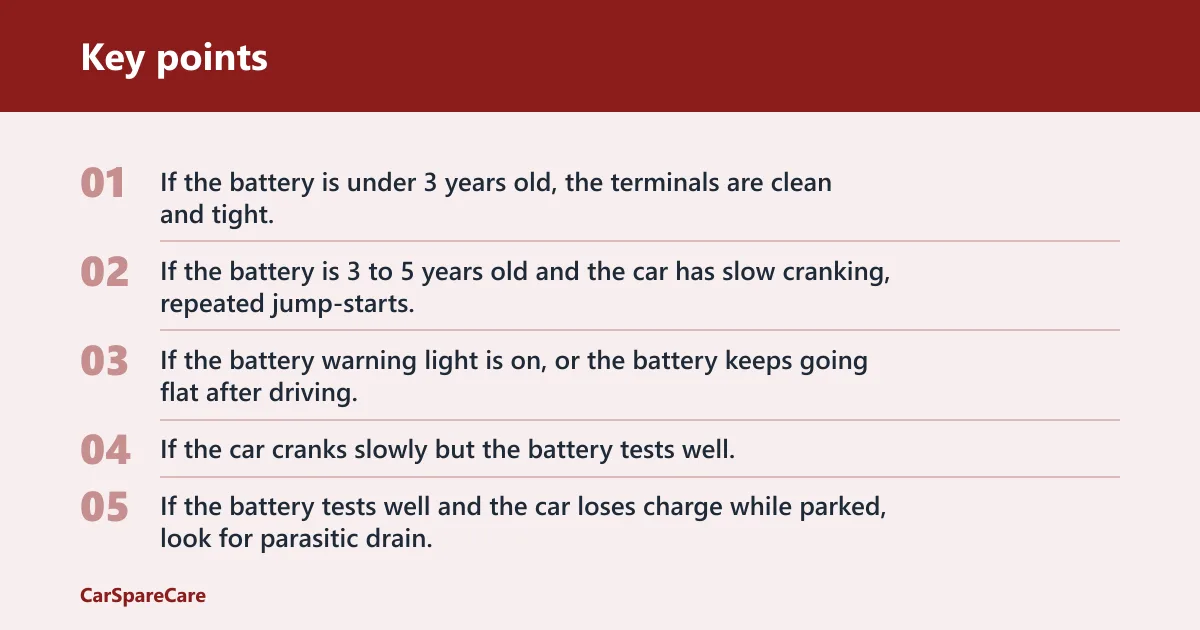
- If the battery is under 3 years old, the terminals are clean and tight, and the car only started poorly once, test now.
- If the battery is 3 to 5 years old and the car has slow cranking, repeated jump-starts, or an overnight no-start, replace now.
- If the battery warning light is on, or the battery keeps going flat after driving, inspect the charging system.
- If the car cranks slowly but the battery tests well, check the starter motor and cable connections next.
- If the battery tests well and the car loses charge while parked, look for parasitic drain.
Picture a hatchback with a 4-year-old battery, short commutes, and visible corrosion on the negative terminal. If the owner cleans the post and the car still cranks slowly at 20°F, the checklist points to testing immediately, not waiting for a roadside failure.
Is it the battery or alternator?
A failing alternator can imitate a bad battery because it does not keep the battery charged while the engine runs. If the battery warning light is on, the battery goes flat again after driving, or multiple electrical systems act weak with the engine running, the charging system needs attention.
What the battery warning light can mean
The battery warning light usually points to a charging-system problem, not just the battery itself. It can indicate alternator failure, a belt issue, wiring trouble, or another electrical fault. If that light appears, do not assume a new battery will solve it without further diagnosis.
How an alternator fault imitates battery failure
A weak alternator may let the battery discharge while driving. Then the car may start badly the next day, click on startup, or need a jump-start even though the battery is not the root cause. That is why a charging-system test matters after a battery replacement if symptoms continue.
When starter motor or parasitic drain is the better suspect
If the battery has power but the engine gives a single click or a hard no-crank, the starter motor or its circuit may be the issue. If the battery drains while the car sits, parasitic drain is more likely. Accessories, control modules, interior lights, and aftermarket electronics can all pull power when the vehicle should be asleep.
Frequently asked questions
How long do car batteries usually last?
A common replacement window is 3 to 5 years, though climate, driving pattern, and electrical load can shorten that. Cold weather makes age matter more because a battery with reduced reserve can fail on a morning that would have been manageable in mild temperatures.
Can a battery be bad even if the car still starts?
Yes. A battery can still start the car and still be weak enough to fail on the next cold morning. Slow cranking, repeated jump-starts, or a low open-circuit voltage are warning signs that should not be ignored just because the car still runs today.
Can short trips drain a car battery?
Yes. Short trips can leave the battery partly charged because the alternator has limited time to recover the energy used to start the engine. Repeated short drives, especially in winter or with heated accessories running, can leave a weak battery unable to recover fully.
What should I check before winter to avoid a dead battery?
Check battery age, terminal corrosion, terminal tightness, open-circuit voltage, and any recent jump-start history. If the battery is 3 to 5 years old or the car has slow cranking, a battery load test is the better next step before the first hard freeze.
Should I replace my battery before winter if it’s over 3 years old?
Not automatically, but a battery over 3 years old deserves closer attention before winter. If it also shows slow cranking, frequent jump-starts, short-trip use, or low voltage, replacement is often the safer choice than waiting for a cold-morning failure.
Why does my car battery struggle more in cold weather?
Cold slows battery chemistry and increases the effort needed to crank the engine. Oil thickens, starter demand rises, and a battery with reduced capacity loses more of its usable power. That is why a battery that seems fine in autumn can fail after the first freeze.

Hi, I’m Melvin, an automobile engineer with extensive experience in automobile equipment. I currently work for a local automobile firm, where I specialize in the car parts industry. I’ve had the opportunity to collaborate with seasoned inspectors, gaining invaluable hands-on experience that goes beyond just theory.
My passion for automotive care started at a young age, which led me to create CarSpareCare. Through CarSpareCare, I share the knowledge and skills I’ve acquired over the years to help others navigate the world of car maintenance and repairs.
My goal is to provide practical tutorials, essential safety advice, and the latest industry insights so that anyone—whether a beginner or an expert—can confidently tackle their automotive projects.

