

If you notice two or more of the same-corner symptoms, bouncing after a dip, nose dive, fluid leakage, cupping wear, or clunking, suspect worn shocks or struts and inspect that corner first. Worn dampers can stretch stopping distances, shorten tire life, and make handling less settled on rough roads. This guide matches each symptom to the likely corner, how urgent it is, and the next step.
What worn shocks and struts feel like
Healthy dampers keep the body of the car from bobbing after the wheels hit a bump. When they wear out, the vehicle keeps moving after the road input is gone. That change shows up most over potholes, railroad crossings, and speed bumps.
A healthy damper usually settles wheel movement within one to two oscillations. If the body keeps bouncing, leans harder in turns, or feels floaty over broken pavement, the suspension is no longer controlling spring motion well enough.
How damping works in plain terms
Shocks control spring oscillation and damp rebound only. Struts do that job too, but they also act as a structural part of the suspension and affect steering geometry. That difference matters when you are trying to decide which corner to inspect first and what extra work may follow.
Front struts often influence steering feel and braking dive more directly. Rear shocks are often easier to inspect on many cars, trucks, and SUVs because the body of the shock is visible without a full suspension teardown.
What is the difference between shocks and struts?
Shocks and struts both calm suspension movement, but they are not the same part. A shock absorber is a separate damper. A strut assembly combines damping with structural support, so wear there can change ride control and steering geometry at the same time.
Where you usually find each part
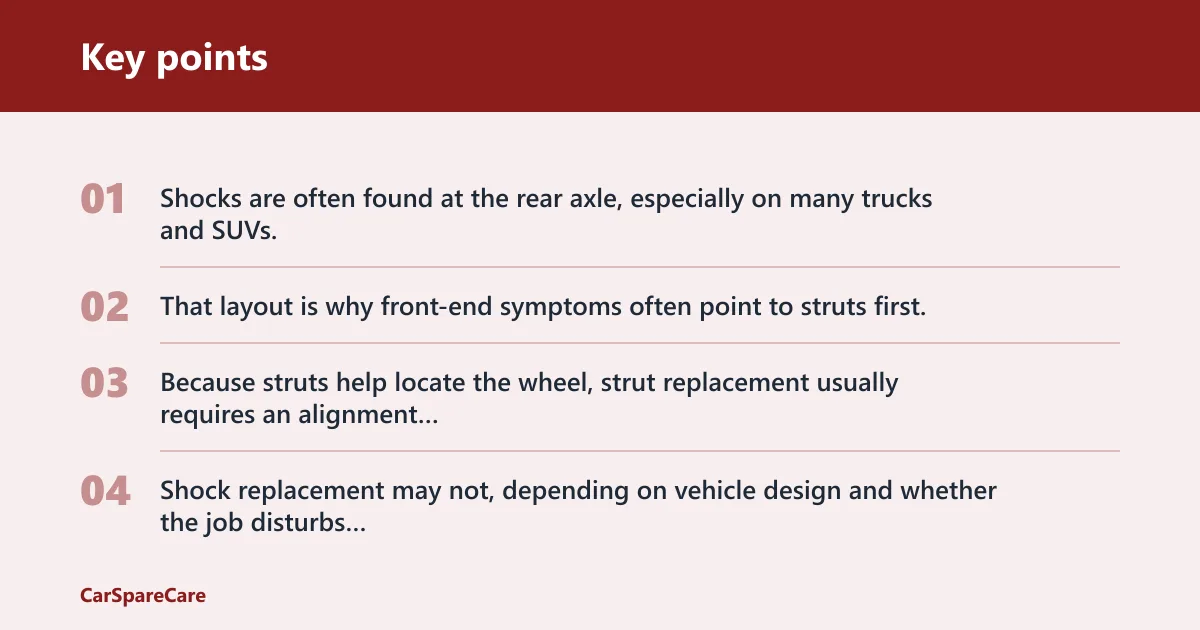
Shocks are often found at the rear axle, especially on many trucks and SUVs, though some cars use them at all four corners. Struts are commonly found on the front axle. That layout is why front-end symptoms often point to struts first, while rear-end bounce often points to shocks.
Because struts help locate the wheel, strut replacement usually requires an alignment afterward. Shock replacement may not, depending on vehicle design and whether the job disturbs alignment settings.
Which symptoms point to front or rear wear?
The most useful first step is to connect the symptom to the corner that shows it. Front symptoms tend to show up in braking, steering, and turn-in. Rear symptoms tend to show up as body bounce, hop, or a rear end that keeps moving after a bump. If both ends feel loose, both axles may be worn.
Front strut symptoms
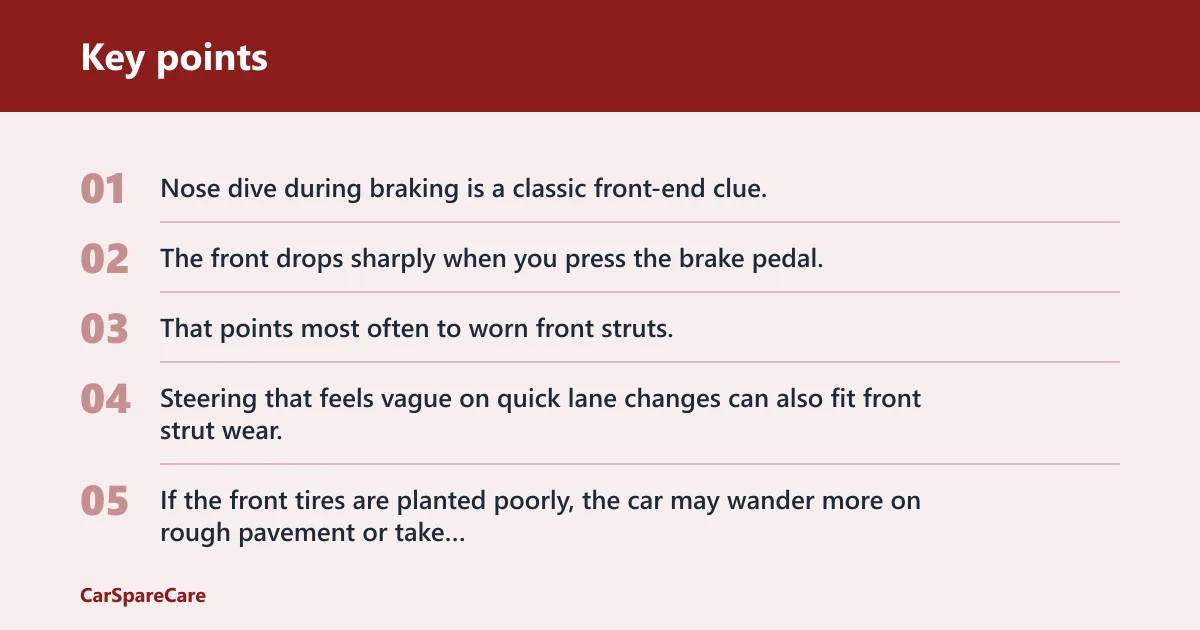
Nose dive during braking is a classic front-end clue. The front drops sharply when you press the brake pedal, and the car may take longer to settle after a stop. That points most often to worn front struts, though front shocks on some vehicles can contribute too.
Steering that feels vague on quick lane changes can also fit front strut wear. If the front tires are planted poorly, the car may wander more on rough pavement or take a beat longer to recover after hitting a bump mid-turn.
Rear shock symptoms
Rear bounce after a bump usually points to rear shocks. If the back of the vehicle keeps moving after a pothole or railroad crossing, the damper on that axle may no longer be controlling rebound well. This is common on vehicles where the shocks are easy to see from the rear wheel well or underbody.
A rear-end that feels loose on washboard pavement can also fit worn rear shocks. The symptom may be more obvious with cargo in the back or when towing, because extra load exposes weak damping faster.
When both axles may be worn
If the car feels floaty at highway speed, bobs several times after a dip, and shows wear on more than one tire, both axles may be aging at the same pace. Many sources place typical service life between 50,000 and 100,000 miles, and inspection is commonly done around 50,000 miles. Rough roads, heavy loads, and frequent potholes can shorten that range.
Say your compact SUV has 78,000 miles, the front dives under braking, and the rear keeps bouncing after speed bumps. That mix suggests wear at both ends rather than a single bad corner, so a full suspension inspection is the safer next step.
Shock symptom table
| Symptom | Most likely worn part/location | Quick at-home check | Recommended next step |
|---|---|---|---|
| Bounces after potholes, railroad crossings, or speed bumps | Rear shock or front strut on the corner that keeps moving | Push down firmly on that corner and watch the rebound | Book service soon if it takes 3 or more bounces; monitor only if it settles in 1 to 2 |
| Front end dips sharply when braking | Front struts first; front shocks on some vehicles | Notice whether the nose drops more than usual during normal stops | Book service soon; replace now if braking feel is unstable or wet-road stopping feels longer |
| Scalloped or wavy tread wear | Both-axle wear is possible; alignment or tire issues can mimic it | Run a hand across the tread and look for alternating high and low spots | Inspect tires, alignment, and suspension together; do not assume the damper is the only fault |
| Visible fluid on the damper body | Failed seal in a shock or strut | Look for hydraulic seepage on the exterior body or dust tube | Replace now if the leak is active; leakage is a strong sign the part has failed |
| Clunks or knocks over bumps | Often bushings, mounts, sway bar links, or other suspension parts | Check whether the noise happens only on one side or during steering changes | Inspect mounts and bushings before ordering dampers; a clunk is not always a bad shock or strut |
| Car keeps bobbing after a dip and feels floaty | Both shocks and struts may be weak | Try the bounce test at each corner | Book service soon, and faster if braking feel or wet-road control has changed |
How do you test shocks and struts at home?
The bounce test is the common home check for worn shocks and struts. Push down firmly on each corner, release, and watch how many times the body moves back and forth. One to two bounces is generally normal. Three or more suggests worn damping.
That test is useful, but it is not definitive. It can miss early wear, and it can be skewed by vehicle weight, spring rate, or tire pressure. Use it as a quick screen, not a final diagnosis.
Visual checks for leaks and damage
Look at the shock or strut body for fluid on the outside. A leak points to seal failure. GEICO lists leaking fluid on the exterior as a warning sign, and that is one of the clearest visual clues you can get without removing parts.
Also inspect the mounts, top plates, and surrounding bushings for torn rubber, rust, or metal-to-metal contact. If the damper is dry but the mount is damaged, the noise may come from the mount rather than the shock or strut itself.
Simple clues from braking and cornering feel
Notice whether the car nose-dives under braking, leans more in turns, or feels slow to recover after a bump. The same source lists excessive bouncing and nose-diving as warning signs. Worn shocks and struts can also increase stopping distance on wet or slippery roads, so a change in brake feel matters even if the pads are fine.
Picture a midsize sedan that feels normal in town but bounces twice too many after each speed bump. If the same car also dips hard when braking for a traffic light, the front dampers deserve priority over the rear.
Can worn shocks cause uneven tire wear?
Yes. Uneven or cupped tire wear can point to suspension bounce, because the tire is not staying planted on the road surface. The same source lists uneven tire wear as a warning sign. The pattern often looks scalloped or wavy across the tread.
That said, cupping is not proof of bad shocks or struts. Alignment faults, worn tire pressure habits, and loose suspension parts can create similar wear. Check the tires, the alignment, and the suspension together before deciding which part failed.
How to tell tire wear from other problems
If only one tire is cupped and the others look normal, a localized problem such as a bad tire, a bent part, or a worn bushing may be more likely than a full axle of failed dampers. If both front tires or both rear tires show the same pattern, the axle and alignment deserve closer attention.
A common first-timer mistake is blaming every noisy, uneven tire for shocks alone. If the tread is feathered on one edge, alignment is often part of the story. If the tread has repeated dips and highs across the width, poor damping becomes more likely.
When should you replace them?
Use urgency, not mileage alone, to decide. If the car still settles in 1 to 2 bounces, there is no leak, and the handling change is mild, you can usually monitor it. If the car bounces 3 or more times, leaks fluid, or dives hard when braking, book service soon. If the leak is active or the handling feels unstable in traffic or wet weather, replace now.
Drive now, book soon, or replace now
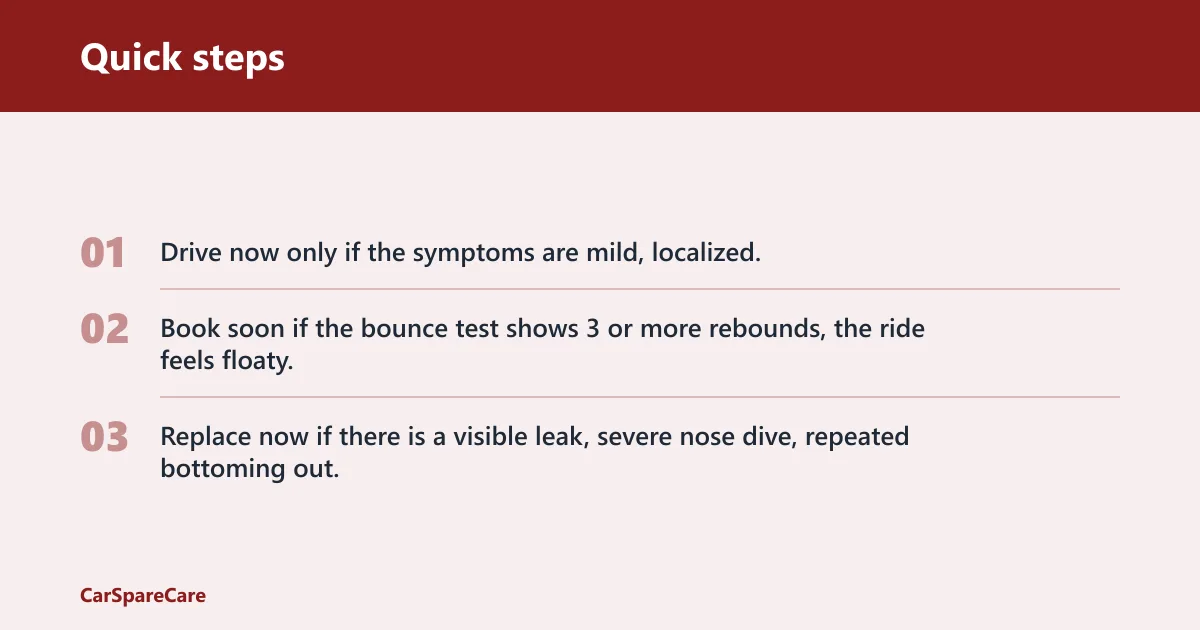
- Drive now only if the symptoms are mild, localized, and the car settles normally after a bump.
- Book soon if the bounce test shows 3 or more rebounds, the ride feels floaty, or tire wear is starting to look uneven.
- Replace now if there is a visible leak, severe nose dive, repeated bottoming out, or a handling change that affects wet-road control.
Worn dampers can lengthen stopping distance on wet or slippery roads, so delay can turn into a safety problem fast. ADAS systems also work best when the car tracks predictably, so suspension wear can make lane keeping and emergency braking less consistent.
Why pair replacement matters
Shocks and struts are commonly replaced in pairs on the same axle. Replacing both fronts or both rears helps keep damping balanced side to side and reduces odd handling after the repair. The labor and parts cost differ by setup, but the axle pair rule is the same.
Strut replacement usually needs an alignment afterward because the strut affects steering geometry. Shock replacement may not require one, but many shops still check alignment if the suspension was disturbed or tire wear is already uneven.
What else may need replacement
Plan for related parts if the vehicle has high mileage or visible wear around the top mount. Mounts, bump stops, dust boots, and worn bushings can add noise or shorten the life of new dampers. If the old part leaked, the new one should not go back into a worn mount without inspection.
Frequently asked questions
What are the signs that shocks or struts are worn out?
The main signs are excessive bouncing after bumps, nose dive during braking, cupped or uneven tire wear, fluid leaking on the body, and a floaty or unstable ride. The most useful clue is when several symptoms point to the same corner or axle instead of one isolated noise.
How can I tell if my shocks or struts are bad?
Start with the bounce test, then check for leaks, uneven tire wear, and a nose dive on braking. If one corner takes 3 or more bounces to settle, that corner is suspicious. If the ride feels unstable but there is no leak, look for worn mounts, bushings, or alignment issues too.
Is it safe to drive with worn shocks or struts?
It can be safe for a short trip if the symptoms are mild, but worn dampers reduce control and can increase stopping distance on wet or slippery roads. If the car bounces a lot, dives hard, or leaks fluid, do not delay repair. The risk rises quickly in rain, on rough roads, and during emergency stops.
How long do shocks and struts last?
Many sources place typical service life between 50,000 and 100,000 miles, and inspection is commonly done around 50,000 miles. Heavy loads, rough roads, and constant pothole impacts can shorten that range. Mileage alone is not enough, so watch for bounce, leak, and tire wear changes.
Do shocks and struts need to be replaced in pairs?
Yes, usually on the same axle. Replacing both fronts or both rears helps keep handling even and avoids side-to-side imbalance. For struts, expect an alignment afterward. For shocks, alignment needs depend on the vehicle design and how much the suspension was disturbed during repair.
Does strut replacement require an alignment?
Usually yes. Struts affect steering geometry, so replacing them almost always calls for a wheel alignment afterward. That is especially important if the car already shows tire wear or if the steering wheel is off-center after the repair. A shock-only job may not need alignment.

Hi, I’m Melvin, an automobile engineer with extensive experience in automobile equipment. I currently work for a local automobile firm, where I specialize in the car parts industry. I’ve had the opportunity to collaborate with seasoned inspectors, gaining invaluable hands-on experience that goes beyond just theory.
My passion for automotive care started at a young age, which led me to create CarSpareCare. Through CarSpareCare, I share the knowledge and skills I’ve acquired over the years to help others navigate the world of car maintenance and repairs.
My goal is to provide practical tutorials, essential safety advice, and the latest industry insights so that anyone—whether a beginner or an expert—can confidently tackle their automotive projects.

