A car battery usually drains while parked because a light, relay, module, or aftermarket accessory keeps drawing current after shutdown; normal key-off draw is often under 50 milliamps, and anything much higher can flatten a healthy battery overnight. Leave it unchecked, and you can end up with no-start mornings, repeated jump-starts, and a new battery that fails for the same reason. This guide shows how to tell a simple left-on load from a parasitic draw, a sleeping-module fault, or a charging-system problem that only appears after shutdown.
Quick checks and triage for a parked battery drain
Some current draw is normal after key-off. Memory circuits for the radio, clock, ECU, and security system need power, so a parked car is not truly “off” electrically. The trouble starts when one circuit stays awake, or one load keeps running long enough to empty the battery.
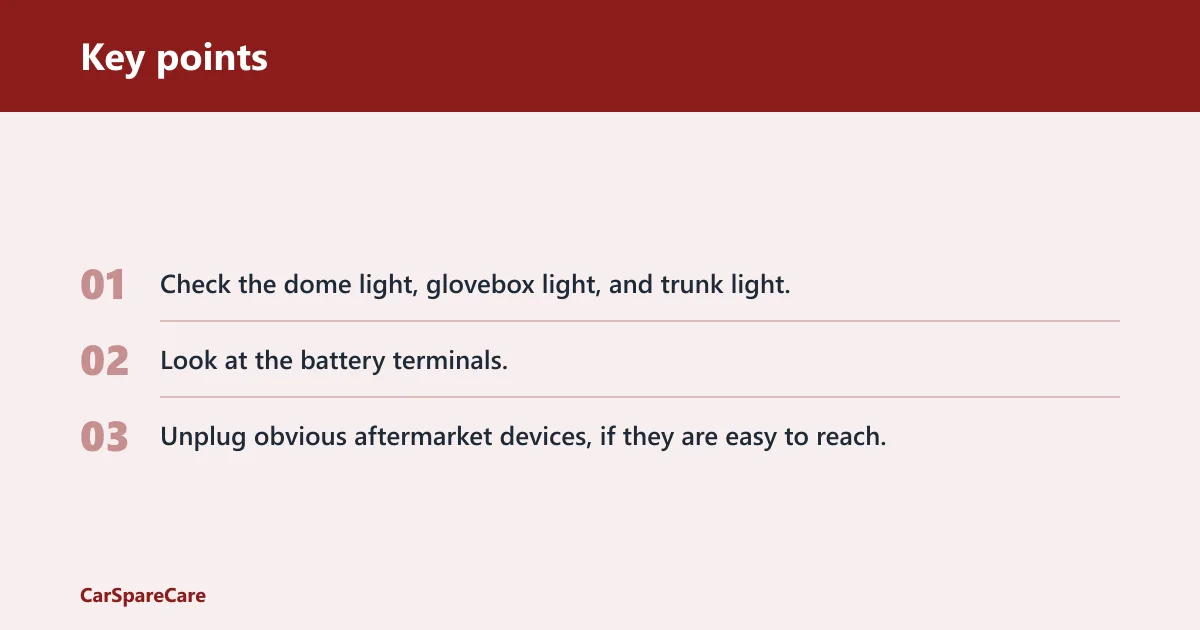
Start with these quick checks
- Check the dome light, glovebox light, and trunk light. A misaligned switch or latch can leave one on all night.
- Look at the battery terminals. Loose clamps or corrosion can mimic a dead battery problem and hide a real drain.
- Unplug obvious aftermarket devices, if they are easy to reach. Trackers, amplifiers, reverse cameras, and alarm additions are common suspects.
Say your hatch closes fine, but the cargo light stays on because the trim switch is bent. That small bulb can flatten the battery faster than you expect, especially if the battery is already old or the car makes short trips.
Parked drain triage table
Use this as a symptom-first shortcut. The draw range is a guide, not a verdict, because a module that has not gone to sleep yet can briefly read high even when the car is healthy.
| Symptom | Likely cause | Quickest check | Typical draw range | Next step |
|---|---|---|---|---|
| Dome, glovebox, or trunk light stays on | Interior light or latch/switch fault | Open each door, trunk, and glovebox; confirm every lamp goes out | Often well above normal; a bulb load can be enough to flatten overnight | Fix the switch, latch, or bulb first |
| Battery dies with a click or hot component after parking | Stuck relay | Feel for a relay or module staying active after shutdown | Can range from tens of milliamps to a problem-level draw | Pull suspect relays one by one |
| Charging seems normal while driving, but battery is low after sitting | Alternator diode back-drain | Test for AC ripple or diode leakage when parked | May sit near or above 0.3A in a fault condition | Check alternator diodes before replacing the battery again |
| Draw is high right after shutdown, then drops later | BCM not asleep yet | Wait for sleep mode and retest current | Can start high and settle into 20mA to 50mA | Retest after the car settles |
| Problem started after a tracker, amp, camera, or alarm was added | Aftermarket accessory or wiring fault | Isolate the add-on circuit or remove the fuse | Often above 80mA if wired badly; severe at 1 amp and above | Inspect installation and parasitic feed points |
| Battery is old, weak, or recently replaced but still goes flat | Battery age plus another draw | Check resting voltage before chasing deeper faults | Normal draw may still overwhelm a weak battery | Test battery health and the drain together |
What drains a car battery while parked is often a combination of small things rather than one dramatic fault. A weak battery, a short-trip pattern, and a borderline draw can add up to the same symptom: dead by morning.
How do you check for parasitic draw?
Use a multimeter for both voltage and current. First, check battery resting voltage at the battery posts or terminals. A healthy resting battery is often around 12.4 to 12.8 V. Then measure current draw in series at the battery once the car has gone to sleep. Normal parasitic draw for most vehicles is 20mA to 50mA.
What draw range is concerning
A reading above 80mA is suspicious in this guide. 0.3A is already a problem level, and 1 amp and above is severe battery drain. At that level, a 75Ah battery can weaken within about 24–48 hours. That is why a parked car can seem fine one night and dead the next.
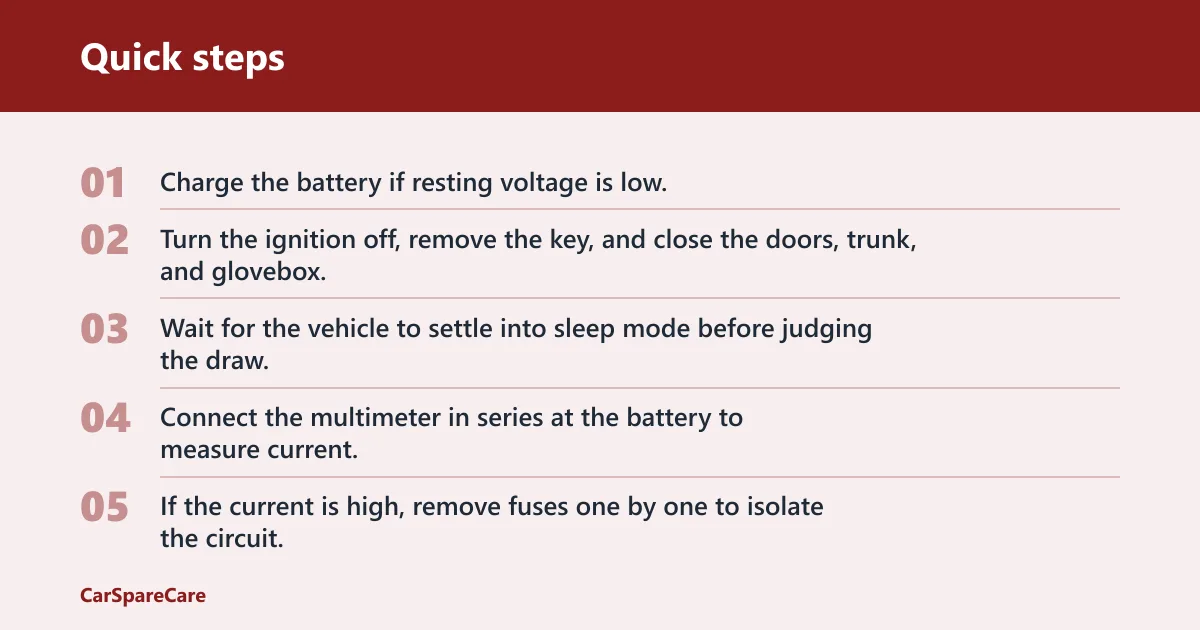
- Charge the battery if resting voltage is low.
- Turn the ignition off, remove the key, and close the doors, trunk, and glovebox.
- Wait for the vehicle to settle into sleep mode before judging the draw.
- Connect the multimeter in series at the battery to measure current.
- If the current is high, remove fuses one by one to isolate the circuit.
Why the car must go to sleep first
Modern vehicles may stay awake for a while after shutdown. The BCM, alarm, door modules, and other systems can remain active during their shutdown routine. If you test too early, you can get a false high reading and chase a fault that is not really there.
Picture a sedan that shows about 180mA right after shutdown. Twenty minutes later, it drops to about 32mA. That is not a bad battery by itself; it is a normal sleep delay. The key is to wait, then compare the settled reading to the normal range.
Can the alternator drain it while parked?
Yes. A bad alternator can drain a battery while parked if a diode leaks current back through the charging circuit. That is different from a charging fault that shows up only while driving. A car can still show acceptable charging voltage on the road and still lose power overnight.
Charging voltage versus parked drain
Charging voltage should usually be about 13.5 to 14.5 volts with the engine running. Firestone lists 13.5 to 14.5 volts as ideal alternator voltage. If the running voltage is low, the charging system needs attention. If running voltage is fine but the battery goes flat after sitting, look for back-drain or another parked load. (Firestonecompleteautocare)
Rustyautos lists a faulty alternator diode as a cause of overnight drain, and that diagnosis matters when the battery dies after sitting but the charging system seems acceptable on the road. Do not replace the battery first and stop there if the alternator is feeding current backward.
When diode testing matters
Diode testing becomes important when the battery is healthy, the draw is higher than expected, and the current does not fall after sleep mode. If the drain stays after fuses are pulled from the cabin side, the alternator and its diodes move up the list.
Why would a module keep drawing power?
A module can keep drawing power because it never enters sleep mode, because a relay is stuck closed, or because an add-on circuit is wired into a live feed. BCM sleep failures, faulty relays, and aftermarket wiring faults are all common paths to the same result: the battery keeps losing charge while the car sits.
BCM sleep-mode failure
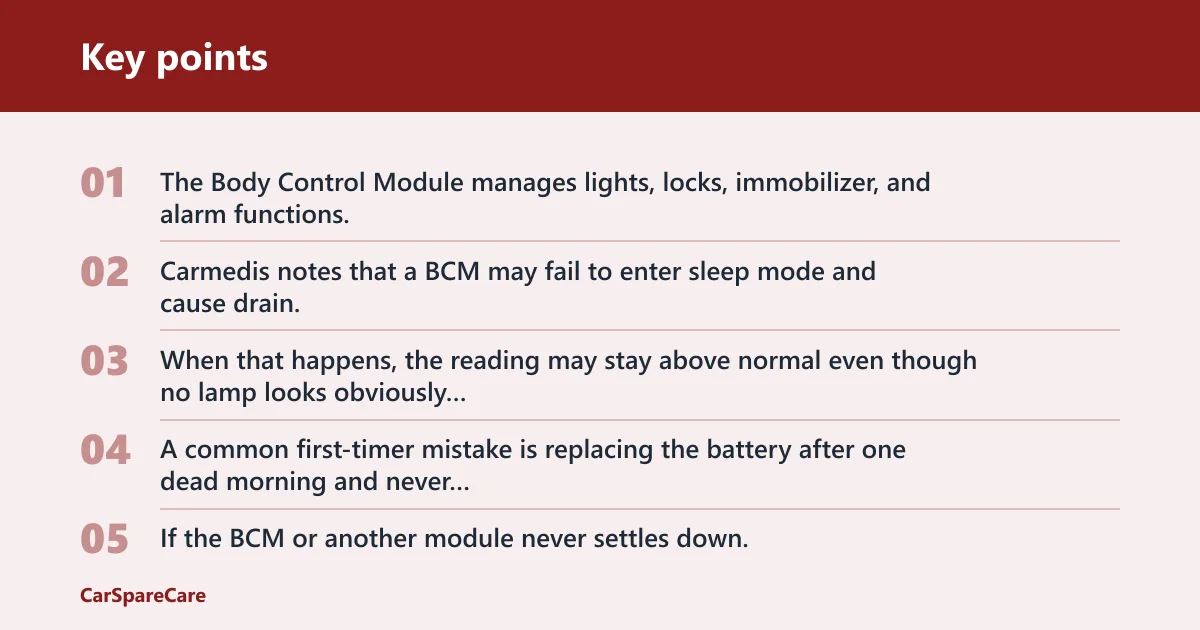
The Body Control Module manages lights, locks, immobilizer, and alarm functions. Carmedis notes that a BCM may fail to enter sleep mode and cause drain. When that happens, the reading may stay above normal even though no lamp looks obviously on.
A common first-timer mistake is replacing the battery after one dead morning and never checking the car’s sleep behavior. If the BCM or another module never settles down, the new battery can fail for the same reason as the old one.
Stuck relay behavior
A faulty relay can stay energized with the key off and keep a circuit powered all night. That may feed an accessory, a cooling fan circuit, or another load that should have gone quiet. Removing relays or fuses one at a time is the fastest way to narrow it down.
Aftermarket wiring faults
Tracking devices, amplifiers, reverse cameras, and alarm systems are major causes of drain when they are added poorly. Battery Hacker also notes accessories like audio systems and power windows can drain the battery. These problems often start after an installation, repair, or accessory upgrade.
Suppose a compact SUV gets a reverse camera and a tracker added in the same week. If the battery starts dying overnight after that work, the most likely path is not a mysterious factory failure; it is the new wiring.
Battery age and replacement clues
Battery age matters because older batteries lose capacity faster, and weak batteries are more vulnerable to sitting drain. A resting voltage near 12.4 to 12.8 V is a useful first check, but it does not prove the battery can hold up under overnight load. A tired battery can fail sooner than the numbers suggest.
When replacement is not enough
If a new battery still dies overnight, stop treating the battery as the only suspect. That usually means the real problem is a parked draw, a sleep fault, or a charging-system issue that was never fixed. A battery replacement alone will not solve a draw that is still present.
Short trips can make this worse. If the car is driven only a few miles at a time, the alternator may not fully replace the energy used for starting and accessory loads, so the battery begins each night at a lower state of charge.
DIY check versus shop diagnosis
Begin with the easy checks: lights, doors, trunk, glovebox, and terminals. Then verify resting voltage, wait for sleep mode, and measure current draw in series with a multimeter. If the draw stays high after you isolate the obvious circuits, a shop diagnosis is usually the better move because fuse-by-fuse testing can take time.
Cost also depends on the fault. A loose terminal, failed bulb, or simple relay is usually cheaper than alternator diode work, BCM diagnostics, or a hidden aftermarket wiring issue. Replacing parts at random is often the most expensive path.
Frequently asked questions
What drains a car battery while parked?
The usual causes are a light left on, a relay stuck closed, a module that does not sleep, a faulty alternator diode, or an aftermarket device that keeps drawing current. Normal parked draw exists, but it should stay in the 20mA to 50mA range for most vehicles.
What should I check first if my battery is dead by morning?
Check the dome light, glovebox light, trunk light, and terminal condition first. Then check whether anything was recently added to the car, such as a tracker, amplifier, camera, or alarm. If those look normal, measure resting voltage and then parked current with a multimeter.
How do I tell if I have a parasitic draw?
Measure current draw in series at the battery after the car has gone to sleep. Normal draw is often 20mA to 50mA, and above 80mA is suspicious in this guide. If the reading drops after a delay, you may have tested before the modules settled.
Can a bad alternator drain a battery while parked?
Yes. A leaking alternator diode can back-feed current after shutdown and flatten the battery even if charging voltage looks acceptable while driving. Charging-system voltage and parked draw are different checks, so a good running voltage does not rule out overnight drain.
Can an interior light or glovebox light drain a battery overnight?
Yes. A dome, glovebox, or trunk light is one of the most common parked-drain causes. Even a single small bulb can empty a weak battery overnight, especially if the battery is already old or the car is sitting after short trips.
How long can a car sit before the battery goes flat?
There is no single answer because battery age, temperature, and draw level all matter. A healthy battery with normal sleep draw may sit for a while, but a 75Ah battery with a 1A draw can weaken within 24–48 hours. That is why draw level matters so much.
What causes a car battery to drain while parked?
Anything that keeps current flowing after shutdown can do it: lights, relays, modules, alternator diode faults, and aftermarket accessories. The fastest way to sort them is to separate normal sleep draw from abnormal draw, then look for the symptom pattern that matches the car.

Hi, I’m Melvin, an automobile engineer with extensive experience in automobile equipment. I currently work for a local automobile firm, where I specialize in the car parts industry. I’ve had the opportunity to collaborate with seasoned inspectors, gaining invaluable hands-on experience that goes beyond just theory.
My passion for automotive care started at a young age, which led me to create CarSpareCare. Through CarSpareCare, I share the knowledge and skills I’ve acquired over the years to help others navigate the world of car maintenance and repairs.
My goal is to provide practical tutorials, essential safety advice, and the latest industry insights so that anyone—whether a beginner or an expert—can confidently tackle their automotive projects.