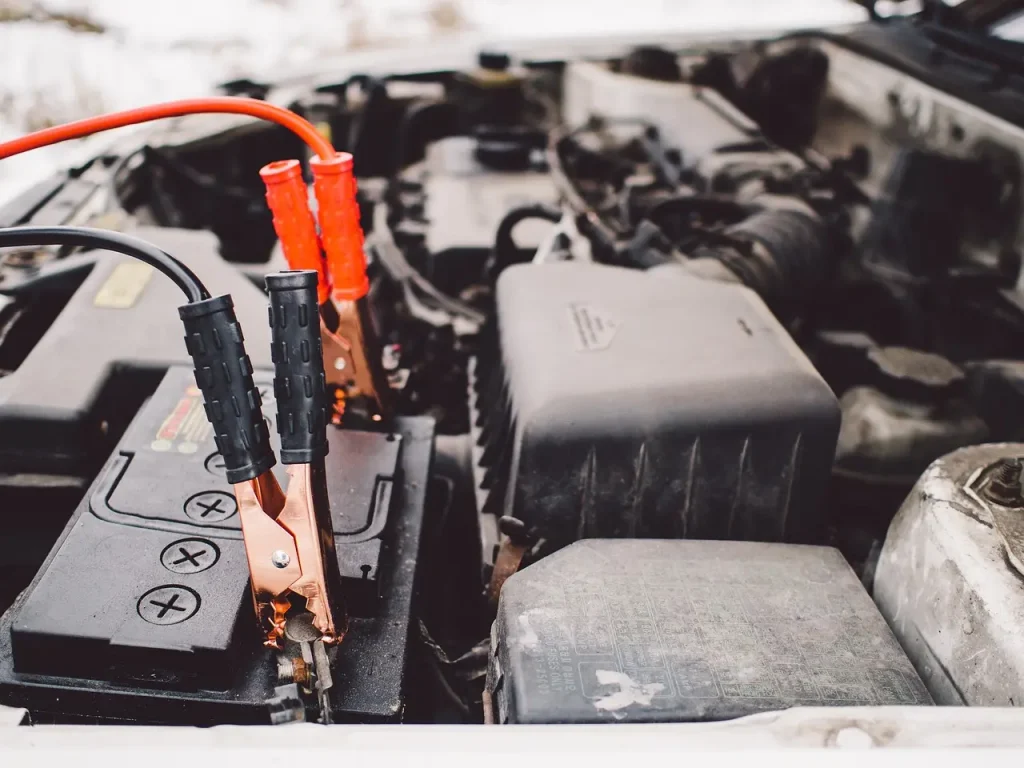
Choose the battery by fitment first: correct group size, terminal layout, hold-down style, and required CCA, then match chemistry and reserve capacity to your driving. I start there because the wrong battery can crank poorly, trigger charging faults, wear out early, or simply refuse to sit in the tray. This guide shows a practical step-by-step way to match your vehicle, charging system, and use case.
How do I know what battery my car needs?
Start with the owner’s manual and the label on the battery already in the car. Then confirm the battery group size, terminal layout, hold-down style, and minimum CCA through a VIN or fitment lookup. The old battery usually points in the right direction, but I verify it against the spec before ordering.
Start with the owner’s manual or OEM spec
The manual often lists a BCI group number, minimum CCA, and sometimes the approved chemistry. If the car has had a battery change before, the manual still matters more than the last battery fitted. That older battery may have been chosen for price or stock availability, not exact fit.
Use VIN or fitment lookup tools
VIN-based parts lookup can catch trim-level differences, start-stop systems, and alternate battery trays. That matters on vehicles where the same model was sold with different electrical loads. A simple model-year search misses too much, especially on late-model cars.
Match the old battery’s group size and dimensions
BCI group size is the first physical filter. It points to standard length, width, height, and terminal layout, but the numbers still need to be checked against the tray and clamp. A battery with strong specs is useless if the case is too tall or the posts sit on the wrong side.
What battery size, posts, and hold-down does my car need?
Your car needs a battery that fits the tray, clears the hood, lines up with the cables, and locks into the hold-down hardware. Group size alone does not guarantee fit. Physical dimensions, terminal orientation, post type, and clamp style all need to match before any electrical spec matters.
Check BCI group number and physical dimensions
BCI group size gives a common reference for battery fitment, though batteries in the same group can still differ a bit. Check the battery’s dimensions against the tray and nearby bodywork. A battery that is a few millimeters too tall can press against the hood or insulation.
Verify terminal orientation and post type
Positive and negative posts must land on the right sides for the cable reach. Top-post and side-post designs are not interchangeable without the correct cable ends. Reversing the orientation or stretching the cables can cause strain, poor contact, or an unsafe install.
Confirm hold-down style and tray clearance
Hold-down fit matters more than many shoppers expect. Some vehicles use J-hook clamps, some use a top clamp, and others use a base ledge. The battery must sit firmly in the tray so vibration does not damage the case or internal plates.
| Fitment item | What to confirm | Why it matters |
|---|---|---|
| BCI group size | Approved group number from manual or fitment lookup | Sets the physical envelope and common terminal layout |
| Dimensions | Length, width, height, tray clearance | Prevents interference with the tray, hood, or brackets |
| Terminal orientation | Positive and negative post position, top post or side post | Ensures cable reach and correct polarity connection |
| Hold-down | J-hook, top clamp, or base ledge fit | Keeps the battery secure under vibration and cornering |
What does CCA mean, and how much do I need?
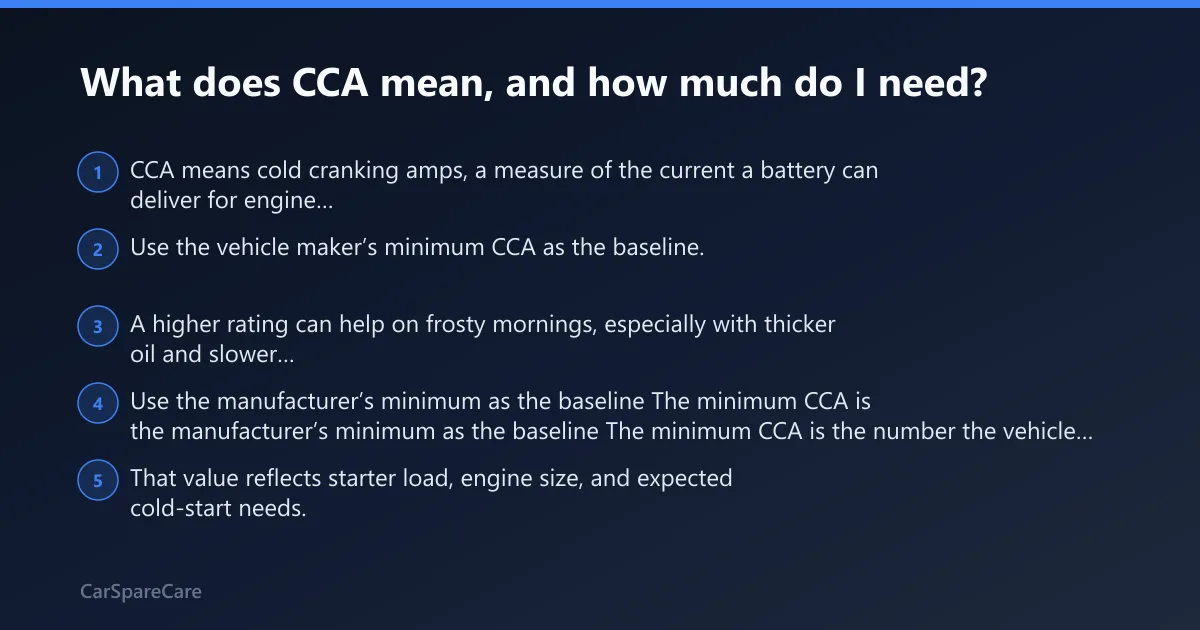
CCA means cold cranking amps, a measure of the current a battery can deliver for engine starting, especially in cold conditions. Use the vehicle maker’s minimum CCA as the baseline. A higher rating can help on frosty mornings, especially with thicker oil and slower starter speed, but it does not fix a poor fit, weak charging system, or bad cables.
Use the manufacturer’s minimum as the baseline
The minimum CCA is the number the vehicle was designed around. That value reflects starter load, engine size, and expected cold-start needs. Matching or slightly exceeding it is normal. Dropping below it is where slow cranking and no-start complaints begin.
When a higher CCA rating helps
More CCA can help in freezing weather, on larger engines, and on vehicles that sit for long periods between starts. It can also add a margin for aging and cable resistance. If the battery still fits the tray and matches the terminals, a higher CCA rating is often fine.
When higher CCA does not solve the real problem
High CCA does not cure a wrong group size, low reserve capacity, corroded terminals, or a charging fault. If the battery is the wrong shape or the system is undercharging, cranking may still be poor. Bigger numbers on the label can hide the real issue.
How does reserve capacity affect real-world use?
Reserve capacity, or RC, is the time a fully charged battery can supply a moderate load before voltage falls too low. It matters when the engine idles, accessories run with the engine off, or short trips never fully recharge the battery. More RC gives extra time before voltage drops, but it will not repair a bad charging system.
Short trips, idling, and accessory load
Urban use is hard on batteries. Frequent short trips may not replace the energy used to start the engine, and accessories such as heated seats, infotainment, lights, and fans add load. A battery with better RC can help the car cope between charging events, but it still needs a healthy alternator.
Hot weather and backup power needs
Heat ages batteries faster, and repeated idling in traffic can raise under-hood temperatures. In warm climates, RC can matter because the battery may need to support load during long stops while the engine idles. A battery with more RC can also tolerate brief charging interruptions better.
Should I buy flooded, AGM, or EFB?
Match chemistry to the vehicle’s electrical system first, then to your use pattern. Standard flooded lead-acid works for many conventional vehicles. AGM is common on higher-demand systems and some start-stop cars. EFB is used on some start-stop applications that do not require a full AGM specification.
Standard flooded lead-acid for conventional vehicles
Flooded batteries are common, affordable, and suitable where the charging system was designed for them. They are still the right answer for many older vehicles without start-stop and without heavy accessory demand. If the car came with flooded, replacement with flooded is usually the simplest path.
AGM for higher electrical demand and many start-stop systems
AGM batteries handle frequent cycling better and are often used in cars with start-stop, heavy accessory loads, or more demanding charging strategies. They resist vibration well and can support repeated engine restarts. But AGM should still be matched to the vehicle’s charging logic and battery monitoring setup.
EFB for some start-stop applications and upgrade limits
EFB is an upgraded flooded design used in some start-stop vehicles that do not require AGM. It can be a direct replacement only when the vehicle spec calls for it or allows it. It is not a universal upgrade path for every start-stop car.
Will my charging system accept a different battery type?
Sometimes yes, sometimes no. Modern charging systems may use battery monitoring hardware, often called IBS or BMS, and software that expects a specific battery type. If the vehicle was calibrated for AGM or EFB, swapping to standard flooded without checking the charging profile can shorten battery life or create faults.
Start-stop systems and battery monitoring sensors
Start-stop vehicles cycle the battery more often than conventional cars. They commonly use IBS or BMS hardware to track battery condition and adjust charging. If the replacement battery type does not match what the system expects, the car may charge it incorrectly or disable start-stop functions.
Alternator charging profile and battery control logic
Some alternators charge differently based on battery chemistry, age, and temperature. A battery control module may reduce charging voltage or change how often the battery is topped up. That is why an AGM upgrade is not always a simple swap, even if the case size fits.
When an AGM upgrade needs more than a simple swap
On vehicles set up for flooded batteries, an AGM replacement may be acceptable only if the charging system can handle it. On vehicles with battery registration or adaptation procedures, the new battery type and capacity may need to be coded. Skipping that step can leave the battery undercharged or overcharged.
What should I check before I buy?
Check the manufacture date code, storage age, warranty terms, and whether the battery matches every fitment point. A battery that has sat too long on a shelf may arrive partially aged. Also watch for common mismatch cases where the label looks right but the battery is wrong for the car.
Manufacture date code and storage age
A fresh battery is better than a long-stored one. Look for a readable manufacture date code and avoid old stock that has sat unmaintained. Battery chemistry still ages on the shelf, and a unit that has been stored too long may have less usable life left.
Warranty length and free replacement period
Warranty terms matter, especially the free replacement period. Compare that first, not just the total warranty length. A longer paper warranty is less useful if the free replacement window is short or the claim conditions are restrictive.
Do-not-buy warning list for mismatch scenarios
- Wrong group size, even if CCA is higher.
- Terminals on the wrong side or wrong post type.
- Battery too tall for hood or cover clearance.
- Hold-down style that does not lock the case securely.
- Flooded battery installed where AGM or EFB is specified.
- AGM or EFB fitted without checking charging-system compatibility.
- Battery with no clear date code or very old shelf age.
- Low CCA for a cold climate or large engine.
Vehicle-battery decision checklist
- Confirm the OEM battery spec in the owner’s manual.
- Use VIN lookup or fitment data to verify the approved battery family.
- Match BCI group size to tray dimensions.
- Check length, width, height, and hood clearance.
- Verify terminal orientation, post type, and cable reach.
- Confirm hold-down style: J-hook, top clamp, or base ledge.
- Choose chemistry: flooded, AGM, or EFB per vehicle spec.
- Set CCA at or above the manufacturer’s recommended minimum.
- Check reserve capacity for short trips, idling, and accessories.
- Confirm start-stop and IBS/BMS compatibility.
- Inspect the manufacture date code and warranty terms.
Frequently asked questions
How do I know what size car battery my vehicle needs?
Check the owner’s manual, the battery label already in the car, and a VIN-based fitment lookup. The correct size means more than one number. It must match group size, dimensions, terminal layout, and hold-down style so the battery fits the tray and cables without strain.
What does CCA mean when choosing a car battery?
CCA means cold cranking amps. It tells you how much starting current the battery can deliver in cold conditions. Use the manufacturer’s minimum CCA as the starting point, then go higher only if the battery still fits and the charging system supports it.
How do I find the correct group size for my car battery?
Use the owner’s manual, the current battery label, or a VIN lookup to get the BCI group number. Then confirm the physical dimensions and terminal position, because the group number is a guide, not the final check. The tray and cable layout still have to line up.
Should I buy the same battery type my car came with?
Usually yes, especially on modern cars with start-stop systems or battery monitoring sensors. Flooded, AGM, and EFB are not always interchangeable. If you want to change type, confirm that the charging system and vehicle control logic accept it before buying.
What happens if I install a battery with the wrong specifications?
You may get poor cranking, charging warnings, short battery life, or a battery that physically cannot be secured. Wrong dimensions, terminal layout, or chemistry can also create fitment and electrical problems. A battery can have good CCA and still be the wrong part for the car.
Does my driving pattern affect which battery I should buy?
Yes. Short-trip driving, long idling, and heavy accessory use can drain a battery faster than the charging system restores it. In those cases, reserve capacity matters more, and the battery must also suit the vehicle’s charging profile. A battery matched only on size may still underperform.
How do I check if my car has start-stop and needs a special battery?
Look for a start-stop button, system indicator, or wording in the owner’s manual. Then check the battery type already fitted and whether the car has IBS or BMS hardware. Start-stop cars often need AGM or EFB, and the replacement must match the charging system’s expectations.

Hi, I’m Melvin, an automobile engineer with extensive experience in automobile equipment. I currently work for a local automobile firm, where I specialize in the car parts industry. I’ve had the opportunity to collaborate with seasoned inspectors, gaining invaluable hands-on experience that goes beyond just theory.
My passion for automotive care started at a young age, which led me to create CarSpareCare. Through CarSpareCare, I share the knowledge and skills I’ve acquired over the years to help others navigate the world of car maintenance and repairs.
My goal is to provide practical tutorials, essential safety advice, and the latest industry insights so that anyone—whether a beginner or an expert—can confidently tackle their automotive projects.