

Start with a pH-neutral wash, a dedicated water-spot remover, and a microfiber dry. If the spot still shows after that, the clear coat is likely etched, and you need polishing rather than more cleaner. Leave them alone or scrub too hard, and black paint can end up with dull rings, scratches, or permanent mineral etching. This guide shows how to judge the severity, remove fresh spots safely, and decide when machine or hand polishing is the right next step.
What you’ll need
- Two buckets
- Car shampoo or baby shampoo
- Plain rinse water
- Soft microfiber drying towel
- Spray bottle
- White vinegar
- Distilled water
- Rubbing alcohol at 70% to 90% strength
- Commercial water spot remover
- Detaling clay bar
- Clean microfiber towels for wiping and buffing
📊 The vinegar mix is left on the spots for 10 minutes. Source: Wikihow.
How to tell fresh spots from etching
Fresh droplets and visible rings usually sit on the surface and often come off with a rinse, wash, and careful drying. Etched marks and dull haze mean the minerals have attacked the clear coat, so cleaning alone will not bring back the finish. Paint, glass, and trim do not react the same way.
Fresh droplets and visible rings
Fresh spots look like water marks that showed up after a wash, sprinkler hit, or rain shower. If the panel still feels smooth and the mark changes or wipes away after cleaning, you are likely dealing with surface residue rather than damage.
Etched marks and dull haze on black paint
If the mark stays after washing, or the area looks cloudy under direct light, treat it as etched clear coat. Black paint can make that haze easier to see, and repeated rubbing can leave marring that may be worse than the original spot.
Paint, glass, and trim do not respond the same way
Glass often tolerates stronger spot cleaners than paint, while textured trim can trap residue in its pores. Use the mildest method that fits the surface, and test any liquid on a small, hidden area first.
Use the mildest method that fits the spot’s severity. Rinse away loose mineral residue, wash the panel with a two-bucket method, dry with a soft microfiber towel, then move up only if the mark remains. On black paint, every pass should be gentle because visible marring is easy to create.
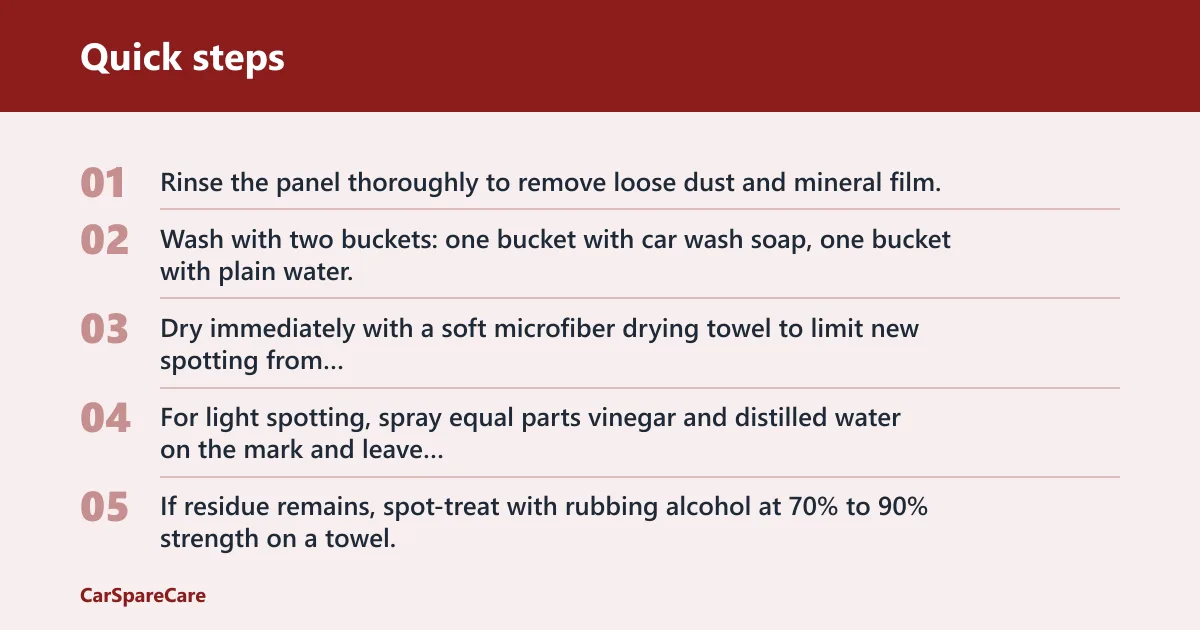
- Rinse the panel thoroughly to remove loose dust and mineral film.
- Wash with two buckets: one bucket with car wash soap, one bucket with plain water.
- Dry immediately with a soft microfiber drying towel to limit new spotting from evaporation.
- For light spotting, spray equal parts vinegar and distilled water on the mark and leave it for 10 minutes, then rinse.
- If residue remains, spot-treat with rubbing alcohol at 70% to 90% strength on a towel, not on the whole panel.
- If the mark still clings, use a commercial water spot remover as directed on the bottle.
- For bonded residue, use a detailing clay bar on lubricated paint, then wipe clean and add protection afterward.
- Stop and polish if the clear coat stays dull, the spot looks like a ghost ring, or the paint no longer reflects evenly.
Suppose a black hood has a few white rings after a sprinkler hit, but the surface still feels smooth. That is the sort of case where vinegar and distilled water may clear the residue without more aggressive work. If the same hood has gray haze that does not change after cleaning, move to the next step instead of repeating the same wipe.
What spot severity needs what action
Match the method to the damage. Fresh droplets often clean off, visible rings may need a spot treatment, etched marks usually need polishing, and haze on black paint often means the finish has already been dulled. The table below gives the safest path and the point where you should stop.
| Spot type | Safest method | When to stop | When polishing is needed | What to avoid |
|---|---|---|---|---|
| Fresh droplets | Quick rinse, two-bucket wash, microfiber drying towel | When the surface is clear and smooth | Not usually needed | Dry scrubbing and letting water air-dry on black paint |
| Visible rings | Vinegar and distilled water in equal parts, left 10 minutes, then rinsed | When the ring lifts without rubbing | If the ring remains after repeat cleaning | Strong pressure and repeated towel passes |
| Etched marks | Commercial water spot remover, then clay bar if residue remains | When the mark is gone but gloss is still even | Often needed if the mark is still visible in light | Assuming clay alone can fix clear-coat damage |
| Haze on black paint | Gentle wash, spot cleaner, then inspect under bright light | When reflection returns evenly across the panel | Likely needed if the finish stays dull | Abrasive pads, dry buffing, and harsh chemicals |
Why black paint shows water spots fast
Black paint makes residue, haze, and towel marks easier to see than lighter colors. Hot, sunny conditions also speed up spotting damage, because water evaporates faster and leaves minerals behind. Abrasive towels can turn a small ring into a visible scratch pattern.
Heat and sun exposure speed up etching
Water that bakes on a hot panel gives calcium and magnesium more time to bond and mark the clear coat. That is why a quick rinse matters when spots are fresh. Waiting until the panel cools often helps, but it does not reverse etching that has already started.
Why towel choice matters on black paint
A soft microfiber drying towel matters because black paint reveals marring easily. A rough towel, an old bath cloth, or a gritty edge can leave fine scratches that look like haze in daylight. Dry in straight lines, not tight circles.
What if the spots are baked on?
Hot panels and sprinkler water can leave stubborn deposits that do not respond to a simple rinse. If household cleaners fail, move to a commercial water spot remover, then clay only if the residue is bonded. If the area stays dull after that, the clear coat is already etched and polishing is the next step.
When household cleaners fail
Use the vinegar mix first on light spotting, then move up to rubbing alcohol at 70% to 90% only on isolated residue. Do not use alcohol as a wash-step cleaner, and do not put it on fresh paint jobs. Overuse can damage paint.
When to stop cleaning and polish instead
If the spot looks like a white crater, a gray ghost ring, or a patch of dullness under overhead light, cleaning has reached its limit. At that point, polishing removes the damaged top layer of clear coat. Claying alone will not restore etched paint.
A common first-timer mistake is chasing one baked-on spot on a black door with repeated rubbing. The mineral stain may fade, but the door can end up with a larger dull patch than the original mark. One careful step up is safer than many aggressive passes.
How do you keep spots from coming back?
Dry the car completely after washing, wash with the two-bucket method, and protect the finish after removal so water sheets away more easily. Those three habits matter most on black paint because new spotting and dried residue show up quickly on dark panels.
Dry after every wash
Use a soft microfiber towel right after rinsing. The faster you remove standing water, the less chance minerals have to dry on the surface and leave rings. This is the simplest way to keep fresh spotting from starting.
Wash with two buckets
The two-bucket method uses two buckets of water. One bucket contains car shampoo or baby shampoo. The rinse bucket is plain water only. That setup helps keep grit and minerals out of the wash mitt instead of redepositing them on the panel.
Protect the finish after cleaning
After the paint is clean and dry, add your preferred paint protection so water does not cling as long. That makes future cleanup easier and lowers the chance that a quick shower turns into a baked-on ring.
Common mistakes
- Using the same method for fresh droplets and etched marks.
- Scrubbing black paint with a dry towel.
- Letting vinegar sit longer than needed.
- Using rubbing alcohol on large areas instead of isolated spots.
- Relying on clay bar alone for etched clear coat.
- Skipping the final dry step after washing.
Frequently asked questions
How do you remove hard water spots from car paint?
Rinse first, wash with two buckets, and dry with a microfiber towel. If the mark remains, use equal parts vinegar and distilled water for 10 minutes, then rinse. Move to a commercial water spot remover only if the residue is still visible after that.
What removes water spots without scratching black paint
A soft microfiber towel, a pH-neutral wash, and a controlled vinegar treatment are the safest first steps. Keep pressure light and use straight motions. If the finish still looks dull, stop and assess for etching instead of rubbing harder.
Is vinegar safe on car paint for water spots?
Yes, for light spotting and only as a short treatment. Mix equal parts vinegar and distilled water, spray the spots, leave it on for 10 minutes, then rinse well. Do not leave it on the paint longer, and do not treat fresh paint jobs with it.
When are water spots too etched to remove by hand?
If the mark stays after washing, spot cleaning, and clay, and the panel still looks dull under direct light, hand cleaning has reached its limit. At that point, polishing is needed because the clear coat is damaged, not just contaminated.
Can a clay bar remove hard water spots?
A clay bar can remove bonded residue and some leftover spot material from the surface. It should be used after washing and spot cleaning, not instead of them. Follow it with protection, and do not expect it to fix etched clear coat by itself.

Hi, I’m Melvin, an automobile engineer with extensive experience in automobile equipment. I currently work for a local automobile firm, where I specialize in the car parts industry. I’ve had the opportunity to collaborate with seasoned inspectors, gaining invaluable hands-on experience that goes beyond just theory.
My passion for automotive care started at a young age, which led me to create CarSpareCare. Through CarSpareCare, I share the knowledge and skills I’ve acquired over the years to help others navigate the world of car maintenance and repairs.
My goal is to provide practical tutorials, essential safety advice, and the latest industry insights so that anyone—whether a beginner or an expert—can confidently tackle their automotive projects.

