Yes, many bent alloy wheels can be straightened if the bend is minor and the wheel has no cracks, gouges through the bead seat, or prior heat damage; wheels with cracks or severe deformation usually need welding or replacement. Poor repairs can leave slow leaks, vibration, extra bearing load, or sudden loss of air. It covers which damage levels are repairable, when welding is acceptable, and what proof you should demand before the wheel goes back on the car.
What makes an alloy wheel bend?
Deep potholes, kerb strikes, road debris, and rough surfaces can bend alloy wheels. The damage usually starts where the impact loads the wheel first: the inner barrel, bead seat, spokes, or hub area.
Alloy wheels are usually aluminium-based, though construction varies. Cast wheels tend to crack or distort differently from forged or spun designs, so the way a wheel was made matters before any repair is approved.
Where the damage usually shows up
The inner barrel is a common impact point because it takes pothole force directly. The bead seat can be damaged when the tyre’s sealing edge is hit. Spokes and the hub mounting face matter because they affect strength, fit, and runout.
How can you tell a wheel is bent?
A bent wheel often shows up as vibration, poor handling, air loss, or uneven tyre wear. It can also look fine while still having enough runout to cause problems, so appearance alone is not a safe guide.
Checks you can do before removal
Look for a wheel that has a flat spot, a buckle, or a dent near the rim edge. If the steering wheel shakes at speed or the car begins to wander after a pothole hit, the wheel should be inspected rather than ignored.
Say your car starts to shake at 55 mph after a deep pothole strike, but the tyre still holds pressure. That pattern fits a possible minor bend, not proof of a safe wheel. The wheel still needs inspection and runout measurement before anyone decides on repair.
Can alloy wheels be straightened safely?
Yes, but only some bent alloy wheels are suitable. Minor radial runout, minor lateral runout, a single flat spot on the inner barrel, or an isolated buckle may be repairable. Straightening is not a fix for cracks, heavy distortion, or damaged mounting faces.
When straightening stops being the right repair
If the bend reaches the bead seat, hub area, or spokes, the risk climbs fast. Damage there can affect sealing, fitment, and strength. A wheel with severe runout or visible structural distortion should move to welding assessment or replacement.
Can alloy wheels be straightened? In many cases, yes. Can alloy wheels be straightened safely after a hard kerb impact? Only if inspection and measurement show the wheel is within repairable limits and the damage is not structural.
Alloy wheel decision matrix
| Damage type | Repair option | Red flags | Recommended next step |
|---|---|---|---|
| Flat spot | Straightening may be possible | No crack, no bead-seat tear, no heat history | Inspect, measure runout, then straighten if within tolerance |
| Buckle | Straightening may be possible | Sharp crease, metal thinning, repeat bend at same point | Check with runout gauge and assess for hidden cracking |
| Bead-seat damage | Weld only if a specialist approves it | Air loss, crushed sealing edge, rim deformation near tyre bead | Inspect for leak path; replace if sealing area is compromised |
| Crack | Usually replace; welding is separate from straightening | Crack in barrel, spoke, hub, or bead seat | Do not straighten first; assess for welding or replacement |
| Prior weld | Case-by-case | Old repair near a bend, heat marks, repeat leakage | Request proof of the earlier repair before any refit |
| Severe runout | Usually replace | Wheel visibly out of shape, repeated tyre loss, large distortion | Reject straightening if geometry cannot be brought back to tolerance |
| Forged wheel | Specialist review only | Complex structure, prior heat, cracked or stretched areas | Get a specialist verdict before any correction or welding |
How a professional straightening process works
Proper straightening starts with tyre removal. That protects the tyre from heat and damage and allows accurate measurement of the wheel itself. A wheel cannot be judged properly while the tyre is masking the shape.
Professional straightening often uses electro-hydraulic equipment or hydraulic rams. The wheel is mounted and rotated while a runout gauge measures deviation. The technician applies gradual pressure, checks progress, then repeats the measurement until the shape is back within tolerance.
What a sound process should include
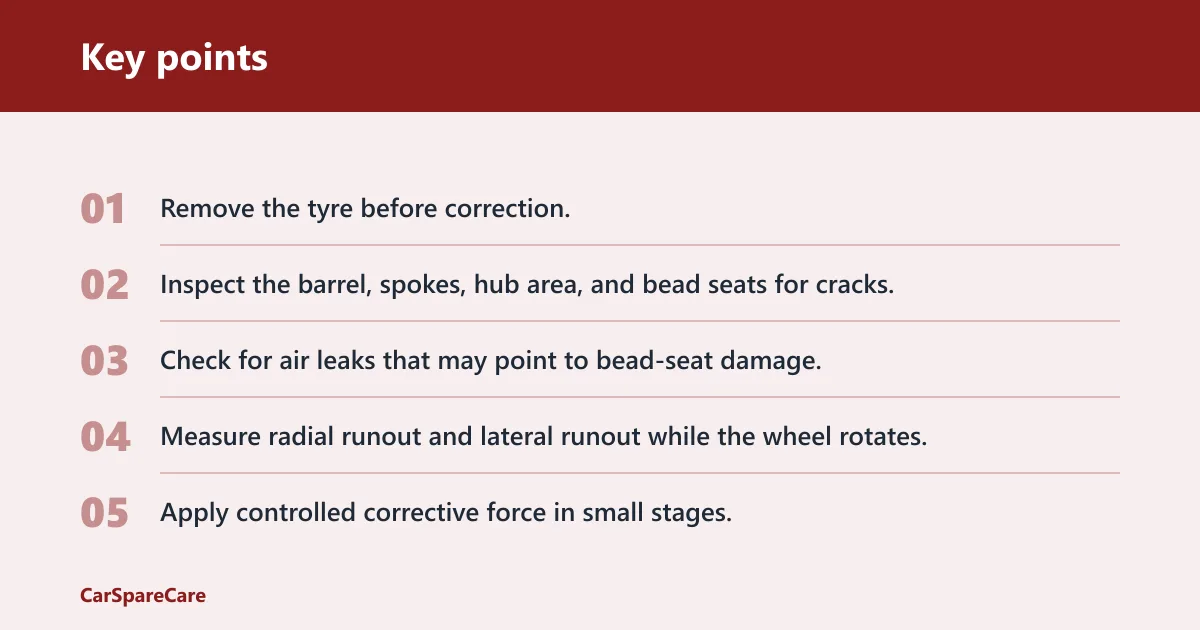
- Remove the tyre before correction.
- Inspect the barrel, spokes, hub area, and bead seats for cracks.
- Check for air leaks that may point to bead-seat damage.
- Measure radial runout and lateral runout while the wheel rotates.
- Apply controlled corrective force in small stages.
- Recheck runout after each correction.
- Return the wheel only after acceptable workshop or manufacturer tolerance is confirmed.
Suppose a 17-inch wheel has a visible flat spot on the inner barrel, with no crack or leak. A qualified shop may straighten it in stages, then remeasure runout before refitting. If the same wheel shows a spoke crack, the repair path changes completely.
When should you repair, weld, or replace?
Repair is reasonable only when the damage is limited to a bend that stays within tolerance after correction. Welding may be used for some crack repairs, but it is not the same as straightening, and it changes the risk picture. Replace the wheel when the crack is structural, the distortion is severe, or the mounting face is damaged.
Cracks need separate judgment
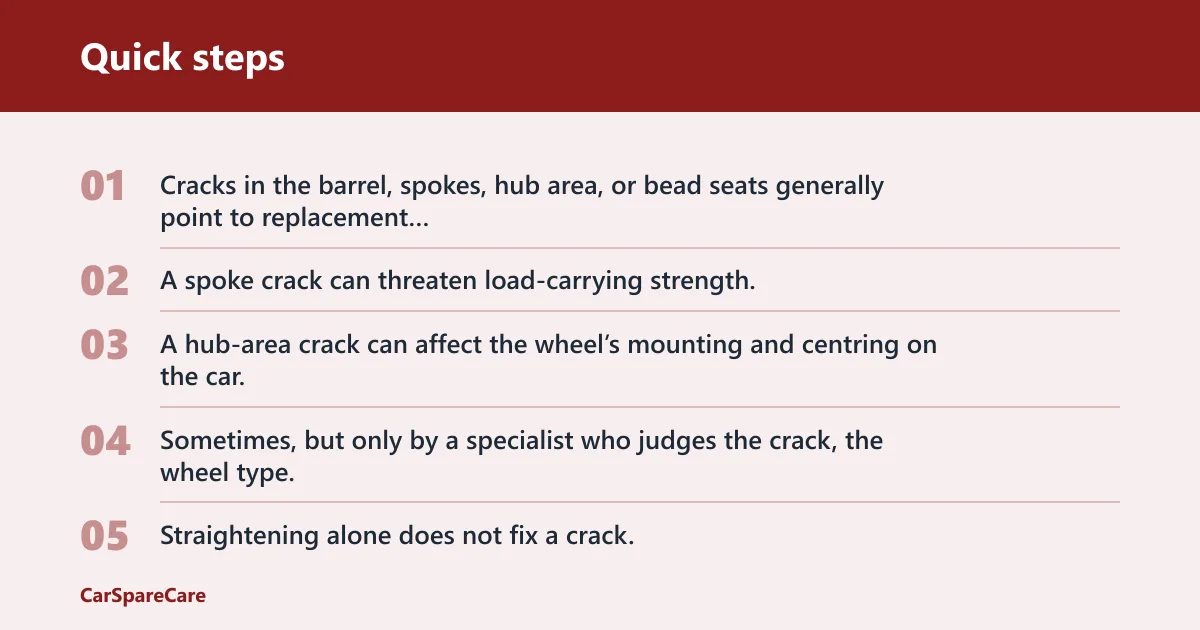
Cracks in the barrel, spokes, hub area, or bead seats generally point to replacement rather than straightening. A bead-seat crack can leak air. A spoke crack can threaten load-carrying strength. A hub-area crack can affect the wheel’s mounting and centring on the car.
Can alloy wheels be repaired if cracked? Sometimes, but only by a specialist who judges the crack, the wheel type, and the repair method. Straightening alone does not fix a crack, and a cracked wheel should not go back on the car without a clear written verdict.
Forged wheel caution
Can forged alloy wheels be repaired? Sometimes, but with more caution than cast wheels. Forged wheels may respond differently to heat and force, and some designs are less forgiving of previous damage or previous repairs. That makes a specialist review more important, not less.
Can alloy rims be straightened? The rim area can often be corrected if the bend is mild and the wheel passes inspection. The word “rim” should not distract from the real test: whether the barrel, bead seat, and mounting points are still structurally sound.
What proof should you demand before refitting?
Ask for proof that the wheel was inspected, corrected, and rechecked. The wheel should not go back on the car until the shop has confirmed acceptable workshop or manufacturer tolerance. That final check is what separates a cosmetic fix from a proper repair.
Consumer checklist for the shop
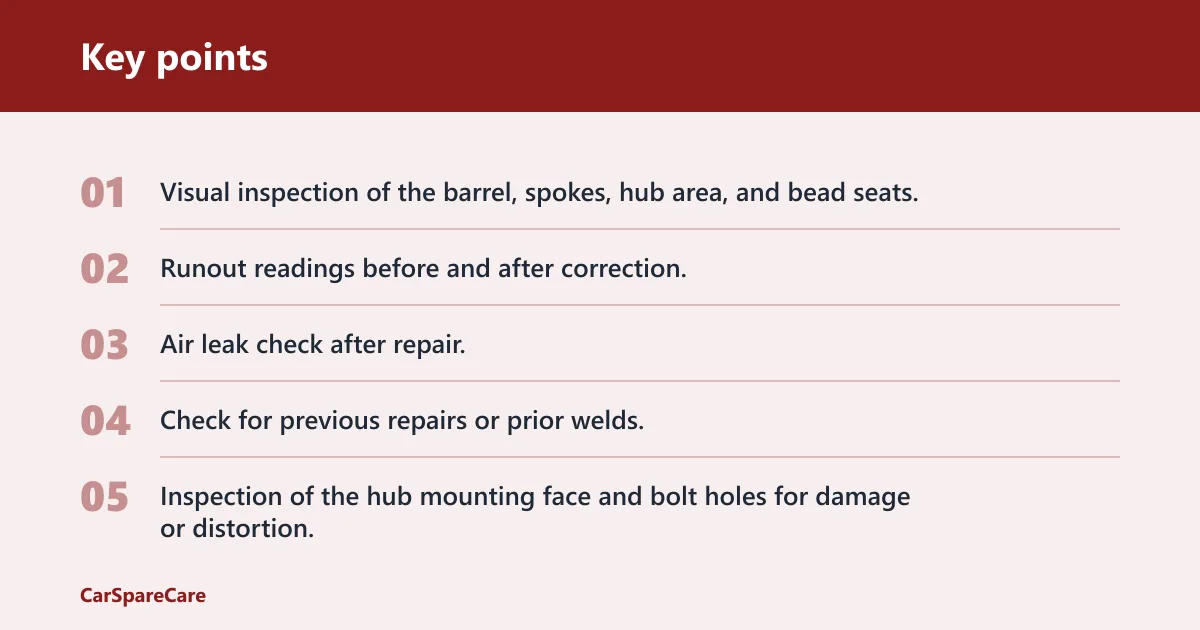
- Visual inspection of the barrel, spokes, hub area, and bead seats.
- Runout readings before and after correction.
- Air leak check after repair.
- Check for previous repairs or prior welds.
- Inspection of the hub mounting face and bolt holes for damage or distortion.
- Confirmation that the wheel meets the stated tolerance before refitting.
A wheel that passes only a visual check is not enough. Can aluminum wheels be straightened? Yes, but aluminium construction still needs measurement, leak testing, and a final tolerance check before the wheel can be trusted on the road.
Can alloy wheels be repaired at home? Not for structural bend repair. Home methods generally cannot measure runout properly, control corrective force well, or confirm whether a crack is hidden at the bead seat or spoke root.
Can alloy wheels be repaired if bent?
Yes, many bent alloy wheels can be repaired if the damage is limited and the wheel is inspected correctly. Minor radial runout, minor lateral runout, a flat spot, or an isolated buckle may be workable. Severe distortion, cracks, and damaged mounting areas usually are not.
Can bent alloy wheels be straightened? Often, yes. Can you get alloy wheels straightened? Also yes, provided the wheel has not crossed the line into structural damage or an unsafe prior repair.
Frequently asked questions
Can alloy wheels be straightened?
Yes, many can. The key is damage type, not just the fact that the wheel is bent. Minor bends with no cracks, no bead-seat damage, and no severe runout are often candidates for professional straightening, followed by measurement and tolerance checks.
Can aluminum wheels be straightened?
Yes. Many alloy wheels are aluminium-based, and aluminium construction does not rule out repair. What matters is whether the wheel is cast, forged, or spun, and whether inspection shows a repairable bend rather than a structural fault.
Can alloy rims be straightened?
Yes, if the damage is limited to a repairable bend in the rim area. The rim can be corrected only when the barrel, bead seat, and mounting face remain sound. A cracked or heavily distorted rim should move to replacement or specialist assessment.
Can alloy wheels be repaired if cracked?
Sometimes, but a crack changes the question entirely. Cracks in the barrel, spokes, hub area, or bead seat usually mean replacement rather than straightening. If welding is considered, it should be a specialist decision, not a routine add-on to a bend repair.
Can forged alloy wheels be repaired?
Sometimes, but with extra caution. Forged wheels can be stronger in some respects, yet their repair risk is more sensitive to design, prior heat, and earlier damage. A specialist should decide whether the wheel can be safely corrected, welded, or replaced.
How do you know if an alloy wheel is too damaged to straighten?
If the wheel has a crack, severe runout, damaged bead seat, distorted hub face, or damage through the spokes, it is usually too far gone for straightening alone. If a shop cannot confirm acceptable tolerance after repair, replacement is the safer next step.

Hi, I’m Melvin, an automobile engineer with extensive experience in automobile equipment. I currently work for a local automobile firm, where I specialize in the car parts industry. I’ve had the opportunity to collaborate with seasoned inspectors, gaining invaluable hands-on experience that goes beyond just theory.
My passion for automotive care started at a young age, which led me to create CarSpareCare. Through CarSpareCare, I share the knowledge and skills I’ve acquired over the years to help others navigate the world of car maintenance and repairs.
My goal is to provide practical tutorials, essential safety advice, and the latest industry insights so that anyone—whether a beginner or an expert—can confidently tackle their automotive projects.