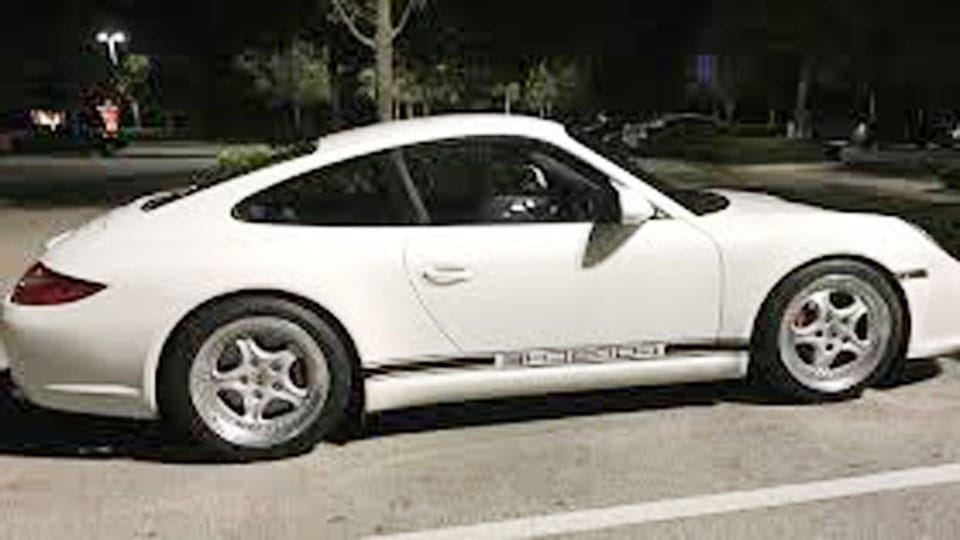
Match the bolt pattern exactly. Make the center bore equal to or larger than the hub, use rings if needed, and keep offset and width within your car’s clearance limits. Miss one check and you can end up with wheels that rub, shake, or will not mount, plus return shipping and restocking costs. This guide shows a step-by-step fitment check using your current wheel first, then bolt pattern, center bore, offset, width, and brake and suspension clearance.
Current wheel specs
Start with the wheel already on the car. Copy the factory wheel data before you compare any aftermarket option, because four critical elements decide whether a rim will fit your vehicle: bolt pattern, backspacing, offset, and center bore.
Find the OEM size in the owner’s manual, on the wheel itself, or in vehicle fitment documentation. Also note the tire size, TPMS type, and brake package, because those details can change fitment even when the bolt pattern looks right.
What measurements do I need before buying aftermarket wheels?
You need the current bolt pattern, wheel diameter, wheel width, offset, center bore, and the tire size now on the car. Add the brake package, TPMS sensor type, and whether the car uses a staggered setup. Those details let you rule out wheels that look correct but fail at the caliper, hub, or fender.
- Read the size stamping on the wheel barrel if visible.
- Check the owner’s manual or OEM documentation for factory specs.
- Record tire size and TPMS details.
- Measure current wheel offset if it is not listed.
- Compare everything to the candidate wheel before checkout.
Can the bolt pattern and lug seat match exactly?
Yes, and they both must. The bolt pattern has to match the hub exactly, including the number of lugs and the pitch-circle diameter. The lug seat also has to match the wheel and hardware, because conical, ball, and mag seats are not interchangeable.
Measure 4-, 5-, 6-, and 8-lug patterns correctly
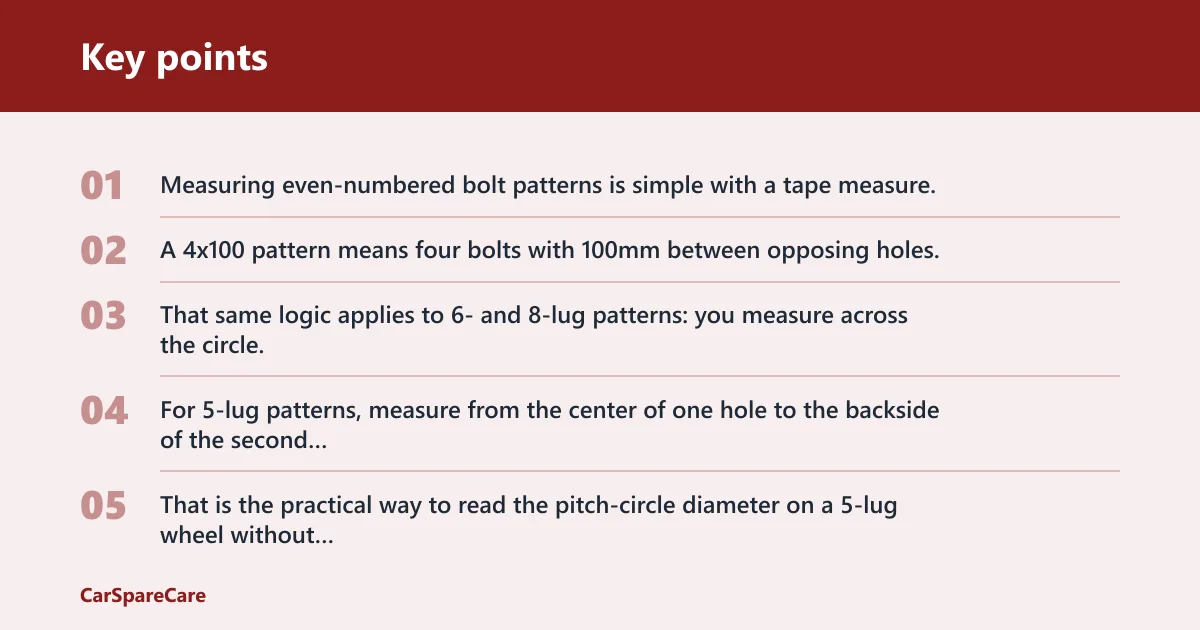
Measuring even-numbered bolt patterns is simple with a tape measure. A 4×100 pattern means four bolts with 100mm between opposing holes. That same logic applies to 6- and 8-lug patterns: you measure across the circle, not edge to edge between neighboring holes.
For 5-lug patterns, measure from the center of one hole to the backside of the second hole away. That is the practical way to read the pitch-circle diameter on a 5-lug wheel without guessing.
| Check | What to verify | Pass or fail |
|---|---|---|
| OEM specs | Factory diameter, width, offset, bolt pattern, center bore | Pass only if known |
| Bolt pattern match | Same lug count and pitch-circle diameter | Pass only if exact |
| Center bore | Wheel bore equal to or larger than hub | Pass if equal or ring-eligible |
| Lug seat type | Conical, ball, or mag seat matches hardware | Pass only if matched |
| Offset delta | Change keeps inner and outer position in range | Pass only if clearances remain |
| Width delta | Wheel width still suits tire and body space | Pass only if clearance remains |
| Brake clearance | Caliper, spoke, and barrel clear the brake package | Pass only if no contact point |
| Inner suspension clearance | A-arms, shocks, springs, tie rods clear at full lock | Pass only if no rub |
| Outer fender clearance | Wheel and tire stay inside body limits | Pass only if no poke rub |
| TPMS compatibility | Sensor type and valve hardware match | Pass only if compatible |
| Hub-centric ring need | Ring can center a larger bore on the hub | Pass only if bore is larger |
| Final test-fit | Wheel clears before full mounting | Pass only if verified |
Match the lug seat type before you buy
The seat shape matters because the lug nut contacts the wheel through that taper or radius. If the seat type is wrong, the wheel may not center correctly or may loosen in service. Check the wheel spec sheet and match it to the hardware the car requires.
Can I use wheels from another car on mine? Sometimes, but only if bolt pattern, center bore, offset, width, and lug seat all fit your hub and braking package. A matching bolt pattern alone is not enough.
Wheel fitment checklist
Use this in order. Treat the first hard failure as a stop sign. A wheel can pass the bolt pattern check and still fail on offset, brake clearance, or tire clearance.
- Confirm OEM size and specs from the manual or wheel stamping.
- Match bolt pattern exactly.
- Confirm center bore is equal to or larger than the hub.
- Confirm lug seat type matches the hardware.
- Compare offset to the current wheel.
- Compare width to the current wheel.
- Check brake-caliper clearance.
- Check inner suspension clearance.
- Check outer fender clearance.
- Verify TPMS compatibility.
- Decide whether hub-centric rings are needed.
- Perform a final test-fit before full installation.
Say your car uses 5×114.3 wheels now and you find a 5×114.3 aftermarket wheel with the right bore. If the offset pushes the barrel inward by a large amount, the wheel can still hit the strut or control arm even though the bolt pattern is correct. That is why the checklist runs in order.
How do offset and width change fitment?
Offset is the distance from the hub mounting surface to the wheel centerline, and it can be positive, negative, or zero. Positive offset moves the wheel inward. Negative offset moves it outward. Width changes where the inner and outer edges sit, so offset and width have to be compared together in millimeters.
Compare offset in millimeters, not guesses
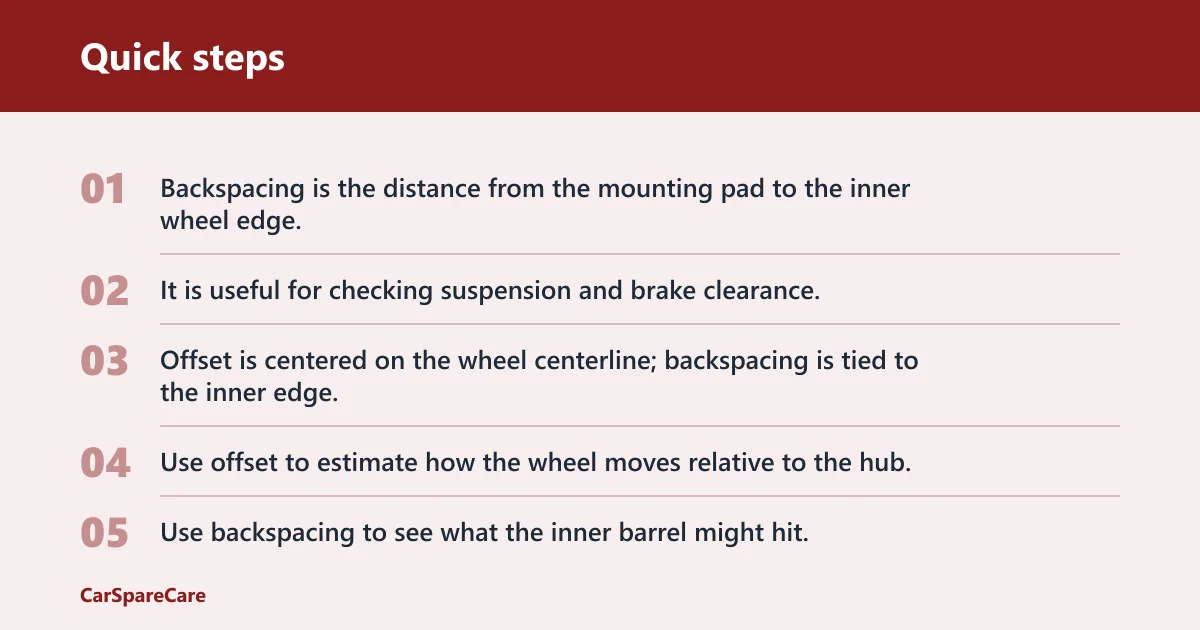
Backspacing is the distance from the mounting pad to the inner wheel edge. It is useful for checking suspension and brake clearance, but it is not the same thing as offset. Offset is centered on the wheel centerline; backspacing is tied to the inner edge.
Use offset to estimate how the wheel moves relative to the hub. Use backspacing to see what the inner barrel might hit. Too much backspacing can hit suspension. Too little can move the wheel outward enough to rub the fender.
Worked offset and width example
Suppose the current wheel is 8.0 inches wide with +40 mm offset. You want to move to 8.5 inches wide with +30 mm offset. The width increases by 12.7 mm overall, so about half of that change, 6.35 mm, goes inward and 6.35 mm goes outward before offset is considered.
In this example, a 10 mm less-positive offset would move the whole wheel about 10 mm outward. Combine the two changes and the inner edge moves about 3.65 mm outward, while the outer edge moves about 16.35 mm outward. That means a little more inner room, but noticeably more poke and a greater chance of fender contact.
A common first-timer mistake is to focus only on wheel diameter and ignore offset, which can leave the new wheels rubbing the fenders or suspension. Suppose an SUV owner moves from an 8-inch wheel to a 9-inch wheel and keeps the same offset. The wheel grows 12.7 mm wider, and the extra half-width appears on both sides. If the tires already sit close to the liner, that extra space can disappear fast at full steering lock.
Will bigger wheels fit if the bolt pattern matches? Not automatically. Diameter must still clear the brakes, width must suit the tire, and the offset must keep the wheel away from suspension parts and the outer fender.
Will the brakes and suspension clear?
Brake calipers are often the first hard stop, especially on the front axle. Even when the bolt pattern matches, the spoke shape, barrel profile, and wheel diameter can still fail at the caliper. Suspension components matter too: A-arms, shocks, mounts, tie rods, and springs all need room at full lock and through compression.
Check caliper clearance first
Brake clearance is a hard-fit check, not a guess. Larger wheels may be required, but spoke design can matter even when diameter and offset look correct. A wheel with the right size on paper can still touch a tall caliper bridge or a spoke pocket.
Check suspension at full lock and compression
Summit Racing also lists common interference points like A-arms, brake calipers, inner fenders, and outer fenders, and says to measure support points on a level surface with the vehicle on jack stands.
Turn the steering to full lock in both directions, then check for clearance between the tire and tie rod ends, shocks, springs, and liners. If possible, compress the suspension or mimic compression to see where contact starts before the wheel is fully mounted.
Do you need hub-centric rings or spacers?
Use hub-centric rings only when the wheel center bore is larger than the hub. They can help center the wheel and may reduce vibration risk, but they do not fix the wrong bolt pattern, the wrong offset, or the wrong lug seat. If the bore is too small, the wheel will not fit the hub.
Separate rings, spacers, and adapters
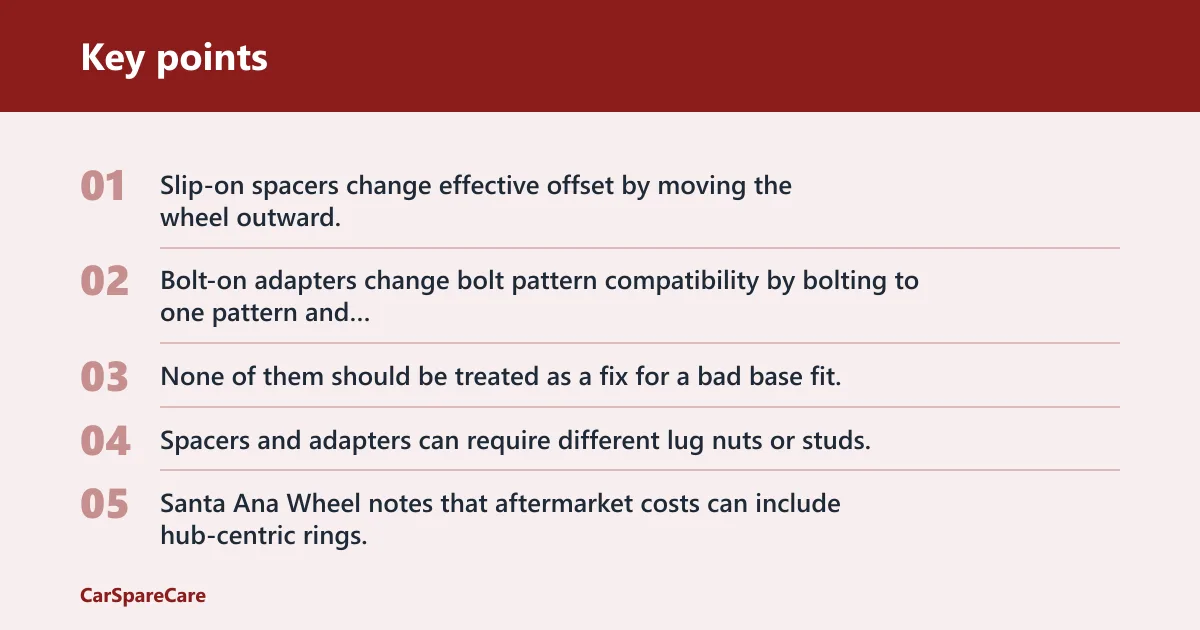
Hub-centric rings are a centering aid. Slip-on spacers change effective offset by moving the wheel outward. Bolt-on adapters change bolt pattern compatibility by bolting to one pattern and offering another. None of them should be treated as a fix for a bad base fit.
Watch thread engagement closely. Spacers and adapters can require different lug nuts or studs, and extended lug nuts may be needed. Santa Ana Wheel notes that aftermarket costs can include hub-centric rings, new TPMS sensors, and extended lug nuts. That extra hardware can affect both budget and timing.
TPMS compatibility matters too. Some aftermarket wheels need new TPMS sensors or different valve hardware, so check the sensor type before checkout. Otherwise the wheel may fit physically but still create a sensor warning or a shop delay.
Final test-fit guidance
Do a dry test-fit before mounting both tires if possible. Seat the wheel, hand-thread the lug nuts, and confirm the barrel, spokes, and rear face clear the hub, brakes, and suspension. After installation, torque to the vehicle spec and recheck torque after the first drive, because vibration often shows up only after load and heat cycles.
Frequently asked questions
Can I use wheels from another car on mine?
Only if the bolt pattern, center bore, offset, width, and lug seat all work on your vehicle. A wheel from another car can share the same lug count and still fail because the hub bore is wrong or the offset pushes the barrel into the suspension. Cross-fit wheels need a full check, not a quick glance.
Do I need hub-centric rings for aftermarket wheels?
Need them only when the wheel’s center bore is larger than the hub and the ring is designed to fit that gap. They help center the wheel and can reduce vibration risk. They do not fix the wrong bolt pattern, and they do not correct a wheel that sits too far in or out.
Will bigger wheels fit if the bolt pattern matches?
No. Bigger diameter may clear the hub pattern but still fail at the brake caliper, inner suspension, or outer fender. Width and offset also change the tire’s position. The wheel has to clear the car at full lock and under compression, not just bolt onto the hub.

Hi, I’m Melvin, an automobile engineer with extensive experience in automobile equipment. I currently work for a local automobile firm, where I specialize in the car parts industry. I’ve had the opportunity to collaborate with seasoned inspectors, gaining invaluable hands-on experience that goes beyond just theory.
My passion for automotive care started at a young age, which led me to create CarSpareCare. Through CarSpareCare, I share the knowledge and skills I’ve acquired over the years to help others navigate the world of car maintenance and repairs.
My goal is to provide practical tutorials, essential safety advice, and the latest industry insights so that anyone—whether a beginner or an expert—can confidently tackle their automotive projects.