
A power steering leak at the pump usually comes from a worn shaft seal, loose or damaged hose fitting, cracked reservoir, or the pump housing itself; inspect the wet point first, before you replace the pump. Leave it alone and you can lose assist, run the pump low on fluid, and turn a small seal job into pump damage. This guide shows how to tell each source apart and decide which part actually needs replacement.
This guide is part of our Power steering and brake problems series.
How to identify the leak source
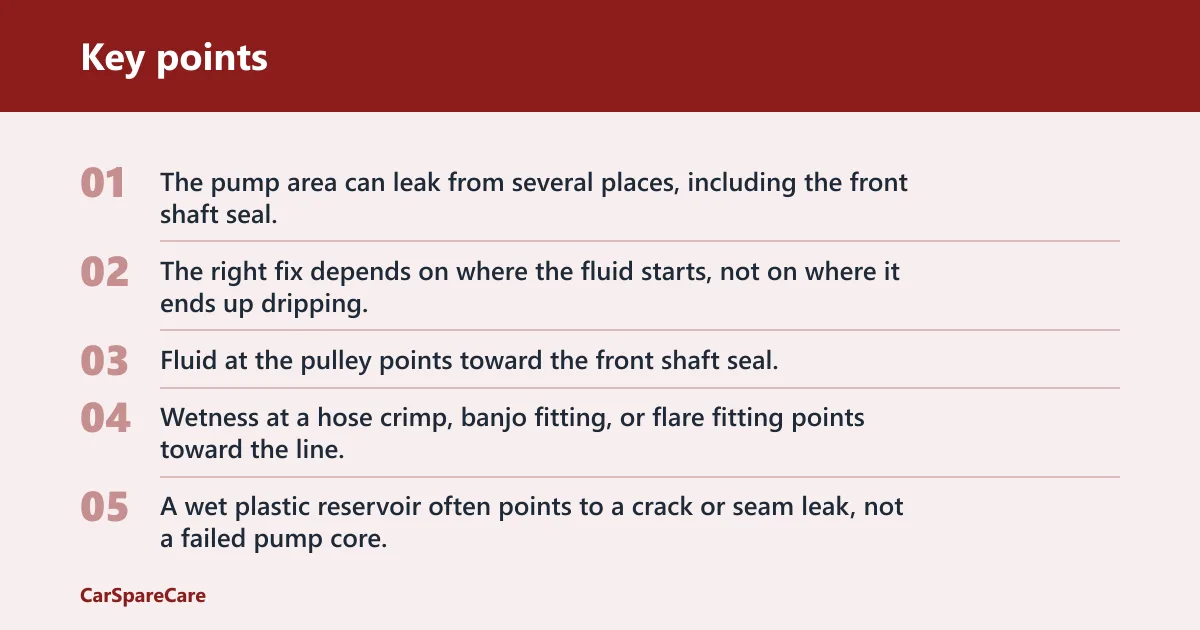


The pump area can leak from several places, including the front shaft seal, the reservoir body or seam, the pressure line connection, the return line connection, or the housing and gasket surfaces. The right fix depends on where the fluid starts, not on where it ends up dripping.
A pump leak usually leaves a pattern. Fluid at the pulley points toward the front shaft seal. Wetness at a hose crimp, banjo fitting, or flare fitting points toward the line. A wet plastic reservoir often points to a crack or seam leak, not a failed pump core.
Low fluid changes the system quickly. You may hear whining, feel heavier steering at low speed, or notice a foamy look in the reservoir from aeration. Foam means the pump is pulling air, which can make noise and reduce assist even before the level drops far enough to show a puddle.
Pump leak decision table
| Symptom pattern | Most likely source | What to check first | Most likely fix |
|---|---|---|---|
| Wet pulley, fluid on belt, sling on nearby parts | Front shaft seal | Area behind the pulley and the pump nose | Reseal or replace the pump |
| Wet hose crimp, damp fitting, drip at the line end | Pressure hose or return hose connection | Crimp sleeve, banjo bolt, flare seat, clamp | Hose or fitting repair |
| Reservoir seam wetness, plastic crack, damp cap area | Reservoir body, seam, O-ring, or cap vent | Upper seam, molded corner, cap seal, vent path | Reservoir or seal repair |
| Whine, belt slip, pulley wobble, repeated leak after repair | Bearing play or misalignment causing seal damage | Pulley runout, shaft play, bracket alignment | Pump replacement is often the better call |
Say your reservoir is damp at the top seam, but the pulley stays dry. That points away from the shaft seal and toward the reservoir body, cap vent, or the reservoir-to-pump connection. Replacing the whole pump in that case can waste time and money.
How do you tell the pump from the hose?
Trace the fluid trail upward and downward. A pump leak starts at the pump body or front seal, then spreads across the pulley, belt, and nearby housing. A hose leak usually starts at the line, then runs along the hose before dripping at the lowest point.
Start with the pressure line and return line connections. Look for a wet crimp sleeve, a damp banjo fitting, or a flare fitting that stays shiny after cleaning. High-pressure hose leaks often show heat hardening near the fitting first, then seepage at the crimp or bend.
The return hose is different. It runs at low pressure, so it often seeps from a loose clamp, aged rubber, swelling at the hose end, or small age cracks. The leak may look minor, but the hose can wet the subframe and make the pump area look guilty.
Check the trail direction before you buy parts. Fluid that starts above the pump and runs down the housing can mimic a pump body leak. Fluid that starts at the hose and travels back along the metal line can fool you into blaming the reservoir.
Step-by-step isolation check
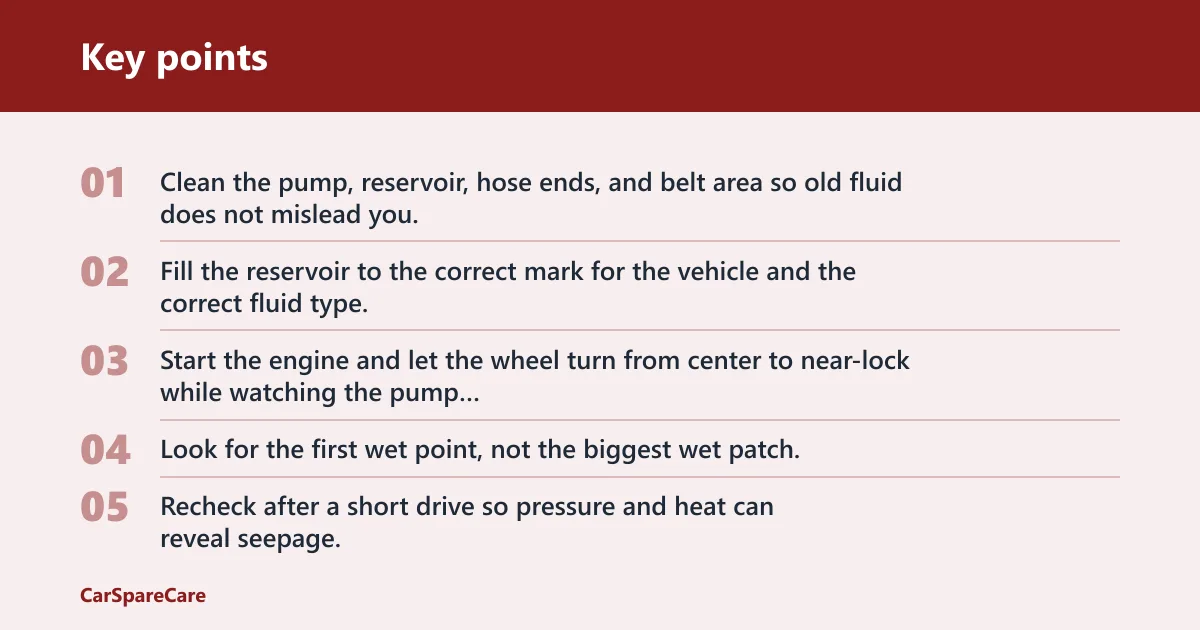
- Clean the pump, reservoir, hose ends, and belt area so old fluid does not mislead you.
- Fill the reservoir to the correct mark for the vehicle and the correct fluid type.
- Start the engine and let the wheel turn from center to near-lock while watching the pump nose and line connections.
- Look for the first wet point, not the biggest wet patch.
- Recheck after a short drive so pressure and heat can reveal seepage.
A common first-timer mistake is replacing the pump because the pulley area is wet. If the wetness begins at the hose crimp and is blown rearward by the belt, the pulley just collects the spray. That is a hose problem until proven otherwise.
What does a bad shaft seal look like?
A worn pump shaft seal usually leaks at the front of the pump, where the shaft exits behind the pulley. The classic pattern is fluid on the pulley hub, sling marks on the belt guard or nearby parts, and a wet ring around the pump nose.
Fluid on the pulley and belt
When the shaft seal fails, the pulley can throw fluid outward as it spins. That leaves a fan-shaped spray pattern. It also contaminates the serpentine belt, which can slip and squeal under load. Once the belt is soaked, the noise can continue even after a small top-up of fluid.
Noise that changes with steering load
Whining that gets louder when you turn the wheel often means the pump is low on fluid, pulling air, or wearing internally. If the noise changes with steering load and the front of the pump is wet, the seal and the pump bearings deserve close inspection.
Bearing play and pulley wobble
Pulley wobble is a warning sign. Bearing play or misalignment can let the shaft move off center, which can damage the front seal and cause repeat leaks. If the pulley does not spin true, resealing the pump may only postpone the same failure.
Picture a compact car that whines only when parking and leaves oily marks on the inner fender. If the pulley has visible side-to-side wobble, the seal may not be the only problem. A bad bearing can be the reason the seal failed in the first place.
Can the reservoir leak instead of the pump?
Yes. A reservoir leak can look like a pump leak because the reservoir sits right on or above the pump on many vehicles. Plastic cracks, seam seepage, O-ring leaks at the reservoir joint, and cap vent problems can all leave the pump area wet without a failed pump core.
Plastic cracks and seam seepage
Plastic reservoirs can crack near mounting points, around molded corners, or along the seam where the halves join. Seepage is often slow, so the outside of the reservoir stays damp while the pulley and shaft area remain mostly dry.
O-ring leaks at the reservoir joint
Some reservoirs seal to the pump with an O-ring. If that O-ring hardens or shifts, fluid can seep around the joint and run down the pump body. Clean the area, then watch whether the wetness starts at the seam or at the shaft opening.
Cap vent problems that leave the area wet
A bad cap vent can push mist or fluid out of the reservoir neck. That leaves wetness around the cap and the top of the reservoir, especially after hot driving. It can look messy enough to blame the pump, but the source is higher up.
When should you reseal or replace the pump?
Choose the repair that matches the source. If the leak is only at the front seal and the pulley spins true with no bearing play, a reseal can make sense. If the hose, fitting, or reservoir is the real source, the pump itself may not need replacement.
When a reseal makes sense
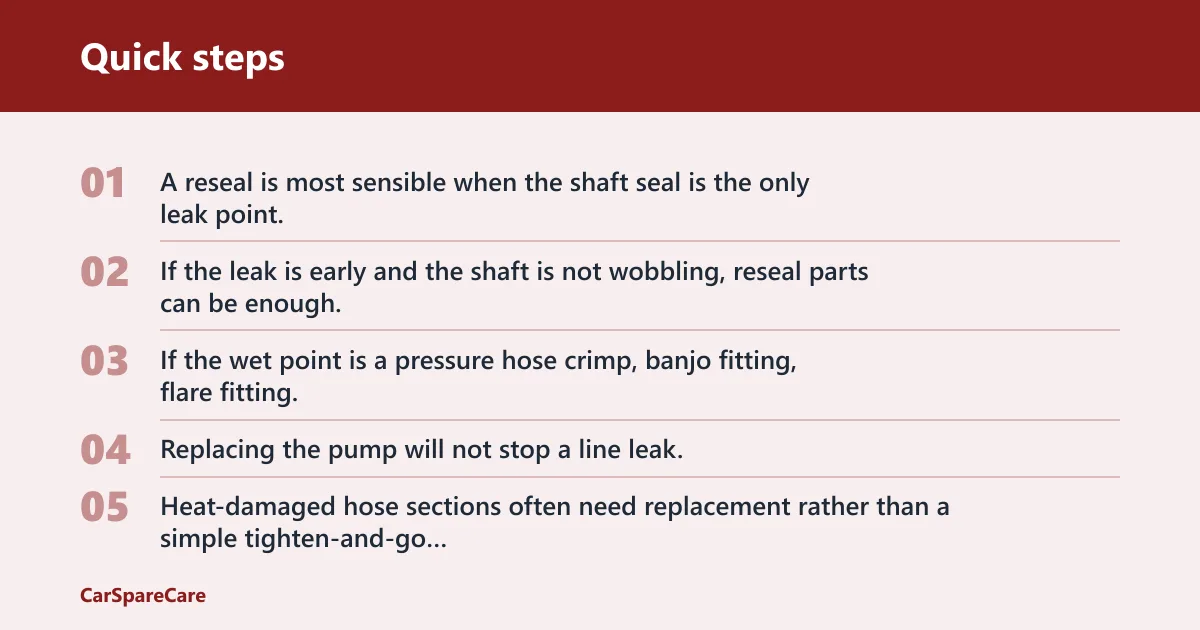
A reseal is most sensible when the shaft seal is the only leak point, the housing and gasket surfaces are dry, and the pulley bearing feels tight. If the leak is early and the shaft is not wobbling, reseal parts can be enough.
When a hose or fitting repair is enough
If the wet point is a pressure hose crimp, banjo fitting, flare fitting, or a return hose clamp, fix that part first. Replacing the pump will not stop a line leak. Heat-damaged hose sections often need replacement rather than a simple tighten-and-go repair.
When pump replacement is the better call
Replace the pump if the pulley wobbles, the bearing is noisy, the shaft seal keeps leaking after repair, or the housing has a crack. Repeated seal failure often means internal wear or misalignment, not just a tired seal.
The fluid type matters, too. Use the correct power steering fluid for your vehicle, not a random generic bottle. Wrong fluid can affect seal compatibility, aeration, and cold-weather behavior. That matters when you are trying to stop a leak without creating another one.
For Los Angeles drivers, Carotech Automotive is listed at 8687 West Pico Boulevard with Monday through Friday hours from 7:00 AM to 5:00 PM, a phone number for bookings and estimates, and 1082 reviews. That helps if you want a local inspection after you have traced the leak path yourself.
Driving with a small leak can be temporary, but only if fluid stays at the correct mark and the belt stays dry. Let it run low and the pump can whine, lose assist, and wear itself harder. A small seep becomes a bigger repair fast when air and heat join in.
Frequently asked questions
What causes a power steering pump leak?
Common causes include a worn front shaft seal, a cracked reservoir, a loose or damaged hose connection, or seepage at the pump housing and gasket surfaces. A pulley that wobbles or a bearing that plays can make the leak return even after a seal repair.
How do I tell if the pump is leaking or the hose is leaking?
Start at the highest wet point and follow the trail. A pump leak usually starts at the shaft, reservoir joint, or housing. A hose leak usually starts at the crimp, clamp, banjo fitting, or flare fitting and runs along the line before dripping lower down.
Can I keep driving with a small power steering leak?
Only for a short time, and only while the level stays within the marks and the steering stays normal. If the fluid drops, the pump can suck air, whine, and lose assist. Fluid on the belt also raises the chance of slip and secondary damage.
How much does it cost to fix a power steering pump leak?
Cost depends on the source. A hose or fitting repair can be much less than a pump replacement, while a reseal sits in between if the pump body and bearing are still sound. The key cost decision is whether the leak is external plumbing or an internal pump fault.
Why is my power steering pump leaking after a recent repair?
Repeat leakage often points to an overlooked wobble, a weak bearing, the wrong fluid, or a nearby hose that was never the real source. It can also mean the seal was replaced, but the shaft surface is worn enough that the new seal cannot hold.
Where do power steering pumps leak from?
They usually leak from the front shaft seal, the reservoir seam or O-ring, the pressure line connection, the return line connection, or the housing and gasket surfaces. The wet pattern tells you which of those points is active, so you can avoid replacing the wrong part.

Hi, I’m Melvin, an automobile engineer with extensive experience in automobile equipment. I currently work for a local automobile firm, where I specialize in the car parts industry. I’ve had the opportunity to collaborate with seasoned inspectors, gaining invaluable hands-on experience that goes beyond just theory.
My passion for automotive care started at a young age, which led me to create CarSpareCare. Through CarSpareCare, I share the knowledge and skills I’ve acquired over the years to help others navigate the world of car maintenance and repairs.
My goal is to provide practical tutorials, essential safety advice, and the latest industry insights so that anyone—whether a beginner or an expert—can confidently tackle their automotive projects.

