
Use your owner’s manual first: follow its service intervals or maintenance minder, and use generic checks only for items the manual leaves to inspection. Check tires, lights, and fluids once a month. Plan oil service and tire rotation about every 5,000 to 10,000 miles if that fits the manual. Ignore maintenance, and you risk tire failure, overheating, poor braking, lower fuel economy, and repair bills that climb fast. This guide sorts car care into what to inspect, what to replace, what you can handle at home, what needs a mechanic, and when the manual overrides mileage rules.
How should you use this car maintenance guide


Use the owner’s manual as the controlling reference for service intervals, fluid specs, capacities, and model-specific service items. Use generic mileage advice only when the manual is missing or vague, split each task into inspect-now or replace-now, and move service earlier if your driving includes short trips, towing, dusty roads, freezing weather, extreme heat, or long idle time.
Start with the manual, then fill gaps
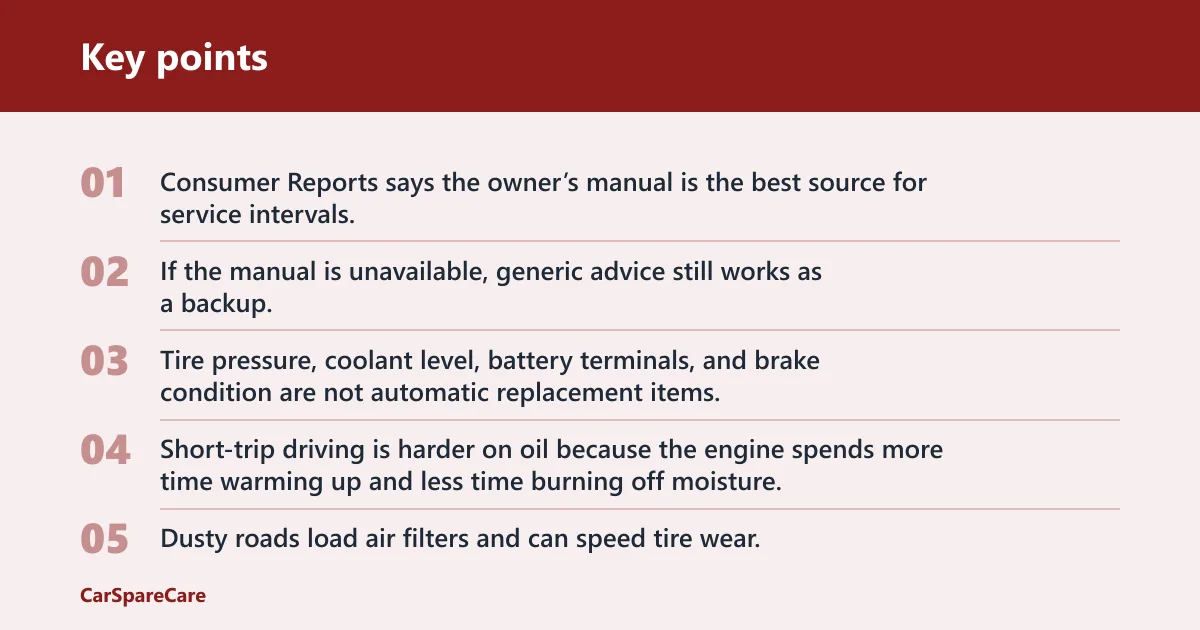
Consumer Reports says the owner’s manual is the best source for service intervals. That matters because the manual does more than list mileage. It also gives the correct oil grade, coolant specification, fluid capacities, the tire-rotation pattern when applicable, and any service items a generic checklist can miss.
If the manual is unavailable, generic advice still works as a backup. Use it to decide what needs inspection now, then confirm the exact service spec before you add parts or fluids to the vehicle.
Separate inspection from replacement
Many maintenance tasks start as inspections. Tire pressure, coolant level, battery terminals, and brake condition are not automatic replacement items. They become replacement items only when you reach a listed interval, see wear, measure a problem, or have a symptom that matches the part.
That split helps you avoid replacing parts early. It also keeps you from delaying the few jobs that can cause major damage if missed, such as a timing belt on an engine that requires scheduled replacement.
Adjust for severe use
Short-trip driving is harder on oil because the engine spends more time warming up and less time burning off moisture. Dusty roads load air filters and can speed tire wear. Towing, extreme heat, freezing weather, and long idle time all count as tougher service than steady highway use.
If a car covers only a few miles at a time in winter and rarely gets fully warm, odometer mileage matters less. In that case, calendar time and the manual’s severe-use notes matter more than a generic internet claim that mileage alone decides everything.
What maintenance should you do monthly?
Monthly maintenance should center on items that can change quickly and that you can verify without taking anything apart: tire pressure, tread condition, visible tire damage, engine oil level, coolant reservoir level with the engine cold, battery-terminal condition, lights, and wiper performance. These checks catch problems early without turning the month into a full service session.
Tire pressure, tread, and visible damage
DriveVX frames maintenance into daily, monthly, quarterly, semi-annual, and annual buckets, and it says monthly checks should include tire pressure. Use a gauge, not a visual guess. Temperature swings change pressure, so a tire that looked fine last week can be low after a cold night.
Underinflation increases shoulder wear and hurts fuel efficiency. Look for cuts, bulges, exposed cords, nails, and uneven tread wear that may point to alignment or suspension trouble.
- Check cold pressure. Measure tire pressure before driving or after the car has been parked long enough to cool. Compare the reading with the door-jamb placard, not the maximum pressure molded into the tire sidewall.
- Inspect tread faces. Look across the inner edge, center, and outer edge of each tire. Uneven wear patterns matter because they change the next decision: air adjustment, rotation, alignment check, or tire replacement.
- Scan sidewalls. Check for bulges, cracks, and impact damage. A damaged sidewall is a replace-now issue, not a monitor-it issue.
Oil level, coolant reservoir, and leaks
Engine oil service intervals vary by vehicle, but oil-level checks are simple and worth doing monthly. Check coolant at the reservoir only when the engine is cold, as DriveVX advises. Also look under the parked vehicle for fresh fluid spots and around the engine bay for wet areas or crusted residue.
- Park on level ground. A level surface gives a more reliable dipstick reading and reservoir view. Shut the engine off and follow the manual’s check procedure.
- Read the dipstick. Pull it, wipe it, reinsert it fully, then read the level. If it is low, add only the oil grade the manual specifies, and do not judge oil condition by color alone.
- Check coolant cold. Read the translucent reservoir markings only when the engine is cold. If the level keeps dropping, inspect for the cause before topping off again, because repeated loss points to a leak.
Say your dipstick reads near the low mark after two months of mostly short trips, but the engine runs normally and no warning light is on. That calls for inspection and a top-off with the correct oil, not proof that an immediate full oil change is due.
Battery terminals, lights, and wipers
Battery terminals belong on a monthly or quarterly checklist. Look for white or blue-green corrosion, loose clamps, and damaged cable insulation. Test all exterior lights while the car is parked, and replace wiper blades when they crack, chatter, or streak.
The same source says wipers should be replaced at least once per year. This is one of the easiest DIY jobs on the car.
What should you service by mileage and by time?
Use mileage to plan wear items and scheduled service, but keep time in the schedule because some fluids age and some low-mileage cars still need annual attention. A practical plan starts with oil service and tire rotation, adds brake inspections and replacement as wear demands, and then covers higher-mileage items such as timing belts, coolant service, and spark plugs.
Oil service and tire rotation
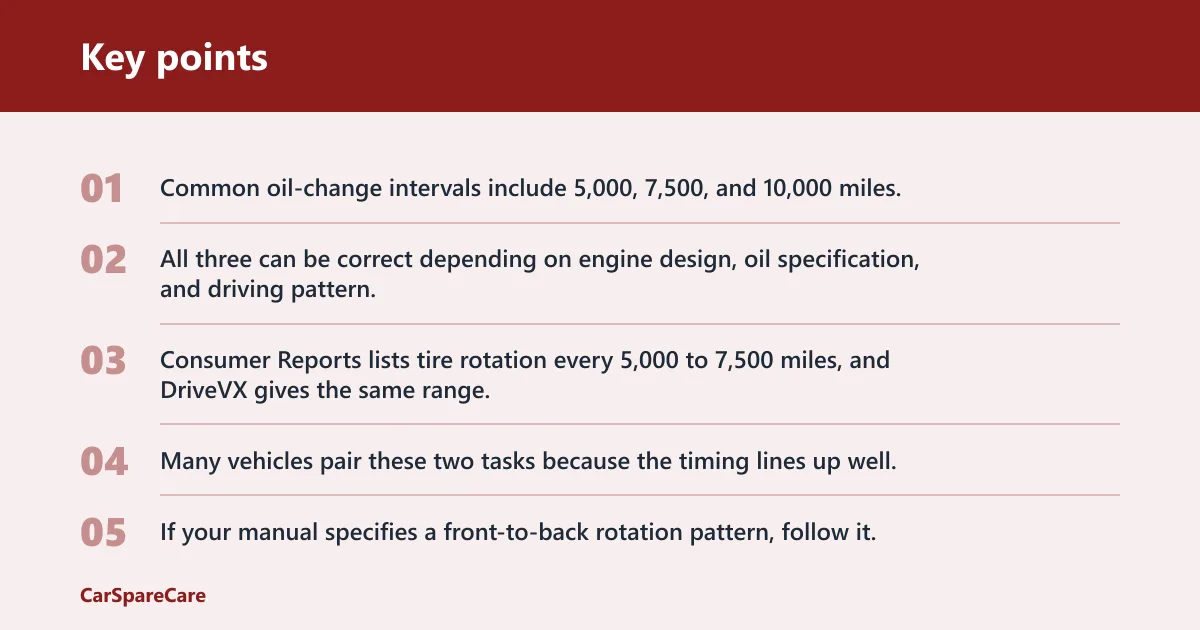
Common oil-change intervals include 5,000, 7,500, and 10,000 miles. All three can be correct depending on engine design, oil specification, and driving pattern. The same source lists tire rotation every 5,000 to 7,500 miles, and DriveVX gives the same range.
Many vehicles pair these two tasks because the timing lines up well. If your manual specifies a front-to-back rotation pattern, follow it. If it lists a different pattern because of tire type or driveline layout, the manual wins.
Brake pads, rotors, and inspection timing
Inspect brakes at every oil change even though replacement is less frequent. Brake pads and rotors are typically replaced at 25,000 to 50,000 miles, but actual wear changes with traffic, hills, towing, driving style, and pad material.
Squeal alone is not enough to plan the whole job. Inspection should check pad thickness, rotor surface condition, pulsation, pulling, grinding, heat cracks, and whether the hardware slides freely. Pads and rotors are often replaced together because a worn rotor can shorten pad life and affect braking feel.
Timing belt, coolant, and major interval work
Timing belts are listed at 60,000 to 120,000 miles. Treat this as replace-now when the manual calls for it, because waiting can lead to major engine damage on some designs. Do not substitute internet folklore for the model-specific interval.
The same source gives coolant flush intervals of up to 100,000 miles. The correct coolant type matters as much as the interval, because mixing the wrong chemistry can create corrosion or sealing problems. Verify both service timing and the exact fluid specification in the manual.
Spark plugs and age-related items
The same source says spark plugs usually last around 100,000 miles. That is common on modern engines, but plug type and engine design still matter, so use the manual for the exact schedule. Wipers, battery condition, and tires may need attention earlier than high-mileage service items because rubber and electrical parts age with time.
How often should you change engine oil?
Check the level by dipstick between services, and use time as a backstop if the car sees light annual mileage, repeated short trips, or long storage periods.
Why several oil intervals can all be right
There is no single universal oil-change number that fits every vehicle. Oil life depends on the engine, the specified oil, operating temperature, load, and driving pattern. A newer car with a maintenance minder may safely go farther than an older vehicle used for short, cold trips.
When the manual and a generic online rule disagree, follow the manual unless there is a separate severe-use note that clearly matches your driving.
How to check the dipstick properly
- Confirm the procedure. Read the manual first because some engines have specific wait times or electronic level checks. That prevents a false low or false high reading.
- Wipe and reread. Pull the dipstick, wipe it clean, reinsert it fully, and read the oil level between the marks. A single smear from the first pull is less reliable than the second reading.
- Add the correct oil. If topping off is needed, use the exact viscosity and specification listed in the manual. Recheck after adding because overfilling can be as unhelpful as running low.
When time matters more than mileage
A low-mileage car can still need annual attention. Oil contamination from repeated cold starts, moisture, and long idle periods does not care that the odometer barely moved. This is where calendar guidance in the manual matters more than broad advice pulled from forums or old habit.
Which maintenance jobs can you do at home?
The best home tasks are low-risk checks and simple replacements: tire pressure, fluid-level checks, wiper blades, light checks, and battery-terminal cleaning if corrosion is mild. Oil changes and wheel-off inspections are possible with care, while brake work, coolant exchange, transmission service, and timing-belt replacement are usually better left to a mechanic.
Good DIY jobs
- Tire pressure checks with a gauge
- Visual tread and sidewall inspections
- Wiper blade replacement
- Washer-fluid refill
- Battery-terminal inspection and light cleaning
- Engine oil level and coolant reservoir checks
DIY with caution
Oil changes, engine air filters, cabin filters, and wheel-off inspections sit in the middle. They are realistic for many owners, but only if you can support the vehicle correctly, torque wheels to spec, reset the maintenance reminder where needed, and dispose of oil or filters legally.
A common first-time mistake is lifting one corner on an uneven driveway, removing a wheel for a brake look, and then guessing at wheel-nut tightness during reassembly. If the job depends on safe lifting, torque specs, or bleeding procedures, it stops being a casual driveway task.
Usually better for a mechanic
Brake pad and rotor replacement, coolant exchange, automatic-transmission service, clutch work, timing-belt replacement, and any repair that needs bleeding, scan-tool calibration, or exact torque sequences are best delegated. The line is simple: if a mistake can affect stopping, steering, engine timing, or fluid sealing, professional service is the safer call.
Maintenance decision table
Use this table to decide what matters now. “Inspect trigger” tells you when to check. “Replace trigger” tells you when action stops being optional. “DIY confidence” is about risk and tool demands, not whether the part looks simple.
| Task | Inspect trigger | Replace trigger | DIY confidence | Risk of waiting too long |
|---|---|---|---|---|
| Engine oil | Monthly level check by dipstick; sooner for short-trip or heavy-use driving | At the manual or maintenance-minder interval; common intervals include 5,000, 7,500, and 10,000 miles | Medium for oil change; high for level check | High: accelerated wear, sludge, overheating risk |
| Coolant | Monthly reservoir check when engine is cold; inspect sooner if level drops or sweet smell appears | At the manual interval; some flush intervals reach up to 100,000 miles | High for level check; low for full exchange | High: overheating, corrosion, leak damage |
| Tire pressure | Monthly with a gauge and after major temperature swings | Replace tire if sidewall is damaged, cords show, or wear is unsafe | High | High: blowout risk, uneven wear, lower fuel efficiency |
| Tire rotation | At each oil-service planning point | Service due every 5,000 to 7,500 miles, following the manufacturer pattern | Medium | Medium: shortened tire life, uneven wear |
| Brake pads and rotors | Inspect at every oil change and any time braking noise, pull, vibration, or grinding appears | Typical replacement range is 25,000 to 50,000 miles; replace sooner if worn or damaged | Low | High: poor braking, rotor damage, unsafe stopping |
| Spark plugs | Inspect when misfire, rough running, or poor acceleration appears, or at scheduled service planning | Around 100,000 miles on many vehicles, per engine-specific schedule | Medium to low depending on engine access | Medium: misfire, poor performance, possible coil stress |
| Timing belt | Review schedule long before due mileage; inspect if the manual calls for related component checks | At 60,000 to 120,000 miles per the owner’s manual | Very low | Very high: possible major engine damage |
| Battery terminals | Monthly or quarterly for corrosion and tightness | Clean or service when corrosion builds or the connection loosens; replace battery by test result, not terminal appearance alone | High for inspection and mild cleaning | Medium: no-starts, charging issues |
| Wiper blades | Monthly visual and performance check | At least once per year or earlier if cracked or streaking | High | Medium: poor wet-weather visibility |
What if your owner’s manual conflicts with common advice?
When the owner’s manual gives a clear interval, fluid specification, or maintenance-minder rule, it should override broad internet advice. Generic mileage rules are fallbacks, not primary authority. The main exceptions are simple calendar-based inspections, such as monthly tire pressure and annual wiper attention, which still matter even on low-mileage cars.
When the manual should win
If the manual specifies a coolant type, capacity, or service note, that is the rule to follow. The same goes for timing belts, transmission service language, and any maintenance minder system built into the vehicle. Internet advice often strips away the model-specific details that actually decide service timing.
How maintenance minders fit
Newer vehicles may calculate service need from temperature, driving style, trip length, and other operating conditions. That is more useful than a fixed mileage sticker when the system is working normally and the vehicle is operated as designed.
Still, a minder does not replace visual checks. Tire pressure, tire damage, coolant level in the cold reservoir, battery corrosion, wiper condition, and fluid leaks should still be checked on a calendar basis.
When common advice still helps
If the manual is missing, vague, or only tells you to inspect, common intervals give you a starting point for questions to ask. They are especially helpful for used-car buyers who need to sort immediate safety items from things that can wait for a planned shop visit.
Are car maintenance plans worth it?
Maintenance plans are worth considering only if the included services match the car’s actual schedule, your annual mileage, and how long you expect to keep it. Compare the plan against a 12-month service bundle, check exclusions and transfer rules, and be careful with plans that prepay for services your car may not need soon.
What most plans include and exclude
Many prepaid plans center on oil service, tire rotation, and inspections. Some add cabin or engine air filters. Wear items such as tires, brakes, batteries, and wiper blades are often excluded or only partly covered. Timing-belt work and transmission service may be excluded entirely.
Compare against a 12-month service bundle
Build a plain one-year forecast from the manual and your mileage. For many drivers, that bundle is monthly pressure and fluid checks, one or two oil services, one or two tire rotations, at least one wiper review, and brake inspections tied to oil service. Then compare that bundle with what the plan actually pays for.
If the vehicle uses a maintenance minder and you drive little, a prepaid plan can be poor value because it may assume more frequent visits than the car will call for.
When a plan makes sense
A plan can make sense if it locks in scheduled routine service, is transferable, and fits an ownership period long enough to use the included visits. It also helps if you prefer predictable monthly budgeting instead of irregular service bills. Skip it if the coverage is narrow or if your driving habits fall below the plan’s assumptions.
Car maintenance manual vs automatic
Most maintenance does not change with transmission type. Tires, brakes, oil, coolant, battery checks, wipers, and the owner’s-manual schedule still drive the plan. The differences show up mainly in transmission-fluid service details, clutch wear on manuals, and extra driveline checks where the design is more complex.
What stays the same
Both manual and automatic vehicles need the same monthly inspections and the same attention to brakes, tires, fluids, and age-related rubber parts. If the car has a timing belt, spark-plug interval, or coolant specification, those are engine-specific, not transmission-specific.
Where maintenance differs
Manual-transmission cars add clutch wear as a service consideration. Engagement point changes, slipping under load, or chatter can move clutch inspection up the list. Automatic vehicles may have more exact fluid-service procedures, fluid temperature requirements, or sealed-unit language that should be verified in the manual before any service is scheduled.
Do not assume any transmission fluid is “lifetime.” Verify the exact wording in the manual and check whether the manufacturer still calls for inspection or service under severe use.
Questions to verify before booking service
- What fluid specification does the transmission require?
- Is there a mileage interval, a severe-use interval, or inspection-only guidance?
- Does the procedure require a fluid temperature check, scan tool, or fill-level method?
- For manuals, is clutch-related inspection part of any scheduled visit?
Frequently asked questions
How do I car maintenance my car?
Start with the owner’s manual or the vehicle’s maintenance minder, then add monthly checks for tire pressure, fluid levels, lights, battery terminals, and wipers. Treat inspections and replacements as separate decisions. If your driving is mostly short trips, towing, dust, heat, cold, or idling, use the severe-use schedule.
What car maintenance should I do monthly?
Check tire pressure with a gauge, inspect tread and sidewalls, read the engine-oil level, check the coolant reservoir only when the engine is cold, look for leaks, inspect battery terminals for corrosion, test exterior lights, and watch for wiper streaking or cracked rubber.
What maintenance can I do myself at home?
Most owners can handle tire-pressure checks, fluid-level checks, wiper replacement, washer-fluid refills, light checks, and mild battery-terminal cleaning. Oil changes and wheel-off inspections require more care. Brake work, coolant exchange, transmission service, and timing-belt replacement are usually better handled by a mechanic.
When should I replace brake pads?
Inspect brakes at every oil change, then replace pads and often rotors when wear, noise, vibration, pulling, or low pad thickness makes replacement necessary. A typical replacement range is 25,000 to 50,000 miles, but traffic, hills, towing, and driving style can move that timing earlier or later.
What maintenance tasks need a mechanic?
Any job that affects braking, engine timing, transmission fill procedure, or fluid bleeding is a strong candidate for professional service. That usually includes brake pads and rotors, coolant exchange, automatic-transmission service, clutch work, timing-belt replacement, and diagnostics for recurring leaks, warning lights, or overheating.

Hi, I’m Melvin, an automobile engineer with extensive experience in automobile equipment. I currently work for a local automobile firm, where I specialize in the car parts industry. I’ve had the opportunity to collaborate with seasoned inspectors, gaining invaluable hands-on experience that goes beyond just theory.
My passion for automotive care started at a young age, which led me to create CarSpareCare. Through CarSpareCare, I share the knowledge and skills I’ve acquired over the years to help others navigate the world of car maintenance and repairs.
My goal is to provide practical tutorials, essential safety advice, and the latest industry insights so that anyone—whether a beginner or an expert—can confidently tackle their automotive projects.

