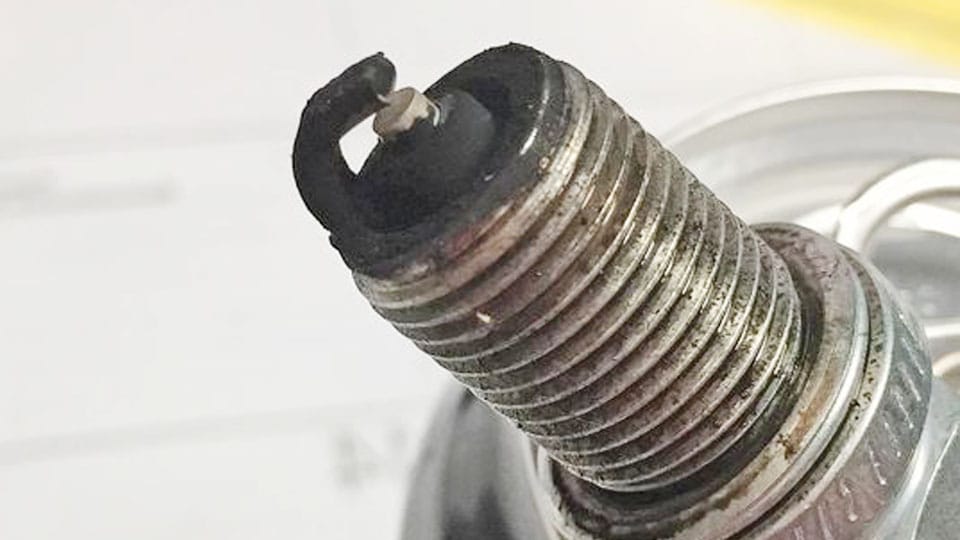
Torque spark plugs to the engine maker’s specification. Overtightening can strip aluminum head threads, crack the plug, and turn a cheap job into a cylinder-head repair. This guide shows how to read the spec, tighten plugs correctly, and avoid thread damage with basic DIY tools.
Why spark plug torque matters
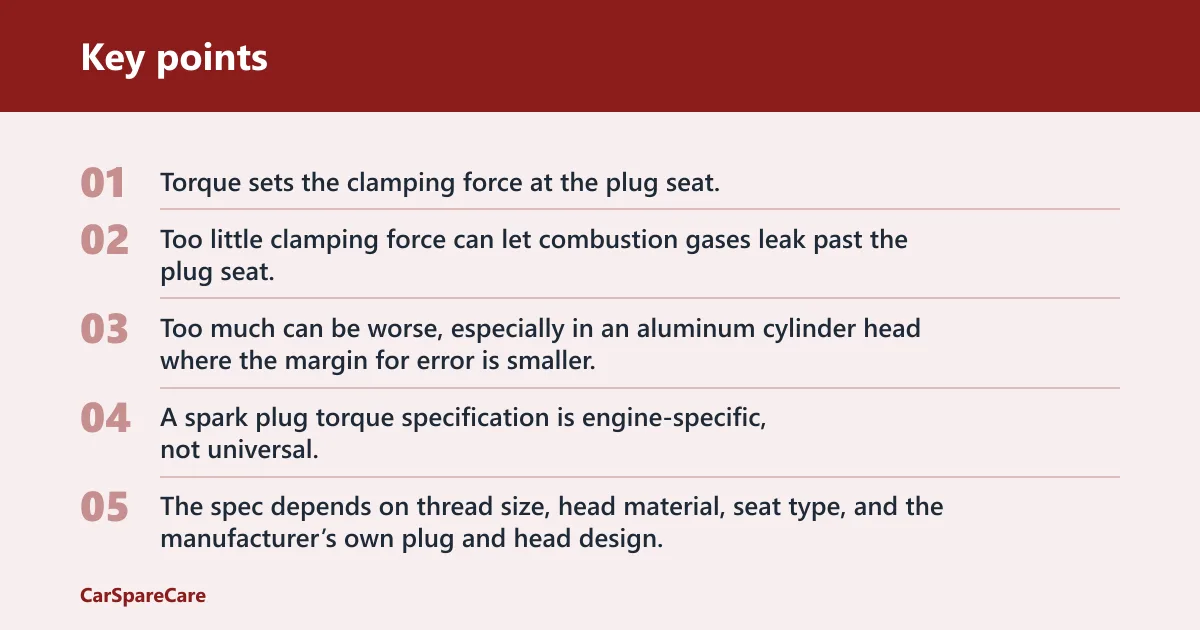
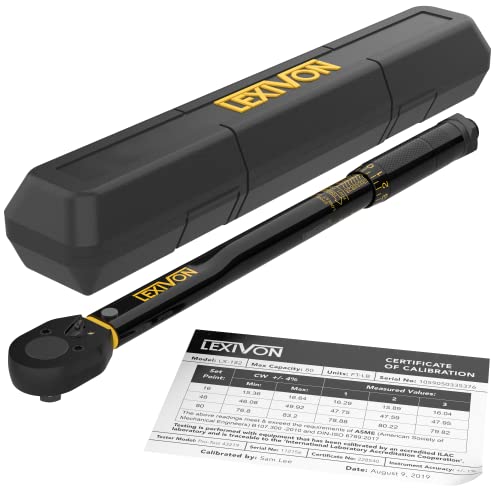


Torque sets the clamping force at the plug seat. That force must seal combustion pressure without deforming the seat, distorting the shell, or starting thread damage in the head.
Too little clamping force can let combustion gases leak past the plug seat. Too much can be worse, especially in an aluminum cylinder head where the margin for error is smaller.
What the spec is controlling
A spark plug torque specification is engine-specific, not universal. It is commonly given in Nm, and many manuals also list ft-lb or in-lb so you can match the tool being used.
The spec depends on thread size, head material, seat type, and the manufacturer’s own plug and head design. A gasket seat plug needs enough force to compress its washer and seal properly; a taper seat plug seals differently and should not be treated the same way.
What happens if a spark plug is overtightened?
Overtightening can deform the crush washer or gasket seat, distort the plug shell, and damage the threads in the head. In an aluminum cylinder head, excessive over-spec torque can make thread damage expensive to repair.
The failure often starts at the seat. The washer flattens too much, the plug is forced deeper than intended, and the extra load transfers into the threads. If the plug is already dry, dirty, or cross-started, the damage can happen faster.
Seat deformation comes first
On a gasket-seat plug, the washer is meant to crush once to create the seal. When torque keeps climbing after that point, the washer can flatten beyond its design range and stop doing its job cleanly.
That can leave the plug harder to remove later. It also makes diagnosis harder, because the plug may look normal from the outside while the seat has already been over-compressed.
How thread damage progresses
Once the seat is over-compressed, the added load goes into the head threads. Aluminum heads are especially vulnerable because the threads have less tolerance for abuse than the steel plug shell, and the material gives up before cast iron usually would.
Cross-threading makes this worse. If the plug starts crooked and then tightens, the first damaged thread can pull the rest along with it until the hole needs a thread-repair insert or, in severe cases, more extensive head work.
When the plug shell can crack
Overtightening can strip the cylinder head threads or crack the plug insulator. That risk rises when the wrench keeps turning after the washer has already crushed and the plug should have stopped.
Picture a 14 mm plug in an aluminum head that suddenly feels smooth, then takes a hard pull at the end. That is not a normal finish. Stop before forcing it further, because the plug shell or insulator may already be stressed.
How tight should spark plugs be?
Use the vehicle service manual or the manufacturer’s service information first, because the correct torque is engine-specific. General charts are only comparison points, not a substitute for the published spec, and the wrong number can damage the seat or the threads.
For exact factory torque, check the engine code in the service manual, factory service information, or the vehicle’s published specification for the plug and head combination. The same thread size can still use a different value depending on seat type and engine design.
Common comparison ranges
| Thread size | Head material | Typical torque range |
|---|---|---|
| 10 mm | General guide value | 10–12 Nm |
| 12 mm | General guide value | 15–20 Nm |
| 14 mm | Aluminum head | 20–30 Nm |
| 14 mm | Cast iron head | 25–40 Nm |
Those figures are useful for orientation only. The manual still wins, especially on small engines, motorcycles, turbo engines, and deep plug wells where access can make it easier to over-pull the wrench.
Gasket seat versus taper seat
A gasket seat plug relies on the washer to seal against the head. A taper seat plug seals on the tapered metal face instead, so the torque target and the point where resistance rises can differ.
That is why seat type matters as much as thread size. Two plugs with the same thread diameter can still need different clamping force.
Aluminum vs cast iron heads
Aluminum heads often use lower torque, but the correct spec also depends on seat design, thread size, and the manufacturer’s head and plug design. Cast iron heads can usually tolerate higher clamping force, which is why their torque window is often wider.
Aluminum also expands at roughly twice the rate of steel. That changes clamp load as the engine heats and cools, so the same installed torque can behave differently over time in aluminum versus cast iron.
Why aluminum strips more easily
When the plug is over-tightened in aluminum, the thread flank can pull out instead of merely resisting. That is why spark plug threads in an aluminum head are more likely to become a repair job after a bad install.
Repair can mean a thread insert if the hole is damaged but still recoverable. If the damage is severe, the cost path can move from a simple retorque to head removal or replacement work.
What cast iron changes
Cast iron gives more warning before failure and generally tolerates a wider torque band. That does not make guesswork safe, but it does mean the same plug can survive a small error better than it would in aluminum.
Use cast iron as a comparison point, not a target to copy. The manual still sets the real number.
Anti-seize and dirty threads
Dry torque and lubricated torque are not the same thing. Anti-seize changes friction, so the same wrench reading can produce more clamping force than expected if the threads are lubricated instead of dry.
Dirty or damaged threads can also make the torque reading lie. Rust, carbon, or paste in the hole can add drag before the seat is fully home, which makes the plug feel tight too early.
Dry install warnings
If the manual does not call for anti-seize, do not assume it is needed. Many modern plug shells are plated, and adding compound can change the effective torque enough to push the joint past spec.
A torque wrench still matters here. Click, beam, or digital, it is the correct tool for applying precise torque instead of guessing by feel.
When anti-seize is present
Anti-seize should be treated as a variable, not a shortcut. It can reduce friction and change the clamping force achieved at the same reading, so a dry spec cannot be copied blindly to a lubricated joint.
Suppose a plug thread has anti-seize on it and starts to feel snug before the expected reading. Do not keep pulling to “make the number happen.” Back out, inspect, and confirm the manual’s position on lubrication first.
Reused plugs and contaminated threads
Reused plugs deserve extra caution because the washer may already be flattened and the threads may carry residue. Contamination in the head can make a plug feel tight before it reaches the real spec, which is a warning sign, not a reason to force it.
Clean, correct threads should turn smoothly by hand for several turns before any wrench is used. If they do not, something is wrong with the fit, the hole, or the plug.
Spark plug overtightening checklist
Use this stop-check-list if a plug feels wrong during installation. Stop at the first bad sign and inspect before continuing, because a few seconds of caution can prevent a stripped aluminum hole.
| Symptom during installation | Likely cause | Action |
|---|---|---|
| Plug starts hard by hand in an aluminum head | Cross-threading, dirty threads, or damaged first thread | Stop, back out, inspect |
| Resistance rises before the manual’s torque value | Contaminated threads, anti-seize changing friction, or reused washer already compressed | Stop, back out, inspect |
| Torque wrench clicks far below expected reading | Seat debris, wrong plug type, or a thread issue in the hole | Stop, back out, inspect |
| Plug keeps turning after the seat should be snug | Washer not seating correctly or threads pulling in the head | Stop, inspect, then retorque only if the parts are sound |
| Aluminum head, plug feels “tight enough” by hand | Friction is masking the true load | Stop, back out, clean threads, retorque with a wrench |
| Reused plug will not follow the same turn pattern as the others | Washer distortion or damaged threads on the plug | Stop, inspect, replace if needed |
| Threads look shiny, torn, or packed with residue | Contamination or thread damage already present | Stop, inspect, clean, or repair before continuing |
| Plug seated, but removal later would likely be hard | Over-compressed washer or over-torque | Do not add more torque; inspect before final tightening |
- Hand-thread first. Start the plug by hand for several turns before using a wrench. This reduces cross-threading risk and helps you feel whether the plug is entering cleanly.
- Check the seat type. Confirm whether the plug is gasket seat or taper seat before tightening. The wrong seat assumption can make the final load wrong even if the wrench is accurate.
- Use the manual value. Set the torque wrench to the engine maker’s spec in Nm or ft-lb. If the manual gives a dry value, do not assume the same number applies after anti-seize.
- Stop at abnormal resistance. If the plug feels tight before spec, back it out and inspect the threads, washer, and hole. A plug that binds early is often signaling contamination or damage, not a need for extra force.
- Retorque only when clean. After inspection, reinstall only if the plug, threads, and seat are sound. If aluminum threads look pulled or rough, a thread-repair insert may be needed before any final torque.
A common first-timer mistake is to treat every plug as if 14 mm means one universal number. That can work until the head material changes, the seat type changes, or the threads in the hole are already partly damaged.
Another common case is a deep plug well on a small engine. Access is awkward, the wrench handle can tilt, and the installer may feel the plug “go tight” before the correct torque is reached. That is the moment to stop and check, not force the last few degrees.
Frequently asked questions
What happens if spark plugs are overtightened?
Overtightening can crush the gasket seat too far, distort the plug shell, and overload the threads in the head. It can also make the plug hard to remove later.
Can overtightening spark plugs strip aluminum threads?
Yes. Aluminum head threads are softer than the steel plug shell, so they can pull out more easily than cast iron threads. Cross-threading and using too much torque are the main failure paths. If the threads are damaged, a thread-repair insert may be needed.
What torque should spark plugs have in an aluminum head?
Use the engine maker’s specified torque for that exact plug and head combination. The correct number can change with seat type and engine design.
Should you use anti-seize when torquing spark plugs?
Not automatically. Anti-seize changes friction, so the same torque reading can produce a different clamping force than a dry install. If the manual does not call for it, treat it with caution and do not copy a dry spec blindly onto lubricated threads.
Can a spark plug crack from being too tight?
Yes. Overtightening can crack the plug insulator or damage the shell, especially if the washer has already crushed and the wrench keeps pulling. A plug that keeps taking force after it should already be seated is a warning sign to stop and inspect.

Hi, I’m Melvin, an automobile engineer with extensive experience in automobile equipment. I currently work for a local automobile firm, where I specialize in the car parts industry. I’ve had the opportunity to collaborate with seasoned inspectors, gaining invaluable hands-on experience that goes beyond just theory.
My passion for automotive care started at a young age, which led me to create CarSpareCare. Through CarSpareCare, I share the knowledge and skills I’ve acquired over the years to help others navigate the world of car maintenance and repairs.
My goal is to provide practical tutorials, essential safety advice, and the latest industry insights so that anyone—whether a beginner or an expert—can confidently tackle their automotive projects.