Inspect petrol-engine spark plugs every about 20,000–30,000 miles, replace standard nickel plugs around 30,000 miles and many platinum or iridium plugs at about 60,000–100,000 miles, and replace any plug with cracked ceramic, heavy deposits, oil fouling, or a worn electrode. Ignore plug condition and you can trigger misfires, hard starts, catalytic-converter damage, and wasted fuel. This guide covers inspection intervals, safe removal, gap checks, wear-pattern diagnosis, and when to clean, re-gap, reinstall, or replace.
What spark plug service includes


Spark plug maintenance typically includes four jobs: inspection, limited cleaning, gap verification or adjustment where allowed, and replacement. The service manual gives you the baseline interval, but plug condition can pull that work earlier because wear, deposits, and heat damage often show up before a mileage reminder does.
Use the service manual as the starting point
Your owner’s manual or factory service information lists the replacement interval for the exact engine and plug type fitted to the vehicle. Use that schedule as the baseline, because ignition energy, combustion temperature, engine calibration, and plug design differ by model, so copying an interval from another car is guesswork.
A minimum spark plug service life is about 20,000 km, but that is not a universal replacement target for every engine or every plug material. Treat it as a floor for planning inspections, then base the actual replacement decision on the vehicle schedule and on what the removed plugs show.
Inspection, cleaning, re-gapping, and replacement are not the same
An inspection asks whether the plug is wearing normally and whether the engine is leaving clues on the firing end. Cleaning is only for light, dry deposits on a plug that is otherwise serviceable. Re-gapping applies only when the plug maker permits it. Replacement is usually the answer for cracked ceramic, heavy oil fouling, a badly rounded electrode, a widened gap beyond spec, or heat damage.
That distinction matters on modern petrol engines. Fine-wire platinum and iridium plugs last well, but they are easier to damage if you bend or scrape them during adjustment.
Condition can matter more than the odometer
Short-trip use, extended idling, towing, frequent boost on turbo petrol engines, and known oil consumption can all justify earlier inspections. Those patterns do not always ruin a plug quickly, but they do raise the odds of fouling, gap growth, or deposits that can mislead diagnosis.
Picture a small turbo petrol engine that rarely gets more than a ten-minute commute. The plugs may still be well inside the scheduled replacement interval, yet repeated cold starts and low-load running can leave dry carbon that points to an air/fuel or operating-pattern issue, not simply an old plug.
When should you inspect or replace spark plugs?
Start with the factory replacement interval, then add planned inspections based on plug material, driving pattern, and season. Copper plugs usually need the shortest replacement interval, platinum plugs usually last longer, and iridium plugs usually last longest, but winter, short trips, oil use, and turbo petrol operation justify earlier checks even before the scheduled replacement point.
Plan by material and operating pattern
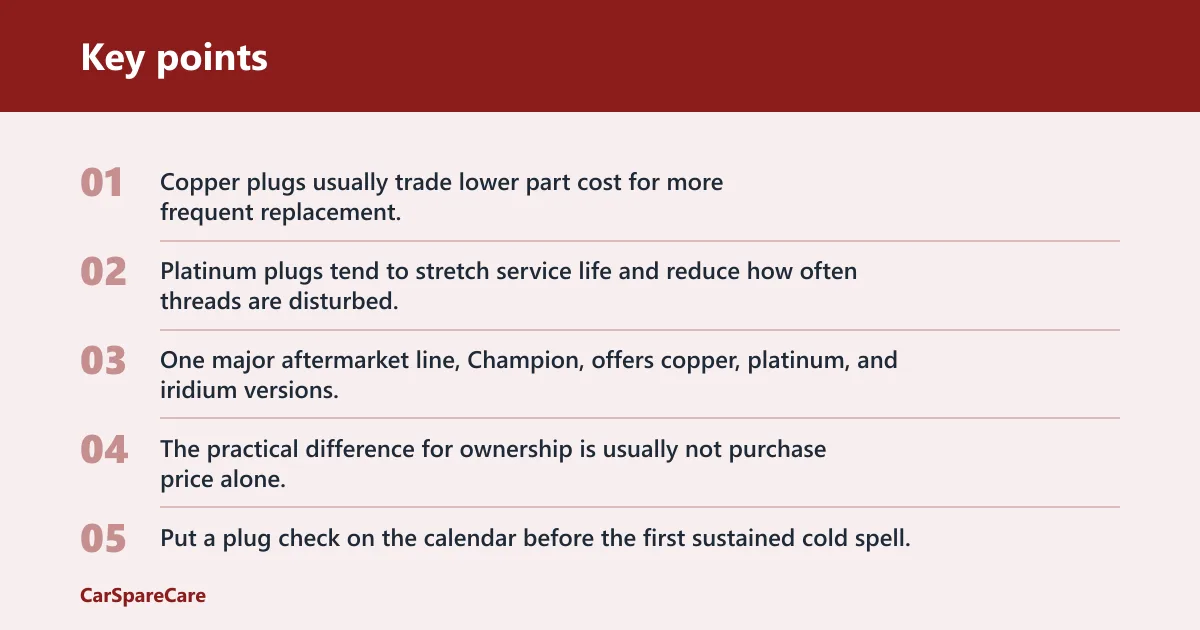
Copper plugs usually trade lower part cost for more frequent replacement. Platinum plugs tend to stretch service life and reduce how often threads are disturbed. Iridium plugs can last up to 120,000 km, and many modern turbo petrol engines commonly specify fine-wire platinum or iridium because high cylinder pressure and tight ignition control favor durable electrodes.
One major aftermarket line, Champion, offers copper, platinum, and iridium versions. The practical difference for ownership is usually not purchase price alone. It is how often the plugs must be changed and how often coils, boots, and aluminum head threads have to be disturbed.
Move inspections earlier for harsh use
Use shorter inspection spacing if the engine does many cold starts, long idle periods, towing, repeated high-load use, or shows any sign of oil consumption. On turbo petrol engines, an early inspection can catch soot, oiling, or heat damage before a cold-start miss turns into a converter-damaging misfire.
Put a plug check on the calendar before the first sustained cold spell. Spark quality matters more as temperatures drop, and easy winter starting depends heavily on plug condition. Weak batteries and damp ignition components also raise winter no-start risk, so plug checks work best as part of a wider cold-weather readiness review.
Maintenance schedule table
| Mileage/time | Driving condition | Plug material | Inspection action | Replacement trigger | Winter-check priority |
|---|---|---|---|---|---|
| At the service-manual interval | Normal mixed driving | Copper | Remove and inspect all plugs; check deposits, gap, ceramic, and electrode shape | Replace at the manual interval or sooner for rounded electrodes, cracked insulator, heavy deposits, or oil fouling | High if cold starting has slowed |
| At the service-manual interval | Normal mixed driving | Platinum | Inspect if symptoms appear or if access is easy during related service; otherwise follow the model-specific schedule | Replace at the manual interval or sooner for damage, abnormal deposits, or gap out of spec | High before the first sustained cold spell |
| At the service-manual interval | Normal mixed driving | Iridium | Favor inspection near the scheduled change point or sooner if hard starting, misfire, or rough idle appears | Replace at the manual interval, at clear wear, or when diagnosis points to plug failure | High on direct-injected and turbo petrol engines |
| Before winter | Any pattern with weak cold starts | Copper / platinum / iridium | Check plugs, battery condition, and signs of dampness in ignition components | Replace any suspect plug rather than gambling on another cold season | Highest |
| Earlier than the manual interval | Short trips, repeated cold starts, or extended idling | Copper / platinum / iridium | Inspect for dry carbon, fuel smell, and incomplete warm-up patterns | Replace if fouled or if cleaning would leave a marginal plug near its scheduled end | Very high |
| Earlier than the manual interval | Towing, heavy load, frequent boost, or spirited use | Platinum / iridium | Inspect for heat marks, white blistering, burnt skirt, and electrode wear | Replace any plug with overheating signs or a gap beyond spec | Medium unless cold starts are also poor |
| Any time symptoms appear | Misfire, rough idle, poor fuel economy, or no-start | Copper / platinum / iridium | Use a cylinder-by-cylinder inspection and compare plug appearance across the engine | Replace failed plugs and trace the cause before fitting a new set | Highest in damp or freezing weather |
| Any time oil use is noted | Oil top-ups between services or blue-smoke complaints | Copper / platinum / iridium | Inspect for wet oil, ash, and isolated-cylinder fouling | Replace fouled plugs after the oil source is addressed | High because fouled plugs worsen cold starting |
How do you tell if a spark plug needs service or replacement?
A spark plug needs service when deposits, gap change, or early wear are present but the plug body is still sound and within specification. It needs replacement when the ceramic is cracked, the electrode is rounded or damaged, deposits are heavy or oily, or the plug shows heat distress that cleaning cannot correct.
What normal wear looks like
Normal wear shows up as gradual edge softening on the electrode and a firing end that is dry, without heavy buildup. The plug may still be serviceable if the insulator is intact and the gap remains within the specification for that engine. Always confirm the allowed gap range in the owner’s manual or manufacturer listing for the exact plug.
Replace-now signs
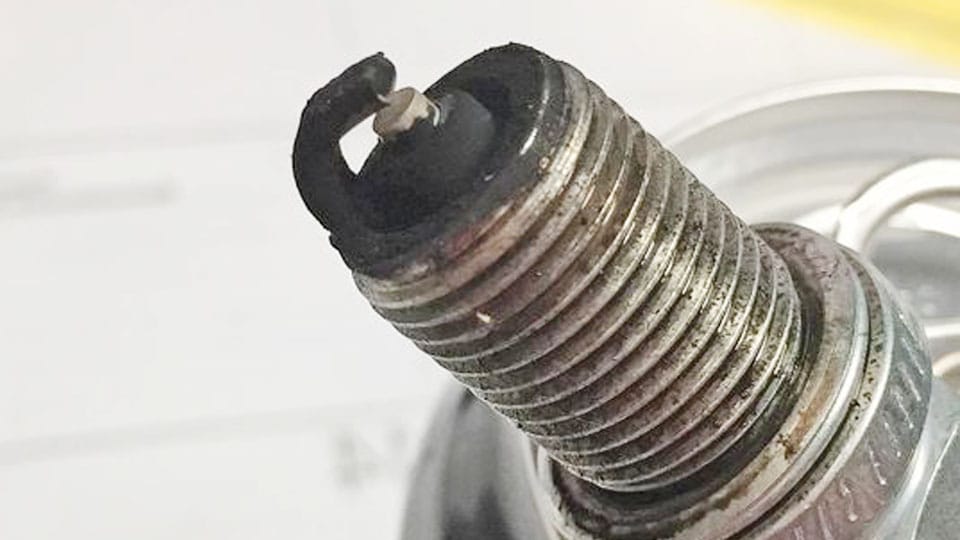
Rounded electrodes, obvious gap growth, cracked insulators, chipped ceramic, a loose terminal, heavy carbon buildup, and oil-wet threads or electrodes are replacement signs. A burnt insulator skirt and a partially melted center electrode can point to multiple engine problems, so those plugs should not go back in.
The center electrode is one of the best visual checkpoints. If it is partially melted, eroded unevenly, or heat-discolored, the cause may be detonation, the wrong plug application, mixture issues, or cooling and timing faults, not simple age.
When reinstallation is reasonable
Reinstall only a plug that matches the correct application, shows light wear, has no ceramic damage, and remains within gap specification or within allowed adjustment limits. If access is difficult, many owners replace a borderline set rather than repeat the labor soon after.
Say your engine has a rear bank buried under an intake plenum and one removed plug shows a fine crack near the hex. Even if the others look usable, reinstalling that set invites a repeat teardown and a hard-to-trace misfire later.
What can spark plug condition tell you about engine problems?
Spark plugs can act like a compact fault record from each cylinder. Dry soot, wet oil, overheated electrodes, and burnt insulator areas point in different directions, so the useful method is a Trouble Tracer Chart mindset: observe the plug, match the pattern, then confirm the likely engine cause before replacing parts blindly.
Dry soot and air/fuel clues
Soot on electrodes is likely related to air/fuel ratio issues. Dry black carbon usually suggests a mixture problem, repeated short-run operation, weak ignition, or an engine that spends too much time cold. It is different from oily fouling, which looks wet or glazed and points elsewhere.
Oil fouling and where it comes
Oil traces on electrodes point to piston rings, valve seals, and the PCV valve. If only one cylinder shows oil, look closely at that cylinder first. If multiple plugs are oily, the pattern may fit a broader ventilation or wear problem rather than a single bad plug.
On turbocharged petrol engines, turbo seal issues can also contribute to oil contamination, especially when the intake tract shows oil residue and the fouled plugs match that pattern. Avoid the common mix-up here: a supercharger does not use a turbine.
Burnt skirt and melted electrode warnings
The insulator skirt is a useful diagnostic area because it shows how heat and combustion are affecting the plug. Burnt insulator skirt and partially melted center electrode can indicate multiple engine problems. Skirt length and shape vary by plug family, so compare the plug to the correct application data, not to a random image online.
If one brand describes a shorter insulator skirt on a lower-number heat grade plug, that is a design clue within that brand family, not a universal rule for every spark plug line.
How does heat range affect maintenance and diagnosis?
Heat range controls how quickly a spark plug transfers heat from the firing end into the cylinder head. The wrong heat range can promote fouling, overheating, pre-ignition, and misleading wear patterns, which is why diagnosis should always confirm the exact plug application instead of relying on thread size or appearance alone.
What heat range changes
Heat range is about heat transfer, not spark strength. A plug that runs too cool for the application may collect deposits and foul more easily. A plug that runs too hot may overheat the electrode and insulator, mask the true engine condition, or in severe cases contribute to pre-ignition.
Numbering is brand-specific
The lower the heat grade number, the higher the heat dissipation capability in some systems. Low-number heat grade plugs are called cold plugs and used in racing engines in those systems. That numbering direction is not universal across all brands, so always confirm the correct heat range by manufacturer application data for the exact engine.
Why the wrong heat range causes bad decisions
A too-cold plug can look dirty enough to make you blame the fuel system when the actual problem is wrong application. A too-hot plug can show heat marks that mimic lean running or timing trouble. If a plug’s heat range is wrong, even a tidy-looking gap check or cleaning session can send diagnosis in the wrong direction.
Which spark plug type makes sense for your maintenance plan?
The right plug type balances service life, labor repetition, and the engine’s ignition demands. Copper plugs usually suit shorter service plans, platinum fits a middle ground, and iridium is often the long-life choice, especially on modern petrol and turbo petrol engines that are calibrated around fine-wire precious-metal plugs.
Copper, platinum, and iridium in practical terms
Copper plugs are often the least expensive to buy, but they usually require more frequent replacement and more repeated labor. Platinum plugs reduce that frequency. Iridium plugs usually cost more up front, yet their longer life often means fewer removal cycles, fewer chances to disturb aging coil boots, and less thread wear in aluminum heads.
That is the real cost comparison for most DIY owners: parts plus how often the work returns. On a simple four-cylinder with easy access, shorter-life plugs may be acceptable. On a transverse V6 or a turbo engine with difficult access, longer-life plugs often make more sense.
Match the plug to the engine, not the shelf label
Modern turbo petrol engines commonly call for platinum or iridium plugs, and replacing them with a different material just because it fits the threads can upset service life and wear patterns. Check the manufacturer’s listing for your model and the owner’s manual for the correct plug family, heat range, and service interval.
How should you inspect and service spark plugs safely?
Safe plug service starts before the first plug loosens. Work on a cool engine, confirm the exact plug specification, keep dirt out of the wells, and decide in advance whether the plugs are being inspected, cleaned, re-gapped where allowed, or replaced, because each path has different limits and risks.
Inspection and service checklist
- Confirm the correct parts. Check the owner’s manual and plug manufacturer listing for your exact petrol engine. Heat range, reach, seat style, and allowable gap adjustment vary by model, and guessing can create starting and drivability problems that look like ignition faults.
- Work on a cool engine. Let the aluminum head cool fully before removal. This lowers the chance of thread damage and gives more accurate feel when loosening plugs that may have been installed for years.
- Clean around each well. Blow or vacuum dirt away before removing a coil or lead. Debris dropped into the cylinder can scratch the bore or hold a valve open long enough to create a fresh misfire after reassembly.
- Label coils or leads. Mark components if there is any chance of mixing them up. Coil-on-plug layouts are less confusing than old lead sets, but connector placement and wiring routing can still lead to crossed reassembly.
- Remove and compare plugs. Keep each plug in cylinder order and examine them side by side. One odd plug among otherwise normal ones often points to a cylinder-specific issue, while all four or six matching deposits usually suggest a system-wide cause.
- Check the gap carefully. Measure only with a proper gap tool, and adjust only if the plug maker permits it. Fine-wire precious-metal plugs often should not be bent or re-gapped except per manufacturer guidance, because the small center electrode is easy to damage.
- Clean only light deposits. If a plug has light, dry carbon and is otherwise healthy, gentle non-abrasive cleaning may be acceptable. Replacement is the better choice for oily, glazed, cracked, overheated, or heavily fouled plugs, and abrasive blasting residue is risky because trapped grit can damage the engine.
- Inspect threads and seat. Check plug threads, the sealing seat, and any crush washer condition. If the plug uses a crush washer, confirm whether a new plug includes one and whether the manufacturer gives any special seating instruction for your model.
- Use thread care wisely. Start every plug by hand to avoid cross-threading, then tighten to the specified method for that engine and plug. Exact torque varies by model, so confirm it in the vehicle and plug manufacturer instructions; many plug makers also warn that anti-seize may be unnecessary on plated threads and can alter torque.
- Choose reinstall or replace. Reinstall only if the plug remains in specification and shows no damage or troubling deposits. Replace the full set when wear is even and the service point is near, or replace the affected plugs after diagnosis if one or two cylinders show a distinct problem.
Common mistakes to avoid
- Installing a plug that merely “looks close” instead of confirming the exact application.
- Bending a fine-wire platinum or iridium ground strap without checking whether adjustment is allowed.
- Using anti-seize by habit without checking the plug maker’s guidance.
- Forcing a plug into aluminum threads rather than backing out and restarting by hand.
- Cleaning an oily or heat-damaged plug when replacement and root-cause diagnosis are the safer choice.
A common first-timer mistake is cleaning a carbon-fouled plug until it looks presentable, reinstalling it, and ignoring the reason it fouled. If the real issue is repeated short-trip running or a mixture fault, the fresh-looking plug may misfire again in days.
How do symptoms map to the next action?
Symptoms matter most when they lead to a specific next check. Misfire, rough idle, poor fuel economy, hard starting, and winter-only no-start complaints each narrow the list, but none proves that the plug itself is the only fault. A Trouble Tracer Chart approach keeps the diagnosis tied to evidence instead of guesswork.
Spark plug maintenance checklist
- Misfire under load: Inspect plugs for widened gap, rounded electrodes, cracked ceramic, and heat marks; then compare coils and fuel delivery on the affected cylinder.
- Rough idle at all temperatures: Check for dry soot, incorrect gap, worn electrodes, and vacuum or mixture faults.
- Poor fuel economy: Look for worn plugs, soot that suggests air/fuel ratio issues, and any stored misfire trend.
- Hard starting when cold: Inspect plugs before winter, then test battery condition and check for damp ignition components.
- Winter-only no-start: Suspect marginal plugs, weak battery output, or moisture tracking before blaming fuel quality alone.
- Single-cylinder oily plug: Trace that cylinder for valve-seal, ring, or localized oil-control issues.
- Multiple oily plugs on a turbo petrol engine: Check PCV operation and look for turbo seal clues along with plug replacement.
Use a trouble Tracer Chart mindset
A Trouble Tracer Chart is simply a disciplined way to match symptom plus plug appearance to likely causes, then verify them. For example, dry soot on every plug and repeated short trips point one way, one melted center electrode points somewhere very different. The plug is evidence, not the verdict.
Suppose the engine cranks normally on damp winter mornings but starts fine once the day warms up. That pattern points your next step toward plug condition, battery strength, and moisture in ignition components rather than straight to injectors or a mechanical engine fault.
Frequently asked questions
How often should I replace spark plugs?
Replacement timing starts with the vehicle service manual, because engine design and plug type set the real schedule. Copper plugs generally need attention sooner than platinum or iridium, while harsh use, oil consumption, turbo petrol operation, and cold-weather starting complaints justify inspection before the scheduled change point.
How do I know if my spark plugs need replacing?
Replace them if the ceramic is cracked, the electrode is rounded or overheated, deposits are heavy, oil is present on the firing end, or the gap is outside specification and the plug is not meant to be adjusted. Hard starting, misfire, and rough idle are reasons to inspect, not proof by themselves.
What do worn spark plugs look like?
Typical wear shows softened electrode edges and gradual gap growth. More serious signs include a rounded center electrode, a cracked insulator, heavy dry carbon, wet oil fouling, a burnt insulator skirt, or a partially melted center electrode. Those latter patterns point to replacement and often to further engine diagnosis.
Can spark plugs tell me if my engine has other problems?
Yes, often very clearly. Dry soot can point toward air/fuel ratio or weak-ignition issues, while oil traces suggest piston rings, valve seals, or PCV faults. On turbocharged petrol engines, oil contamination can also fit turbo seal problems. Heat damage can hint at cooling, timing, or wrong-application issues.
What spark plug life should I expect from copper vs iridium?
Expect copper plugs to sit at the shorter end of the service plan and iridium at the longer end, with platinum between them. Exact life varies by model, but iridium plugs can last up to 120,000 km. The tradeoff is usually fewer replacement cycles versus lower upfront part cost.
Why does the wrong spark plug heat range matter?
The wrong heat range changes how the plug sheds heat, which can create fouling, overheating, misleading deposits, and in severe cases pre-ignition risk. Numbering direction is brand-specific, so never assume one brand’s lower or higher number means the same thing on another application. Always confirm by manufacturer data.

Hi, I’m Melvin, an automobile engineer with extensive experience in automobile equipment. I currently work for a local automobile firm, where I specialize in the car parts industry. I’ve had the opportunity to collaborate with seasoned inspectors, gaining invaluable hands-on experience that goes beyond just theory.
My passion for automotive care started at a young age, which led me to create CarSpareCare. Through CarSpareCare, I share the knowledge and skills I’ve acquired over the years to help others navigate the world of car maintenance and repairs.
My goal is to provide practical tutorials, essential safety advice, and the latest industry insights so that anyone—whether a beginner or an expert—can confidently tackle their automotive projects.