
By [Author Name], automotive refinishing editor — For any fresh paint, follow the coating maker’s TDS/P-sheet first; if you do not have the exact product sheet, use the conservative timelines below. A practical minimum is 30 days before waxing fresh automotive refinish work, but some touch-up systems may become wax-safe sooner or later depending on film build, temperature, humidity, and bake schedule. Waxing too early can trap solvents, soften the finish, and leave dull spots or print-through. This guide explains safe wait times for touch-ups, basecoat/clearcoat jobs, and full-panel repaints.
What to know first
Fresh paint moves through stages, and each stage means something different. Dry to the touch only means the surface no longer feels tacky. Dust-free means it can resist light dusting without grabbing debris. Polishable means it can be safely refined without smearing or loading. Fully cured means the film has hardened enough for waxing, polishing, or compounding without risk of marks or solvent lock-in. That stage order is consistent with manufacturer-first guidance: use the exact TDS/P-sheet whenever possible, because product and system variability is real.
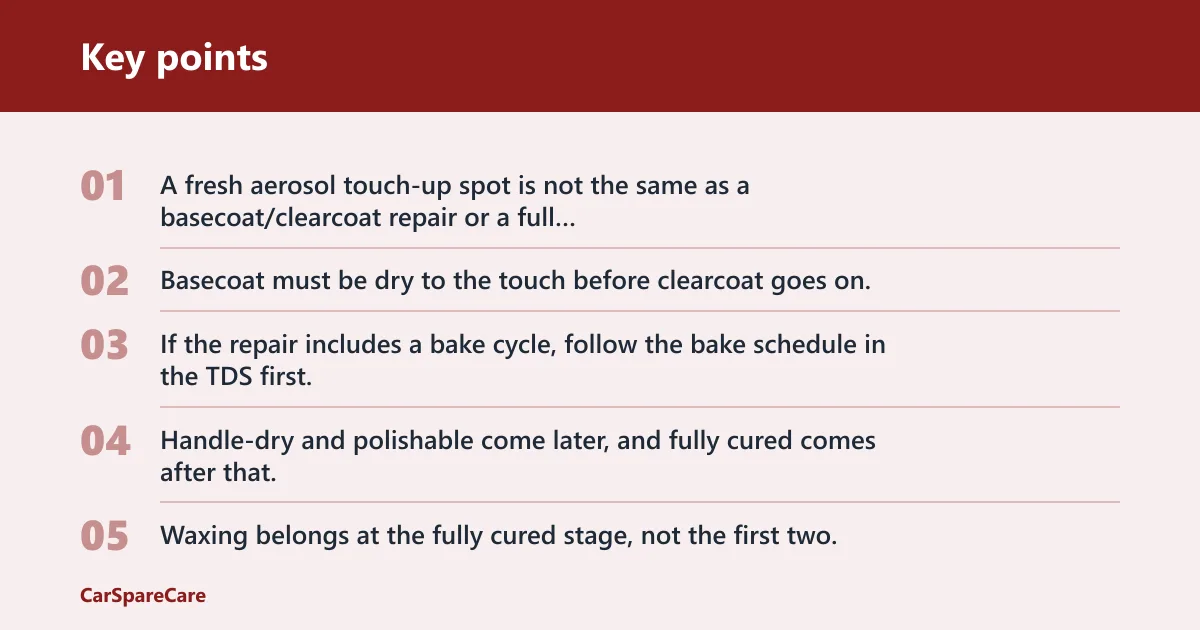
The answer changes by paint system. A fresh aerosol touch-up spot is not the same as a basecoat/clearcoat repair or a full respray. Basecoat must be dry to the touch before clearcoat goes on, and clearcoat is the final protective layer before waxing or compounding. If the repair includes a bake cycle, follow the bake schedule in the TDS first; if it is air-dry only, use the conservative cure windows below.
Dry-to-touch versus fully cured
Dry to the touch is an early stage. Dust-free comes next. Handle-dry and polishable come later, and fully cured comes after that. Waxing belongs at the fully cured stage, not the first two. A finish can look glossy before it is safe to seal, and a glossy surface can still hold solvent below the skin.
Why the answer changes by paint system
Basecoat, clearcoat, and touch-up paint do not dry at the same rate. Basecoat may take multiple wet coats, then clearcoat seals it. A full-panel repaint holds more solvent than a small chip repair, so it usually needs the longest wait before wax. In a shop setting, the difference between air-dry and force-bake also changes cure time materially, so “30 days” is a floor only when the TDS does not give a shorter or longer approved window.
What you’ll need
- Soft microfiber towels
- Clean water and a pH-balanced, paint-safe car wash soap
How long should you wait before waxing?
Use the paint system, not the calendar alone. Follow the TDS/P-sheet for the exact product, especially for bake times, air-dry times, recoat windows, and polishing/waxing restrictions. If the product sheet is unavailable, a practical conservative minimum is about 30 days for fresh automotive paint. PPG, BASF, Axalta, Sherwin-Williams, and 3M all emphasize system-specific cure behavior rather than a single universal wax date.
Fresh aerosol touch-up paint
Small chip repairs and spot fills can often be wax-safe after the film is fully hard. Some systems list handling or polish readiness in the 7–14 day range, but that is not the same as wax-safe. Treat 7–14 days as a conservative touch-up window only when the repair has stopped shrinking, is dry throughout the film, and the product sheet allows the next step. If the spot still feels soft, smells of solvent, or prints under light pressure, wait longer.
Basecoat/clearcoat repairs
Basecoat should be dry to the touch before clearcoat is applied. After the clearcoat goes on, give it a cure period before any wax or compound. In spray-can or small repair work, two wet coats of clearcoat are common, but the exact film build, flash time, and recoat window should come from the product TDS rather than a fixed rule. A panel that is dust-free is not automatically polishable, and polishable is not automatically wax-safe.
Full-panel repaint
A full-panel repaint usually needs the longest wait because the film build is higher and solvent release takes longer. Start with 30 days unless the paint maker gives a different cure schedule. Cooler air, high humidity, and enclosed garage drying can extend that wait. Force-baked systems may be ready sooner for certain steps if the manufacturer says so, but air-dry systems generally need more patience.
Paint curing timeline
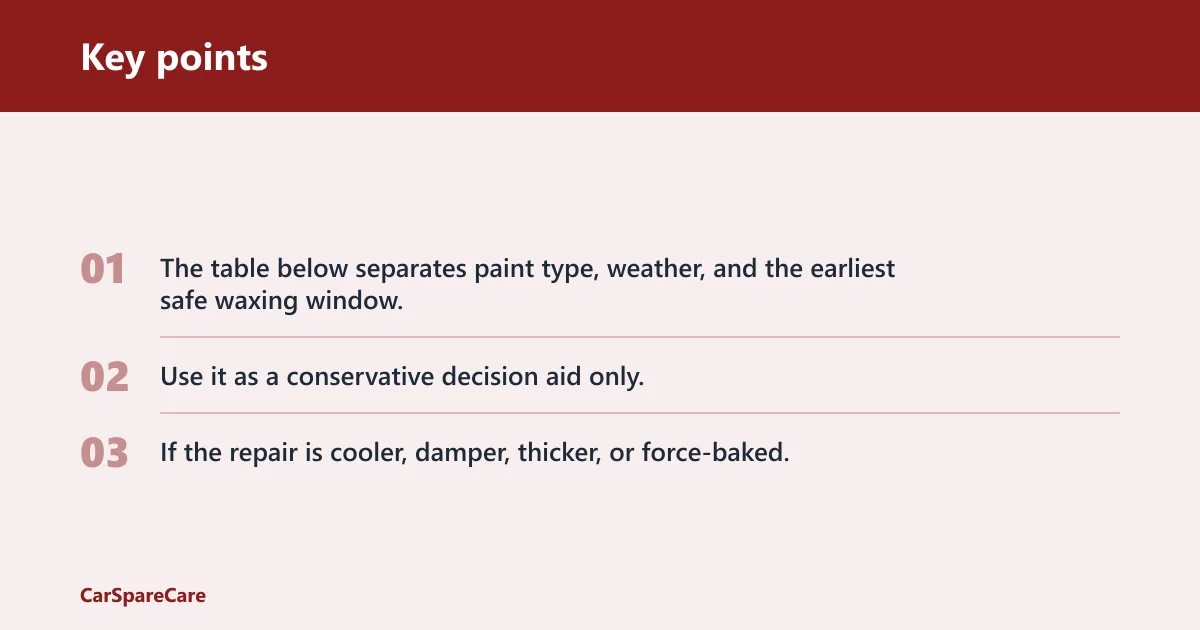
The table below separates paint type, weather, and the earliest safe waxing window. Use it as a conservative decision aid only; if the TDS/P-sheet gives a different schedule, follow that instead. If the repair is cooler, damper, thicker, or force-baked, adjust based on the manufacturer’s cure instructions and the inspection signs in the last two columns.
| Paint type | Fresh aerosol touch-up | Basecoat/clearcoat | Air temperature | Humidity | Earliest safe wax date | Do not wax yet |
|---|---|---|---|---|---|---|
| Warm, dry conditions | Dust-free in hours; polishable only after full hardening; wax-safe only if the product sheet allows it and the repair is fully hard | Dust-free after flash; polishable only after cure; wax-safe only after clearcoat has fully cured | About 70°F | Below 50% | Yes, if the repair is fully hard and the TDS/P-sheet permits wax or sealant at this stage; otherwise wait 30 days | No if it still smells of solvent, prints under light pressure, or shows solvent trap/softness |
| Cool garage | Allow extra time beyond the product label; dust-free is not wax-safe | Allow extra time beyond the product label; polishable and wax-safe arrive later than in warm conditions | 50°F to 60°F | Below 50% | Only after the finish is fully hard, stable, and confirmed by the manufacturer’s cure guidance | No if the repair is still soft, glossy only on top, or leaves a fingerprint |
| Damp weather | Wait longer than the label if the spot stays tacky or cool to the touch | Wait longer than the label if the clearcoat is soft or hazy underneath | About 70°F | Above 50% | Only after full cure and a clean inspection; use the longer end of the manufacturer window | No because moisture slows cure and can prolong solvent release |
| Fresh full respray | Not the usual case | Longest wait of the common repair types unless the TDS allows an earlier force-bake/wax-safe sequence | At least 50°F | Below 50% is preferred | 30 days is the practical minimum for air-dry work when no product sheet is available | No until the coating is fully cured and no longer soft, shrinks, or prints |
Does the wait change by weather?
Yes. Temperature and humidity affect cure, but the product sheet still comes first. Around 70°F is a common target for predictable air-dry behavior, and many refinish systems specify minimum application temperatures around 50°F or higher depending on product. Humidity should stay within the product’s stated range; if no range is published, lower humidity is generally safer for cure. Cooler air and damp conditions slow solvent release, so the surface can feel dry before it is truly ready for wax.
Why about 70°F helps
At about 70°F, paint dries more predictably and solvents leave the film at a steadier rate. That lowers the chance of soft clearcoat, print-through, or a wax layer sealing in leftover solvent. Heat beyond the label can cause other problems, so stay within the paint maker’s range. In the field, delayed cure often shows up as a finish that looks fine on day one, then maps or prints later because solvent was still working out.
Why humidity below 50% matters
Higher humidity can slow drying and leave a finish vulnerable longer. That matters most on clearcoat, which needs a cure period before compounding or waxing. If the air stays damp, add time rather than forcing the finish forward. Manufacturer literature consistently treats humidity as a variable that can extend cure, not shorten it.
What happens below 50°F
Below 50°F, spray application and curing both slow down. The paint can skin over on top while the layer underneath stays soft. Waxing at that stage risks softening, dull spots, or imprinting from a towel. If the TDS gives a colder spray range for a specific product, follow that product sheet; if not, treat 50°F as a conservative floor for cure planning.
What should you do before waxing?
Wash the repair gently, inspect it in bright light, and confirm the coating is fully hard. Use a paint-safe car wash soap, not household dish soap, because dish soap can strip residues and leave the surface too dry for proper care. For any product used on fresh paint, choose something labeled body-shop-safe and non-sealing; otherwise, wait and use plain wash water only.
- Wash the area with clean water and a paint-safe wash product.
- Dry it with a soft microfiber towel.
- Check for tackiness, softness, solvent smell, or edge shrinkage.
- If the clearcoat is fully cured, apply rubbing compound sparingly with clean soft cotton only if correction is needed.
- Stop at a body-shop-safe, non-sealing detail spray or plain wash if the paint is not yet in the waxing window.
When rubbing compound is safe
Rubbing compound is used after the clearcoat dries to smooth and shine the area. The safe floor here is not a universal “3 days”; it is the manufacturer’s polishable/compoundable window, which may be earlier or later depending on system and film build. On a fresh clearcoat that still smells of solvent, compounding can worsen solvent trap or reveal soft edges, so it should wait until the coating is clearly polishable.
When to stop at quick detailer
If the repair is clean but not yet cured, skip wax and heavy polish. A light detail spray can be safer only if it is labeled body-shop-safe, non-sealing, and approved for fresh paint; otherwise use a plain wash and microfiber drying only. That keeps the paint breathable until the cure window opens. Avoid generic quick detailers on uncured paint unless the label specifically says they are safe for fresh refinishing work.
Common mistakes
Waxing too soon is the biggest one. It can trap solvents, reduce gloss, or leave print-through where a microfiber towel or applicator leaves marks. In a worst case, the finish can lift or peel if the coating has not stabilized. Manufacturers warn about delayed cure for the same reason: a surface can look ready while the film underneath is still moving.
Waxing before clearcoat cures
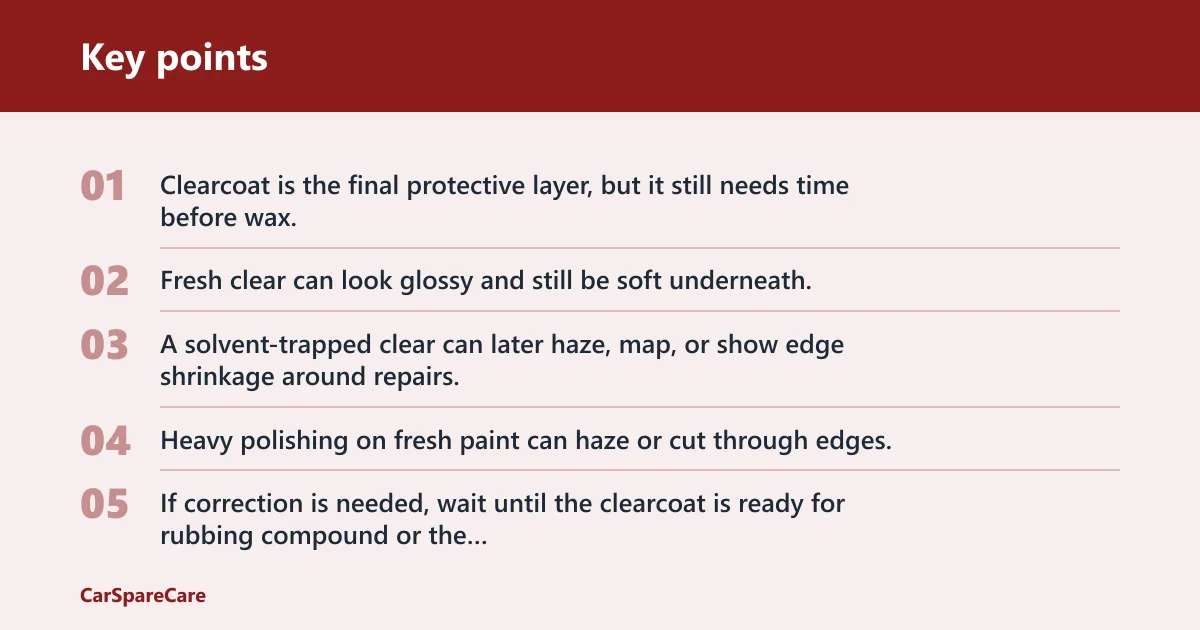
Clearcoat is the final protective layer, but it still needs time before wax. Fresh clear can look glossy and still be soft underneath. Treat gloss as a clue, not permission. A solvent-trapped clear can later haze, map, or show edge shrinkage around repairs.
Polishing too early
Heavy polishing on fresh paint can haze or cut through edges. If correction is needed, wait until the clearcoat is ready for rubbing compound or the product is specifically listed as polishable. That step belongs after the cure period, not during it.
Wet sanding the final coat
Wet sanding uses wet and dry sandpaper on some intermediate steps. It is not for the final coat. If sanding is needed, do it between coats or on cured paint only when the repair process calls for it. Sanding a soft final coat can create distortion that later shows as print-through.
Skipping adhesion promoter on non-metal surfaces
Adhesion promoter is relevant only where the substrate and paint system call for it; do not use it as a substitute for correct substrate preparation or a valid TDS.
Say your bumper cover is plastic and the spot repair is a small area. If the promoter is missing, the finish may look fine at first and then lift later. In that case, more wax will not fix adhesion; the repair needs proper prep from the start.
Suppose a clearcoated panel sits in a garage at 55°F with damp air. Even if it feels dry on day 10, the coating can still be soft under the skin. Waiting longer is safer than forcing wax onto a finish that has not fully hardened. That is a classic delayed cure outcome: the surface looks acceptable, then later shows print-through or solvent trap after sealing.
Frequently asked questions
How long to wait before waxing new car paint?
Use the product sheet first. For fresh refinish work, a conservative minimum is 30 days unless the paint maker gives a longer or shorter cure time. Small touch-ups can be ready sooner, but only when they are fully hard and the TDS/P-sheet allows it. Cooler temperatures and damp air can push the safe date back.
How long to wait before waxing new auto paint?
New auto paint should be waxed only after it is fully cured, not just dry to the touch. A general minimum is 30 days for repaint work when no product sheet is available. Fresh touch-up paint may be sooner if the product label allows it and the film is hard enough to resist imprinting.
Can you wax fresh clear coat the same week?
No. Clearcoat should dry for at least three days before rubbing compound only if the product sheet gives that window and the film is already polishable; waxing still should wait until the coating is fully cured. Same-week waxing can trap solvent and dull the finish. If the repair is still soft, leave it alone longer.
What happens if you wax new paint too soon?
Wax can seal in solvents, soften the surface, and leave dull spots or print-through. On a soft coating, it can also cause imprinting from applicators or towels. If the finish starts to haze or lift, stop and let it cure longer. Manufacturer guidance treats solvent release as part of the cure process, not a cosmetic detail.
Does the wait time change for basecoat and clearcoat?
Yes. Basecoat must be dry to the touch before clearcoat goes on. After clearcoat, wait for the cure period before waxing or compounding. The clearcoat is the layer that matters most for the final wait, and the exact timing depends on the system, film build, and whether the finish was air-dried or force-baked.
What should you use instead of wax on fresh paint?
Use a gentle wash and microfiber drying only, or a body-shop-safe, non-sealing detail spray if the product is specifically approved for fresh paint. Do not use wax or compound until the paint is cured. For repairs that still need protection, patience is safer than sealing too early.
Sources
Because cure windows vary by product family, catalyst, film build, substrate, bake cycle, and ambient conditions, always follow the exact product sheet when available; the timelines above are conservative fallbacks for situations where the product-specific instructions are missing or incomplete.

Hi, I’m Melvin, an automobile engineer with extensive experience in automobile equipment. I currently work for a local automobile firm, where I specialize in the car parts industry. I’ve had the opportunity to collaborate with seasoned inspectors, gaining invaluable hands-on experience that goes beyond just theory.
My passion for automotive care started at a young age, which led me to create CarSpareCare. Through CarSpareCare, I share the knowledge and skills I’ve acquired over the years to help others navigate the world of car maintenance and repairs.
My goal is to provide practical tutorials, essential safety advice, and the latest industry insights so that anyone—whether a beginner or an expert—can confidently tackle their automotive projects.

