Choose interior cleaners by surface first: use a pH-neutral interior cleaner for vinyl, plastic, and most trim, a dedicated leather cleaner for coated leather, glass cleaner only on glass, and an upholstery or fabric cleaner for cloth. Skip one-bottle products that claim to do everything. The wrong formula can leave residue, stain trim, dry leather, or haze touchscreens. This guide gives a simple surface-to-product decision matrix so you can buy only what your cabin actually needs.
What you’ll need
- Microfiber towels, preferably low-lint and scratch-safe
- Soft detail brush for seams, vents, and textured plastics
- Handheld vacuum with crevice and brush attachments
- All-purpose interior cleaner for vinyl, rubber, plastic, and sometimes leather when the label allows it
- Upholstery cleaner for cloth seats and carpets
- Leather cleaner for natural, faux, and perforated leather
- Interior protectant for vinyl, rubber, and plastic
- Odor eliminator for smoke, food, or pet smells after cleaning
Choose the cleaner by surface
Match the cleaner to the material before you spray. Start with the surface, then check the finish and the cleaning strength you need. Some makers list interior products for leather, cloth, vinyl, rubber, plastic, glass, and odor elimination, plus interior kits for different job sizes.
Leather, including natural, faux, and perforated
Use a dedicated leather cleaner when the surface is real, coated, faux, or perforated leather. It should clean without drying or scuffing the surface, especially around stitched seams and perforations. After cleaning, add conditioner only when the leather needs protection or dryness control; conditioner is not a cleaner.
Cloth seats and carpets
Use an upholstery cleaner for cloth seats and carpets. Spot-cleaner formats work best for spills, stains, and isolated marks, while full-shampoo use makes more sense when the whole seat or carpet needs a reset. Over-wetting is the main risk here, so work in passes and dry the fabric fully.
Vinyl, rubber, and hard plastic
Use an all-purpose interior cleaner or a dedicated interior protectant on vinyl, rubber, and plastic. Chemical Guys says Total Interior Cleaner & Protectant cleans leather, vinyl, plastic, and more, while VRP Vinyl, Rubber, Plastic Protectant is made for those surfaces. Pick matte or satin for a natural look; glossy finishes can look slick or distracting on touch points.
Alcantara and touchscreens
Use the mildest product on Alcantara and the least wet method on touchscreens. Alcantara behaves like a delicate textile, so skip heavy scrubbing and strong solvents. For screens, use a cleaner made for electronics or a lightly damp microfiber towel, then dry immediately. Residue is the main failure mode.
What should I look for in a car interior cleaning product?
Look for chemistry that fits the surface, a finish that fits the location, and an application method that limits residue. Water-based or residue-free formulas are best for most interiors, especially around vents, screens, and soft-touch panels. The label should clearly name the materials it is safe on and whether dilution is allowed.
Safe label clues
For general trim, the cleaner should name vinyl, rubber, and plastic. For cloth, it should mention upholstery or fabric. For leather, it should say leather and ideally specify coated, natural, faux, or perforated leather. Chemical Guys says its All Purpose Cleaner & Degreaser is concentrated and can be diluted, which matters when you need different strength for different jobs.
When to avoid it
Avoid products that are bleach-heavy, highly alkaline, ammonia-based, or solvent-heavy unless the label specifically approves the surface. Those formulas can dull trim, dry leather, leave haze on touchscreens, or create a slick steering wheel. If a product does not name your surface, do not guess.
Spray versus diluted concentrate
Choose a ready-to-use spray for quick maintenance, small cabins, or if you want less mixing risk. Choose a diluted concentrate when you clean often, need separate strength for different surfaces, or want one product that can be mixed weaker for delicate trim. A concentrate only helps when the label provides clear dilution guidance.
Interior cleaner selector
This table gives the practical match first. Start with the safest product type, then avoid the finish or method that causes the usual failure.
| Surface | Safest product type | Finish to avoid | Application tool | Common failure mode |
|---|---|---|---|---|
| Leather | Dedicated leather cleaner; conditioner after cleaning if needed | Glossy protectant or strong all-purpose degreaser | Microfiber towel; soft detail brush for seams | Drying, scuffing, or greasy residue |
| Cloth | Upholstery cleaner | Heavy saturating spray | Microfiber towel; upholstery brush | Over-wetting and slow drying |
| Alcantara | Mild fabric or upholstery cleaner approved for delicate textiles | Wet foam, solvent-heavy cleaner, stiff-bristle brush | Microfiber towel; very soft brush | Matted fibers and water marks |
| Vinyl | All-purpose interior cleaner or interior protectant | Sticky gloss finish | Microfiber towel | Slick feel and streaks |
| Rubber | All-purpose interior cleaner or interior protectant | Oily high-shine dressing on pedals or mats | Microfiber towel; detail brush for texture | Slippery surface or uneven shine |
| Plastic | All-purpose interior cleaner; protectant if UV exposure is a concern | Glossy finish on touch points | Microfiber towel; soft detail brush | Haze, streaking, or dust attraction |
| Touchscreens | Screen-safe cleaner or lightly damp microfiber towel | Ammonia, abrasive pads, heavy dressing | Clean microfiber towel | Residue and haze |
| Odor control | Odor eliminator after cleaning the source | Using fragrance alone as a fix | Spray, tablet, or air-freshener format | Smell returns when the source remains |
How to clean without damaging the cabin
- Remove trash, personal items, and loose mats, then vacuum seats, cupholders, floor mats, and crevices first.
- Test the cleaner on a hidden spot, especially on leather, Alcantara, or older plastic that may react badly.
- Apply cleaner to the microfiber towel or detail brush, not directly to the panel, unless the label clearly says otherwise.
- Work one surface at a time and keep the towel damp, not dripping; if cloth gets too wet, stop and dry it before moving on.
- Wipe dry with a clean microfiber towel and inspect for streaks, whitening, or tackiness before adding protectant or conditioner.
- If needed, add protectant in a thin pass, then recheck after 1 minute for excess shine or residue.
Say your dashboard has dust, sunscreen smears, and a matte finish. A water-based interior cleaner on a microfiber towel will usually do the job without leaving glare. Suppose a perforated leather seat has a spill near the stitched edge. Use a leather cleaner on a soft brush, then dry the area fully before deciding whether conditioner is needed.
What products should I avoid on dashboards and trim?
Avoid household cleaners that are not labeled for car interiors, plus any product that is strongly alkaline, bleach-heavy, ammonia-based, or solvent-heavy. Those formulas can strip sheen from plastic, leave trim sticky, and fog clear touch surfaces. On glossy trim and screens, residue is often worse than visible dirt.
Also avoid abrasive pads, paper towels, and stiff brushes on soft-touch dashboards. Those tools can leave fine marks that show under daylight. If a panel already looks streaky after cleaning, switch to a clean microfiber towel and a milder product, then wipe dry in straight passes.
Do I need separate products for pet hair, stains, and odors?
Yes, if you want cleaner results and fewer side effects. Pet hair calls for vacuum tools, stains call for the right fabric or leather cleaner, and odors call for an odor eliminator after the source is removed. One product can overlap jobs, but the job itself still changes the best tool.
Pet hair and vacuum attachments
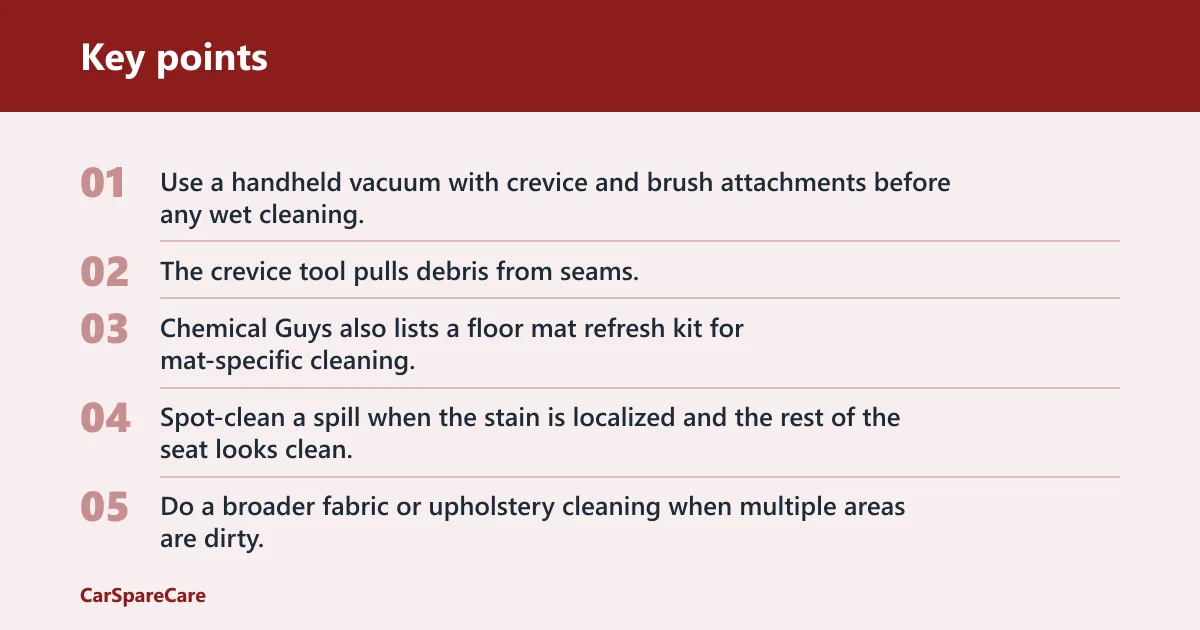
Use a handheld vacuum with crevice and brush attachments before any wet cleaning. The crevice tool pulls debris from seams, while the brush attachment helps lift hair from cloth and carpet. Chemical Guys also lists a floor mat refresh kit for mat-specific cleaning, which fits separate treatment for mats and cabin surfaces.
Stains versus full-seat cleaning
Spot-clean a spill when the stain is localized and the rest of the seat looks clean. Do a broader fabric or upholstery cleaning when multiple areas are dirty, when body oils have built up, or when the whole seat smells stale. The wrong move is flooding one spot and leaving a water ring.
Odor eliminators
Use an odor eliminator after cleaning, not instead of it. Sprays, tablets, and air-freshener formats can help with smoke, food, or pet smells, but they do not remove the source by themselves. Chemical Guys says its products include odor elimination, and Inner Clean is described as removing dirt, dust, fingerprints, and body oils.
How do I choose between a spray, wipe, and concentrate?
Choose the format based on job size, surface sensitivity, and how much control you want over strength. Sprays are often the fastest option for routine interior care. Wipes are convenient for quick touch-ups. Concentrates make sense when you clean larger interiors often or want to dilute stronger or weaker for different materials.
Spray
Pick a spray for weekly maintenance, dash cleaning, and small touch-up jobs. It gives better control than a wipe when you need to target seams, vents, or textured plastic. A spray is also easier to apply to a towel first, which reduces overspray on screens and switchgear.
Wipe
Pick a wipe for emergency cleanup, glovebox storage, or fast dust removal. Wipes are less flexible for heavy soil and can leave too much residue on shiny trim if used alone. They work best as a travel backup, not as the main cleaner for a heavily used cabin.
Concentrate
Pick a concentrate if you want one product for multiple interior jobs and are comfortable measuring dilution. Chemical Guys says its All Purpose Cleaner & Degreaser is concentrated and can be diluted, which is useful for dialing strength up or down. Keep the mix exact, then recheck the surface after each pass.
Frequently asked questions
Are all-purpose cleaners safe for car interiors?
Sometimes, yes. An all-purpose interior cleaner can be safe on vinyl, rubber, plastic, and sometimes leather if the label says so. It is not a universal answer for cloth, Alcantara, screens, or unfinished surfaces, so read the compatibility list before use.
Which cleaner should I use on leather, cloth, and plastic?
Use leather cleaner for leather, upholstery cleaner for cloth, and an all-purpose interior cleaner or interior protectant for plastic. If the leather is perforated, use a gentle product and a soft brush so cleaner does not sit in the holes. Finish with conditioner only where needed.
Is a household cleaner safe to use inside a car?
Usually not. Many household cleaners are too harsh for dashboards, trim, touchscreens, or leather because they can strip coatings or leave residue. If you must substitute, pick a product that is explicitly labeled for automotive interiors and test it in a hidden area first.
What tools do I need with interior cleaning products?
At minimum, use a handheld vacuum, microfiber towels, and a soft detail brush. A vacuum handles dry debris first, microfiber reduces scratching, and the brush reaches seams and vents. For cloth seats, add an upholstery brush; for leather, keep the brush soft.

Hi, I’m Melvin, an automobile engineer with extensive experience in automobile equipment. I currently work for a local automobile firm, where I specialize in the car parts industry. I’ve had the opportunity to collaborate with seasoned inspectors, gaining invaluable hands-on experience that goes beyond just theory.
My passion for automotive care started at a young age, which led me to create CarSpareCare. Through CarSpareCare, I share the knowledge and skills I’ve acquired over the years to help others navigate the world of car maintenance and repairs.
My goal is to provide practical tutorials, essential safety advice, and the latest industry insights so that anyone—whether a beginner or an expert—can confidently tackle their automotive projects.