For one-wheel brake or wheel work, crack the lug nuts first, then lift the car onto one jack stand at the approved jacking point and chock the wheels. Skip those steps, and the car can shift or drop, crushing a hand, bending parts, or worse. This guide covers the minimum stable setup, the lift order, and a final fail-safe check.
What you’ll need
- Car jack
- Jack stands with a rating suited to the vehicle and load
- Wheel chocks
- Lug wrench or breaker bar
- Owner’s manual
- Thick plywood board for soft ground or asphalt that may give way
- Gloves and a flashlight
The jack lifts the car. The stands hold it. Keep those jobs separate. Use the jack only to raise the vehicle, then let the stands carry the weight after it is up. Stand bases should be wide, with a locking mechanism, and their capacity should suit the car, not just the corner you plan to raise.
What should I do before lifting a car with a jack?
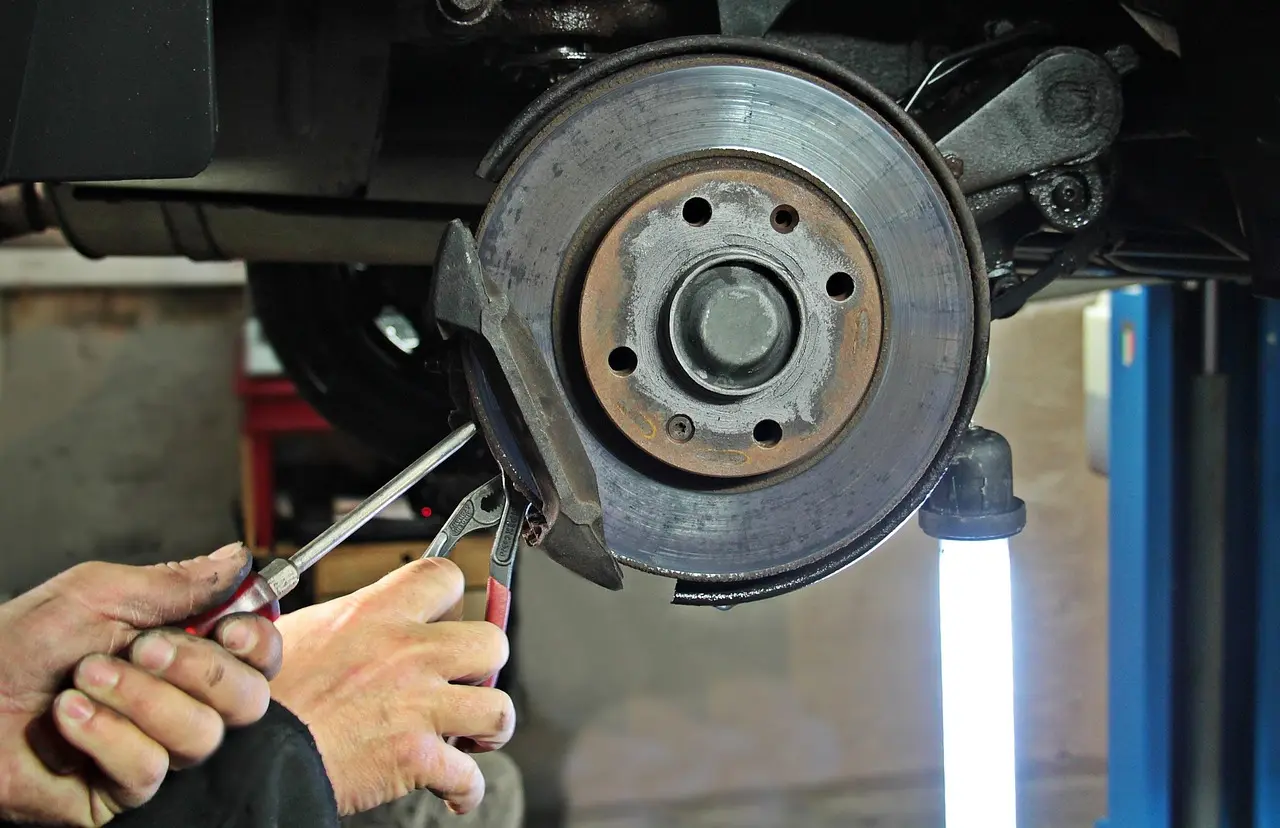
Park on a reasonably flat surface, set the parking brake, and put the transmission in Park or in gear. Then loosen the lug nuts before the tire leaves the ground, since it is usually easier before the wheel is off the ground. Place wheel chocks on the opposite side of the lift, with one in front of and one behind the wheel that stays on the ground.
Pre-lift order
- Park on a garage floor or flat driveway.
- Set the parking brake and transmission position.
- Chock the opposite side of the vehicle.
- Crack the lug nuts loose.
- Gather the jack, stands, and the owner’s manual.
A common first-timer mistake is jacking first and reaching for the lug wrench second. That adds side load to the car and can make the wheel harder to remove later.

Where is the safest place to jack up a car?
The safest place is the vehicle-specific jacking point listed in the owner’s manual, on firm, level ground. Many cars use frame or suspension points. Do not guess at thin body panels, floor sections without support, or any spot that does not leave room for a jack stand to sit flat afterward.
Jacks and jack stands only work by lifting straight up, so the contact point must be solid and square. If the surface is soft, use a sturdy plywood support board under the jack and stands so they are less likely to sink into grass or asphalt.
Ground and support checks
- Avoid slopes, loose gravel, and broken, uneven pavement.
- Keep the jack base level before pumping.
- Make sure each stand foot can sit flat.
- Reset the setup if the car shifts as it rises.
How many jack stands do I need?

For a single-wheel removal, the car still needs stable support from the remaining wheels and the lifted corner’s nearby structure. For any end-of-car lift, use two jack stands, one per side under the lifted end. If you are lifting the whole car, use four jack stands. Stand capacity should be at least half the vehicle’s weight, with a margin that suits the vehicle type and load.
That margin matters in practice. A compact car and a heavier SUV place different loads on the same stand. Match the stand rating to the vehicle, then choose a size that gives enough height without leaving the post nearly maxed out.
Wheel-work safety checklist by lift type
| Scenario | Exact setup steps | Minimum jack stand count | Where chocks go | What to inspect before lowering | Stop now if you see |
|---|---|---|---|---|---|
| Single-wheel removal | Loosen lug nuts, lift at the approved point, place one stand under a solid support point if the vehicle design keeps the opposite wheels stable, then lower until the car rests on the stand. | 1 if the remaining axle and wheels stay stable; use 2 if the job lifts an end | Opposite side of the lift, in front of and behind the wheel that stays on the ground | Stand locked, base flat, wheel area clear, no sinkage under the stand foot | Any wobble, tilted stand, shifting suspension, or cracked ground |
| Front-end lift | Chock the rear wheels, raise the front at the manual’s front jacking point, set one stand per side, then lower evenly onto both stands. | 2 | Rear wheels, one chock in front and one behind a rear wheel | Both stands at matching height, both feet flat, no twist in the body | One side sits lower, the jack wants to tilt, or the surface compresses |
| Rear-end lift | Chock the front wheels, raise the rear at the manual’s rear point, set one stand per side, then lower evenly onto both stands. | 2 | Front wheels, one chock in front and one behind a front wheel | Stand locks engaged, axle or approved support points aligned, no shifting as weight transfers | Uneven lowering, stand leg movement, or any sinking into asphalt or soil |
How do you set the car onto jack stands safely?

Raise the vehicle only as high as needed, set the stands at the correct height on approved support points, then lower the jack slowly until the car rests fully on the stands. Never leave the jack as the only support while you work. Remove the jack, or leave it as a light backup only after the car is fully settled on the stands.
Setting the stands
- Place each stand under a support point from the manual.
- Adjust both stands to the same height when lifting one end.
- Check that the feet sit flat on the surface or plywood board.
- Lower the jack slowly so the load transfers evenly.
- Confirm the locking mechanism is fully engaged.
Say your driveway slopes just enough that one stand sinks a little into warm asphalt. The body can lean, the stand can tilt, and the wheel opening can close up on one side. Stop there and reset the setup, do not call it good enough.
How do you know if the car is stable on jack stands?
Do a gentle shake test after the car is fully on the stands. A stable setup should stay planted, with no wobble, shifting, or movement at the stands or the body. Check the surface under each foot as well. If one side sinks more than the other, lower the car and reset the support before touching the wheel or brake parts.
Stability check
- Press lightly on the body near the lifted corner.
- Watch the stands for tilt or movement.
- Look under each foot for sinking or cracking.
- Recheck the locking pins or ratchet position.
Suppose one stand sits on a patched driveway crack and the other does not. The height mismatch may look small, but it can change the load path enough to make one side move when you pull a seized lug nut.
Can I work under a car supported by a jack alone?
No. A jack is for temporary lifting, not for supporting the vehicle while you work. Jack stands help keep you safer when working under your car, and they provide a wider, locked support base than a jack alone. If the task requires your hands, head, or torso under the vehicle, set it on stands first.
Even for wheel work, the safer habit is the same: raise, support, check, then start turning fasteners. If the car is not stable enough to pass the shake test, stop.
What are the safest jack stands for home use?
The safest stands for home use are the ones that fit the vehicle’s weight, height, and support points. Choose stands with a wide base, a positive locking mechanism, and a rating that is at least half the vehicle’s weight. For wheel work, the stand must also fit under the approved point without forcing the car too high.
What to look for
- Capacity suited to the vehicle and load.
- Wide footprint for better ground contact.
- Solid lock, pin, or pawl engagement.
- Height range that matches the job.
- Flat saddle contact on the support point.
Choose the stand size by the job, not by the cheapest label. A full-end lift on an SUV and a single-wheel brake job on a compact car do not ask the same thing of the equipment.
Common mistakes that make wheel work unsafe
Most failures come from rushed setup, not bad luck. The biggest errors are using the jack as the only support, skipping chocks, placing stands on soft or uneven ground, and trusting a stand before the car has passed a shake test. Loose, tilted, or sinking support should stop the job immediately.
If that happened, reset the setup
- Lower the vehicle fully to the ground.
- Move to a flat, level surface.
- Reposition the chocks on the opposite side of the lift.
- Place a plywood board under the jack or stands if the ground is soft.
- Lift again at the approved points and repeat the stability check.
Prevention: Before every lift, check the manual, the ground, the chocks, and the stand locks in the same order. That habit keeps most setup mistakes from turning into a moving car.
Frequently asked questions
How do you use a jack and jack stands safely?
Park on a flat, level surface, loosen the lug nuts, chock the opposite side, lift at the approved point, and set the car onto properly rated jack stands. Then do a gentle shake test before any wheel or brake work starts. Never rely on the jack alone for support.
Where should jack stands go on a car?
Place jack stands only at approved support points from the owner’s manual, usually frame or suspension points. The stand saddle must sit flat, with enough room for the feet to rest on solid ground. Avoid thin panels, plastic covers, and any point that forces the stand to lean.
Do I need jack stands to change a wheel?
Yes if the wheel job lifts an end of the car or leaves you reaching near suspension parts. For a simple single-wheel removal, the car still needs secure support from the remaining wheels and proper chocking. A jack alone is not considered safe working support.
Can I use jack stands on a driveway?
Yes, if the driveway is flat and level. A garage floor or flat driveway is the best place to jack a car. Avoid sloped, gravel, bumpy, or cracked areas that let the jack or stands move. Use a thick plywood board if the surface is soft or questionable.

Hi, I’m Melvin, an automobile engineer with extensive experience in automobile equipment. I currently work for a local automobile firm, where I specialize in the car parts industry. I’ve had the opportunity to collaborate with seasoned inspectors, gaining invaluable hands-on experience that goes beyond just theory.
My passion for automotive care started at a young age, which led me to create CarSpareCare. Through CarSpareCare, I share the knowledge and skills I’ve acquired over the years to help others navigate the world of car maintenance and repairs.
My goal is to provide practical tutorials, essential safety advice, and the latest industry insights so that anyone—whether a beginner or an expert—can confidently tackle their automotive projects.