Powder coat often lasts several years on wheels, sometimes longer than paint, while paint can last a similar span if the wheel is prepped well, sealed correctly, and kept away from curb rash and harsh chemicals. Bad prep or repeated impact damage makes either finish peel, chip, and corrode, which means another refinishing job. This guide compares durability, failure modes, and the wheel-use scenarios where each finish makes more sense.
| Factor | Powder coat | paint for wheels | Winner |
|---|---|---|---|
| Impact resistance | Thicker polymer shell resists chips and scuffs better. | Thinner coating chips more easily from gravel and curb contact. | Powder coat |
| Corrosion resistance | Usually better barrier protection when prep is sound. | More vulnerable if the clear coat breaks down or the edge gets nicked. | Powder coat |
| Repairability | Damaged areas often need broader refinishing. | Spot repair is easier for small chips and edge wear. | paint for wheels |
| Recoat cost | Usually higher upfront because of stripping and oven curing. | Usually lower upfront and simpler to redo. | paint for wheels |
| Best fit use case | Daily drivers, winter wheels, salt-belt cars, higher-abuse use. | Show cars, low-use wheels, owners who want cheaper refinishing. | Depends on use case |
Powder coat vs paint for wheels: the real trade-off
Powder coat usually lasts longer because it builds a thicker, thermally bonded polymer shell on the wheel, but that only happens when the wheel is cleaned, stripped, and cured the right way. Paint can look good for years too, especially on low-mileage wheels, yet it is more likely to chip, fade, or peel sooner under road abuse.
Durability is not the same as wheel life
The coating can fail while the wheel stays usable. That difference matters. A wheel may still be straight and safe after the finish chips at the lip or lifts around a spoke, but the cosmetic layer is then the weak point, not the metal itself.
Say your 18-inch aluminum commuter wheel gets one rock strike each week on a gravel shoulder. The finish at the outer lip will usually fail long before the wheel structure does, even though the wheel itself may remain sound.
Which lasts longer on wheels?
Powder coat usually lasts longer on wheels than paint because it forms a thicker, heat-cured polymer shell that stands up better to chips and corrosion. The Wheel Shop says powder coating often lasts decades with proper care, while spray paint typically lasts only a few years. That gap narrows when prep is poor or the wheel sees regular curb contact.
Impact resistance
Powder coat handles small strikes better because the coating is thicker and less brittle in normal service. The Wheel Shop describes powder as 3-5 times more durable, but even that does not make it stone-proof. Rock chips and curb scrapes happen to every finish.
Corrosion resistance
Powder usually wins on corrosion resistance because it seals the metal more completely when the surface is clean and properly prepped. ColorWerks says powder is more chemical-resistant than paint, which matters around winter grime, wheel cleaners, and brake dust.
UV fade and brake-dust staining
Paint often shows fading and staining sooner, especially if brake dust is left to bake on or strong cleaners are used. Powder can still discolor or dull over time, but the thicker coating usually tolerates repeated washing better than a thin paint system.
Repairability after chips or curb rash
Paint is easier to touch up in a small area. Powder coat usually needs more of the wheel refinished if the damage is visible, because a patch rarely blends cleanly on a curved spoke or polished lip.
How powder coating works on wheels
Powder coating uses dry powder, an electrostatic spray gun, and heat curing in a curing oven, often around 400°F for wheels. The charged powder particles are attracted to grounded metal, then the heat fuses the coating into a thick polymer shell.
Electrostatic spray gun and grounded metal
The gun charges the powder so it clings to the wheel substrate. That substrate may be aluminum or steel, but it has to be clean. Any grease, oxidation, or old coating left behind can break the bond.
Heat curing in a curing oven
The oven is what turns loose powder into a hard finish. The Wheel Shop says the heat-curing process occurs around 400°F. That step is central to durability, because the coating has to flow and bond evenly across the wheel surface.
What can go wrong with old corrosion or poor stripping?
Powder coating over an old finish can peel early. ColorWerks strips powder to bare aluminum before coating, which shows why prep is not optional. If corrosion stays trapped under the coating, the finish can lift from the edge or bubble from underneath.
A common first-timer mistake is powder coating a wheel that still has hidden corrosion in the barrel. The face may look fine for a while, then flake at the spoke base after winter use because the corrosion was never removed.
How painted wheels fail
Paint on wheels usually relies on primer, color coat, and clear coat. The system can work well, but it is thinner and less forgiving than powder, so chips, peeling, cracking, and fading tend to appear sooner when the wheel sees daily use.
Chipping and peeling
Paint chips at exposed edges first. Once the clear coat is broken, moisture can creep under the layer and the damage spreads. On a wheel lip, that often means a small nick grows into a visible peel line.
Cracking and fading
Paint can crack when the film is too thick or the substrate was not cleaned well enough. UV exposure also dulls many painted finishes over time, especially on wheels that sit in direct sun and are washed with aggressive chemicals.
Brake dust and wash chemicals
Brake dust is abrasive and chemically active, so leaving it on the wheel shortens finish life. Harsh wheel cleaners and stiff brushes can do the rest by cutting into the clear coat or scuffing through the top layer.
What really shortens wheel finish life?
Road salt, gravel, curb rash, brake dust, UV exposure, and poor prep are commonly reported reasons both powder coat and paint fail early. The finish label matters less than what the wheel sees, how it was prepared, and how often it is cleaned without damage.
Road salt and winter grime
Does road salt damage powder coat or paint faster? Salt attacks both, but paint usually shows the damage sooner once chips expose the edges. Powder coat resists salt better when intact, yet any break in the coating can still let corrosion start at the damaged spot.
Gravel and stone strikes
Loose gravel is hard on both finishes. Powder coat usually holds up better against small impacts, but repeated strikes will still chip it. Paint tends to lose the edge sooner because the coating film is thinner.
Curb rash and parking damage
Curb contact is one of the fastest ways to shorten finish life. It can cut through either coating in one scrape, then expose bare metal. Once that happens, corrosion becomes a maintenance issue rather than a finish issue.
Brake dust buildup and harsh cleaners
Brake dust should be washed off before it bonds to the surface. Strong acidic cleaners, alkaline degreasers, and abrasive brushes can shorten the life of both finishes. Hand washing with a mild wheel-safe cleaner is the safer default.
Existing corrosion on the wheel substrate
Wheel substrate matters. Aluminum and steel wheels need proper cleaning and prep, and existing corrosion state can shorten either finish’s life. If corrosion remains under the coating, the top layer may fail long before the wheel reaches the end of its structural life.
Wheel finish decision matrix
| Scenario | Impact resistance | Corrosion resistance | Repairability | Recoat cost | Pick |
|---|---|---|---|---|---|
| Daily commuter | Powder coat | Powder coat | paint for wheels | paint for wheels | Powder coat |
| Winter/salt belt car | Powder coat | Powder coat | paint for wheels | paint for wheels | Powder coat |
| Curb-heavy city parking | Powder coat | Powder coat | paint for wheels | paint for wheels | paint for wheels |
| Track or street performance car | Powder coat | Powder coat | paint for wheels | paint for wheels | Powder coat |
| Show car | tie | tie | paint for wheels | paint for wheels | paint for wheels |
Daily commuter
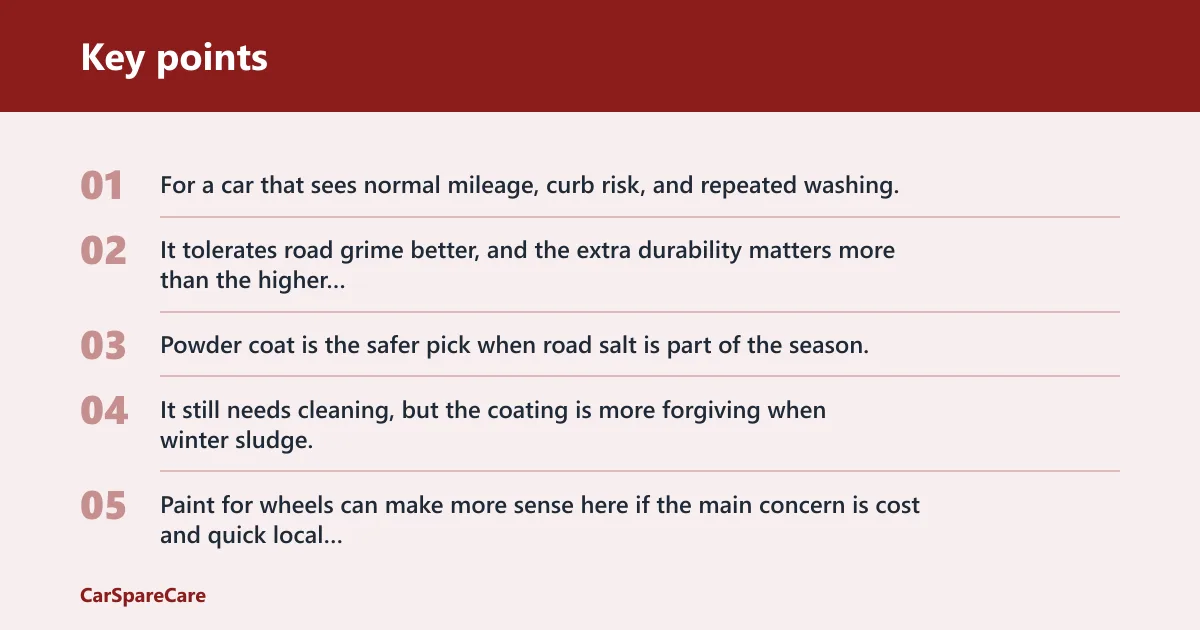
For a car that sees normal mileage, curb risk, and repeated washing, powder coat is usually the better long-term choice. It tolerates road grime better, and the extra durability matters more than the higher refinish cost.
Winter or salt-belt car
Powder coat is the safer pick when road salt is part of the season. It still needs cleaning, but the coating is more forgiving when winter sludge, salt spray, and frozen slush cling to the wheel for days at a time.
Curb-heavy city parking
Paint for wheels can make more sense here if the main concern is cost and quick local repair. If the wheel gets bumped often, a finish that is cheap to touch up may be more practical than one that needs full refinishing after a scrape.
Track or street performance car
Powder coat fits better when brake heat, dust, and frequent washing are part of the picture. It is not immune to chips, but it usually handles the abuse better than paint on a wheel that gets regular road and track wear.
Show car
Paint for wheels is often the better fit for a low-use show car because visual refinement and spot repair matter more than long-haul abuse resistance. If the wheels are handled carefully, the easier repair path can outweigh the lower durability.
Choose Powder coat if… / Choose paint for wheels if…
Powder coat wins when you want the longer-lasting finish under real driving conditions. Paint for wheels wins when your priority is lower upfront cost, easier touch-up work, and a wheel that does not see much salt, gravel, or curb contact.
Choose Powder coat if…
- You drive year-round and face road salt or winter grime.
- You want better chip and corrosion resistance for daily use.
- You are refinishing wheels that need a tougher barrier than paint usually gives.
- You can accept higher upfront cost for longer service life.
Choose paint for wheels if…
- You want the cheapest upfront refinish.
- You care most about spot repair after small scrapes.
- The car is a low-use show car or fair-weather vehicle.
- You expect future color changes and want an easier redo.
Can I powder coat alloy wheels? Yes, alloy wheels can be powder coated if they are stripped, cleaned, and prepped correctly. Existing corrosion and old coatings are the problems to solve first, because alloy surfaces that keep contamination under the finish are more likely to peel early.
Which wheel finish is cheaper over time, paint or powder coat? Paint is usually cheaper upfront, but powder coat can cost less over time if the wheel sees salt, gravel, or frequent washing damage. The better value depends on whether you pay more now for longer service life or less now for more frequent refinishing.
Frequently asked questions
Is powder coating better than paint for wheels?
For most drivers, yes. Powder coat usually lasts longer, resists chips better, and handles corrosion better when the wheel is properly stripped and cured. Paint still makes sense when repairability and low upfront cost matter more than maximum finish life.
How long does powder coating last on wheels?
It can last the life of the wheel when done right. The Wheel Shop says powder coating often lasts decades with proper care, but that depends on prep, road exposure, and whether the wheel gets curb damage or salt exposure that breaks the coating edge.
How long does painted wheels finish last?
The Wheel Shop says spray paint typically lasts only a few years on wheels. That can be shorter if the wheel sees winter salt, frequent brake-dust buildup, harsh cleaners, or repeated curb scrapes. Careful prep and gentle washing can stretch that service life.
Does powder coating chip less than paint on wheels?
Usually yes. Powder coat is thicker and more impact-resistant, so it generally holds up better against gravel and minor road strikes. It is still not immune to chips, and a hard curb hit can damage it just as surely as it damages paint.
Is powder coating worth it for daily driver wheels?
Often yes. For daily drivers, the extra durability helps against salt, dust, and repeated washing. If the car lives in a mild climate and you expect easy touch-ups to matter more than long service life, paint for wheels can still be the practical choice.
Does road salt damage powder coat or paint faster?
Road salt is harder on paint once the coating is nicked, because corrosion can spread from exposed edges more quickly. Powder coat usually holds up better while intact, but both finishes fail earlier if the wheel was not cleaned and prepped correctly before refinishing.

Hi, I’m Melvin, an automobile engineer with extensive experience in automobile equipment. I currently work for a local automobile firm, where I specialize in the car parts industry. I’ve had the opportunity to collaborate with seasoned inspectors, gaining invaluable hands-on experience that goes beyond just theory.
My passion for automotive care started at a young age, which led me to create CarSpareCare. Through CarSpareCare, I share the knowledge and skills I’ve acquired over the years to help others navigate the world of car maintenance and repairs.
My goal is to provide practical tutorials, essential safety advice, and the latest industry insights so that anyone—whether a beginner or an expert—can confidently tackle their automotive projects.