Check the wheel’s casting or stamping for an OEM part number: a factory wheel usually has one, while many aftermarket wheels show a brand name, size, load rating, or no automaker part code. I have seen wrong guesses lead to bad fitment, vibration, and wheels that will not clear the hub, brakes, or sensors. This guide covers the stamps, back-side markings, construction clues, and fitment checks I use to tell OEM from aftermarket fast.
How can you tell if a wheel is OEM or aftermarket?
Start on the back side of the wheel. An OEM wheel, meaning the wheel that came on the car from the factory, usually carries an automaker part number, finish code, and fitment data that matches the vehicle’s factory spec. Aftermarket wheels often show the wheel maker’s brand, size, load rating, and separate approval marks instead.
Face design is a weak clue. I have handled replica wheels that copied the spoke pattern so closely the front view gave almost nothing away. The rear face, barrel, and hub pad usually tell the truth.
Use markings, dimensions, and hardware together
- Check the back pad for an OEM part number or brand stamp.
- Read the size, offset, and center bore markings.
- Look for JWL, VIA, and DOT marks, then treat them as testing or road-use clues, not proof of factory origin.
- Inspect the lug seat shape and the valve stem or TPMS area.
- Compare everything with the vehicle’s factory wheel spec, not with another wheel that only looks similar.
A wheel can look factory-correct and still be aftermarket. I see that often with replica designs and with used wheels that were refinished or repainted.
📊 Santa Ana Wheel says it has been in the wheel business since 1958. Source: OEM vs Aftermarket Wheels: The Complete 2026 Guide.
What markings should I look for on the back of a wheel?
Look for the part number first, then the casting marks, size stamp, offset, load rating, and any brand or approval marks. A factory wheel often has an automaker part number or engineering code. Aftermarket wheels more often show the wheel brand, a mold code, and general spec markings rather than a vehicle-specific part code.
Part numbers, casting numbers, and manufacturer codes
Part numbers are the strongest single clue when they match the vehicle maker’s numbering format. Casting numbers can help separate a genuine factory wheel from a copy, but they are not enough alone because replicas sometimes copy visible text too. Manufacturer codes often identify the wheel maker or casting plant.
JWL, VIA, and DOT marks
JWL and VIA are Japanese testing standards. They are quality and inspection marks, but they do not prove the wheel is OEM. A wheel with those marks may be OEM or aftermarket. DOT markings are described as legally required for U.S. highway use, so they matter for road legality, not factory origin.
Size, offset, load rating, and center bore stamps
Size and offset tell you whether the wheel was built for the same fitment envelope as the original. Center bore matters because it must match the hub or use hub-centric rings. Load rating tells you what the wheel is built to carry. If the numbers do not line up with the car’s spec, treat the wheel as suspect.
Does wheel weight help identify OEM vs aftermarket?
Wheel weight can hint at construction differences, but it cannot prove origin. A quality 18-inch alloy wheel is said to weigh 20–28 lbs, and over 30 lbs is flagged as a red flag for an 18-inch alloy. Even then, cast design, finish, and reinforcement can move the number around.
When weight can help
Very heavy wheels may point to a lower-grade casting, a steel wheel, or a wheel built with extra material. Very light wheels may suggest a thinner performance design. That said, both OEM and aftermarket wheels can fall anywhere in the same band.
Why weight alone cannot prove origin
Refinished wheels can gain coating weight. Bent or repaired wheels may be filled. Replica wheels can be made heavier or lighter than the factory wheel they copy. Use weight as one clue, not as the ID method.
What else to compare before buying
- Back-side part numbers
- Offset and center bore
- Lug seat angle
- TPMS fitment
- Brake and caliper clearance
Can an aftermarket wheel look exactly like OEM?
Yes. Replica wheels can copy an OEM design closely enough that the spoke shape, center cap style, and finish appear factory-correct at a glance. The wheel is still aftermarket if it was not supplied as the original factory wheel. The giveaway usually sits on the back side or in the fitment details.
How replica wheels copy factory designs
Replicas often mimic the same diameter, spoke layout, and face finish because buyers want a direct visual match. Some even copy the outer barrel profile and cap recess. What they usually cannot copy perfectly is the automaker’s part numbering, internal casting code, and exact rear machining pattern.
Clues that usually give them away
Look for a wheel brand stamped on the barrel, a generic size mark, different valve stem placement details, or a center bore that needs a hub-centric ring. If the wheel needs different lug nuts or a different TPMS fitment path, it is behaving like an aftermarket piece even if the face looks OEM.
Why fitment details matter more than spoke shape
Spoke shape can be copied. Offset, center bore, load rating, and lug seat angle are harder to fake without affecting installation. That is why a wheel that looks right in a photo can still be the wrong wheel for the car.
What is the proof checklist for a used wheel photo?
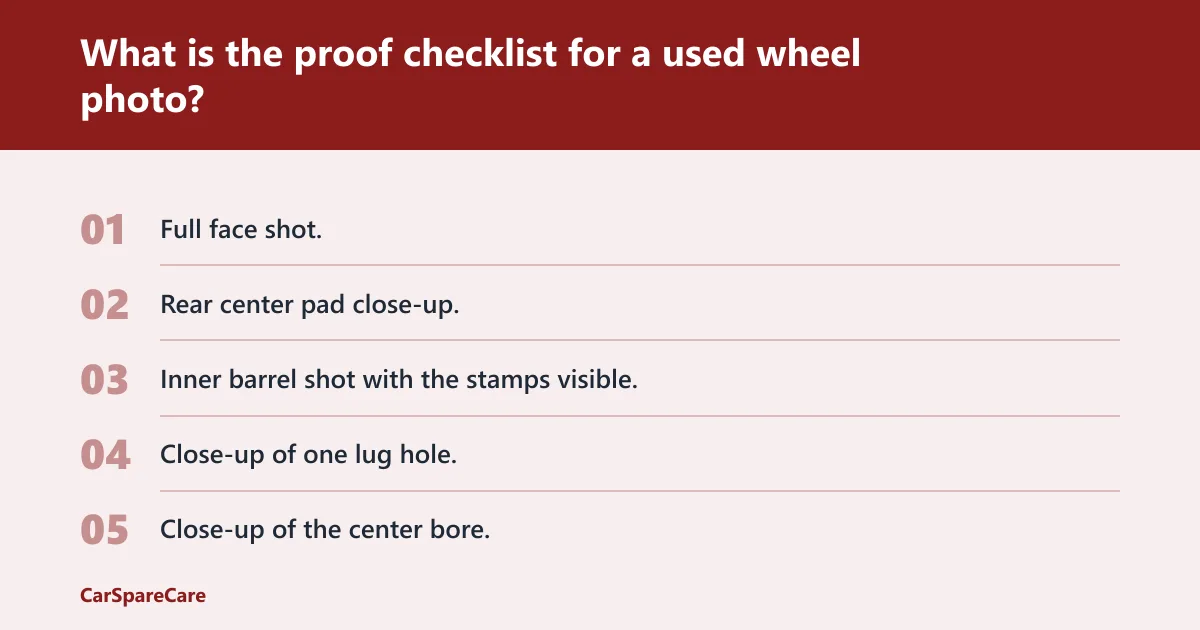
For a used wheel, ask for photos of the back side, not just the face. The best proof comes from clear shots of the part number, casting marks, offset stamp, center bore, and any JWL, VIA, or DOT marks. A complete photo set often helps show whether the wheel is OEM, a replica, or another aftermarket style.
Photo-based identification checklist
| Where to look on the wheel | What marking or feature to capture | What each clue usually means for OEM, replica, or aftermarket wheels |
|---|---|---|
| Back of the center hub pad | OEM part number, casting number, brand stamp | OEM if the automaker part code matches the vehicle; aftermarket if the wheel brand or generic code is present |
| Inner barrel | Size, offset, load rating, JWL, VIA, DOT | Testing or road-use clues; useful for legality and fitment, not proof of factory origin |
| Hub bore | Center bore diameter or machining ring | Exact hub match can point to OEM; a larger bore with a ring often points to aftermarket |
| Lug hole seats | Conical, ball, or flat seat profile | Different seat angle from the factory spec can mean the wheel needs different lug nuts |
| Valve stem area | TPMS opening, sensor clearance, stem type | May indicate aftermarket compatibility work if the original sensor or valve hardware will not transfer cleanly |
| Rear machining and finish | Clean casting, smooth machining, paint coverage | Rough or uneven rear finishing can hint at lower quality or a repaired wheel |
Photo angles to request from sellers
- Full face shot.
- Rear center pad close-up.
- Inner barrel shot with the stamps visible.
- Close-up of one lug hole.
- Close-up of the center bore.
- Close-up of any cracks, curb rash, welds, or repairs.
Red flags in marketplace and salvage listings
- No rear photos at all.
- Stamps are blurred or painted over.
- The seller will not show offset or load rating.
- Two wheels in the set have different marks or different rear finishes.
- The wheel looks OEM on the front but needs rings or unusual lug hardware.
Will aftermarket wheels affect fitment or resale value?
They can. Aftermarket wheels may need hub-centric rings, different lug nuts, TPMS sensor handling, and sometimes more frequent rebalancing. OEM often makes fitment simpler because it was designed and tested for the car. For resale, OEM-equivalent wheels usually keep the car easier to sell than no-name replacements.
Center bore, hub-centric rings, and vibration risk
If the center bore does not match the hub, the wheel may center on the lug nuts instead of the hub. That can cause vibration or a steering shake. Hub-centric rings are often an extra cost and are usually a relatively low-cost add-on that can help the wheel center correctly.
Offset, lug nut seat angle, and TPMS compatibility
Offset controls how far the wheel sits inboard or outboard. Wrong offset can change scrub, clearance, and even the way the car feels in turns. Lug nut seat angle matters because aftermarket wheels may use a different seat shape than the factory wheel. TPMS sensors may also need transfer or replacement, and the guide notes $30–80 each if needed.
When OEM keeps resale simpler
OEM or factory-style wheels are easier for a buyer to accept because they match the vehicle’s original spec. The guide says OEM vehicles can sell for $500–1,500 more than similar aftermarket-equipped cars. That is not automatic on every sale, but it is a real reason many buyers prefer original wheels.
How do I know if the wheel on my car is the original factory wheel?
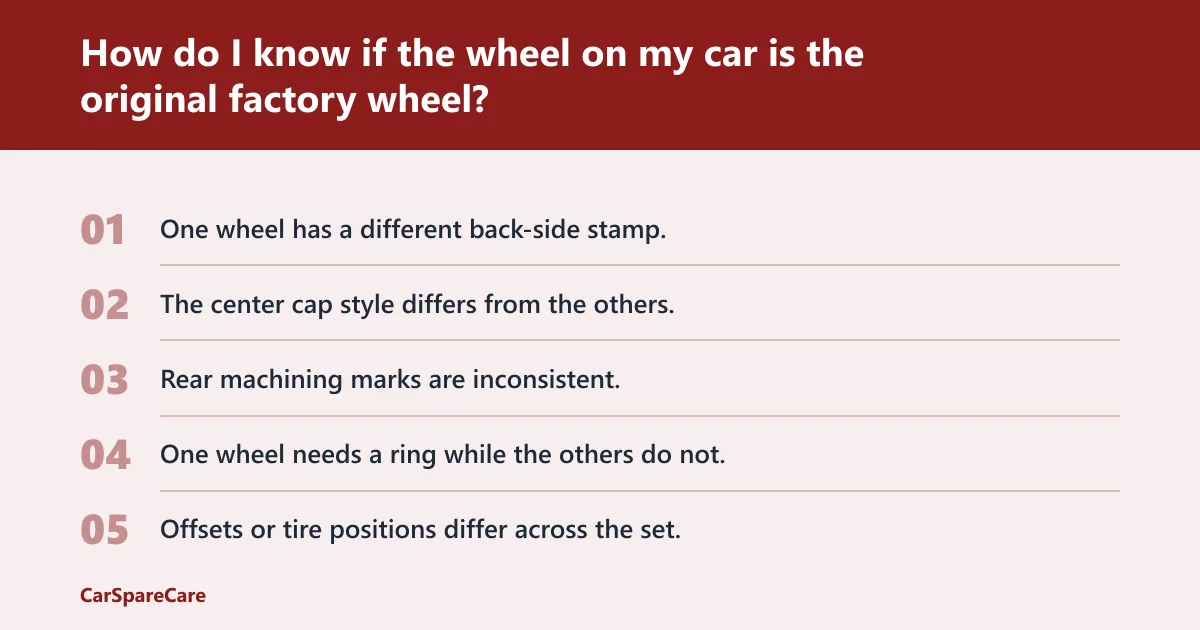
Match the wheel stamps to the car’s factory spec. The original factory wheel should generally match the OEM part number, size, offset, center bore, and finish code for that trim or package. If the markings do not line up, the wheel may be replaced, refinished, or a lookalike aftermarket piece.
Check for original part numbers and finish codes
Use the vehicle’s wheel spec sheet, dealer parts listing, or factory documentation to compare the numbers on the wheel. A true factory wheel usually carries an automaker part code that points to that model and trim. Finish codes matter because factory colors and coatings are often vehicle-specific.
Spot signs of replacement, repair, or mix-and-match sets
- One wheel has a different back-side stamp.
- The center cap style differs from the others.
- Rear machining marks are inconsistent.
- One wheel needs a ring while the others do not.
- Offsets or tire positions differ across the set.
Common brand and fitment clues by wheel type
| Wheel type | Typical back-side clues | Common fitment or ownership clue |
|---|---|---|
| OEM wheel | Automaker part number, factory finish code, exact size and offset | Usually direct bolt-on with the simplest hub and TPMS match |
| Replica wheel | Copied face design, aftermarket brand or casting code, similar size and offset | May fit well, but should be checked for finish quality, bore size, and lug seat angle |
| Aftermarket wheel | Brand stamp, general size/load marks, JWL/VIA/DOT, different offset or bore | May need hub-centric rings, different lug nuts, or TPMS changes |
Frequently asked questions
Are JWL and VIA marks OEM marks?
No. JWL and VIA are Japanese testing standards, so they tell you the wheel has met a recognized testing path. They do not prove OEM origin. An OEM wheel can carry them, but many aftermarket wheels do too.
What is a replica wheel?
A replica wheel is an aftermarket wheel that copies an OEM design. Buyers usually choose it for lower cost or easier availability. It is still aftermarket, so it should be checked for finish quality, bore size, offset, load rating, and hardware compatibility before purchase or installation.

Hi, I’m Melvin, an automobile engineer with extensive experience in automobile equipment. I currently work for a local automobile firm, where I specialize in the car parts industry. I’ve had the opportunity to collaborate with seasoned inspectors, gaining invaluable hands-on experience that goes beyond just theory.
My passion for automotive care started at a young age, which led me to create CarSpareCare. Through CarSpareCare, I share the knowledge and skills I’ve acquired over the years to help others navigate the world of car maintenance and repairs.
My goal is to provide practical tutorials, essential safety advice, and the latest industry insights so that anyone—whether a beginner or an expert—can confidently tackle their automotive projects.