
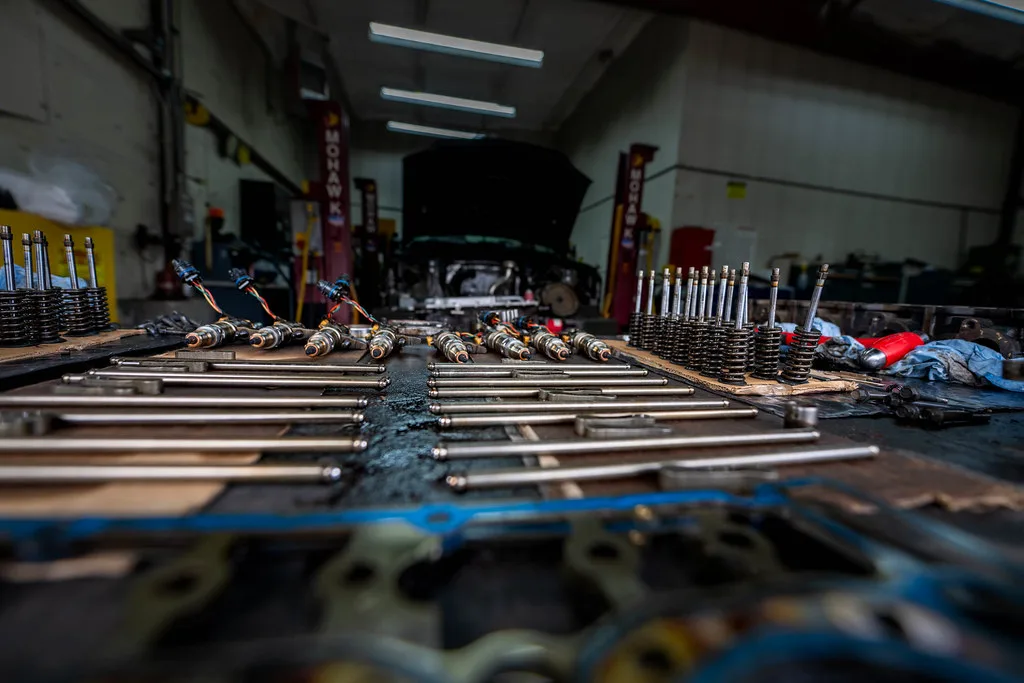
Fuel injectors usually need cleaning when repeat misfires, rough idle, hard starts, or lean fuel-trim codes remain after you check plugs, coils, vacuum leaks, fuel pressure, and the air filter. Skipping the wrong repair wastes money and can hide a fault that cleaning will not fix. This guide shows how to confirm injector cleaning is justified with symptom patterns, scan data, and engine-type clues before you buy cleaner or book service.
Injector function and deposits
Fuel injectors are computer-controlled valves that meter fuel into the combustion chamber or intake manifold. Because they shape the air-fuel mix, a partial blockage can hurt performance, fuel economy, and emissions. A poor spray pattern can also make one cylinder behave differently from the others.
The main buildup inside injectors is carbon deposit. It can narrow the nozzle, cut flow, and create uneven spray or dribbling. That matters because an injector does not have to be fully blocked to cause trouble; a small change in flow or atomization can be enough to create roughness or a lean condition.
Direct injection and port injection do not behave the same way. In port systems, fuel sprays into the intake tract. In direct injection, fuel goes into the cylinder, and that setup is more sensitive to injector cleanliness and to intake-valve deposits that may exist at the same time.
Signs your injectors need cleaning
The clearest signs are rough idle, misfires, hard starting, and lower fuel economy. A dirty injector can also cause hesitation, knocking, or a fuel smell if the spray is uneven or if one cylinder runs richer or leaner than the others. A check engine light may appear, but it is not proof by itself.
Rough idle and unstable rpm
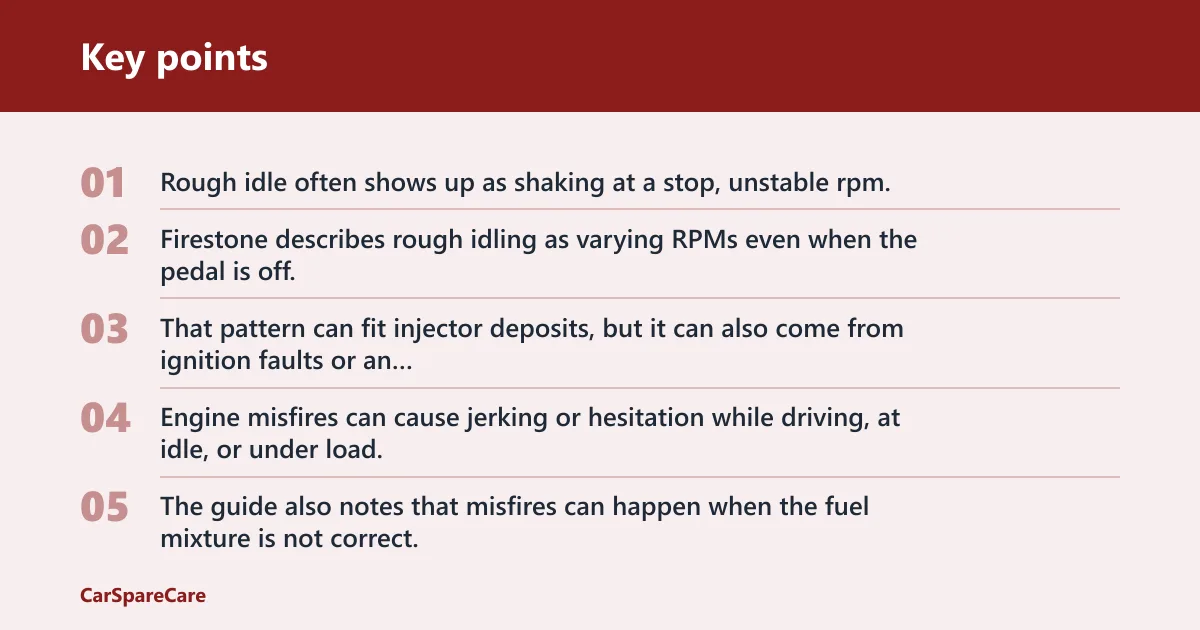
Rough idle often shows up as shaking at a stop, unstable rpm, or a stall right after start-up or while idling. Firestone describes rough idling as varying RPMs even when the pedal is off. That pattern can fit injector deposits, but it can also come from ignition faults or an air leak.
Misfires, hesitation, and poor mpg
Engine misfires can cause jerking or hesitation while driving, at idle, or under load. The guide also notes that misfires can happen when the fuel mixture is not correct. If fuel delivery is weak on one cylinder or across the rail, the engine may burn extra fuel while still feeling short on power.
Poor MPG matters too, but it is a weak clue on its own. Many things reduce mileage, including dragging brakes, tire pressure, and short-trip driving. Injector cleaning belongs on the list only when poor economy travels with rough running, fuel-trim codes, or a fuel delivery pattern that makes sense.
Say your compact sedan starts cleanly, then idles at 700 rpm but bounces between 600 and 900 rpm at every stoplight. If that happens with P0302 and no vacuum leak found, injector cleaning may be justified for cylinder 2 after the rest of the diagnosis is checked.
Hard starting and fuel smell
Hard starting can point to fuel injector issues, and in some cases the engine may not start at all. A fuel smell adds another clue, but it does not always mean the injector is dirty. It can also mean an injector is leaking, a seal has failed, or pressure is bleeding down after shutdown.
That distinction matters. A cleaner can address light deposit buildup. It cannot seal a leaking injector, repair an electrical fault, or fix an external fuel leak. If the smell is strong or there is visible wet fuel, stop treating this as a cleaning problem and inspect for leaks first.
What a check engine light can and cannot tell you
The same source lists a check engine light as a possible sign of a dirty fuel injector, but the light is not injector-specific. It can turn on for misfires, lean conditions, fuel pressure faults, sensor errors, or many other problems. Treat it as a prompt to scan codes, not as a reason to clean by default.
An OBD-II scan tool is the first useful check. Look at stored and pending codes, then compare them with the symptom pattern. Pending codes matter because they can appear before the light stays on, and that can help you catch a pattern before spending on the wrong fix.
Do I actually need injector cleaning?
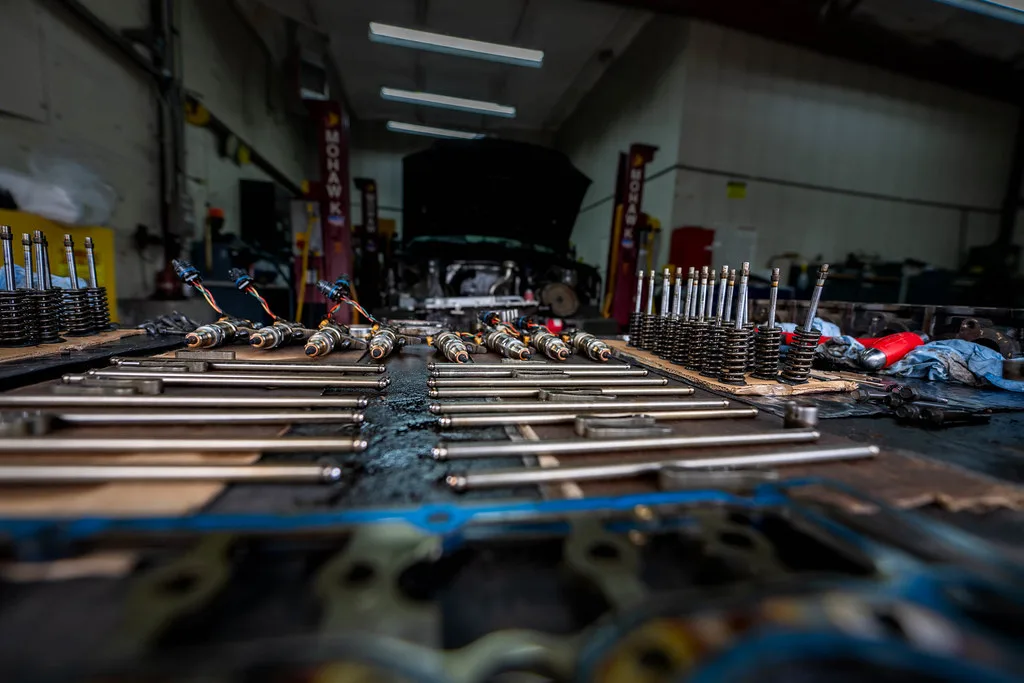
Use symptoms, codes, and basic checks together before you buy cleaner or schedule service. The goal is to separate true deposit-related problems from faults that cleaning cannot fix. If the engine has an injector electrical failure, a bad coil, a vacuum leak, or low fuel pressure, cleaning alone is the wrong next step.
| Symptom | Likely injector cause | Alternate causes to rule out | Next action |
|---|---|---|---|
| P0300 random misfire | Uneven spray or partial clog across more than one injector | Ignition coils, spark plugs, vacuum leak, low fuel pressure | Diagnose further |
| P0301-P0308 on one cylinder | Restricted or dripping injector on the coded cylinder | Coil, plug, compression issue, wiring fault, injector connector | Diagnose further |
| P0171 or P0174 | Lean mix from restricted fuel delivery | Vacuum leak, MAF/MAP issue, exhaust leak, low fuel pressure | Diagnose further |
| Rough idle | Light deposit buildup causing uneven flow at low demand | Ignition, air leak, idle control issue, dirty throttle body | Diagnose further |
| Hard start | Slow fuel delivery or injector bleed-down from deposits | Fuel pump, pressure regulator, battery, crank sensor, leakdown | Diagnose further |
| Poor mpg | Poor atomization or a leaking injector | Tire pressure, brakes, O2 sensor, thermostat, driving pattern | Diagnose further |
| Fuel smell | Leaking injector or dribbling nozzle | Fuel line leak, seal leak, external seepage | Replace |
| Direct-injection engine with intake-valve deposits | Injector issue may be only part of the problem | Intake-valve carbon, airflow issues, misfire source elsewhere | Diagnose further |
| Electrical injector fault or open circuit | Not a cleaning problem | Harness, connector, ECU driver, fuse | Replace |
If the table pushes you toward clean, the next step is light to moderate deposit service. If it points toward diagnose further, stop and inspect the other systems first. If it points toward replace, cleaning is not the fix.
What the codes mean
P0300 through P0308 are misfire codes. P0300 is random or multiple-cylinder misfire. P0301 through P0308 point to a specific cylinder. Those codes can fit injector trouble, but they do not prove it, because ignition and compression faults can produce the same result.
P0171 and P0174
P0171 and P0174 are lean fuel-trim codes. They can point toward injector-related restriction, especially when rough idle and hesitation are present. They can also point toward vacuum leaks, airflow meter issues, exhaust leaks ahead of the sensor, or low fuel pressure.
The combination matters. P0171 or P0174 plus rough idle and weak acceleration raises suspicion for fuel delivery. P0171 or P0174 alone does not. Scan the freeze-frame data if available, then check whether the engine is lean at idle, under load, or both.
When codes point away from injectors
Codes that stay on a single cylinder after a coil or plug swap often point away from the injector and toward ignition, wiring, or mechanical trouble. A misfire code with no fuel-trim clue may also point away from dirty injectors if fuel pressure, airflow, or compression is obviously off.
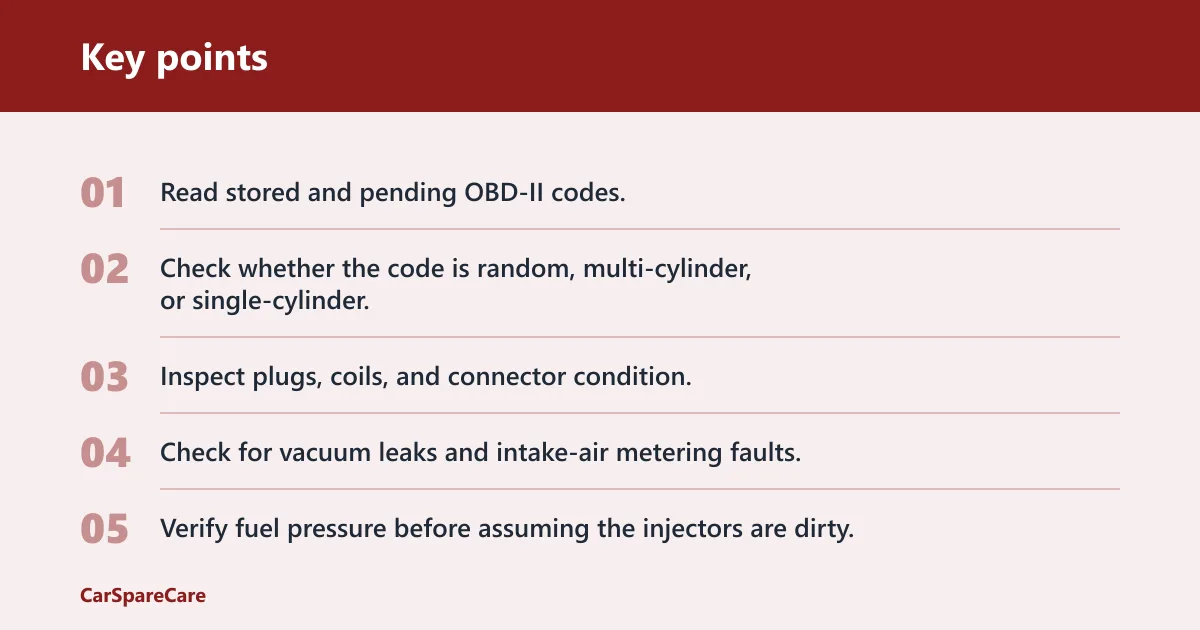
- Read stored and pending OBD-II codes.
- Check whether the code is random, multi-cylinder, or single-cylinder.
- Inspect plugs, coils, and connector condition.
- Check for vacuum leaks and intake-air metering faults.
- Verify fuel pressure before assuming the injectors are dirty.
A common first-timer mistake is buying cleaner after one rough idle and one P0171 code. That can miss a split vacuum hose or a weak pump, and the car will still run poorly after the bottle is empty.
What else can look like dirty injectors?
Ignition faults, vacuum leaks, and fuel pressure problems can look very similar to dirty injectors. That is why cleaning should be a decision, not a guess. If the symptom pattern does not match deposit buildup, keep diagnosing.
Ignition faults
Bad spark plugs, worn coils, and wiring problems often create the same rough idle and misfire pattern that people blame on injectors. If a cylinder stays dead after plug and coil checks, then injector testing makes more sense. If the misfire follows the coil, the injector is probably not the root cause.
VehicleRuns notes that active misfire codes are a reason to use a mechanic. That advice fits here, because active misfires can come from problems that a cleaner cannot fix.
Vacuum leaks and air metering issues
A vacuum leak can create a lean mix that looks like a fuel problem. So can a bad MAF or MAP reading. In those cases, the engine is not getting the right air measurement, and the injectors may be fine. Fix the airflow error first or the fuel trim code may return.
Fuel pressure and pump problems
A fuel pressure check is worth doing when the symptoms overlap. Low pressure can cause lean codes, hard starts, and misfires that look like injector clogging. If pressure is wrong at the rail, cleaning the injector will not solve the delivery problem.
Picture a truck that starts after two long cranks, idles rough, and sets P0174. If fuel pressure is low at the rail, the fault is upstream of cleaning. If pressure is correct and one cylinder still misfires, injector diagnosis becomes more likely.
Cleaning methods and when they fit
Not every cleaning method fits every problem. The right choice depends on deposit severity, engine type, and whether the injector still works electrically and mechanically. Routine cleaning is not universal, so use evidence rather than mileage alone.
In-tank additive
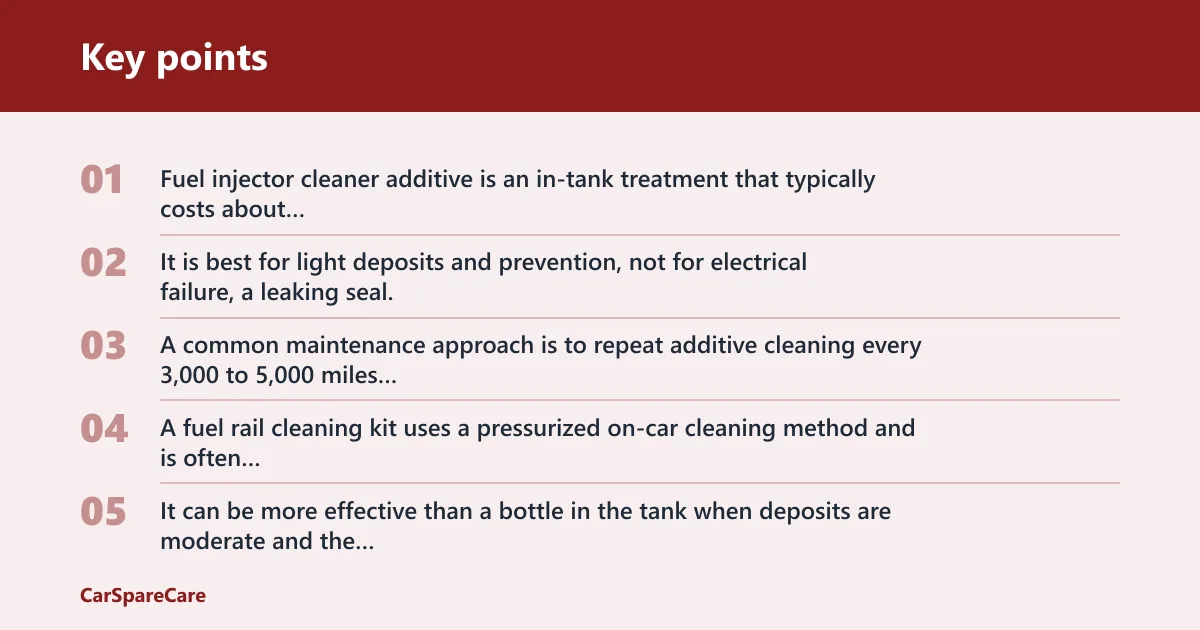
Fuel injector cleaner additive is an in-tank treatment that typically costs about $10-$20 per bottle. It is best for light deposits and prevention, not for electrical failure, a leaking seal, or a badly restricted injector. A common maintenance approach is to repeat additive cleaning every 3,000 to 5,000 miles when the engine calls for it and the symptoms are mild.
Fuel rail cleaning kit
A fuel rail cleaning kit uses a pressurized on-car cleaning method and is often described at about $30-$80. It can be more effective than a bottle in the tank when deposits are moderate and the engine still runs well enough to process the service. It still will not fix a broken injector coil or a fuel leak.
Ultrasonic cleaning
Professional ultrasonic cleaning uses sound waves and specialized fluid, and it is often listed at about $80-$150. This is the better choice when deposits are heavy enough that flow and spray pattern need bench attention, or when the injector should be tested off the car. It is also the most useful path when one injector behaves differently from the others.
When replacement makes more sense
Replace the injector when the fault is electrical, the body leaks externally, the seal fails, or cleaning does not restore normal flow. Replacement also makes more sense when the injector sticks open, dribbles fuel, or shows an open or shorted circuit. A cleaner cannot repair those conditions.
VehicleRuns estimates DIY cost at $10-$60 and shop cost at $120-$350, which is a useful spread for planning. The lower end usually fits additive work. The higher end often reflects professional service, diagnosis, or parts replacement.
| Method | Typical cost | Best use | Limits |
|---|---|---|---|
| Additive | $10-$20 | Light deposits and prevention | Won’t fix electrical failure or leaks |
| Fuel rail cleaning kit | $30-$80 | Moderate buildup on-car | Not for damaged injectors |
| Ultrasonic cleaning | $80-$150 | Heavy deposits, bench cleaning, spray testing | May still require replacement |
| Replacement | Varies by engine | Electrical failure, leaks, stuck injector | Not a cleaning step |
Direct injection vs port injection
Diagnosis differs by engine type because the fuel path differs. Jalopnik identifies PFI, GDI, and common rail direct injection as the major injection types. That matters because a GDI engine can have injector concerns and intake-valve deposits at the same time, while a port-injected engine more often points back to the injector itself or the intake tract.
Direct injection is more sensitive, so symptoms can appear sooner and cleaning decisions can be more complicated. If a GDI engine has rough idle or misfires, do not assume the injectors are the only issue. Intake-valve carbon, airflow errors, and ignition faults can all create similar complaints.
On a port-injected engine, a cleaner may be more reasonable when the scan data and fuel-pressure check fit a mild restriction. On a direct-injected engine, that same symptom may need a closer look at the valves, the ignition system, and the injector spray pattern before any service is chosen.
Frequently asked questions
How often should fuel injectors be cleaned?
There is no universal schedule, and manufacturer guidance varies. Some drivers may never need routine cleaning, while others benefit from periodic additive use when symptoms point to light deposits. A practical rule is to clean only when scan data, symptoms, and fuel checks support the need.
Can you get fuel injectors cleaned?
Yes. You can use an in-tank additive, a fuel rail cleaning kit, or professional ultrasonic cleaning. The right option depends on deposit level and whether the injector still functions correctly. If the injector leaks or has an electrical fault, cleaning is not enough.
Does cleaning fuel injectors work?
It can work when the problem is deposit buildup that restricts flow or changes spray pattern. It does not fix a failed coil, damaged wiring, leaking seal, or external fuel leak. The best results come when cleaning is matched to real evidence rather than used as a guess.
When do fuel injectors need cleaning?
They need cleaning when repeat rough idle, misfires, hard starts, or lean codes remain after you have checked plugs, coils, vacuum leaks, fuel pressure, and airflow. That is the point where the injector becomes a strong suspect instead of one of many possible causes.
What are the signs your fuel injectors need cleaning?
The main signs are rough idle, hesitation, misfires, poor MPG, hard starting, and sometimes a fuel smell. A check engine light can appear too, but it does not point to injectors by itself. Use codes and fuel-system checks to confirm the pattern first.
Should I use a fuel injector cleaner or go to a mechanic?
Use a cleaner when the symptoms are mild, the codes fit a light deposit pattern, and there is no sign of leaking or electrical failure. Go to a mechanic when the misfire is active, pressure is low, the fuel smell is strong, or the code keeps returning after basic checks.

Hi, I’m Melvin, an automobile engineer with extensive experience in automobile equipment. I currently work for a local automobile firm, where I specialize in the car parts industry. I’ve had the opportunity to collaborate with seasoned inspectors, gaining invaluable hands-on experience that goes beyond just theory.
My passion for automotive care started at a young age, which led me to create CarSpareCare. Through CarSpareCare, I share the knowledge and skills I’ve acquired over the years to help others navigate the world of car maintenance and repairs.
My goal is to provide practical tutorials, essential safety advice, and the latest industry insights so that anyone—whether a beginner or an expert—can confidently tackle their automotive projects.

