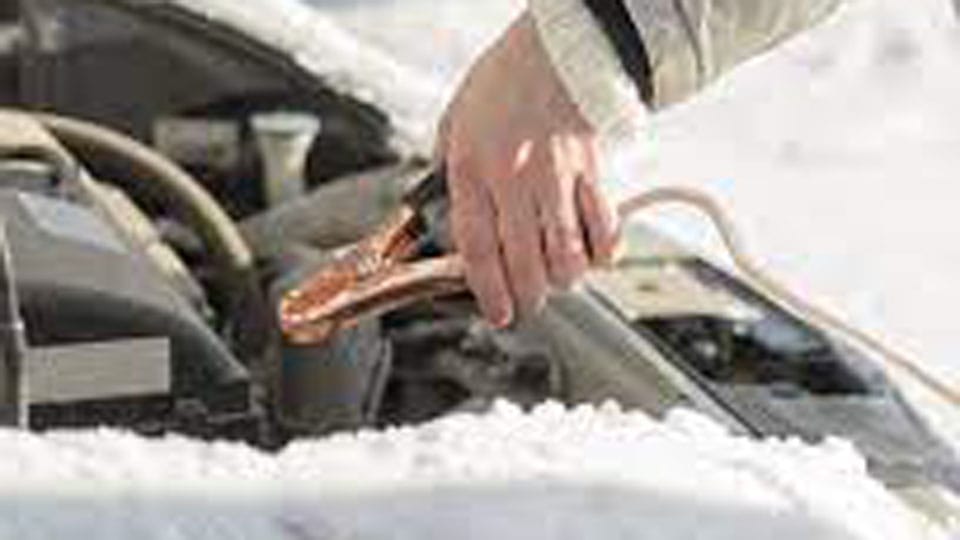
A dead car battery is usually discharged, damaged, or being drained by a fault; if it repeatedly drops below 12.4 volts at rest or dies again after a jump, start with charging, testing, and parasitic-draw checks. Ignoring the cause can leave you stranded, mask alternator or wiring faults, and turn a replaceable battery problem into a repeated no-start. This guide shows the fastest way to tell which fault you have and the next check for each one.
Why does your battery keep dying?
A battery that keeps dying usually comes down to three faults: it is undercharged, it is worn out, or the charging system is not putting power back while you drive. The quickest driveway split is simple: check resting voltage, inspect the terminals and cables for looseness or white, blue, or green buildup, and then test charging output before replacing parts.
Discharged battery versus failed battery
A discharged battery can often be recharged. A failed battery will not hold that charge for long, even if the car starts after a boost. In a healthy 12V lead-acid system, a fully charged resting battery is commonly around 12.6V; 12.4V is partly discharged, and 12.0V is very low.
Charging fault versus drain fault
If the battery dies after driving, the alternator or charging circuit may be the issue. If it dies while parked, look harder for a drain fault, such as an accessory that stays awake or a stuck module. A healthy alternator should show over 14 volts on idle.
Fastest first checks at the driveway
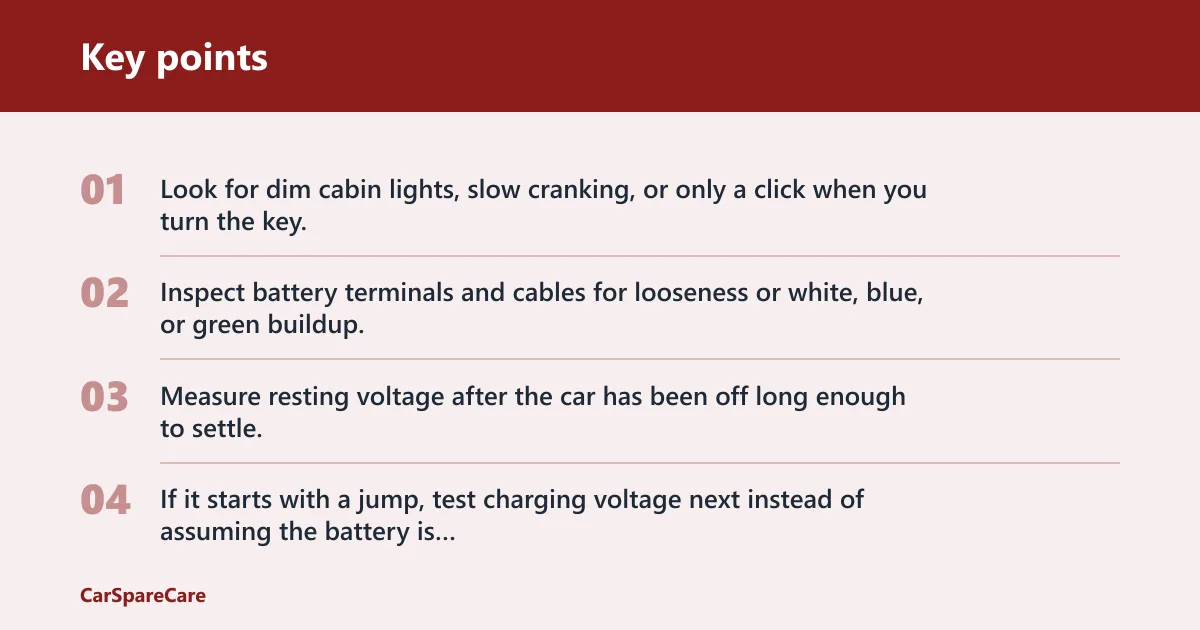
- Look for dim cabin lights, slow cranking, or only a click when you turn the key.
- Inspect battery terminals and cables for looseness or white, blue, or green buildup.
- Measure resting voltage after the car has been off long enough to settle.
- If it starts with a jump, test charging voltage next instead of assuming the battery is fine.
What are the signs of a dead battery?
The most common signs are slow cranking, clicking when you try to start, dim headlights, and a no-start that gets worse after the car sits. A jump-start that only works briefly is a warning sign too, because it can point to a battery that will not hold charge or a charging fault.
Slow crank, clicking, and dim lights
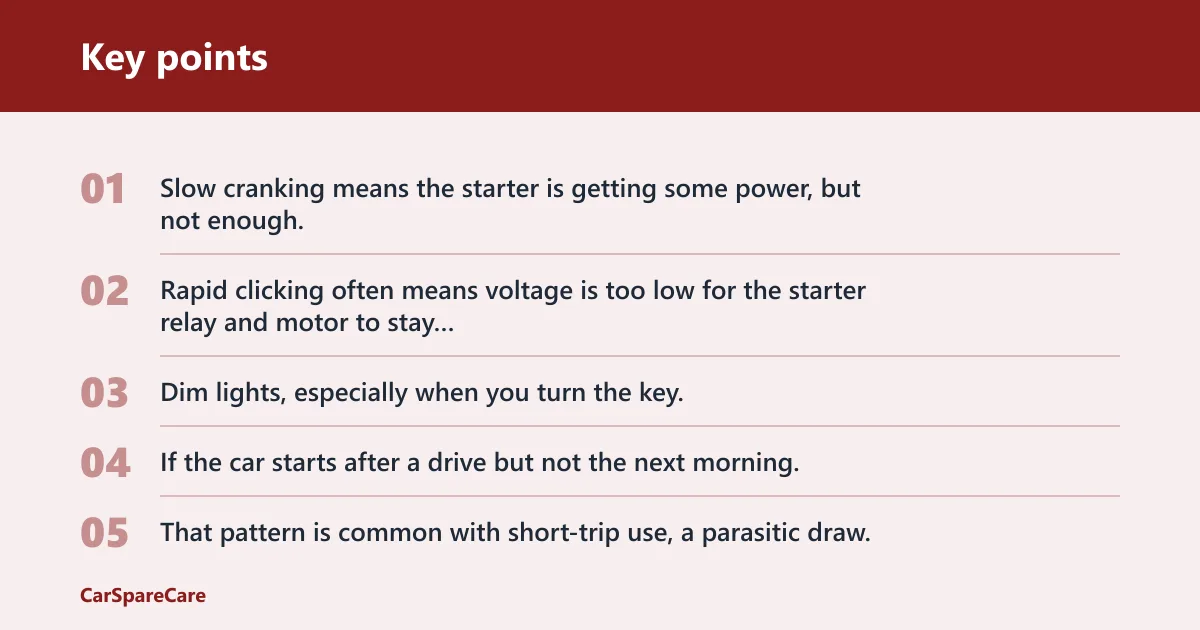
Slow cranking means the starter is getting some power, but not enough. Rapid clicking often means voltage is too low for the starter relay and motor to stay engaged. Dim lights, especially when you turn the key, usually mean the battery is weak or the connections are poor.
No-start after sitting overnight
If the car starts after a drive but not the next morning, the battery may be undercharged, aging, or being drained while parked. That pattern is common with short-trip use, a parasitic draw, or a battery near the end of its life. A battery older than three to five years deserves close attention. (AAA)
When a jump-start points to a deeper problem
Repeated jump-start success followed by quick relapse is one of the clearest clues that the battery has an internal fault or that the charging system is not restoring it. A dead cell can behave this way. So can an alternator that charges too weakly or not at all.
Car battery troubleshooting matrix
Use this table to sort the symptom first, then move to the fastest check and next action. It is easier to diagnose a dead battery from the driveway when you separate discharge, battery failure, and charging-system faults before replacing anything.
| Symptom | Likely cause | Quick check | Next action |
|---|---|---|---|
| Lights left on overnight, battery dead in the morning | Simple discharge | Check headlight and dome-light switches; measure resting voltage | Charge the battery fully, then retest after sitting |
| Frequent short drives, battery weak again soon | Short-trip undercharge | Look at daily drive length and resting voltage after parking | Use a smart charger; add a longer drive after starting |
| Clicking or no-start, but posts show white, blue, or green buildup | Corroded terminals or loose cables | Wiggle-test the connections and inspect the clamps | Clean and tighten terminals before replacing the battery |
| Battery dies again after driving | Alternator fault | Check charging voltage at idle; healthy output should be over 14 volts | Have the charging system tested before buying a battery |
| Battery dies while parked, no obvious light left on | Parasitic drain | Measure key-off current draw after the car has had time to sleep | Track down the circuit or module drawing power |
| No-start after a freezing night | Cold-weather weak battery | Check resting voltage and age; low-charge batteries are more vulnerable | Charge first, then test the battery under load |
| Battery is older than three to five years and struggles more often | Normal age-related wear | Check the battery date code and resting voltage | Replace if it will not hold a charge |
| Jump-start works, but the car dies again soon after | Dead cell or internal damage | Charge the battery, then see whether voltage or starting ability falls quickly | Replace the battery if it will not hold charge |
What lights left on can do
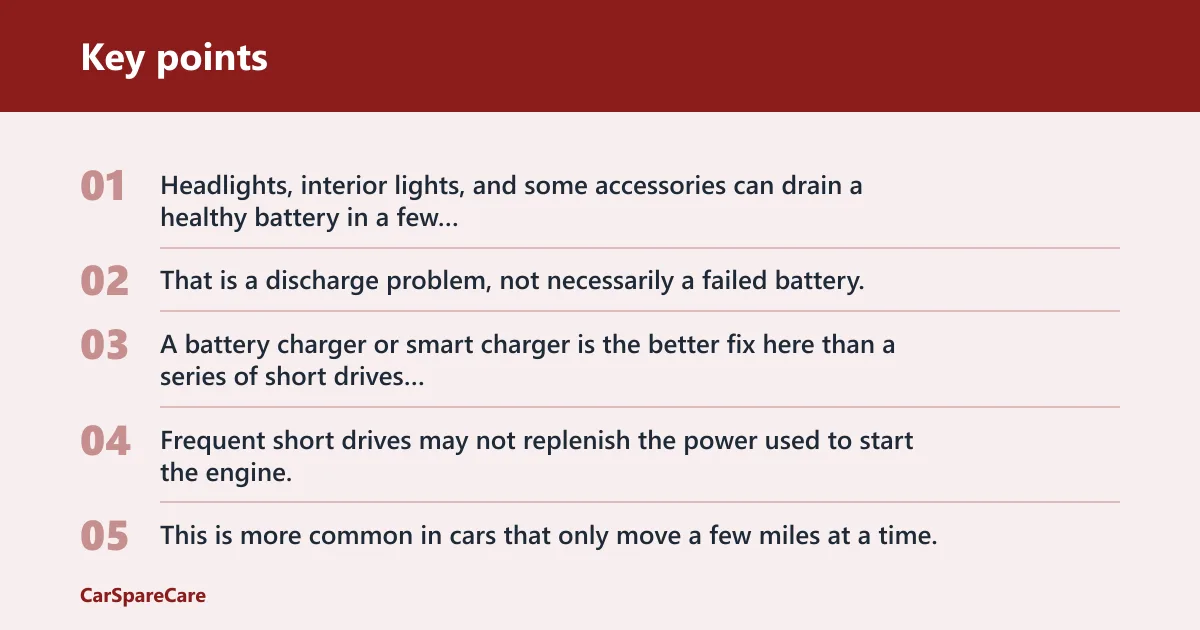
Headlights, interior lights, and some accessories can drain a healthy battery in a few hours or overnight. That is a discharge problem, not necessarily a failed battery. A battery charger or smart charger is the better fix here than a series of short drives that never restore the lost energy.
Why short-trip use matters
Frequent short drives may not replenish the power used to start the engine. This is more common in cars that only move a few miles at a time, especially in winter or with accessories running. A battery can stay chronically undercharged even though the car is used every day.
What a dead cell looks like
A dead cell often shows up as a battery that takes a jump, then drops flat again soon after. It may also refuse to reach or hold normal resting voltage after charging. That is different from a simple overnight discharge and usually means replacement is the correct next step.
Say your car starts with jumper cables, runs for 10 minutes, and then needs another jump the next morning. That pattern is much more suspicious than a one-off dead battery after leaving a dome light on. It points toward internal battery damage, a weak alternator, or a drain that is still active.
Why is the battery completely dead?
A battery can go completely flat from lights or accessories left on, from age-related wear, or from a fault that drains it while the car sits. The fastest clue is the resting voltage after the car has been off. A fully charged battery is commonly around 12.6V; 12.0V means it is very low.
Headlights, dome lights, and accessories left
Forgetting the headlights or interior lights is still one of the most common reasons a battery dies suddenly. Even a small accessory left powered can drain a battery over several hours. If the battery was fine before parking, start with the obvious load before assuming a failure.
Battery age, sulfation, and internal damage
Most conventional car batteries last roughly three to five years. AAA says most are designed to last three to five years on average. Heat, repeated low charge, and long storage can accelerate sulfation and internal damage, which reduces the battery’s ability to accept and hold charge. (AAA)
What a resting voltage test can tell you
Resting voltage is one of the fastest checks you can do. Around 12.6V is commonly considered fully charged, 12.4V is partly discharged, and 12.0V is very low. If the battery reaches normal voltage after charging but drops quickly again, suspect internal damage or a drain.
What causes a battery to die after driving?
When a battery dies after you have driven, the problem is often on the charging side, not the battery itself. The alternator may not be restoring charge, the belt may be slipping, or a poor connection may be interrupting current flow. Short trips can make the problem look worse.
Alternator output that is too low
The alternator recharges the battery while the engine runs. If it is weak, failing, or not being driven properly, the battery may start the next trip already low. A healthy alternator should show over 14 volts on idle, so a lower reading deserves attention.
Loose belts, poor connections, or weak charging current
A loose belt can reduce alternator output, and bad battery cables can make charging look weaker than it is. Corrosion on terminals can also create resistance. Before blaming the alternator, check the belt, the battery posts, and the cable ends carefully.
Why short drives can keep the battery low
A few minutes of driving after startup may not replace what the starter and accessories used. That is why a battery can seem to “die after driving” when the real issue is repeated undercharging. A smart charger is often a better recovery tool than hoping the commute will fix it.
Suppose a compact car is driven two miles to work and two miles back, then sits all weekend. That pattern can leave the battery chronically low, especially in cold weather. The fix may be as simple as a maintenance charge and a longer drive, but only after the battery and charging system test properly.
Can parasitic drain flatten a battery?
Yes. A parasitic drain is a small current draw that keeps running after the car is off, and it can flatten a battery over hours or days. Aftermarket electronics, stuck relays, and control modules that do not go to sleep are common causes, especially in modern cars.
Aftermarket electronics and stuck modules
Alarm systems, dash cams, amplifiers, trackers, and remote-start parts can all create unwanted draw if wired poorly or left active. Factory modules can do it too when they fail to shut down. If the battery is healthy but keeps going flat while parked, a drain test is the right next step.
Why sleep mode can delay diagnosis
Modern cars can be harder to diagnose because modules may stay awake for a while after shutdown. That delay can create a false reading if you test too soon. A common rule of thumb for key-off current draw is around 50 milliamps, but the car may need time to settle before that reading is meaningful.
When to suspect a drain instead of an old battery
Suspect drain first if the battery is new-ish, the car is parked for long stretches, or the no-start happens without any obvious lights left on. A battery that repeatedly tests fine after charging, then dies while sitting, is a better drain candidate than a worn-out battery.
How do terminals and weather affect the battery?
Loose or corroded terminals can mimic a dead battery, and weather can turn a weak battery into a no-start. White, blue, or green buildup on the posts or cables can block current flow. Cold weather weakens low-charge batteries; hot weather shortens battery life and can damage cells.
Corrosion and loose connections
Check for movement at the clamps and for buildup around the posts. A connection that looks only slightly dirty can still cause hard starting, dim lights, or repeated jump-start success. Clean and tighten the terminals before you assume the battery has failed.
Cold weather and hot weather
Cold weather can freeze or weaken a low-charge battery, so a battery that was already marginal may fail suddenly after a cold night. Hot weather is harder in a different way: it shortens battery life and can damage cells, especially in older batteries. Seasonal symptoms are a warning, not a cure.
Cleaning and tightening before replacing parts
If corrosion or looseness is present, fix that first. A healthy battery cannot start the car well through a bad connection. If the battery still drops below normal resting voltage after cleaning, charging, and retesting, replacement becomes the more likely answer.
Frequently asked questions
What are the signs of a dead car battery?
The usual signs are slow cranking, clicking, dim lights, and a no-start condition. Repeated jump-starts that only help briefly are another strong clue. If the battery starts the car but fails again soon after, look beyond the battery itself and check charging output or parasitic draw.
Why is my car battery completely dead?
A battery can be completely dead because lights or accessories were left on, the battery is old, or a fault is draining it while parked. A resting voltage test helps separate a simple discharge from a battery that is worn out or an alternator that is not recharging it.
Can you fix a dead car battery?
Sometimes. A discharged battery can often be recharged with a battery charger or smart charger, then tested again. If it will not hold charge after proper charging and a check of the terminals and charging system, replacement is usually the correct next step.
What are the common causes of a dead car battery?
The common causes are lights left on, short-trip use, corroded or loose terminals, alternator failure, parasitic drain, cold weather, and simple age. Most conventional car batteries last roughly three to five years, so age alone can be enough to make starting unreliable.
How do you know when you have a dead car battery?
Look for a no-start, weak cranking, clicking, or dim lights. Then check resting voltage. Around 12.6V is commonly full, 12.4V is partly discharged, and 12.0V is very low. If the battery falls flat again after charging, suspect internal damage or a drain.
What causes a car battery to have a dead cell?
A dead cell usually comes from age, heat, sulfation, or repeated deep discharge. The telltale sign is a battery that starts only briefly after a jump, then fails again quickly. If charging does not restore normal behavior, replacement is usually more practical than repeated recovery attempts.

Hi, I’m Melvin, an automobile engineer with extensive experience in automobile equipment. I currently work for a local automobile firm, where I specialize in the car parts industry. I’ve had the opportunity to collaborate with seasoned inspectors, gaining invaluable hands-on experience that goes beyond just theory.
My passion for automotive care started at a young age, which led me to create CarSpareCare. Through CarSpareCare, I share the knowledge and skills I’ve acquired over the years to help others navigate the world of car maintenance and repairs.
My goal is to provide practical tutorials, essential safety advice, and the latest industry insights so that anyone—whether a beginner or an expert—can confidently tackle their automotive projects.