If your car battery dies after sitting overnight, the first suspects are a parasitic draw, a weak battery with low reserve capacity, or a charging system that did not fully recharge it; If it restarts after a jump but dies again within about 8 to 12 hours, start with a draw test before replacing parts. Ignoring that pattern can leave you stranded and can waste money on a battery that is not the real fault. This guide shows how to separate battery failure from alternator or drain problems and which test to run first.
The first steps to diagnose overnight battery drain
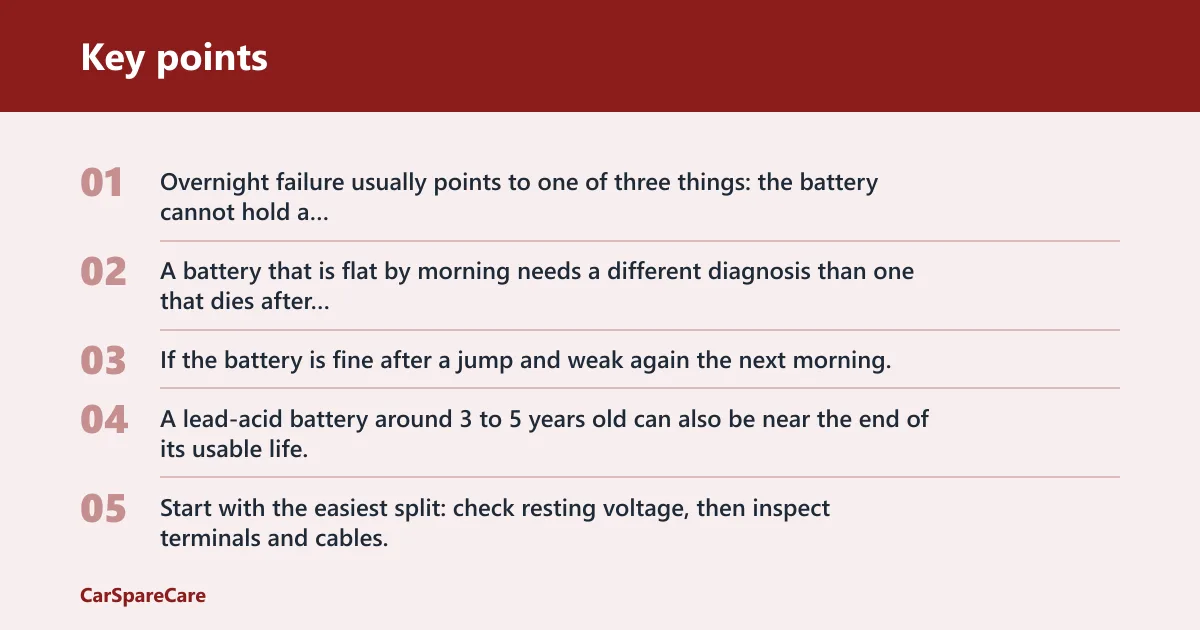
Overnight failure usually points to one of three things: the battery cannot hold a charge, something is drawing power while the car sits, or the alternator did not restore the battery during the previous drive. The timing matters. A battery that is flat by morning needs a different diagnosis than one that dies after several days parked.
What the overnight timing usually points
If the battery is fine after a jump and weak again the next morning, the pattern often points to a parasitic draw or an undercharged battery. That is different from slow self-discharge. A lead-acid battery around 3 to 5 years old can also be near the end of its usable life, especially after heat, short trips, or repeated deep discharge.
The first fault to rule out
Start with the easiest split: check resting voltage, then inspect terminals and cables, then test for draw. A healthy, fully charged lead-acid battery is commonly about 12.6 to 12.8 volts with the engine off. If the battery reads low before the car even starts, that does not prove the battery is bad, but it does tell you where to begin.
When to suspect the battery itself
Suspect the battery if it is old, has failed a load test, or reads charged but drops hard under starter demand. A battery load test is often more reliable than voltage alone because it simulates starting load. If the battery is weak but charged, the problem may be age, heat damage, or repeated short trips that never let it recover.
Battery fault checklist
| Symptom pattern | Most likely cause and first test to run |
|---|---|
| Dies overnight | Most often a parasitic draw or a weak battery. Check resting voltage first, then measure parasitic current with a multimeter in milliamps. |
| Dies after sitting 3 to 7 days | Battery self-discharge, a slow parasitic draw, or an aging battery with low reserve capacity. Start with a resting voltage check, then a load test. |
| Dies while driving | Alternator or charging-system failure. Check running voltage at the battery with the engine on; healthy charging is often about 13.7–14.7V. |
| Only in cold weather | Cold reduces available capacity, so a marginal battery fails sooner. Check resting voltage, then a load test, especially if the battery is older than 3 to 5 years. |
| Dies after a jump-start | Charging failure, a hidden draw, or a battery that cannot hold charge. Test alternator output after the jump, then check for parasitic draw once the car is parked. |
Is the battery itself weak?
A weak battery can act like almost any other electrical fault. If the battery is already near the end of its service life, it may start the car once and still fail the next morning. Use resting voltage and a load test together. That combination separates low charge from a battery that cannot deliver current under load.
Resting voltage to check
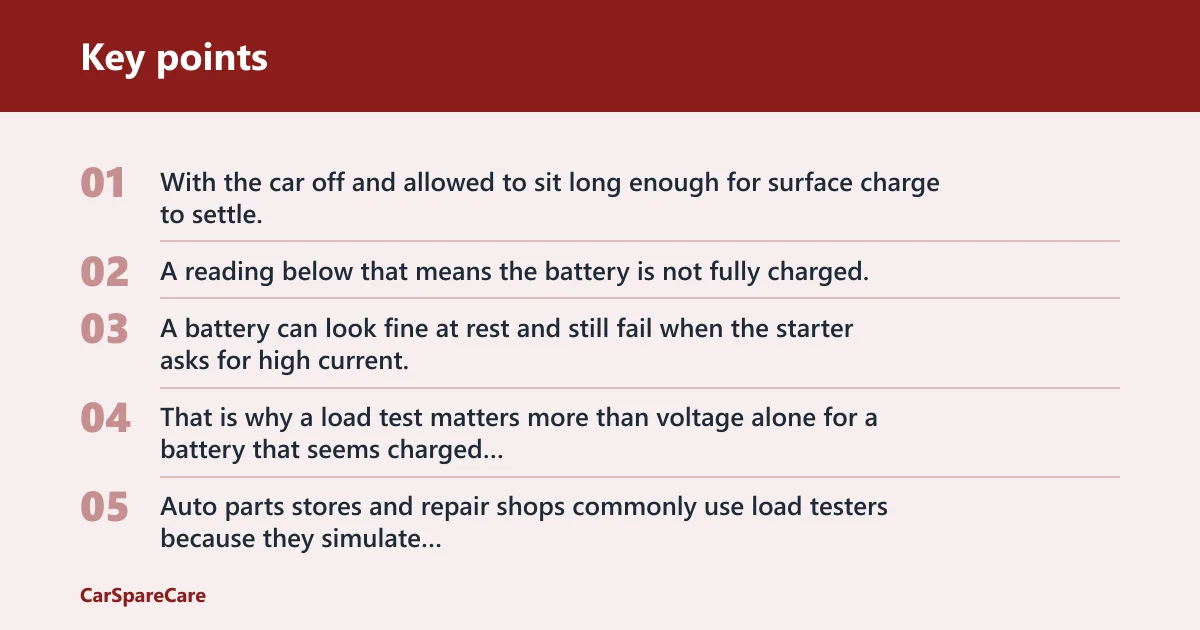
With the car off and allowed to sit long enough for surface charge to settle, a healthy battery should read about 12.6V, and a fully charged lead-acid battery is about 12.8 volts. A reading below that means the battery is not fully charged, but it does not automatically mean replacement. You still need to know why it is low.
Why a load test matters
A battery can look fine at rest and still fail when the starter asks for high current. That is why a load test matters more than voltage alone for a battery that seems charged but will not crank the engine. Auto parts stores and repair shops commonly use load testers because they simulate start-up demand instead of only measuring open-circuit voltage.
Age, heat, and short trips
Most lead-acid batteries last about 3 to 5 years, and many units older than 4 years are already on the edge. Heat can shorten battery life over time, while short trips of about 10 minutes may not give the alternator enough time to refill what starting used. A battery can fail sooner even if it still looks physically intact.
Say your sedan sits outside in July and gets only a 7-minute school run twice a day. The battery may never recover fully between starts, so the next overnight park leaves too little reserve. The battery may still crank one morning, then fail the next, which looks like a sudden problem but often reflects gradual capacity loss.
What is draining my car battery while parked?
A parked battery should lose very little power. If it goes flat while the car sits, something is staying awake or staying on. Common suspects include interior lights, glovebox or trunk lamps, dash cams, OBD dongles, alarms, stuck relays, aftermarket electronics, or modules that do not enter sleep mode properly.
Parasitic draw and normal sleep current
Parasitic draw means current flowing with the ignition off. Some draw is normal because modern vehicles keep memories and security modules alive, but abnormal draw can drain a battery overnight. The problem is often invisible, which is why it needs a multimeter test in milliamps after the vehicle has had time to sleep.
Common parked drains to inspect
Look for dome lights, trunk lights, glovebox lights, phone chargers, dash cams, tracker devices, and OBD dongles that remain powered all night. Aftermarket audio gear and alarms can also create a drain. A trunk lamp with a bad switch is easy to miss because the lid looks closed, yet the bulb stays on.
How a multimeter helps isolate the draw
A multimeter can check resting voltage and measure parasitic current draw. For overnight diagnosis, that second function is the one that separates a bad battery from a drain. If the battery holds voltage after charging but current draw stays abnormal with the car parked, the fault is not just battery age.
A common first-timer mistake is replacing the battery first because the car starts after a jump. If the battery is discharged by an interior lamp or a stuck module, the new battery will die too. That is why draw testing comes before parts replacement when the problem returns overnight.
Could the alternator be the problem?
Yes. A bad alternator can leave the battery undercharged even after driving, so the car may start after a jump but fail again later. This is more likely when the battery dies after a normal trip, when headlights look dim, or when a warning light appears. Alternator failure is a charging problem, not a parked-drain problem.
Why a bad alternator can mimic a bad battery
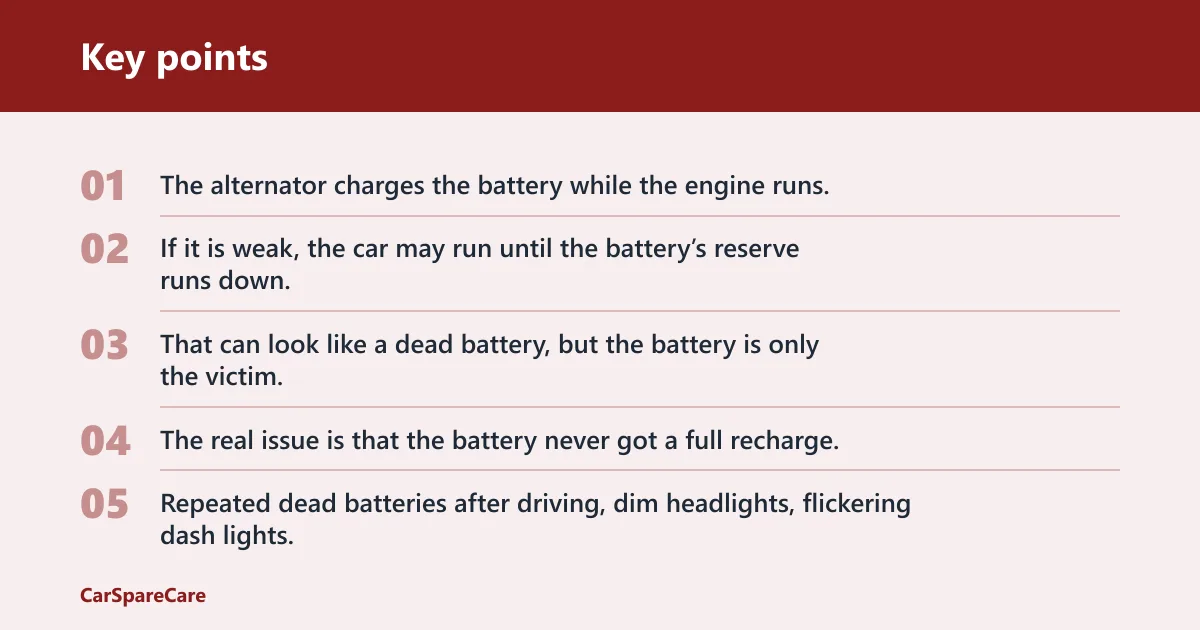
The alternator charges the battery while the engine runs. If it is weak, the car may run until the battery’s reserve runs down, then the next start fails. That can look like a dead battery, but the battery is only the victim. The real issue is that the battery never got a full recharge.
Signs that point to charging failure
Repeated dead batteries after driving, dim headlights, flickering dash lights, or a battery that dies after a jump and a short drive all point toward charging trouble. If the battery dies while driving, or if the car goes dead soon after a normal trip, test the alternator before buying another battery.
What output check to run
Check running voltage at the battery with the engine on. A healthy charging system is often about 13.7–14.7V, depending on the vehicle and load. If charging voltage is low, inconsistent, or absent, the alternator, its wiring, or the regulator path needs attention. A resting voltage test alone cannot catch that fault.
Battery terminal and cable checks
Loose or corroded terminals can make a good battery act weak. Resistance at the clamps or ground path reduces the current available to the starter and can create intermittent no-starts. Before replacing a battery, inspect the terminals, the ground cable, and the connectors. These checks are fast and often missed.
Corrosion and loose clamps
Check for white, blue, or green corrosion on the posts and clamps. Loose battery terminals can interrupt power even when the battery itself is fine. Clean corrosion with baking soda and water or a brush, then tighten the clamps so they grip securely. A connection that can be twisted by hand is not secure enough.
Ground cable inspection
Inspect the negative cable from the battery to the body and engine. Look for cracked insulation, loose bolts, or damaged connectors. A poor ground can create the same symptoms as a weak battery because the starter sees extra resistance. The cable may also fail only under load, which makes the issue feel random.
When cleaning is enough
If the battery is healthy, the terminals are simply dirty, and the cables are intact, cleaning and tightening may solve the problem. If corrosion has eaten into the clamp or the cable end is damaged, cleaning is only a temporary fix. In that case, the failed connector needs replacement, not another round of cleaning.
Why new batteries still die
A new battery can still die if the wrong size was installed, the ground path is poor, or the vehicle has a sleep-mode issue. A fresh battery does not erase a draw or a charging fault. If the replacement dies fast, treat that as a sign that the fault was missed, not proof that the new battery is bad.
Wrong battery size or specification
If the battery does not match the vehicle’s required size or capacity, it may crank the engine once and then fall short on reserve power. That can matter in vehicles with many electrical accessories or start-stop systems. Always compare the replacement to the specified fitment, not just to the old battery’s physical shape.
Bad grounds or poor installation
A battery installed with a loose clamp, missing hold-down, or poor ground connection can fail immediately. The car may act like the battery is weak when the real issue is the install. Recheck both terminals and the ground path after any replacement, especially if the new battery dies within days.
Module sleep and aftermarket load issues
Some vehicles take time to enter sleep mode, and a stuck module can keep drawing power instead. Aftermarket alarms, amplifiers, remote starters, dash cams, and trackers can also prevent normal sleep. If the battery is new but dies after a night parked, a sleep issue or accessory draw should be on the list.
Why does my car battery keep dying after a few days?
If the battery lasts a few days instead of only one night, the fault is often a slow draw, a weak battery with limited reserve, or a vehicle that is not being driven long enough to recharge fully. That pattern is different from a dead-overnight car and usually needs a longer draw test or a load test.
Picture a truck that only gets used for short errands and then sits through the weekend. The battery may appear fine on Friday, then fail by Monday morning because short trips never restored it. That is especially likely in city driving, where the alternator spends less time rebuilding the battery after each start.
Why does my car battery keep dying in cold weather?
Cold weather reduces available battery capacity, so a marginal battery may fail first in winter. A battery that seems acceptable in mild weather can struggle in freezing conditions, especially if it is already older or partly discharged. Heat is also harmful, because it shortens battery life over time even when the car starts normally.
Seasonal weakness you can spot
If the car starts fine in autumn but dies in the morning during a cold snap, the battery may be close to the limit. A typical battery in freezing weather loses about 20% capacity, and capacity can drop by 50% at -22 degrees Fahrenheit. Temperature swings can expose a weak battery that was already marginal.
Frequently asked questions
Why does my car battery keep dying?
Repeated battery death usually comes from one of four faults: an old battery, a parasitic draw, a charging-system problem, or a bad connection. The key is timing. Overnight failure points to draw or weak reserve, while failure after driving points more toward alternator trouble or a battery that will not hold charge.
Why does car battery suddenly go dead?
A battery can seem sudden when a hidden drain has been building for days or when a marginal battery finally crosses its limit. A loose terminal, a stuck trunk lamp, or a weak alternator can all make the failure appear abrupt. The battery often was not healthy enough to absorb the extra stress.
Why does my truck battery keep dying?
Trucks often have more aftermarket equipment, larger cabs, and more accessory circuits than smaller cars, so parked drains are common. Remote starters, lights, audio gear, and OBD devices can all keep drawing power. A truck that dies after sitting should be checked for parasitic draw and terminal corrosion before replacement.
Can a bad alternator drain a battery overnight?
Indirectly, yes. A bad alternator can leave the battery undercharged so it starts the night with too little reserve. That is different from a true overnight draw. If the battery dies after a jump and normal driving, test alternator output around 13.7–14.7V and then check for any remaining draw.

Hi, I’m Melvin, an automobile engineer with extensive experience in automobile equipment. I currently work for a local automobile firm, where I specialize in the car parts industry. I’ve had the opportunity to collaborate with seasoned inspectors, gaining invaluable hands-on experience that goes beyond just theory.
My passion for automotive care started at a young age, which led me to create CarSpareCare. Through CarSpareCare, I share the knowledge and skills I’ve acquired over the years to help others navigate the world of car maintenance and repairs.
My goal is to provide practical tutorials, essential safety advice, and the latest industry insights so that anyone—whether a beginner or an expert—can confidently tackle their automotive projects.