No, if the crack is small, sits in the barrel or outer lip, and the wheel passes inspection. Cracks at the spoke or hub are tow-only or replace-only. A wrong call can mean sudden air loss, wheel failure, and higher repair costs if the damage spreads. This guide gives a simple location-and-severity checklist for initial screening, but a specialist inspection still decides repair or replacement.
When wheel damage means repair is unsafe
A cracked alloy wheel is structural damage, not a cosmetic flaw. If the crack opens the tire seal, reaches a load-bearing area, or is paired with a bend or previous repair, the wheel may fail under load. The safe answer depends on location, crack length, deformation, and whether the wheel still holds air.
What makes a crack structural instead of cosmetic
Scratches and curb rash affect appearance. A crack changes how the wheel carries weight and seals the tire bead. That can lead to slow leaks, vibration, and, in worse cases, sudden loss of air or wheel breakage. If you can see daylight through a split, or the tire keeps losing pressure, treat it as structural damage.
When a wheel becomes tow-only
Stop driving and arrange recovery if the crack is at the spoke root, hub face, or another refusal zone, or if the wheel is visibly bent, the tire is going flat fast, or the crack is growing. A short drive on a damaged wheel can turn a repairable case into a replacement case.
When replacement is the safer call
Replacement is the safer choice when the crack is long, repeated, or paired with major deformation. It is also the better call after more than one prior repair, because the wheel has already been weakened and reworked. If a shop cannot verify structural soundness, replace the wheel rather than pushing for a weld.
Cracked wheel decision matrix
Use this checklist to sort the wheel before anyone agrees to repair it. It separates tow-for-repair cases and replace-now cases. If more than one row points toward a higher-risk outcome, follow the stricter recommendation.
| Crack location | Crack length or severity | Air loss or symptoms | Previous repairs | Recommended action |
|---|---|---|---|---|
| Outer lip | Short, single crack with no visible bend | No leak, no vibration, tire pressure stable | No prior wheel repairs | Safe to inspect-drive to a specialist shop at low speed, then inspect for repair |
| Outer lip | Long crack, jagged break, or chipped edge | Slow leak or audible hiss | Any prior repair near the same area | Tow for professional inspection and likely replacement if the crack is not clean and limited |
| Bead seat | Short crack with no heavy deformation | Slow air loss at the tire seal | No prior repairs in the bead area | Tow for specialist inspection; some shops accept bead-seat repairs if the wheel is otherwise sound |
| Wheel barrel | Limited crack with no major bend or flat spot | No rapid leak, no strong vibration | No repeated repairs | Tow for structural inspection and runout measurement; repair may be possible if the wheel is straight |
| Spoke root | Any visible crack near the spoke base | Any leak, vibration, or visible movement of the crack | Any prior repair | Replace immediately; spoke-root cracks are high risk and often refused |
| Hub face | Any crack in the mounting face or near bolt holes | Any symptom | Any prior repair | Replace immediately; this area is load-bearing and commonly non-repairable |
| Any location | Multiple cracks, long spread, or severe corrosion damage | Rapid pressure loss or wheel wobble | One or more prior repairs | Replace immediately; do not drive except to move the car off danger if absolutely necessary |
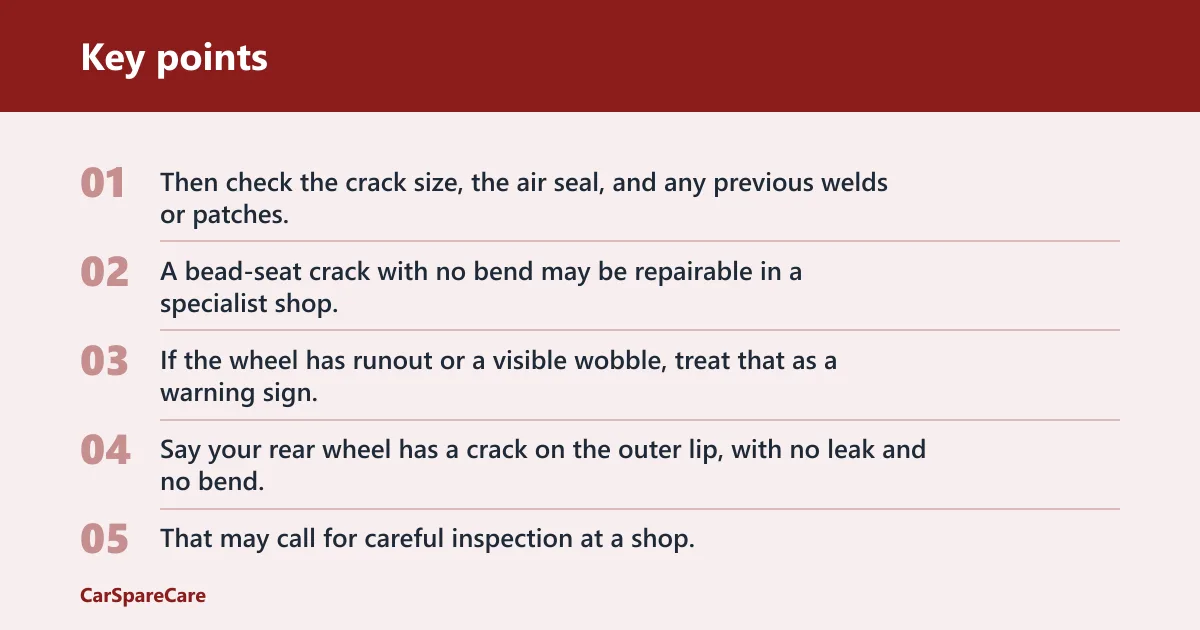
How to use the table
Start with location. Then check the crack size, the air seal, and any previous welds or patches. A bead-seat crack with no bend may be repairable in a specialist shop, while the same-sized crack at a spoke root should be refused. If the wheel has runout or a visible wobble, treat that as a warning sign, not a cosmetic issue.
Say your rear wheel has a crack on the outer lip, with no leak and no bend. That may call for careful inspection at a shop. Suppose the same wheel also has a prior weld in the barrel. That moves the decision toward replacement because the risk has climbed.
Which wheel cracks are usually repairable?
Repairable cases are usually limited to short cracks in less stressed areas, and even then only after inspection. The best candidates are outer lip, bead seat, and some barrel cracks when the wheel remains straight, the crack is limited, and there is no major corrosion or repeat repair history.
Outer lip cracks
Outer lip cracks are among the more common repair candidates because they are often easier to access and inspect. They still need a specialist judgment. If the lip is split but the barrel and spokes are intact, a shop may be able to weld and verify the wheel afterward.
Bead seat cracks
Bead-seat cracks matter because they affect tire sealing. Twin City Wheel identifies bead-seat cracks as common and usually fixable. That does not mean every bead-seat crack is safe to repair. The wheel still needs a structural inspection to confirm that the bead area is not distorted or weakened beyond use.
Wheel barrel cracks with no major deformation
Wheel barrel cracks may be repairable if the wheel is structurally sound and runout stays within acceptable limits after inspection. The barrel carries load, so straightness matters. A wheel with a limited barrel crack and no visible bend may be accepted by a specialist after runout measurement and leak testing.
Which cracks should usually be replaced?
Cracks in high-stress areas are much more likely to fail a repair check. If the damage is at the spoke root, hub face, or around bolt holes, replacement is usually the safer route. The same is true for repeated repairs, wide splits, and cracks mixed with severe bends or corrosion loss.
Cracks at spoke roots
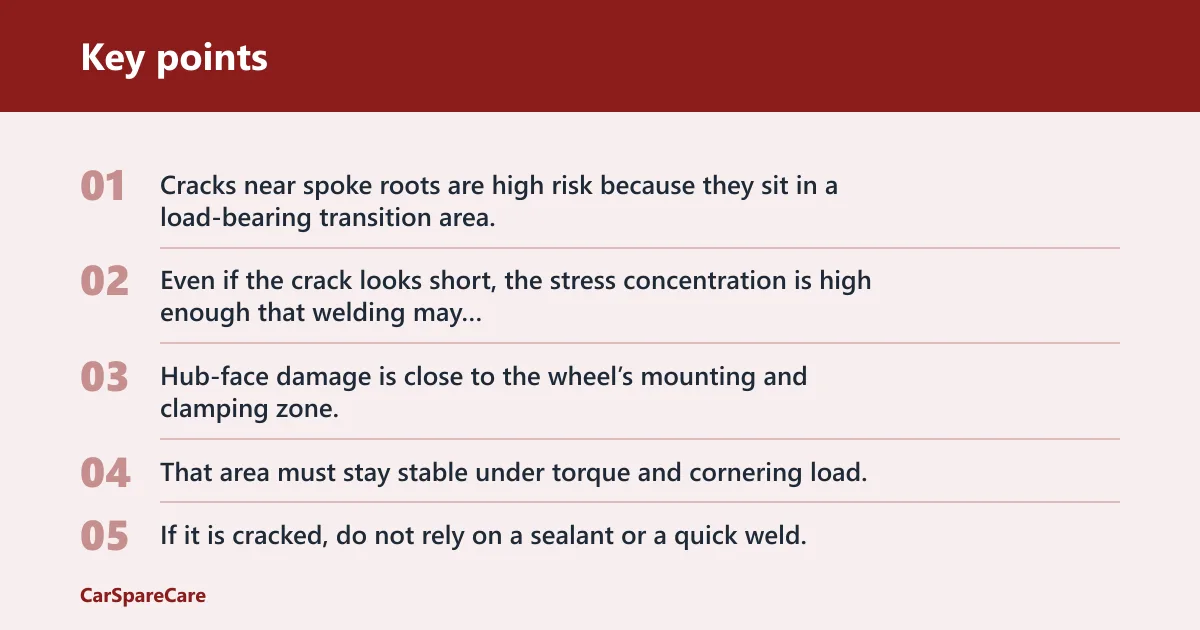
Cracks near spoke roots are high risk because they sit in a load-bearing transition area. Many shops refuse them. Even if the crack looks short, the stress concentration is high enough that welding may not restore safe strength. A replacement wheel is the better call here.
Cracks near the hub face
Hub-face damage is close to the wheel’s mounting and clamping zone. That area must stay stable under torque and cornering load. If it is cracked, do not rely on a sealant or a quick weld. The safer option is replacement, not a roadside patch.
Multiple cracks or repeated repairs
One crack can sometimes be assessed. Two or more cracks usually mean the wheel has deeper fatigue or impact damage. Previous repairs also matter because the metal has already been heated and altered. If a wheel has been repaired before and cracked again, replacement is often the practical choice.
Severe bends, gouges, or corrosion damage
A crack plus a bend means the wheel has taken a harder hit than the crack alone suggests. Deep gouges and corrosion can also remove material needed for a sound weld. Some shops advertise up to 75% savings versus replacement, but that saving disappears if the wheel fails inspection and still needs replacement.
What a specialist repair involves
Professional welding is a specialist process, not a driveway fix. A cracked wheel repair should start with structural inspection and end with verification. The right standard to expect is a wheel that has been structurally tested before it goes back on the car.
Structural inspection and runout measurement
Inspection should check crack length, exact location, air leaks, deformation, and whether the wheel has prior repairs. Runout measurement matters because radial and lateral runout show whether the wheel is still straight enough for safe use. If the wheel is out of shape beyond tolerance, repair is the wrong path.
Professional welding or reinforcement
Specialist shops may weld a repairable crack and, where appropriate, add reinforcement. That work belongs to a wheel repair professional, not a general roadside fix. A sound weld still needs a sound base metal. If the wheel material is too thin, cracked in a refusal zone, or badly distorted, welding should stop there.
Balancing and final leak checks
Wheel balancing is part of the finish, because a repaired wheel that is out of balance can create vibration and stress. Tire remounting and balancing are part of the real bill, too. The final cost is more than the weld alone.
Tire mounting and balancing can add to the total, and some shops advertise up to 75% savings versus replacement. Twin City Wheel says many crack repairs can save 75%+ versus new wheels. Those figures help explain why repair is often considered, but they do not change the inspection outcome.
Can you fix a cracked wheel with JB Weld?
No. JB Weld is not a structural repair for a cracked wheel, and it is not a safe permanent fix. Epoxy may hide the crack or slow a small seep, but it cannot restore the wheel’s load-carrying strength. A repaired wheel still has to survive cornering force, potholes, braking, and heat.
Why temporary fixes can fail under load
Temporary sealants and epoxies can come loose, crack again, or trap the real damage under a hard skin. That makes inspection harder and can delay the correct fix. If the wheel is losing air, the problem is not cosmetic. It needs proper assessment or replacement, not a chemical patch.
What to do instead if you need to move the car
If the tire still holds enough air to move the car a very short distance, go slowly and only to reach recovery or a specialist shop. If the wheel is cracked at the spoke root, hub face, or bead seat with a leak, do not keep driving. Tow it.
Can you repair a cracked rim at home?
No home repair is safe for structural wheel cracks. You can inspect the wheel visually, but you should not weld, grind, or “seal” a cracked alloy wheel at home. The risk is too high because the wheel may fail later even if the crack looks smaller after a quick fix.
What you can inspect safely yourself
You can check for obvious crack location, whether the tire is flat, and whether the wheel face is bent or gouged. Look for fresh air loss, bead damage, and signs of a prior weld. If the crack is near the hub face or spoke root, stop there and plan for recovery.
- Park on level ground and avoid further driving.
- Look for the crack’s exact location: outer lip, barrel, bead seat, spoke root, or hub face.
- Check tire pressure loss, sidewall damage, and any wobble.
- Note any prior welds, patches, or cracked paint lines that follow the same area.
- Choose safe-to-inspect-drive, tow for repair, or replace immediately using the checklist above.
When to stop driving and call for recovery
Stop driving if the tire is going flat, the wheel is wobbling, or the crack sits in a refusal zone. Also stop if the wheel has multiple cracks or you can see the metal flexing around the split. A common first-timer mistake is assuming a slow leak means a small problem; on a cracked wheel, that can be the start of failure.
How much does it cost to fix cracked rims?
Costs depend on crack location, whether the wheel needs remounting, balancing, or replacement, and whether the shop accepts the wheel at all. A repair quote can look lower than replacement, but hidden costs matter. Tire removal, balancing, inspection, and a possible failed repair add up quickly.
What changes the final bill
Expect the price to reflect the repair itself, tire mounting, balancing, leak testing, and possible straightening. Tire mounting and balancing can add to the total. If the wheel cannot pass inspection after disassembly, the only remaining cost-saving option may be replacement.
Frequently asked questions
Can a cracked wheel be repaired safely?
Sometimes. A cracked wheel can be repaired safely only when the crack is short, limited to the barrel or outer lip, and the wheel passes structural inspection. Cracks at the spoke root, hub face, or bead seat with deformation usually belong in the tow or replace category.
Can you repair a cracked alloy wheel?
Yes, in some cases. Specialist shops can repair certain alloy wheel cracks with welding and post-repair checks. The wheel still needs inspection for location, length, leak points, bend, and previous repairs. If those checks fail, replacement is the safer option.
When should a cracked wheel be replaced instead of repaired?
Replace it when the crack is at the spoke root or hub face, when there are multiple cracks, when the wheel has major deformation, or when it has been repaired before and cracked again. If the shop cannot verify safe structure, replacement is the better call.

Hi, I’m Melvin, an automobile engineer with extensive experience in automobile equipment. I currently work for a local automobile firm, where I specialize in the car parts industry. I’ve had the opportunity to collaborate with seasoned inspectors, gaining invaluable hands-on experience that goes beyond just theory.
My passion for automotive care started at a young age, which led me to create CarSpareCare. Through CarSpareCare, I share the knowledge and skills I’ve acquired over the years to help others navigate the world of car maintenance and repairs.
My goal is to provide practical tutorials, essential safety advice, and the latest industry insights so that anyone—whether a beginner or an expert—can confidently tackle their automotive projects.