
To detail car paint without micro-scratches, wash with plenty of lubrication, use clean microfiber only, and stop wiping the moment a panel feels dry or gritty; if contamination remains, re-rinse first. Bad technique leaves swirls, haze, and fine scratches that show in sunlight. This guide covers a low-friction workflow, a scratch-risk checklist, and the exact points to wash, rinse, wipe, or stop.
What you’ll need


- Microfiber wash mitt
- Two wash buckets, one for wash solution and one for clean rinse water
- Vehicle-specific car wash cleaner
- Plush microfiber towels for drying and wipe-off
- Clean buffing pad matched to the polish task
- Scratch remover polish is generally meant for light to moderate marks.
- Filtered blower for mirrors, trim, emblems, and grilles
- Separate wheel brush and wheel bucket
- Spray bottle of clean water for re-rinsing problem spots
How do I detail car paint without making micro-scratches?
Use a clean-contact workflow: rinse first, wash with a microfiber mitt, rinse the mitt often in a second bucket, dry with a plush microfiber towel, and stop the moment the surface feels dry, grabby, or dirty. Clear coat is thin enough to show dirt drag, so the safest move is always to re-rinse before more wiping.
Use this low-friction sequence
- Pre-rinse the panel until loose dust and road grit are gone.
- Wash with a microfiber mitt in shampoo, not dish soap.
- Rinse the mitt in clean water after each panel or dirty section.
- Wipe only while the panel is still wet and slick.
- Dry with a clean microfiber towel laid flat, using minimal pressure.
- Stop immediately if the towel drags, and re-rinse the panel before continuing.
How this workflow lowers contact risk
Professional detailers always start with a clear water rinse to remove dust and road grit. A microfiber wash mitt can be preferable because trapped grit may rinse out more easily, while a chamois can drag particles across the paint instead of lifting them off. Straight-line motions are safer than tight circles because a caught particle is less likely to leave obvious swirl marks.
What tools are safest for wiping and drying paint?
The safest tools are a clean microfiber wash mitt for washing and a plush microfiber towel for drying or wipe-off. Microfiber towels collect particles better than a chamois, and a clean towel lowers the chance of grinding grit into clear coat. Keep wheel tools separate from body-panel tools.
Best tool choices by task
- Wash: microfiber mitt, rinsed often
- Dry: plush microfiber towel, laid flat
- Panel wipe: clean microfiber towel only
- Blower work: mirrors, emblems, grilles, trim
- Do not use: old bath towels, dirty sponges, or a chamois on unverified clean paint
Why clean towels matter
A towel that picks up a grain of grit becomes the abrasive. That is why the first pass matters most. If the towel touched a dirty sill, wheel arch, or dropped ground, stop and replace it before it touches paint again.
Which paint types need the most care?
Soft black paint needs a very light touch because it can show marring quickly. Ceramic-coated paint still scratches if dirt is dragged across it, even though it may resist sticking grime better. Older paint with a thinner clear coat needs extra caution because it may mark more easily and leaves less room for correction.
Adjust pressure by paint condition
- Soft black paint: use the lightest pressure and the cleanest towel
- Ceramic-coated paint: keep lubrication high and do not assume the coating makes wiping safe
- Older thin clear coat: shorten wipe passes and stop at the first sign of drag
What changes on delicate paint
On sensitive paint, even a drying aid or quick detail spray can become a drag medium if the panel is still dirty. The fix is not more pressure. It is more rinsing, a cleaner towel, and a shorter section size.
Do I need a two-bucket wash before polishing?
Yes. The two-bucket wash method lowers grit transfer before any detailing wipe or polish step. One bucket holds wash solution, and the second holds clean rinse water. That rinse bucket matters because it removes road grit from the mitt before the mitt goes back to paint.
Wash and decontaminate the panel first
- Rinse the panel until loose grit is gone.
- Load the microfiber mitt with wash solution.
- Wash a small section from top to bottom.
- Rinse the mitt in the clean-water bucket before reloading soap.
- Repeat across the panel, keeping the mitt clean.
- Rinse again if the panel feels rough or the mitt picks up visible debris.
Why this step matters before polish
Scratch remover polish cannot fix dirt trapped under the pad. If the panel is not clean first, the pad just drags contamination around and can add haze. Use a vehicle-formulated cleaner instead of dish washing liquid, because dish soap strips protection and is a bad choice for paint prep.
When is the panel safe to wipe?
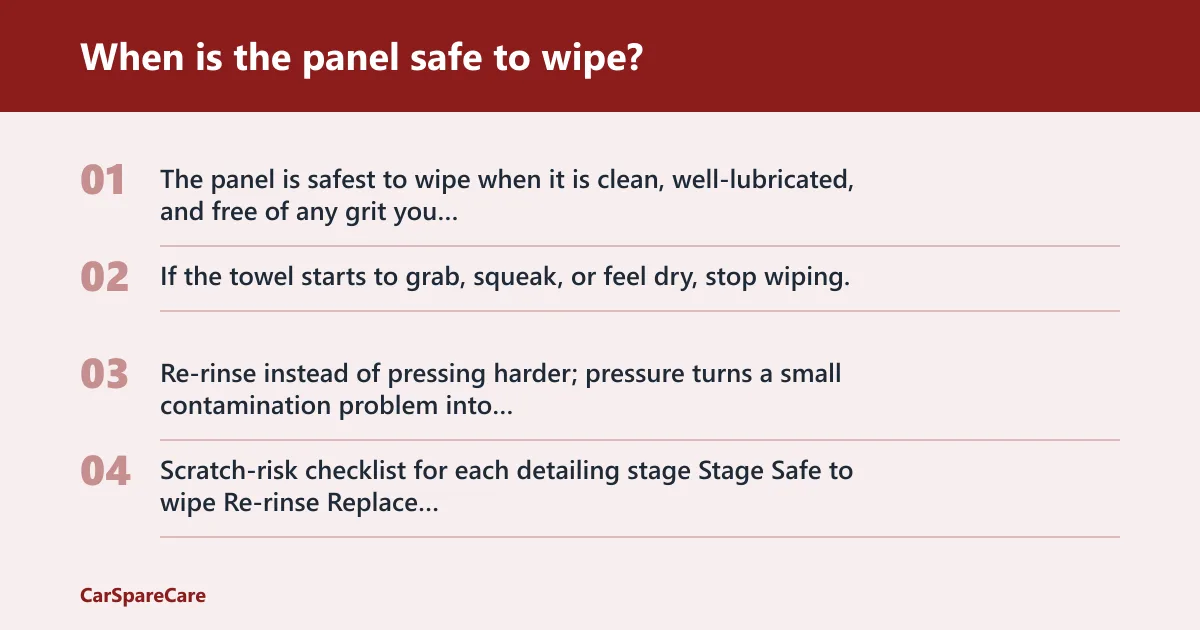
The panel is safest to wipe when it is clean, well-lubricated, and free of any grit you can feel through the towel. If the towel starts to grab, squeak, or feel dry, stop wiping. Re-rinse instead of pressing harder; pressure turns a small contamination problem into visible micro-scratches.
Scratch-risk checklist for each detailing stage
| Stage | Safe to wipe | Re-rinse | Replace towel | Stop and decontaminate | Common mistake that causes micro-scratches |
|---|---|---|---|---|---|
| Drying the panel | Only when water beads are gone and the towel is clean | If the panel feels grabby or leaves streaky grit | If the towel touches dirt, trim dust, or the ground | If the paint feels rough after the first pass | Dragging a loaded towel across partly dirty clear coat |
| Quick detail spray cleanup | Only on a visibly clean, lightly dusty panel | If the spray pulls visible grit into the towel | If one towel face starts to trap particles | If residue keeps smearing after one light pass | Using spray as a shortcut over bonded dirt |
| Applying scratch remover polish | Only after the panel is washed and dry | If residue or dust is still on the paint | If the buffing pad loads up with spent polish | If the scratch edges catch a fingernail or feel sharp | Working polish over contamination or with a dirty pad |
| Panel wipe before wax or sealant | Only after the polish residue is fully removed | If the towel drags or leaves streaks | If the towel picks up polish dust | If the panel still feels gritty after wiping | Pressing harder to remove residue instead of refreshing the towel |
| Touch-up prep around chips | Only on a cleaned, decontaminated spot | If the chip area sheds dirt into the swab or towel | If the applicator picks up paint chips or grit | If the surrounding area is dirty, waxy, or dusty | Applying touch-up to a contaminated edge and grinding debris in |
How do I polish without making swirls?
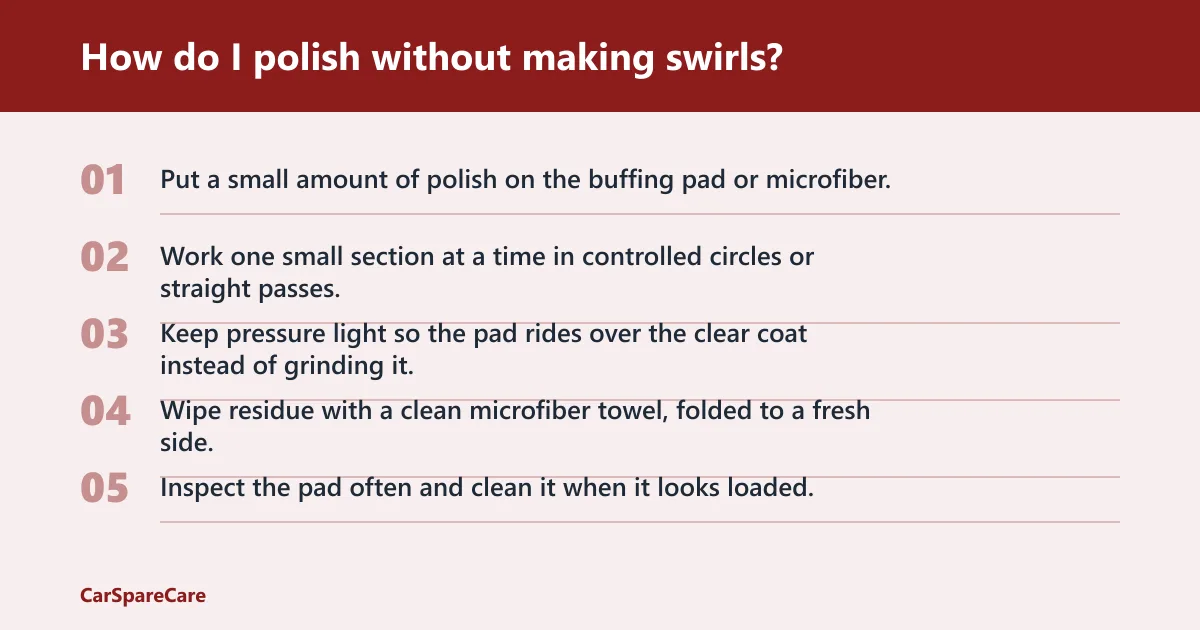
Apply scratch remover polish to the pad or microfiber, not directly to the paint. Work small areas by hand, keep pressure light, and wipe residue with a clean microfiber towel. If the pad or towel starts collecting dirt, stop and clean the surface again before continuing.
Use this hand-polish method
- Put a small amount of polish on the buffing pad or microfiber.
- Work one small section at a time in controlled circles or straight passes.
- Keep pressure light so the pad rides over the clear coat instead of grinding it.
- Wipe residue with a clean microfiber towel, folded to a fresh side.
- Inspect the pad often and clean it when it looks loaded.
Pad choice matters
A buffing pad comes in different shapes, sizes, and textures, and it should be matched to the task. A soft finishing pad is safer for light correction. A more aggressive pad can move product faster, but it also holds more residue and needs more cleaning between sections.
What should I clean before polishing a scratched panel?
Clean the whole panel first, then clean the problem spot again. Remove dust, tar, road film, and old dressing overspray before any polish touches paint. If the scratch area is dirty, polishing just drags contamination across the clear coat and can make the finish look worse.
Clean these areas before polish or touch-up
- Body panel surface
- Panel edges and lower seams
- Trim next to the scratch
- Door handle recesses
- Emblems and nearby texture that can shed debris
If that didn’t work, try this next
- Wash the panel again with fresh rinse water and a clean microfiber mitt.
- Dry with a new microfiber towel face, not the used side.
- Blow out seams, badges, and mirror bases with a filtered blower.
- Stop and decontaminate if any wipe pass still feels gritty.
Can rubbing compound or scratch remover make scratches worse?
Yes, if the pad is dirty, the product is too aggressive, or the panel was not cleaned first. Scratch remover polish is meant for mild to moderate marks and should be worked in small circles on the pad, then wiped off with a clean microfiber towel. Heavier scratches often need more substantial correction.
How to keep polish from adding marks
- Use a clean buffing pad only
- Do not apply compound to a dusty panel
- Use the least aggressive product that can address the defect.
- Stop if the residue turns gritty or the pad starts skipping
Common mistakes that create micro-scratches
- Using a chamois on dirty paint
- Pressing too hard with one towel
- Reusing a loaded buffing pad
- Using dish soap before paint work
- Wiping a panel until it is dry and grabby
Prevention: rinse the mitt often, keep a second dry microfiber towel ready, and swap towels the moment one face picks up visible grime.
Frequently asked questions
Should I use a microfiber towel or a chamois on car paint?
Use microfiber. A chamois absorbs water, but it does not pick up grit well and can grind particles into paint. Microfiber towels collect contamination better and are the safer default for drying and final wipe-off.
How do I avoid swirl marks when applying polish by hand?
Put polish on the pad or microfiber, not straight onto the paint. Work small areas with light pressure and wipe residue with a clean towel. If the pad loads up or the surface feels rough, stop and clean the panel again.
How do I know if a scratch is safe to polish at home?
If the mark is light, does not catch a fingernail, and the surrounding paint is clean, it may be worth a gentle hand polish. If the area feels rough, looks deep, or still sheds grime after washing, clean it again first or move to a more careful correction method.

Hi, I’m Melvin, an automobile engineer with extensive experience in automobile equipment. I currently work for a local automobile firm, where I specialize in the car parts industry. I’ve had the opportunity to collaborate with seasoned inspectors, gaining invaluable hands-on experience that goes beyond just theory.
My passion for automotive care started at a young age, which led me to create CarSpareCare. Through CarSpareCare, I share the knowledge and skills I’ve acquired over the years to help others navigate the world of car maintenance and repairs.
My goal is to provide practical tutorials, essential safety advice, and the latest industry insights so that anyone—whether a beginner or an expert—can confidently tackle their automotive projects.

