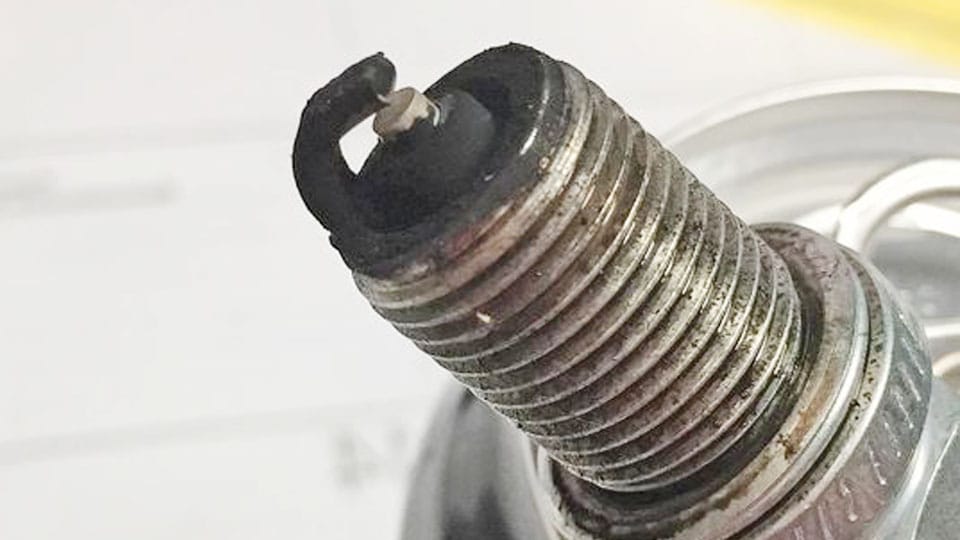
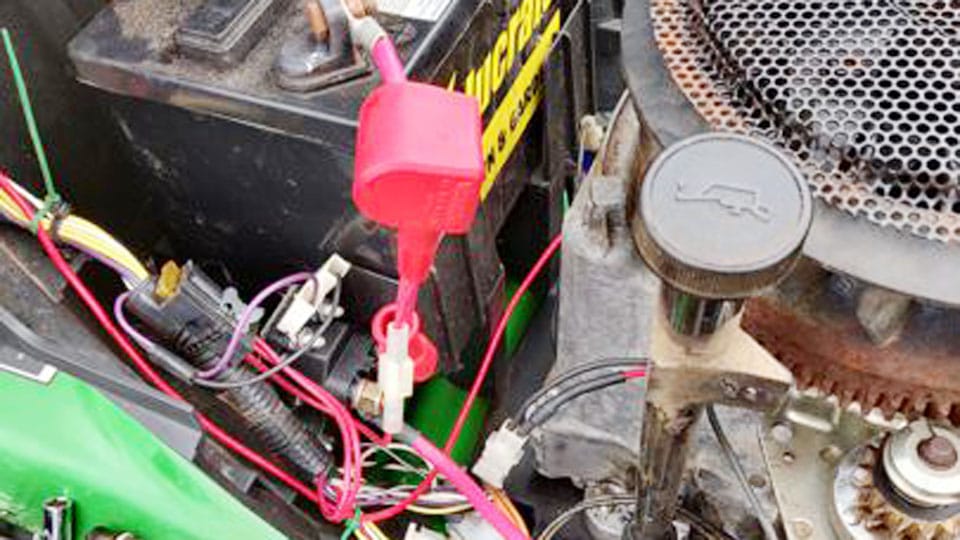
Spark plug wires arc at night because high-voltage current escapes through cracked insulation, worn boots, or carbon tracks, and the glow stands out in darkness; moisture makes the leak easier to spot. If it is ignored, the engine can misfire, run rough, waste fuel, and may damage the catalytic converter. This guide explains what you are seeing, why damp weather makes it worse, and how to trace the leak before you replace parts.
This guide is part of our Spark plug maintenance guide series.
Why the arc shows up at night
What you are usually seeing is ignition voltage leaving its intended path. Spark plug wires connect the spark plugs to the distributor or ignition coils, and they carry 30,000 volts or higher. In darkness, that stray discharge stands out because the eye notices the glow against a black background.
What the glow really means
A visible external spark on a wire is not a harmless lighting effect. It often means the insulation is leaking, the boot is not sealing, or contamination has created a path for current to follow. That is a fault to correct, not a normal condition to monitor.
Why darkness makes leakage easier to see
Daylight hides small arcs. Night lets you spot the faint blue or violet trace that may be lost in sun glare, fan movement, and engine-bay reflections. Moisture can make the leak easier to see because water and dirt lower surface resistance and help the charge track outward instead of staying inside the wire.
When a faint glow is a real fault
If the glow appears on the outside of the wire, boot, or connector, treat it as leakage. That is different from a hidden problem inside the ignition system. A visible discharge usually points to aging insulation, a contaminated boot, or a damaged wire path that should be repaired.
Spark plug wire arcing basics
Plug wires carry ignition voltage from the coil or distributor to the spark plug. They need high-voltage insulation because the current should stay inside the conductor until it jumps the plug gap. Many plug wires also have built-in resistance to reduce radio static, and the exact value must match the vehicle’s service information.
How the wire carries voltage
The ignition coil is the source of high voltage for the ignition system. In older distributor systems, the coil feeds each plug wire through the distributor cap. In newer vehicles, coil-on-plug designs may eliminate traditional plug wires entirely, so the diagnosis changes with the ignition type.
Why resistance matters
Some wires are designed with resistance to control radio-frequency noise. Factory manuals may specify wire resistance in ohms per foot, and the acceptable range varies by design. Do not compare every wire set to one universal number; compare each lead with the vehicle’s manual guidance.
How moisture and dirt create a path
A thin film of dirt can create a conductive path when moisture is present. That is why damp-weather misfiring can point to a wire problem. Water does not fix the fault; it exposes it by helping the charge travel across a dirty or cracked surface instead of through the intended insulation.
Say your sedan runs smoothly on a dry evening, then starts stumbling after a light rain. If the misfire follows a wet plug well or a dirty boot, the leak path is often at the wire end rather than deep in the engine electronics.
Spark plug wire symptoms and causes
Misfires, hard starting, and weak fuel economy are common wire-problem symptoms, and they can lead to catalytic converter damage if the fault keeps dumping raw fuel into the exhaust. The most likely causes are cracked insulation, loose or dirty boots, carbon tracking, corrosion, or an internal break that raises resistance. Age and vibration usually make the fault worse over time.
Cracked insulation
Insulation on plug wires can break down and arc to ground or other wires. Cracks may be visible, but some damage is subtle and only opens when the engine moves. Vibration can also break the wire inside the insulation, often at a connector, where bending stress is highest.
Loose or dirty boots
The spark plug boot is the end connector between the wire and the plug. It can collect dirt and moisture, and it can loosen or corrode. That creates a leakage path right at the plug end, where heat and contamination often build up after long service.
Carbon tracking and corrosion
Carbon tracking is a repeated-arc failure mode. Once a wire or boot has tracked, it can keep following the same burned path until the part is replaced. Corrosion on terminals raises resistance and can weaken the spark enough to cause a misfire under load or in damp weather.
Excessive resistance or internal breakage
An ohmmeter or multimeter checks whether the wire is within the vehicle specification from end to end. A wire can look fine and still fail if the conductor inside is damaged. That is why electrical testing matters even when the jacket has no obvious crack.
| Symptom | Likely cause | Quick test | Next action |
|---|---|---|---|
| Visible spark on the outside of a wire at night | Cracked insulation or carbon tracking | Yes: arc visible with engine running in darkness; No: no external discharge seen | Inspect the wire and boot closely; replace the failed lead if damage is found |
| Misfire only in damp weather | Moisture revealing a leakage path | Yes: symptom appears after rain or spray; No: no weather link | Check boots, plug wells, and jacket condition before replacing coil parts |
| Rough running after water spray near a plug end | Dirty or loose boot | Yes: engine stumbles when moisture reaches the boot; No: no change | Clean the area, reseat the boot, and inspect for corrosion or cracking |
| Repeated spark path in the same spot | Carbon tracking | Yes: dark trail or burned line visible; No: jacket clean | Replace the wire or boot; cleaning usually will not remove the track |
| Boot or terminal shows green or white residue | Corrosion | Yes: residue present at the connector; No: connector clean | Clean the terminal if light, replace the part if pitted or loose |
| Wire fails resistance check | Excessive resistance or internal break | Yes: meter reading outside the vehicle specification; No: within spec | Replace the wire; do not guess from appearance alone |
| Visible damage but no misfire yet | Insulation breakdown in progress | Yes: cracks, swelling, or burn marks present; No: jacket intact | Plan replacement soon because age and vibration can turn a warning sign into a hard fault |
| Misfire remains after a wire swap | Mistaken coil fault or another ignition issue | Yes: problem follows the coil or stays on the same cylinder; No: fault disappears with the wire | Inspect the ignition coil, plug, and connector before buying more wires |
How do you test spark plug wire resistance?
Use a multimeter or ohmmeter to test each wire end to end, then compare the reading with the vehicle service manual. Do not rely on a generic target. Factory manuals may specify wire resistance in ohms per foot, and the correct reading depends on the wire design and the vehicle’s ignition system.
- Turn the engine off and let hot parts cool.
- Remove one wire at a time so the routing stays clear.
- Set the multimeter to resistance measurement.
- Touch one probe to each end of the same wire.
- Record the reading.
- Compare that reading with the service manual for that exact vehicle.
- Repeat for every wire.
How to read the result
If a reading is outside the vehicle’s specification, that wire is suspect even if the jacket looks intact. If all wires are in range but the engine still misfires, inspect boots, terminals, routing, and the coil. A wire set should match vehicle specifications, not a generic parts-store guess.
Suppose a four-cylinder car uses long plug leads and one wire reads far higher than the others. If that wire also shows a slight miss under load, the meter result and the symptom point in the same direction: the lead is failing internally.
What should you inspect before replacing parts?
Check the boots, terminals, plug wells, and wire routing before buying parts. Separate wire faults from coil faults, because the coil is the high-voltage source and a plug-wire symptom can be caused by a bad connection elsewhere. A damp-weather clue often points back to leakage at the wire end.
Boots and plug wells
Look for dirt, oil, water, and corrosion inside the plug well. The boot may seem seated while still leaking to the head or valve cover. If the boot surface is dirty and damp, clean it and inspect for cracking, swelling, or a loose fit.
Coil inspection by ignition type
On distributor systems, inspect the coil tower, cap, and wire ends. On coil-on-plug systems, there may be no traditional wire set, so the fault may sit in the coil boot, the plug, or the coil connector. Do not assume every misfire near the coil is caused by the coil itself.
Routing and separation
Wire routing matters. Long parallel runs can invite crossfire, while crossed routing can be intentional to cancel magnetic fields. Misrouting wires can cause one wire to induce voltage in another. Put each lead back where the service manual shows it belongs.
Replacement and routing checks
If a wire fails testing or shows visible leakage, replace the damaged lead or the full set when the design calls for matched lengths and resistance. Some replacement sets use spiral wound construction, and the diameter and core design can vary by application. The part choice should follow the vehicle specification, not just the plug count.
Match the right wire set
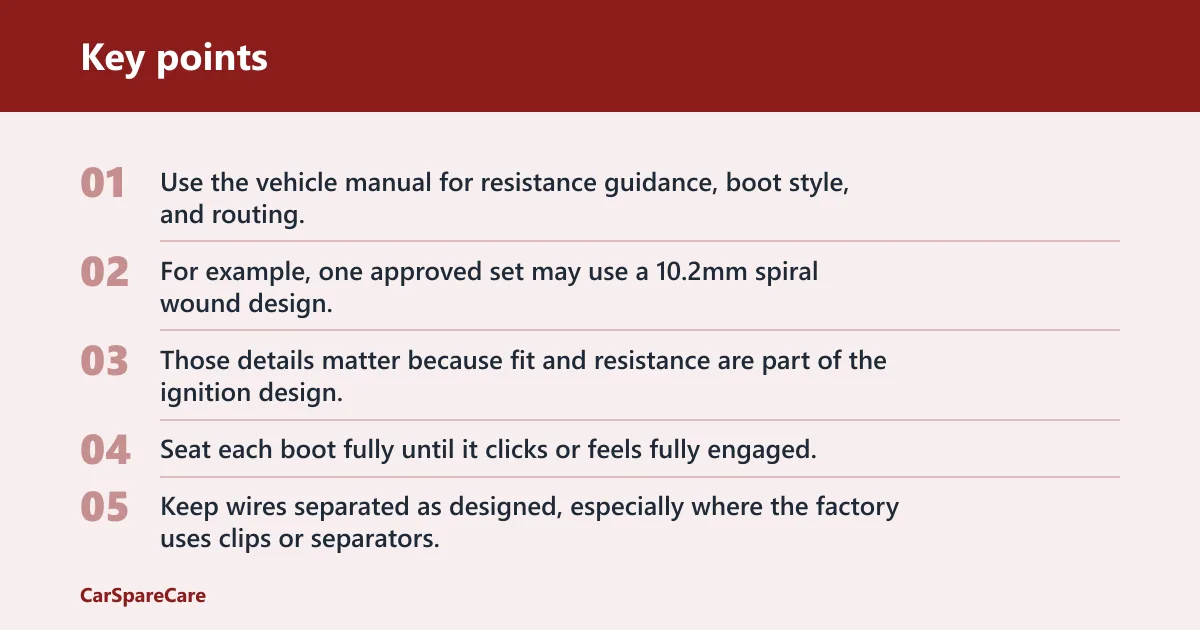
Use the vehicle manual for resistance guidance, boot style, and routing. For example, one approved set may use a 10.2mm spiral wound design, while another may use an 8.2mm diameter with a Kevlar core. Those details matter because fit and resistance are part of the ignition design.
Install and verify
Seat each boot fully until it clicks or feels fully engaged. Keep wires separated as designed, especially where the factory uses clips or separators. After installation, start the engine in the dark only if it is safe to do so, and watch from a clear position without reaching near belts, fans, hot parts, or direct ignition connections.
Do not replace the wrong part first
A visible arc does not automatically mean the ignition coil is bad. A cracked wire, dirty boot, or corroded terminal can look like a coil fault. Trace the leak path first, then replace the part that actually fails the inspection or resistance test.
Frequently asked questions
Why do spark plug wires arc at night?
They arc at night because high-voltage leakage becomes easier to see in darkness. The wire’s insulation, boot, or terminal lets current escape, and moisture makes the path easier to trace. A visible external arc usually means the wire path is aging or damaged and needs correction.
Do spark plug wires wear out?
Yes. Heat, vibration, age, and contamination break down the jacket, connectors, and internal conductor over time. A wire may still look acceptable while its resistance rises or its insulation starts leaking. That is why both visual inspection and resistance testing matter.
Can moisture make spark plug wires arc?
Yes. Moisture can reveal a weak insulation path, especially when dirt or corrosion is already present. A thin film of dirt can create a conductive path when moisture is present, which is why damp-weather misfiring is a useful clue. The underlying fault is still the wire or boot.
What should I replace if spark plug wires are arcing?
Replace the part that actually leaks: the wire, boot, or corroded connector, not the first component you suspect. If the wire fails the resistance test or shows cracked insulation or carbon tracking, replace it. If the problem follows the coil or stays after wire replacement, inspect the ignition coil and plug end.
How do spark plug wires work?
Spark plug wires carry ignition voltage from the coil or distributor to the spark plug while keeping the current inside high-voltage insulation. Many have built-in resistance to reduce radio static. They must also be routed correctly, because crossed or parallel placement can create induced voltage and misfire.

Hi, I’m Melvin, an automobile engineer with extensive experience in automobile equipment. I currently work for a local automobile firm, where I specialize in the car parts industry. I’ve had the opportunity to collaborate with seasoned inspectors, gaining invaluable hands-on experience that goes beyond just theory.
My passion for automotive care started at a young age, which led me to create CarSpareCare. Through CarSpareCare, I share the knowledge and skills I’ve acquired over the years to help others navigate the world of car maintenance and repairs.
My goal is to provide practical tutorials, essential safety advice, and the latest industry insights so that anyone—whether a beginner or an expert—can confidently tackle their automotive projects.