Wheel adapters are bolt-on parts that change a vehicle’s bolt pattern or hub size; wheel spacers only move the wheel outward, and both are safe only when hub centering, correct lug-thread engagement, and load rating are right. Bad fitment can cause vibration, stud failure, bearing strain, or wheel loss. This guide separates adapters from spacers and shows how to judge safety by fitment, hardware compatibility, and brake clearance.
What wheel adapters do
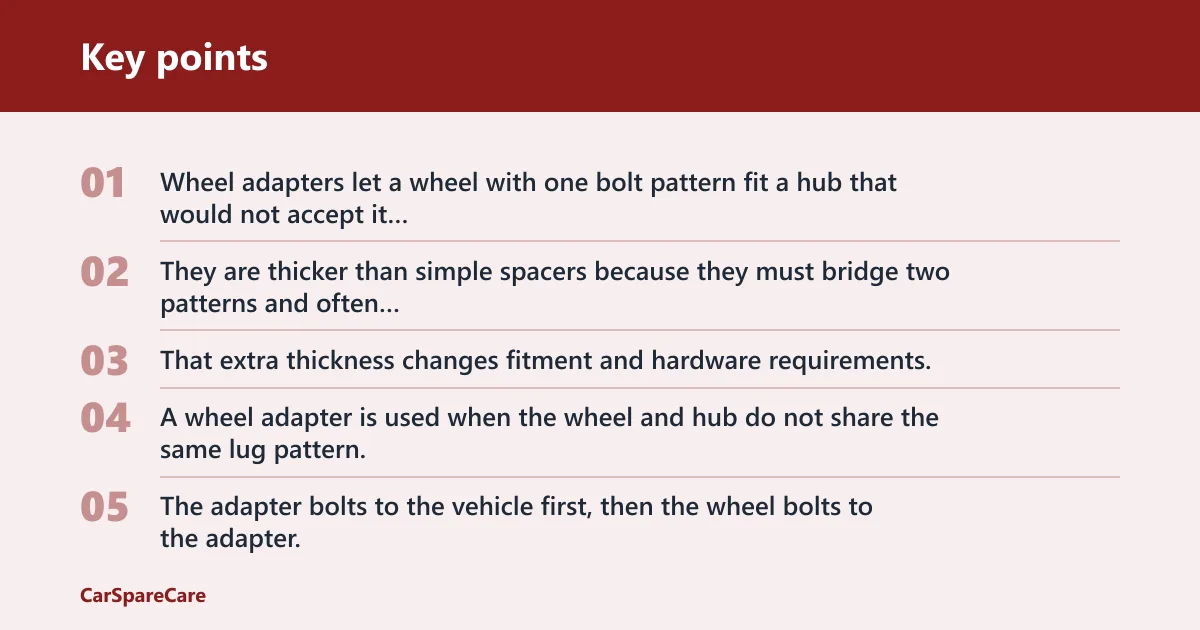
Wheel adapters let a wheel with one bolt pattern fit a hub that would not accept it directly. They are thicker than simple spacers because they must bridge two patterns and often create a new mounting face with their own studs or threaded holes. That extra thickness changes fitment and hardware requirements.
How adapters change bolt pattern fitment
A wheel adapter is used when the wheel and hub do not share the same lug pattern. The adapter bolts to the vehicle first, then the wheel bolts to the adapter. That is why adapters are not the same thing as spacers.
Because the adapter becomes part of the mounting stack, you need the vehicle-side pattern, the adapter’s hub bore, and the wheel-side pattern to all fit together cleanly. If any one of those is wrong, the setup can vibrate or loosen even if the wheel “seems” to bolt on.
Why adapters are thicker than spacers
Adapters usually need enough thickness to contain both the vehicle-side attachment and the wheel-side attachment. By contrast, a simple spacer only needs to create distance. That is why many adapters are bolt-on style parts rather than thin slip-on plates.
When people ask what are wheel adapters and how do they work, the short answer is that they solve a pattern mismatch. Spacers solve a position problem. Mixing those two jobs is where a lot of bad advice starts.
Are wheel adapters safe?
Wheel adapters can be safe when the bolt pattern matches, the hub is centered correctly, the hardware length is right, and the torque specs are verified. They are not safe when the fit is forced, the adapter is the wrong thickness for the wheel setup, or the hardware leaves too little thread engagement after installation.
The fitment checks that matter most
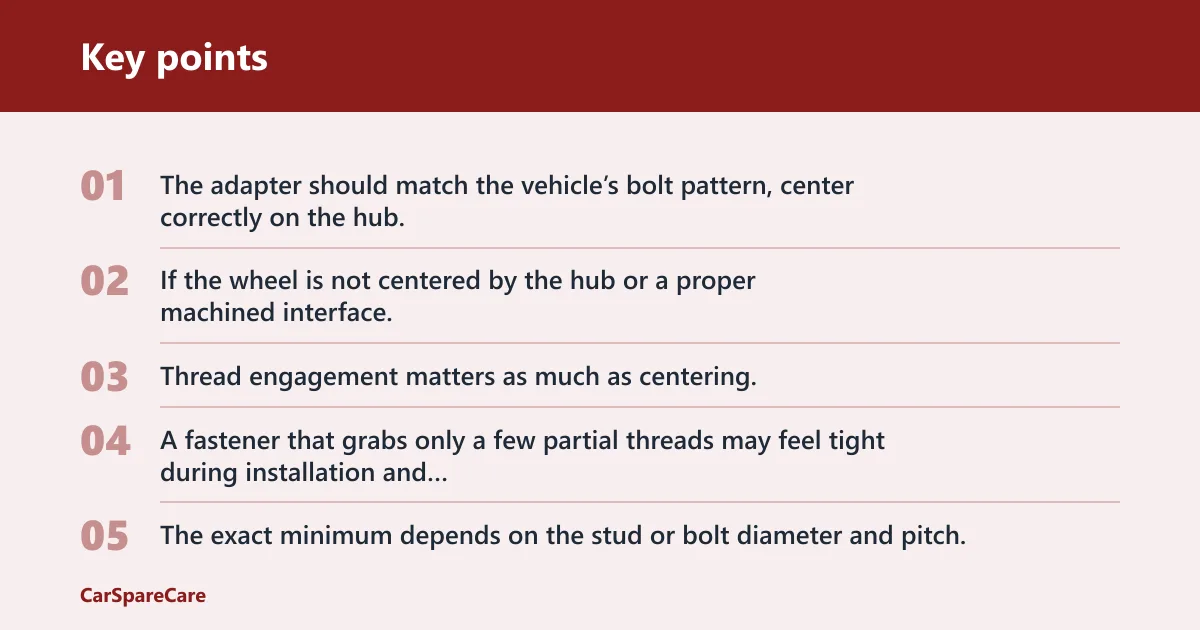
Safety starts with basic compatibility. The adapter should match the vehicle’s bolt pattern, center correctly on the hub, and accept the wheel without forcing the center bore. If the wheel is not centered by the hub or a proper machined interface, vibration risk goes up fast.
Thread engagement matters as much as centering. A fastener that grabs only a few partial threads may feel tight during installation and can still fail under road load. The exact minimum depends on the stud or bolt diameter and pitch, so verify the manufacturer’s requirement for that vehicle and hardware.
When the answer is no
If the adapter creates major offset correction, leaves too little thread engagement, or requires stacked parts, the better answer is usually no. Large changes in wheel position can make a new wheel the cleaner fix. That is especially true when the goal is only stance, not fitment correction.
Say your wheel barely clears the brake caliper and you are tempted to add a thick adapter just to make it work. If the wheel face and center bore are already borderline, a different wheel with the right offset is usually a safer long-term solution than forcing the fit with extra hardware.
Why centering and thread engagement decide a lot
Vibration often comes from poor centering, not from the idea of an adapter itself. A hub-centric adapter locates the wheel on the hub, which helps keep the wheel centered as the vehicle rolls. Generic fitment that relies only on lug hardware is less forgiving.
Thread engagement is the other major issue. Lug nuts and wheel studs are load-carrying fasteners. If the engaged thread length is too short, clamp force can drop and the joint can work loose. That risk does not depend on brand names or marketing terms; it depends on the actual hardware stack.
Adapter safety checklist
| Check | Pass | Fail |
|---|---|---|
| Bolt pattern match | Vehicle side and wheel side match the adapter exactly. | Any pattern mismatch or forced fit. |
| Hub bore match | Adapter locates correctly on the hub and wheel center bore. | Wobble, slop, or a bore that relies on luck to center. |
| Hub-centric or ring required | Adapter is properly hub-centric, or a required ring is specified for the wheel side where appropriate. | Wheel is left to center only on lug hardware. |
| Spacer thickness | Thickness is enough for clearance or pattern conversion without creating rub or hardware conflict. | Thickness is added “until it fits” with no measured reason. |
| Required stud/bolt length | Hardware length is correct for the full stack on that vehicle. | Original hardware is reused even though engagement drops. |
| Minimum thread engagement | Manufacturer minimum is met for that stud or bolt. | Partial threads, shallow bite, or no verified minimum. |
| Caliper clearance | Brake parts clear through full steering and suspension travel. | Contact or near-contact at lock, compression, or heat expansion. |
| Fender clearance | Wheel and tire stay clear at full turn and compression. | Rubbing on liners, fenders, or suspension parts. |
| Torque spec verification | Correct torque is confirmed for the vehicle and the adapter hardware. | Generic torque guesswork or impact-only installation. |
| Post-install re-torque interval | Re-torque interval is set and followed after installation. | No re-check plan at all. |
How wheel spacers change offset
Wheel spacers move the wheel outward without changing the bolt pattern. Effective offset equals wheel offset minus spacer thickness. A 10mm spacer turns ET+45 fitment into ET+35 fitment. That change can improve flushness, but it also changes clearance and load path.
Flush fitment versus rubbing risk
Slip-on spacers are typically 3mm to 15mm thick. That range is common because thin spacers adjust stance or clear small interference points without making the hardware stack too long. Past that, the fitment change becomes more consequential and should be checked against tire size, steering lock, and suspension travel.
Wheel offset is not just a number on a listing. Push the wheel outboard and you may gain fender fill, but you also increase the chance of rubbing at the arch, liner, or outer lip. A spacer that solves one clearance issue can create another if the tire is wide.
A common first-timer mistake is choosing a spacer for stance and then discovering the tire touches the fender liner on a full-lock parking turn. The spacer did its job. The wheel position was the problem.
When caliper clearance is the real reason
The spacer can move the wheel outboard while the caliper stays stationary. That is why spacers are sometimes used to clear brake calipers or rotor hats. The trick is to measure that need instead of guessing, because too much thickness can create new rub or alter handling feel.
If the brake package needs a large correction, the right wheel may be the better fix. A different offset or a wheel with the correct barrel shape can solve the issue without adding extra parts between the hub and wheel.
What hardware do you need?
Hardware choice depends on the style of spacer or adapter. Slip-on spacers depend on the vehicle’s original studs or bolts, so you must confirm that enough thread remains. Bolt-on adapters usually bring their own studs, which changes the question from “longer vehicle studs?” to “is the adapter’s supplied hardware correct?”
Wheel studs and slip-on spacers
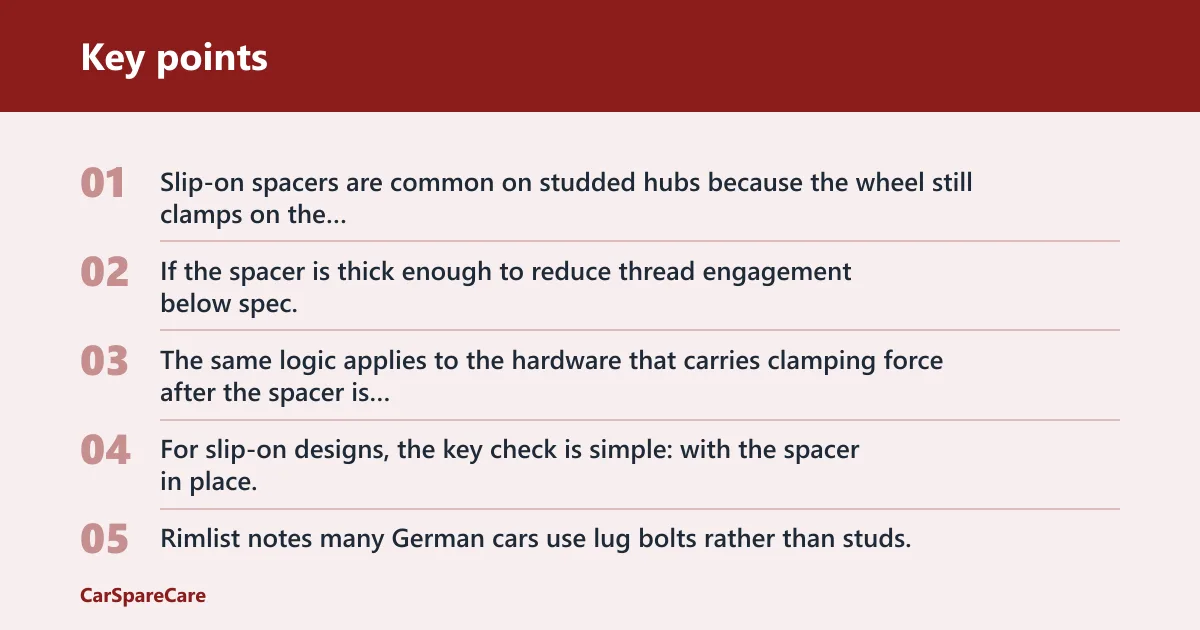
Slip-on spacers are common on studded hubs because the wheel still clamps on the original studs. If the spacer is thick enough to reduce thread engagement below spec, longer studs are needed. The same logic applies to the hardware that carries clamping force after the spacer is installed.
For slip-on designs, the key check is simple: with the spacer in place, does the nut still engage enough full threads to meet the vehicle or fastener maker’s requirement? If not, the setup is incomplete.
Lug bolts and thicker spacers
Rimlist notes many German cars use lug bolts rather than studs. On those vehicles, the bolt threads directly into the hub, so spacer thickness has to be accounted for in bolt length. If the bolt is too short, engagement drops and the wheel may not clamp properly.
This is why asking “do I need longer studs or bolts for wheel adapters” needs a split answer. Sometimes yes for slip-on spacers, sometimes no for bolt-on adapters with their own studs, and often the right answer depends on the exact vehicle hardware.
Bolt-on adapters with built-in studs
Bolt-on spacers are typically 15mm and up. Bolt-on adapters also commonly use their own studs or threaded inserts, which reduces dependence on factory stud length. That design still needs proper torque and centering, but it changes the hardware question in a useful way.
Do not assume bolt-on means universally safer. It means the hardware path is different. If the adapter is not hub-centric, or if its studs are the wrong length or grade for the wheel, the problem is still there.
When adapters make sense and when they do not
Adapters make sense when the wheel bolt pattern does not match the vehicle and the rest of the fitment can be made correct. Spacers make sense when you need a small outward move for brake clearance or offset correction. If the required change is large, a different wheel is often the cleaner choice.
Brake clearance and pattern mismatch cases
Should you use adapters for brake caliper clearance? Only when the needed outward move is small enough that the wheel still clears the fender and the hardware stays within spec. If the setup needs a major correction, a wheel with different offset or barrel shape is usually better than adding thickness.
Can wheel adapters cause wheel bearing wear? The adapter itself is not the main mechanism. The larger factor is moving the wheel farther outboard, which increases leverage on the bearing. More offset change means more load moment, so a thin correction is one thing and a large correction is another.
Daily driving versus track, towing, and off-road use
For daily driving, the safest setup is usually the one with the fewest variables: correct bolt pattern, hub-centric location, verified thread engagement, and no rub at full steering lock. That is the baseline.
For track, towing, and off-road use, the margin gets tighter because heat, impact, and sustained load expose weak fitment faster. A setup that feels fine on a short road test may still be poor if the wheel sees repeated cornering loads or heavy vertical impacts.
Is it bad to use wheel adapters? No, not by itself. It is bad to use the wrong adapter, the wrong hardware, or the wrong amount of spacer thickness for the wheel and vehicle combination.
Frequently asked questions
Are wheel adapters dangerous?
They can be, but only when fitment is wrong. The main dangers are poor centering, insufficient thread engagement, wrong bolt pattern, and clearance problems. A properly matched hub-centric adapter with verified hardware can be a reasonable solution. A forced fit is the opposite.
Do wheel adapters cause problems?
They can cause vibration, rub, or loose hardware if the setup is mismatched. Problems usually come from center bore mismatch, wrong thickness, or incorrect torque, not from the concept of an adapter itself. The more the wheel moves outward, the more clearance and load issues matter.
What is the difference between wheel spacers and wheel adapters?
Spacers only move the wheel outward and change effective offset. Adapters do that too, but they also convert one bolt pattern to another. Because adapters do two jobs at once, they are typically thicker and have more hardware variables to verify before installation.
How much spacer thickness is too much?
There may not be a universal limit. The right thickness depends on stud or bolt length, thread engagement, wheel offset, and clearance at the fender and caliper. A 3mm to 15mm slip-on spacer is common, while larger changes often push the setup toward a different wheel choice.
Do I need longer studs or bolts for wheel adapters?
Sometimes, but not always. Slip-on spacers often need longer studs or longer bolts if thread engagement drops below spec. Bolt-on adapters usually use their own studs, so the factory studs may not be the issue. Check the exact hardware path, then verify engagement after installation.
Are hub-centric wheel adapters safer than generic ones?
Yes, when the adapter is properly machined to center on the hub and locate the wheel correctly. Hub-centric location reduces vibration risk because the wheel is centered by the hub, not just by the lug hardware. Generic parts that do not center well are harder to trust.

Hi, I’m Melvin, an automobile engineer with extensive experience in automobile equipment. I currently work for a local automobile firm, where I specialize in the car parts industry. I’ve had the opportunity to collaborate with seasoned inspectors, gaining invaluable hands-on experience that goes beyond just theory.
My passion for automotive care started at a young age, which led me to create CarSpareCare. Through CarSpareCare, I share the knowledge and skills I’ve acquired over the years to help others navigate the world of car maintenance and repairs.
My goal is to provide practical tutorials, essential safety advice, and the latest industry insights so that anyone—whether a beginner or an expert—can confidently tackle their automotive projects.