

If your car vibrates only while accelerating, start with drivetrain and engine-load faults first; if it also vibrates at steady speed with no throttle, look to wheels, tires, or brakes. A small axle, mount, or tire fault can quickly become expensive wear or a roadside failure. This guide gives you a fast symptom-based path to separate throttle-linked, speed-linked, brake-linked, and turn-linked vibration.
What the vibration pattern tells you
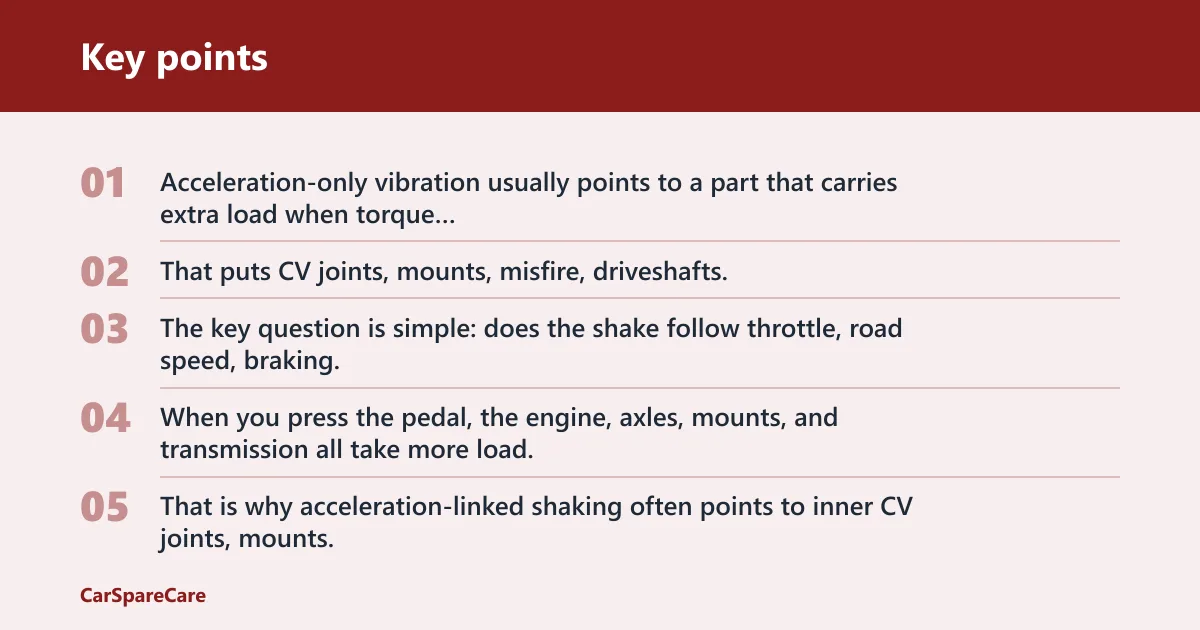
Acceleration-only vibration usually points to a part that carries extra load when torque is applied, not just when the car rolls along. That puts CV joints, mounts, misfire, driveshafts, and transmission issues high on the list. The key question is simple: does the shake follow throttle, road speed, braking, or steering input?
What changes when the shake happens only under throttle
When you press the pedal, the engine, axles, mounts, and transmission all take more load. That is why acceleration-linked shaking often points to inner CV joints, mounts, U-joints, or tire imbalance. If the shake fades when you lift off, that is a useful clue. It separates load-related faults from problems that exist whenever the wheels turn.
Why coasting, braking, and turning point to different faults
A vibration that stays present while coasting usually tracks wheel speed more than engine load. A shake that shows up only during braking points away from acceleration causes and toward rotor problems. A turn-linked vibration raises suspicion for outer CV joints or wheel bearings, because turning changes the load on those parts.
How speed, load, and gear engagement narrow the search
Speed-linked vibration often becomes more noticeable as road speed rises, even if the throttle position stays steady. Load-linked vibration shows up when you climb a hill, pull away from a stop, or accelerate in a higher gear. Gear engagement matters too: a thump or knock on takeoff can point to worn mounts, while a shudder under load can point to transmission fluid trouble.
Vibration diagnosis matrix
This table helps you match the pattern before you start replacing parts. Read it left to right, then follow the cheapest checks first.
| When it happens | Where it is felt | Likely component | Quick check | Urgency |
|---|---|---|---|---|
| Only under throttle | Floor or whole car | Inner CV joint, mount, misfire | Inspect CV boots, scan OBD2 codes, watch engine movement in Drive and Reverse | Book soon |
| Only uphill | Whole car | Inner CV joint, weak mount, fuel mixture fault | Try a gentle uphill pull in a lower gear; note whether the shake increases with load | Book soon |
| From a stop | Floor or seat | Mount, transmission fluid, inner CV joint | Check for thump on takeoff and inspect fluid level and condition | Medium |
| At 60 mph | Steering wheel or seat | Wheel balance, bent rim, tire damage, driveshaft | Look for missing wheel weights, bulges, bent rims, and recent tire work | Medium |
| During turns | Front corner or one side | Outer CV joint, wheel bearing | Listen for clicking or growl while turning left and right | Book soon |
| During braking | Steering wheel or pedal | Rotor problem | Compare brake vibration with the same road at light throttle | Medium |
| Only in Drive or Reverse | Cabin and body | Engine or gearbox mount | Foot on brake, shift between Drive and Reverse, watch for excess engine movement | Medium |
| Worsens with speed in rear-wheel-drive or four-wheel-drive vehicles | Seat or floor | Driveshaft or prop shaft | Check for visible runout on a lift and look for damaged joints or balance weights | High |
| Returns after recent balance work | Steering wheel or seat | Wheel weights missing, tire defect, bent rim | Inspect for fresh weight loss, pothole damage, and road-force issues | Medium |
| Acceleration shake with OBD2 fault codes | Whole car | Misfire, MAF sensor, O2 sensor | Read codes and live data before replacing sensors | Book soon |
| First inspections, cheapest to most expensive | — | Tires and wheel weights, CV boots, fluid level, OBD2 scan, balancing, mounts, axle or driveshaft work | Start with visible damage and code checks; move to mechanical diagnosis if the symptom stays | Cost-priority path |
Quick checks ranked from cheapest to most expensive
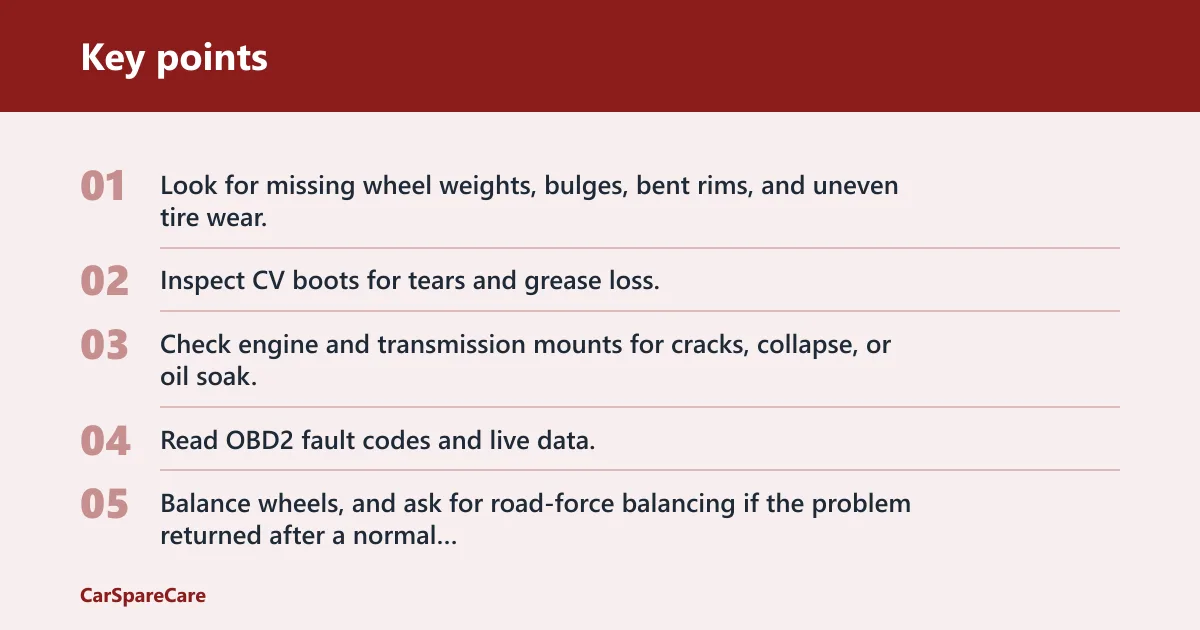
- Look for missing wheel weights, bulges, bent rims, and uneven tire wear.
- Inspect CV boots for tears and grease loss.
- Check engine and transmission mounts for cracks, collapse, or oil soak.
- Read OBD2 fault codes and live data.
- Balance wheels, and ask for road-force balancing if the problem returned after a normal balance.
- Inspect drivetrain joints, axle shafts, or a prop shaft on a lift.
When to stop DIY checks and book a shop diagnosis
Stop at the basic checks if the vibration is growing, if the car shudders hard under load, or if the fault returns after a recent balance. Repeating wheel balancing can waste money when the real fault is a torn CV boot, a bent rim, or a failing shaft. If the symptom is speed-linked on a rear-wheel-drive or four-wheel-drive vehicle, a driveline inspection is the next step.
What if it shakes only when you press the pedal?
That pattern points to a load problem. Inner CV joints, engine or transmission mounts, and engine fueling faults are the main suspects when the shake appears only as you add throttle. If the vibration disappears as soon as you lift off, focus on parts that move or twist under torque rather than on brake rotors or ordinary road-speed vibration.
Inner CV joint shudder under load
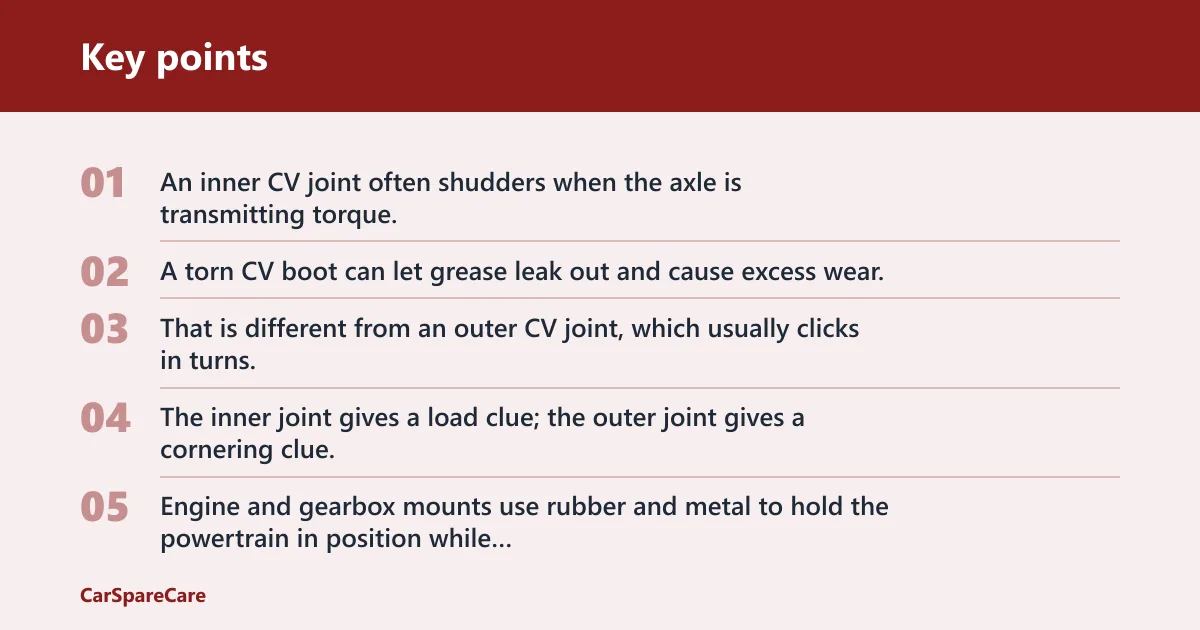
An inner CV joint often shudders when the axle is transmitting torque, especially on front-wheel-drive vehicles. A torn CV boot can let grease leak out and cause excess wear. That is different from an outer CV joint, which usually clicks in turns. The inner joint gives a load clue; the outer joint gives a cornering clue.
Engine or transmission mount movement
Engine and gearbox mounts use rubber and metal to hold the powertrain in position while still absorbing movement. Worn mounts are often most noticeable during initial acceleration. A simple test is to shift into Drive and Reverse with the brake held, then watch for excessive engine movement or a thump or knock on takeoff.
Misfire or fuel mixture fault under acceleration
A misfiring engine can cause shaking when accelerating, especially on petrol engines. The cause may be spark plugs, plug wires, fuel delivery, or compression. A faulty MAF sensor can make the engine misfuel and shake during acceleration, and an O2 sensor fault can upset fuel mixture control. Use OBD2 fault codes and live data before replacing sensors when a misfire, MAF sensor, or O2 sensor fault is suspected.
Say your 1.6-litre hatchback shakes only when merging uphill in third gear, but the steering wheel stays calm on level roads. That pattern fits a load-related fault better than a wheel problem, so an inner CV joint, mount, or fuel mixture issue moves ahead of wheel balancing.
Why does it shake at a certain speed?
A fixed speed band usually points to rotation, not throttle. A vibration that shows up at a specific speed band suggests rotational imbalance. Wheel balance, bent rims, tire damage, and driveshaft imbalance are the first places to look. If the vibration is present at that same road speed whether you are on the gas or not, treat it as speed-linked first.
Wheel balance and wheel weights
An unbalanced wheel vibration often becomes more noticeable as speed increases. Check for missing wheel weights, recent tire work, and any pothole impact. If the vibration is in the steering wheel, the front wheels are more likely involved. If the shake is felt through the seat, the rear wheels are more likely involved.
Bent rims, tire wear, and pothole damage
Tires and wheels matter because uneven wear, bulges, and bent rims can all create vibration. A bent rim may show up after a pothole hit, even if the tire still holds air. If the shake was “fixed once” and then came back, repeated balancing may be treating the symptom while the rim or tire remains the real fault.
Driveshaft or prop shaft imbalance
Rear-wheel-drive and four-wheel-drive vehicles can develop vibration from a driveshaft or prop shaft that is out of balance or shows visible runout. That vibration usually worsens with speed. On a lift, visible wobble is a strong clue, and the fault often feels like a seat or floor vibration rather than a steering-wheel shake.
Why does my car vibrate when accelerating from a stop?
Shaking from a stop can point to mount problems, low-speed CV loading, and transmission fluid condition. If the car feels fine once rolling, that points away from pure wheel balance and toward parts that react hardest at launch. A thump, shudder, or delayed takeoff is useful diagnostic evidence.
Mounts that thump on takeoff
Worn engine or gearbox mounts can be most noticeable during initial acceleration. Rubber cracks, collapsed mounts, or oil-soaked mounts let the powertrain shift more than it should. A sharp knock as you pull away is more suggestive of mount movement than of a simple tire issue.
Transmission fluid level or condition
Low or dirty transmission fluid can cause vibration because the transmission may not function as intended. It also affects torque converter lubrication and hydraulic pressure. If the car shudders under light throttle from a stop, check the fluid level and condition before assuming a major internal fault.
Low-speed CV joint load symptoms
Front-wheel-drive vehicles can shake from a worn CV joint under acceleration, and the symptom may be easiest to feel when starting from rest. A torn boot, grease loss, and wear in the inner joint are the details that matter. Outer joint clicking in a parking lot turn points to a different side of the axle.
What does turn-linked vibration mean?
Turn-linked vibration changes with steering angle, not just speed or throttle. That shift is important because it points toward the axle or wheel bearing on the side that is being loaded. Outer CV joints and wheel bearings are the main suspects here, while inner CV shudder is more about straight-line acceleration under load.
Outer CV joint clicking versus inner joint shudder
An outer CV joint usually announces itself with clicking during turns. An inner CV joint usually shudders under load in a straight line. Do not treat those as the same fault. If the sound or shake appears mainly while cornering, the diagnosis changes, and axle replacement on the correct side matters.
Wheel bearing clues in left and right turns
A wheel bearing often gives a growl or hum, and the sound or vibration can change when you turn left or right because the load shifts. A bearing issue can create vibration under acceleration or at speed, but the turning clue is what helps separate it from a wheel balance problem.
Why turn-load changes matter on FWD, RWD, and AWD
Drive layout changes how the fault behaves. On front-wheel-drive vehicles, the axles are both steering and driving, so a turn can reveal CV joint wear more easily. On rear-wheel-drive and four-wheel-drive vehicles, a bearing, axle, or prop shaft may be the better fit if the vibration lives in the seat or floor.
Suppose a sedan vibrates only when turning left onto a highway ramp, and the sound grows into a low hum. That pattern is more useful than a general “it shakes sometimes” complaint because it points toward a wheel bearing or outer CV joint on the loaded side.
What should you check first?
Start with the parts you can inspect in minutes: tires, wheel weights, visible boots, leaks, and codes. Those checks separate cheap fixes from deeper drivetrain work. If the fault is still unclear after that, the next step is not random part replacement; it is a structured diagnosis based on where and when the vibration appears.
Tires, wheels, and recent repair clues
Check for uneven wear, bulges, bent rims, and missing wheel weights. Look for recent tire work, because a balance issue that returns soon after service may mean the wheel itself is bent or the tire has a defect. If the shake is mainly in the steering wheel, focus on the front wheels first; if it sits in the seat, look rearward.
Boots, fluid leaks, and mount condition
Inspect CV boots for splits and grease loss. Look at engine and transmission mounts for cracks, collapsed rubber, and excessive movement. Check transmission fluid level and condition if the vehicle shudders from a stop or under load. A quick visual check can rule in the right system before deeper work begins.
OBD2 codes and live data for engine faults
If the vibration comes with poor acceleration or a flashing warning lamp, read OBD2 fault codes first. Misfire codes can point to spark, fuel, or compression problems. For a suspected MAF sensor or O2 sensor issue, live data matters because a sensor can misreport load or mixture even when it does not look physically damaged.
Frequently asked questions
Why does my car vibrate when accelerating?
Acceleration-only vibration usually points to a fault that shows up under load, such as an inner CV joint, mount, misfire, driveshaft, or tire issue. The fastest way to narrow it is to note whether the shake disappears when you coast, stays at one road speed, or changes in turns or braking.
Why does my car shake when accelerating but not coasting?
That pattern usually means the problem needs torque to show itself. Inner CV joints, worn engine or gearbox mounts, and engine fueling faults are common suspects. If the car is smooth while coasting at the same speed, wheel balance drops down the list and load-related parts move up.
Why does my car shake when accelerating from a stop?
Shaking from a stop often points to mount movement, low or degraded transmission fluid, or a low-speed CV joint issue. A thump on takeoff is a strong mount clue. If the vibration fades once the car is rolling, focus less on road-speed balance and more on launch load.
Why does my car shake when accelerating at high speeds?
A shake that appears as speed rises usually suggests rotational imbalance. Wheel weights, tire damage, bent rims, and driveshaft imbalance are common causes. If the vibration is felt in the steering wheel, the front wheels are more likely involved; if it is in the seat, the rear wheels or prop shaft move higher on the list.
Why does my car vibrate when accelerating uphill?
Uphill acceleration adds load, so it often reveals faults that stay quiet on level ground. Inner CV joint wear, weak mounts, and fuel mixture problems are common fits. If the same road is smooth downhill but shakes uphill, treat it as a load-linked problem rather than a simple wheel-speed issue.
Why does my car shake when accelerating and braking?
That usually means two different faults may be present, or one issue affects both wheel rotation and load transfer. Brake-linked shaking points toward rotor problems, while acceleration-linked shaking points toward CV joints, mounts, tires, or driveline parts. Separate the two by testing each symptom on the same road stretch.

Hi, I’m Melvin, an automobile engineer with extensive experience in automobile equipment. I currently work for a local automobile firm, where I specialize in the car parts industry. I’ve had the opportunity to collaborate with seasoned inspectors, gaining invaluable hands-on experience that goes beyond just theory.
My passion for automotive care started at a young age, which led me to create CarSpareCare. Through CarSpareCare, I share the knowledge and skills I’ve acquired over the years to help others navigate the world of car maintenance and repairs.
My goal is to provide practical tutorials, essential safety advice, and the latest industry insights so that anyone—whether a beginner or an expert—can confidently tackle their automotive projects.

