

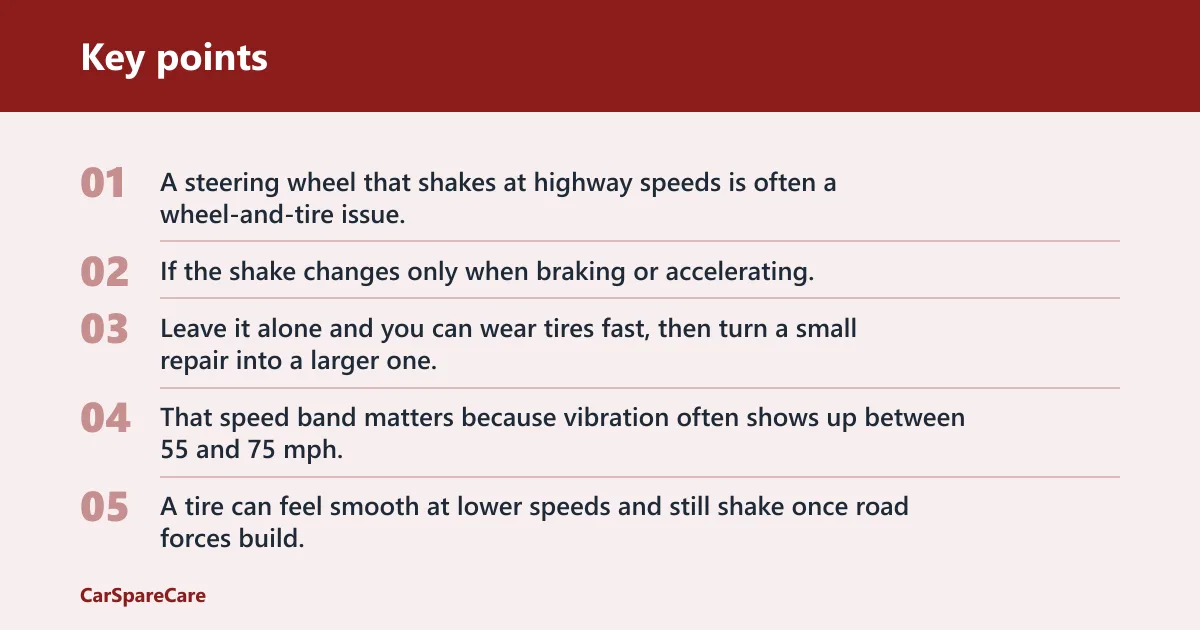
A steering wheel that shakes at highway speeds is often a wheel-and-tire issue, especially wheel balance, a bent wheel, uneven tire wear, or tire pressure problems. If the shake changes only when braking or accelerating, the likely cause shifts toward brakes or driveline parts. Leave it alone and you can wear tires fast, then turn a small repair into a larger one.
That speed band matters because vibration often shows up between 55 and 75 mph. A tire can feel smooth at lower speeds and still shake once road forces build. Rough pavement can make a small fault feel worse, so a bumpy stretch may turn a mild shimmy into a wheel shake you cannot ignore.
Road surface amplifies minor wheel imbalances
The steering wheel gives useful clues. Front-end faults often show up there first because the front wheels steer the car and can send vibration through the steering system. Rear-wheel problems can still shake the car, but they are more likely to be felt in the seat or floor than in the wheel.
How road surface can make a small fault feel worse
Rough pavement can magnify a mild imbalance, a slightly bent rim, or tire wear that is already uneven. If the vibration is much worse on one road and calmer on smooth asphalt, that points toward a marginal tire or wheel issue rather than a major steering failure.
That pattern also helps separate a speed fault from a road fault. A true wheel-balance problem usually follows speed. A road-surface problem often comes and goes with pavement texture, even if the speed stays the same.
Steering wheel shake diagnostic matrix

This table separates the most common vibration patterns before you buy parts. Match the symptom first, then inspect the most likely area. That approach is cheaper than replacing tires or balancing wheels repeatedly when the real fault is a bent wheel or worn suspension part.
| Symptom pattern | Likely cause | Quick driveway check | Urgency level |
|---|---|---|---|
| Steady cruise | Wheel balance, bent wheel, uneven tire wear, tire pressure issue | Look for missing balance weights, bulges, scalloped tread, or a wheel that wobbles when spun by hand | Check soon if the shake is repeatable at speed |
| Only braking | Front brake rotors with surface variation, rust, or overheating | Feel whether the steering wheel pulses only during braking, not on constant throttle | Prompt shop inspection |
| Only accelerating | Driveline or suspension load-related play, sometimes tire or wheel problems that shift under torque | Compare light throttle, hard throttle, and coasting at the same speed | Check soon; sooner if the vibration grows |
| Changes by speed | Wheel balance, bent wheel, damaged tire, wheel bearing play, road-speed resonance | Note the exact mph where the shake begins and whether it fades above or below that point | Check soon |
| Worse on rough roads | Tire wear, bent wheel, loose suspension part, or tire pressure issue | Compare smooth pavement with rough pavement at the same speed | Check soon; inspect for loose parts if the car feels unstable |
Could wheel balance be the cause?
Yes. Unbalanced tires are one of the most common causes of steering wheel shake at highway speed. If a balance weight falls off, the wheel can feel fine around town and then vibrate once you reach highway speed, with the front wheels usually felt first in the steering wheel.
That is why balance belongs near the top of the list. The fix is a tire shop balance, but the source of the imbalance still matters. If a wheel is bent, the balance can seem to “come back” after a short time because the wheel itself keeps forcing the tire out of true.
What a tire shop checks during balancing
A proper balance check looks for missing weights, a tire that needs more than one correction, and a wheel or tire that will not run evenly. If the shop finds the same wheel needing repeated correction, ask whether the rim has runout, whether the hub face is dirty or damaged, and whether the tire itself is out of round.
That matters because repeated balancing without finding the cause wastes time and money. A wheel that is bent, a hub that is not true, or a tire with internal damage can all mimic a simple balance problem.
Tire wear and pressure checks
Uneven tire wear can create a repeating vibration at speed. Cupping, feathering, flat spots, and edge wear are common tire wear patterns that can cause a shake even when the wheels are balanced. A damaged tire can shake even at low speeds, not just highway speeds, so do not assume speed alone proves balance is the issue.
Tire pressure also matters. Underinflation and overinflation change how the tire sits on the road and can worsen wear and ride quality. Temperature swings can shift pressure enough to change how the car feels, so a quick pressure check is worth doing before you drive to a shop.
What to inspect before you drive to a shop
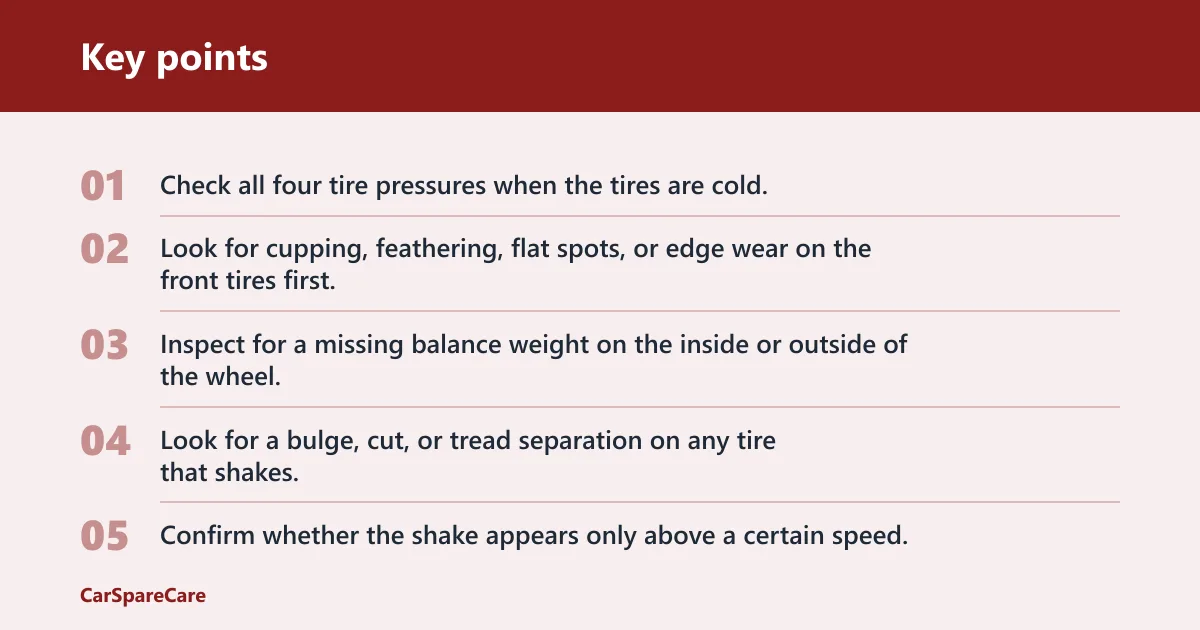
- Check all four tire pressures when the tires are cold.
- Look for cupping, feathering, flat spots, or edge wear on the front tires first.
- Inspect for a missing balance weight on the inside or outside of the wheel.
- Look for a bulge, cut, or tread separation on any tire that shakes.
- Confirm whether the shake appears only above a certain speed.
Suppose your steering wheel starts trembling at 62 mph after the car felt normal at 45 mph. If the front tires also show scalloped tread on the inner edges, that points more toward wear or suspension-related tire wear than a simple one-time balance issue.
Could alignment or suspension be involved?
Yes. Wheel alignment problems can make the vehicle pull and feel less stable, and they often contribute indirectly by creating uneven tire wear. Toe and camber issues can wear the tread in a way that later causes vibration at highway speed, even after the original alignment fault has changed.
Worn suspension components listed in many shop inspections include ball joints, tie rods, and control arm bushings. Wheel bearings, struts, and shocks can also let the wheel move enough to amplify shake. If the steering wheel feels loose, wanders, or needs constant correction, look beyond balance alone.
Why uneven wear can return after a repair
If the tire is balanced but the car still has a worn tie rod, loose control arm bushing, or weak strut, the tire can wear unevenly again. That is how a “fixed” vibration returns. The repeat problem is often not the tire shop’s fault; the underlying play was never removed.
That is also why alignment should not be treated as a separate cosmetic service. If the steering wheel is off-center, the car pulls, or the front tires wear oddly, inspect the suspension and steering parts before assuming the next balance will solve everything.
Why does the wheel shake when braking?
If the steering wheel shakes mainly while braking, front brake rotors move to the top of the list. Rotor surface variation, rust, or overheating can create a pulsation that travels through the front suspension and into the wheel. If the shake disappears when you release the brake pedal, the brakes deserve attention first.
Brake shake usually feels different from cruise-speed vibration. Cruise shake follows road speed. Brake shake follows brake application. That difference is useful because it saves you from chasing tires and balance when the rotors are the real fault.
When brake issues need prompt inspection
A brake-related shake should be checked soon, especially if stopping feel has changed, the pedal pulses, or the car pulls under braking. Warped brake rotors especially cause shaking while braking, and front rotors are the ones most likely to send that vibration into the steering wheel.
If the wheel shudders only during braking from highway speed, do not ignore it. The problem may still be drivable for a short trip to a shop, but it should not be left to grow.
Could a bent wheel be the problem?
Yes. Bent wheels can create a vibration similar to an unbalanced tire, and pothole or curb impact damage is a common cause. The bend may be subtle and hard to see, so a wheel can look normal at a glance while still shaking the steering wheel at speed.
That hidden damage is one reason balance problems keep returning. A wheel can be balanced on a machine and still wobble on the car if the rim is not true. In that case, the tire shop may keep adding weights without solving the root cause.
How to spot subtle wheel damage
Look closely at the rim lip for flat spots, dents, or fresh scuffs from curb contact. Spin the wheel if the car is safely lifted and watch for side-to-side wobble. A wheel that looks slightly “out of round” can be enough to cause a highway-speed shake.
Say your steering wheel vibrates only above 60 mph after a pothole strike, and the tire pressure is correct. If one front wheel has a small bend on the inner barrel, that can explain why the shake feels like balance trouble even after a fresh balance.
Is it safe to drive if my steering wheel shakes at highway speed?
Sometimes, briefly. If the shake is mild, stable, and limited to a known speed range, you may be able to drive straight to a shop. If the steering feels loose, the car pulls hard, the vibration is severe, or the brake pedal and wheel pulse together, stop driving and get it checked before continuing.
The risk is not only discomfort. Tire wear can accelerate, a bent wheel can worsen, and a loose suspension part can create a safety problem. If the shake is getting stronger, treat it as a soonest-possible repair rather than a nuisance.
What should I check first when the steering wheel shakes?
Start with tire pressure, visible tire damage, and missing balance weights. Then note whether the shake happens at a specific speed, only while braking, or only while accelerating. That pattern tells you whether to begin with tires and wheels, brakes, or suspension and steering parts.
If you want the fastest low-cost path, inspect in this order: tire pressure, tire wear, wheel condition, brake behavior, then suspension play. That sequence catches the common causes before you pay for alignment or replacement parts that may not be needed.
Quick first-pass order
- Confirm the exact speed where the shake begins.
- Check whether braking changes the vibration.
- Check whether throttle changes the vibration.
- Inspect tire pressure and tread wear patterns.
- Look for bent wheels or missing balance weights.
- Have a shop inspect for wheel balance, rotor variation, and suspension play.
Frequently asked questions
What causes shaking in the steering wheel?
The most common causes are wheel balance, uneven tire wear, bent wheels, brake rotor variation, alignment issues, and worn suspension parts. The key is the pattern: cruise-speed shake points more toward tires and wheels, while braking-only shake points more toward front brake rotors.
Why does my steering wheel shake only at highway speeds?
Highway speed makes small faults easier to feel. Vibration often appears between 55 and 75 mph, and a tire can seem fine at lower speeds but start shaking once road forces rise. That is why balance and bent wheels are so common in this symptom range.
Why is my steering wheel shaking while driving?
While driving, the shake usually comes from something that rotates or moves with road load: tires, wheels, brakes, alignment, or suspension parts. The best clue is when it happens. If it follows speed, look at tires and wheels. If it follows braking, look at rotors.
Can wheel balance cause steering wheel shaking?
Yes. Wheel balance can matter when the wheel shakes at speed, and unbalanced tires are one of the most common causes. If a balance weight falls off, the shake may start suddenly and often shows up first in the steering wheel because the front wheels transmit it more directly.
Could bent rims cause shaking in the steering wheel?
Yes. Bent wheels can create a vibration similar to an unbalanced tire, and the bend may be hard to see. A pothole or curb strike can damage the rim enough that balancing alone does not solve the problem, so the wheel itself needs inspection.
How can I tell if the problem is tires, brakes, or suspension?
Use the symptom pattern. If the shake is steady at cruise, suspect tires or wheels first. If it appears only while braking, suspect rotors. If the wheel feels loose, the car pulls, or the shake returns after a balance, suspension or alignment-related wear may be involved.

Hi, I’m Melvin, an automobile engineer with extensive experience in automobile equipment. I currently work for a local automobile firm, where I specialize in the car parts industry. I’ve had the opportunity to collaborate with seasoned inspectors, gaining invaluable hands-on experience that goes beyond just theory.
My passion for automotive care started at a young age, which led me to create CarSpareCare. Through CarSpareCare, I share the knowledge and skills I’ve acquired over the years to help others navigate the world of car maintenance and repairs.
My goal is to provide practical tutorials, essential safety advice, and the latest industry insights so that anyone—whether a beginner or an expert—can confidently tackle their automotive projects.

