For most cars, you reset TPMS after changing wheels with the dash menu or a scan-tool relearn. If the wheel set uses different sensors or IDs, you need a relearn, cloned sensors, or full sensor replacement. Skip that step and the warning light can stay on, hide a real low-pressure fault, or fail an inspection. This guide shows the wheel-and-sensor decision tree, the reset steps, and how to tell a simple reset from a relearn or sensor swap.
What you’ll need
- Cold tire pressure set to the door placard or owner’s manual spec
- The owner’s manual or the vehicle’s dash menu access
- A TPMS tool if your vehicle needs sensor wake-up, triggering, or programming
- A tire pressure gauge you trust
- A notebook or phone note for sensor IDs if the vehicle stores them
- Replacement TPMS sensors if a battery is dead, a sensor is missing, or the frequency does not match
Reset vs relearn vs repair?
Use a reset when the system needs to reinitialize pressure thresholds after you set the tires to the correct cold pressure. Use a relearn when the vehicle must register sensor IDs again after a wheel swap, seasonal set change, rotation on some vehicles, or sensor replacement. Use repair or replacement when a sensor is dead, missing, incompatible, or the wrong frequency.
What a TPMS reset does
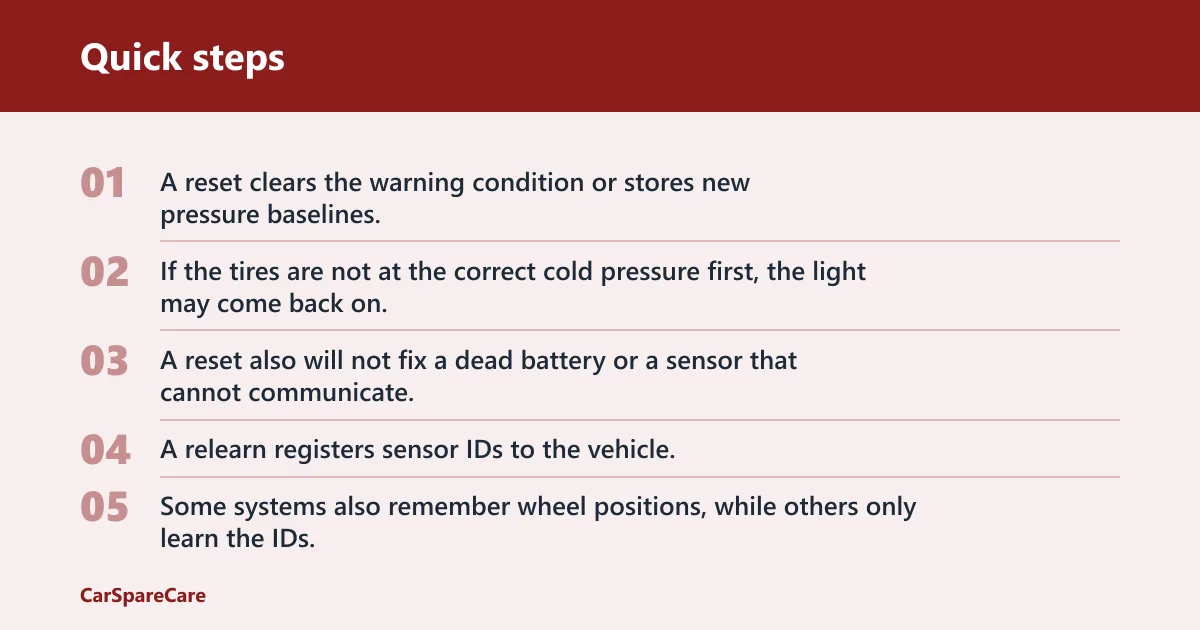
A reset clears the warning condition or stores new pressure baselines, but it does not create a working sensor. If the tires are not at the correct cold pressure first, the light may come back on. A reset also will not fix a dead battery or a sensor that cannot communicate.
What a TPMS relearn does
A relearn registers sensor IDs to the vehicle. Some systems also remember wheel positions, while others only learn the IDs. The method varies: stationary, auto-learn, or OBD-based depending on the vehicle. Some systems support auto-relearn when driven at approximately 20 mph, and some can finish in about 10–20 minutes of driving.
When you need sensor replacement instead
If a sensor battery is dead, the battery is usually sealed and non-replaceable, so the sensor itself is the fix. Many TPMS sensor batteries are designed to last 5–10 years. A replacement is also needed when the sensor frequency does not match the vehicle or when a sensor is missing from the wheel.
TPMS wheel-change decision table
| Vehicle behavior | Wheel/sensor scenario | Likely fix | Tool needed | Estimated DIY time | Common failure symptom |
|---|---|---|---|---|---|
| Light stays on after a seasonal wheel swap | OEM sensors moved to new wheels | Reset, then relearn if the vehicle stores sensor IDs | Owner menu or TPMS trigger tool | 10–30 minutes | Light stays on even though pressures are correct |
| No sensor data for the new wheel set | New blank programmable sensors | Program sensors, then relearn | Programming-capable TPMS tool | 20–45 minutes | Flashing light, missing sensor IDs, or no response from one corner |
| Vehicle reads some wheels but not all | Mixed-frequency sensors | Replace the mismatched sensors with the correct frequency | Parts lookup and possibly a TPMS trigger tool | 30–60 minutes | One wheel never reports, or the light returns after driving |
| Only one corner fault remains | One-wheel replacement | Check that the replacement wheel has a working matched sensor, then relearn | TPMS trigger tool or scan tool | 15–30 minutes | One wheel shows no ID or no pressure reading |
| Light clears without special tools | No-tool auto-relearn vehicles | Set pressure, then drive the relearn cycle | None on some vehicles | 10–20 minutes of driving | Light stays on if the drive cycle was too short |
How do you reset TPMS?
Start with correct cold pressure, then use the vehicle’s reset or menu procedure. On some cars that is enough. On others, you still need a relearn drive cycle or a TPMS tool. If the light is flashing, treat it as a system fault first, not a simple low-pressure warning.
- Check all four tires when cold and set each one to the door-placard pressure.
- Find the vehicle’s TPMS menu or reset command in the dash, center screen, or instrument cluster.
- Run the reset command exactly as the owner’s manual shows it.
- If the vehicle calls for a drive cycle, drive at steady speed until the system learns the sensors.
- Recheck the light after the drive and confirm that all pressures still match the placard.
Suppose a crossover has OEM sensors moved from the old wheels to a winter set. The pressures are correct, but the light stays on after the menu reset. That usually means the vehicle still needs a relearn, not more air.
Do you need a TPMS tool?
Some vehicles only need a menu reset or a drive cycle. Others need a TPMS tool to wake sensors, trigger them in sequence, or program blank aftermarket sensors before relearn. An OBD-based relearn is the right path when the vehicle wants sensor IDs written into its memory through the diagnostic port.
- Check the owner’s manual for the relearn type: stationary, auto-learn, or OBD-based.
- Use a trigger tool if the manual calls for sensor wake-up or wheel-by-wheel activation.
- Use a programming-capable TPMS tool only if the new sensors are blank and must be written first.
- Use an OBD scan tool when the vehicle wants the sensor IDs stored through the diagnostic connector.
A simple trigger tool is often enough for a relearn. It is not the same as a programmer. A programmer is needed only when the new sensor arrives blank and must be loaded with the proper vehicle data first.
Common mistakes
Most failed resets come from the same few errors. The fix is usually simple, but the order matters. Set the pressure first, then reset. If the light flashes, stop adding air and check for a fault. If a sensor battery is dead, no reset will bring it back.
- Resetting before setting correct pressure. Recheck every tire cold before you touch the menu.
- Assuming a flashing light means low pressure. It often points to a system fault, missing sensor, or incompatible sensor.
- Trying to reset a dead or missing sensor. A sealed battery cannot be revived by a reset.
- Skipping the owner-specific procedure. Use the manual because reset paths vary by model year and ignition type.
- Ignoring frequency mismatch. TPMS communication depends on the sensor frequency matching the vehicle; examples include 315 MHz and 433 MHz.
Picture a sedan with one replacement wheel and three original wheels. If the spare wheel has a sensor that never reports, the problem is not the reset. The likely fix is a matched sensor, then a relearn.
Why won’t my TPMS reset after a tire change?

If the reset fails after a tire change, the usual causes are wrong cold pressure, a missing or dead sensor, the wrong sensor frequency, or a relearn that was never completed. A wheel swap or seasonal set change can also change sensor IDs or positions, so the vehicle may need a new registration step.
If that didn’t work, try this next
- Verify every tire is at the placard pressure when cold.
- Check the wheel set for a missing sensor or a damaged valve stem assembly.
- Confirm the sensor frequency matches the vehicle specification before buying parts.
- Run the relearn again using the exact menu, tool, or drive cycle listed in the manual.
- If one wheel still will not report, replace that sensor rather than repeating the reset.
Cost is different for each fix. A reset is often free. A relearn tool ranges from a basic trigger tool to a pricier programmer. Sensor replacement adds the part cost plus labor if you do not mount and balance the tire yourself. Shop relearn service is usually less than a full sensor swap, but pricing varies by vehicle and parts needed.
How to tell if a TPMS sensor is bad or just needs resetting
A sensor that needs resetting usually still communicates once the correct procedure is run. A bad sensor often shows no response, a missing ID, or a repeated fault on the same wheel. If the battery is sealed and the sensor is old, the likely fix is replacement, not another reset.
Can you reuse TPMS sensors on new wheels?
Yes, if the sensor is compatible, alive, and still matched to the vehicle. OEM sensors can often move to new wheels, but the vehicle may still need a relearn. Reuse fails when the sensor is damaged during transfer, the battery is dead, or the frequency does not match the new vehicle.
How to reset TPMS after tire rotation
After a rotation, some vehicles only need a menu reset, while others need a relearn because the vehicle tracks sensor IDs or wheel positions. If the tire shop moved the sensors with the wheels, or if your system expects a new registration after rotation, follow the manual rather than assuming the light will clear on its own.
Frequently asked questions
How do I do a TPMS reset?
Use the dash menu, center screen, or button sequence listed in the manual, then complete any required drive cycle. On some vehicles the reset is enough; on others the light will not clear until the system relearns the sensors. Pressure must already be correct when cold.
Do I need to relearn TPMS after swapping wheels?
Usually yes if the sensor IDs changed, the wheel set is seasonal, or the vehicle does not auto-learn. A relearn may be stationary, drive-based, or OBD-based. If the new wheels use blank sensors, they must be programmed before the relearn can work.
Do I need a tool or can I drive to reset TPMS?
Some vehicles can auto-relearn by driving, sometimes at around 20 mph for about 10–20 minutes. Others need a trigger tool or an OBD relearn. If the manual calls for a programming step, driving alone will not register blank sensors.
How do I tell if my TPMS sensor is bad or just needs resetting?
If a correct reset and relearn do not bring back one wheel, suspect the sensor itself. A dead battery is common because many sensor batteries are sealed and non-replaceable. Missing data, a flashing light, or a wheel that never reports usually points to replacement rather than another reset.

Hi, I’m Melvin, an automobile engineer with extensive experience in automobile equipment. I currently work for a local automobile firm, where I specialize in the car parts industry. I’ve had the opportunity to collaborate with seasoned inspectors, gaining invaluable hands-on experience that goes beyond just theory.
My passion for automotive care started at a young age, which led me to create CarSpareCare. Through CarSpareCare, I share the knowledge and skills I’ve acquired over the years to help others navigate the world of car maintenance and repairs.
My goal is to provide practical tutorials, essential safety advice, and the latest industry insights so that anyone—whether a beginner or an expert—can confidently tackle their automotive projects.