Car battery corrosion usually comes from acid vapor escaping through a bad seal, overcharging, or a loose connection, and repeated corrosion after cleaning is a sign to inspect the battery’s charge rate and case for cracks or seepage. Ignoring it can cause hard starts, voltage loss, and damaged cables or terminals. This guide explains what white or blue-green buildup means and what to check next before cleaning or replacing parts.
What battery corrosion tells you
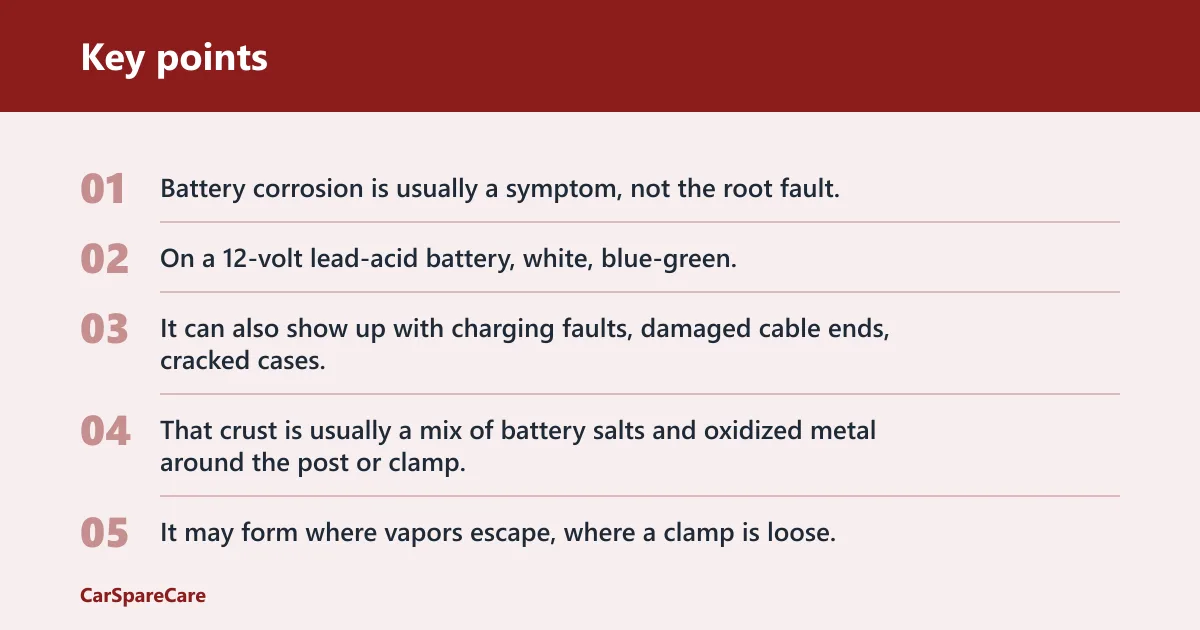


Battery corrosion is usually a symptom, not the root fault. On a 12-volt lead-acid battery, white, blue-green, or brown crust around the posts and clamps often points to vented electrolyte, moisture, or a connection problem. It can also show up with charging faults, damaged cable ends, cracked cases, or an aging battery that is losing control of its electrolyte.
What the white or blue-green buildup
That crust is usually a mix of battery salts and oxidized metal around the post or clamp. It may form where vapors escape, where a clamp is loose, or where moisture and dirt sit on the connection. The color alone does not tell you whether the battery is good, and corrosion by itself does not prove a failing alternator.
Why corrosion points to a problem, not a finish line
Corrosion can increase resistance at the joint and make starting harder. It can also hide a loose clamp or cable-end fault that keeps returning after cleaning. Interstate notes that corrosion does not tell you whether the battery is good, so you need to check the case, the cables, and the charging system before deciding on replacement.
What causes car battery corrosion?
Car battery corrosion usually comes from vented electrolyte, hydrogen gassing during charging, moisture contamination, or a damaged battery case. On lead-acid batteries, hydrogen gas venting is a common source of corrosion, and acid can seep out of a cracked case. Dirt, salt, and loose connections make the buildup happen faster and return sooner.
Vented electrolyte and battery vapors
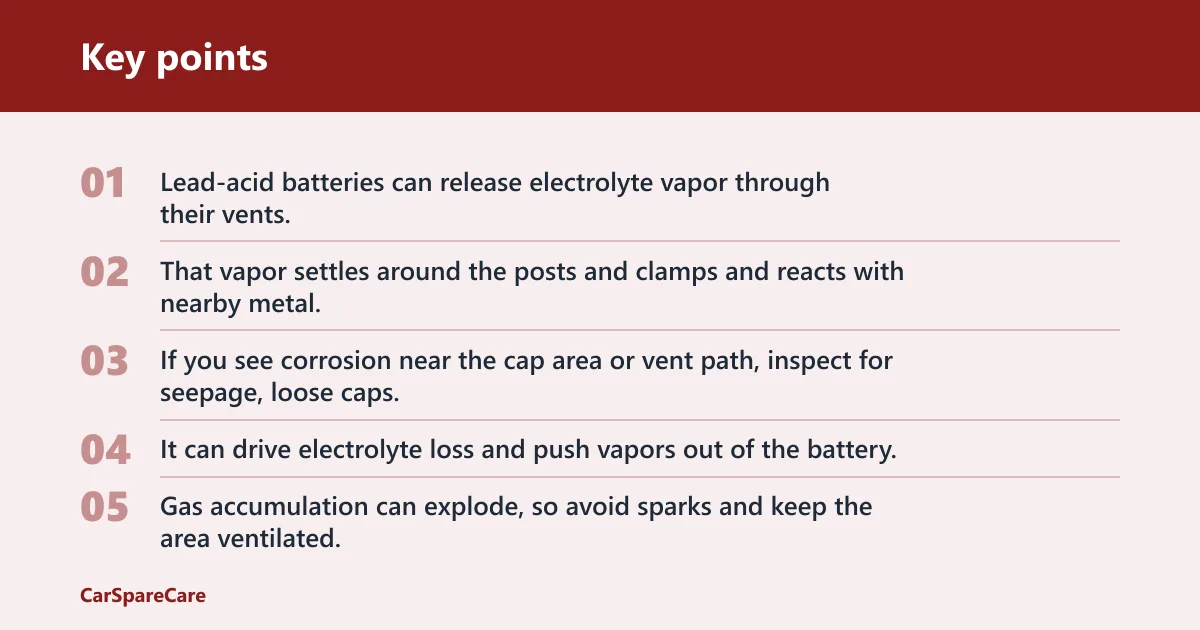
Lead-acid batteries can release electrolyte vapor through their vents, especially when the battery is warm, overcharged, or not sealed as intended. That vapor settles around the posts and clamps and reacts with nearby metal. If you see corrosion near the cap area or vent path, inspect for seepage, loose caps, or a case issue.
Hydrogen gassing during charging
Hydrogen gassing can occur during charging. It can drive electrolyte loss and push vapors out of the battery, which is why ventilation matters around a charging lead-acid battery. Gas accumulation can explode, so avoid sparks and keep the area ventilated. If corrosion keeps returning, check charging voltage against the battery’s needs.
Moisture, dirt, and clamp contamination
Humidity, road salt, and temperature swings can help corrosion form and spread. Loose connections raise electrical resistance and generate heat, which can damage the clamp surface and make buildup worse. Yuasa recommends checking terminals, clamps, and cables for corrosion or loose connections, then cleaning corroded parts with a wire brush as part of the repair process.
Cracked cases, seepage, and vent issues
The same source says corrosion can come from acid seeping out of a cracked case. That matters because a leak can look like ordinary terminal buildup at first. A wet ring, damp residue, or staining near a seam is more serious than dry powder on an old clamp. A crack or seep often means the battery needs replacement.
What causes car battery corrosion on positive terminal?
Positive-terminal corrosion often appears when vapor, seepage, or clamp damage affects that post and its connection. It may show overcharging, but it does not prove it. Look first for a loose or dirty clamp, a damaged cable end, or wet residue around the battery case, because the terminal location alone is not a full diagnosis.
What it can mean
The positive post can corrode because it is part of the path where charging and discharge happen, and heat or vapor can collect around the connection. If the clamp is damaged, the metal may oxidize and trap crust inside the joint. That can create starting trouble even when the battery still turns the engine sometimes.
What to inspect first
Check the clamp fit, the cable jacket near the terminal, and the battery case around the positive post. A loose clamp can mimic a battery fault. If the corrosion is wet, tacky, or forms again quickly after cleaning, inspect for seepage from the case or vent path before blaming the alternator.
When the clamp or cable end is the real fault
A corroded terminal can hide a split cable end or a clamp that no longer grips properly. In that case, cleaning the post alone does not solve the problem. If the metal at the cable end is swollen, pitted, or green under the insulation, the connection may need repair or replacement rather than another cleaning cycle.
What causes car battery corrosion on negative terminal?
Negative-terminal corrosion can also come from vented electrolyte, contamination, or a loose ground connection. It is often mistaken for a direct sign of undercharging, but that shortcut is too simple. The negative side may corrode because the ground path is loose, the clamp is damaged, or the battery is venting and the residue reaches both posts.
Why it may appear on the ground side
The negative terminal is tied to the vehicle ground path, so any weakness in that connection can create resistance and heat. That makes the joint more vulnerable to oxidation and buildup. If the negative clamp is dirty or loose, the battery may crank slowly even when the battery case itself looks normal.
What else can be mistaken for a bad battery
A weak ground cable, a poor body connection, or corrosion inside the clamp can all act like a failing battery. A battery may also appear charged while still performing poorly if acid stratification or sulfation has reduced its ability to deliver current. The symptoms can overlap, so inspect the whole circuit, not the post alone.
How to read the corrosion pattern
The pattern matters more than the color by itself. One terminal, both terminals, or the cable end all point in different directions. Dry powder suggests old residue or vented electrolyte that has dried out, while wet residue points more toward an active leak or fresh seepage. The case, not just the post, should guide your next check.
One terminal versus both terminals
Corrosion on one side can point to a local clamp problem, a damaged cable end, or venting that favors that area. Corrosion on both terminals can suggest contamination, vapor release, or an underhood environment issue. Use that pattern as a clue, not a verdict. A battery can be corroded and still test poorly or test fine.
Dry powder versus wet residue
Dry white or blue-green powder often means older buildup that has dried around the post or clamp. Wet residue, stains, or damp crust near the top of the battery are more concerning because they can signal an active leak or venting issue. If the residue feels oily or acidic, stop and inspect the battery case carefully.
Cable end damage and hidden clamp corrosion
Corrosion can creep under the clamp and into the cable end where you cannot see it at first glance. That hidden damage raises resistance and can cause heat, weak cranking, or repeated buildup after cleaning. If the clamp itself is pitted or the cable is stiff, swollen, or green under the insulation, plan for repair.
When the battery case points to a leak
Suppose a battery shows crust at the positive post and a damp trail along the top seam. That pattern is more consistent with seepage than simple surface grime. In that case, do not stop at cleaning the terminals. Check the case, the vent area, and the fit of the battery in the tray before returning the car to service.
Corrosion clue matrix
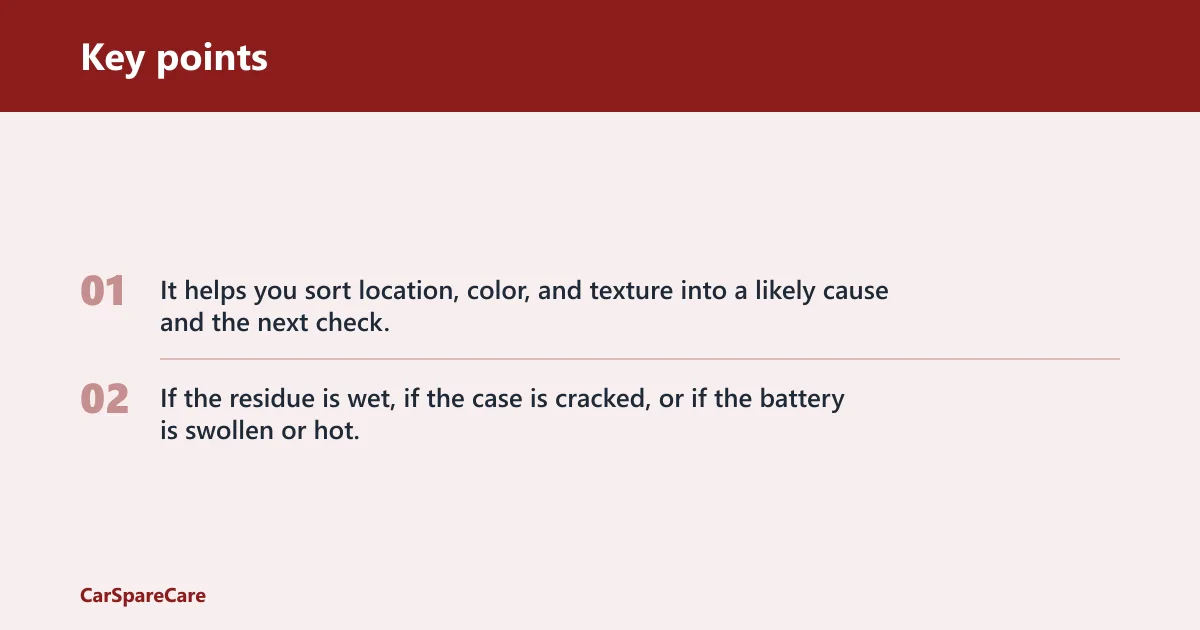
Use this matrix before you clean anything. It helps you sort location, color, and texture into a likely cause and the next check. If the residue is wet, if the case is cracked, or if the battery is swollen or hot, treat the issue as more serious than ordinary terminal buildup.
| Corrosion location | Color | Texture | Likely cause | Quick check | Next action |
|---|---|---|---|---|---|
| Positive terminal | White, blue-green, or brown | Dry crust or powder | Vented electrolyte, loose clamp, or cable-end damage | Check clamp fit and inspect the cable end for pitting or swelling | Clean and retest; if it returns, inspect charging voltage and battery condition |
| Negative terminal | White or blue-green | Dry crust around the post or clamp | Loose ground connection, contamination, or vapor exposure | Check the ground cable and body connection for looseness | Tighten or repair the connection, then test starting and charging |
| Both terminals | White, blue-green, or brown | Powder on both posts and clamps | General venting, contamination, or repeated moisture exposure | Inspect the top of the battery for dampness, stains, or seepage | Check the battery case, venting, and charging system before another cleaning |
| Cable end | Green, white, or dark crust under the clamp | Pitted, swollen, or hidden buildup | Corrosion creeping into the cable end or clamp damage | Remove the clamp and inspect the metal under it | Repair or replace the cable or terminal end if the metal is damaged |
| Wet residue | Clear, oily, or damp staining with crust | Sticky or active-looking residue | Leak, seepage, or active venting | Inspect the case seams and vent area for cracks or stains | Stop and replace the battery if the case is cracked or leaking |
| Dry powder | White or blue-green | Loose, dusty, dry buildup | Older residue from venting, moisture, or a loose connection | Check for repeat buildup after cleaning and tightening | Confirm charging voltage and inspect cable fit, battery age, and tray condition |
| Stop driving / replace now | Any color | Wet, swollen, hot, cracked, or actively leaking | Battery failure, case damage, or unsafe leakage | Look for heat, odor, swelling, or acid on nearby parts | Do not keep driving until the battery is replaced and the area is cleaned safely |
Why it keeps coming back
Recurring corrosion usually means the root cause is still present. Low charge state, short-trip driving, acid stratification, sulfation, cable damage, or a charging-system fault can all make the problem return. Corrosion can return within weeks if the battery is still venting, not charging properly, or sitting in a damp, dirty connection area.
Low charge state and short-trip driving
A battery that rarely reaches full charge is more likely to develop stratification and sulfation. Short-trip driving is a common reason the battery never gets fully recharged. That leaves the electrolyte uneven and the plates less able to conduct current, which can make the battery seem weak even before it fails completely.
Acid stratification and sulfation
Acid stratification means the electrolyte becomes more concentrated at the bottom of the cell. It is often reported below about 80% state of charge and may promote corrosion and sulfation. Sulfation reduces conductivity and contributes to eventual battery failure. A battery can look charged but still crank poorly because the chemistry inside is not balanced.
Why CCA can drop even when the battery seems charged
CCA, or cold cranking amps, is a performance measure, and stratification can lower it. That matters because voltage alone may not reveal the loss. A battery may appear normal at rest, yet still struggle under load. If corrosion keeps returning and cranking gets slower, the battery may be nearing the end of its useful life. Batteries often last 3 to 5 years in normal conditions.
How do you prevent corrosion from returning?
Preventing return corrosion means fixing the cause, not only cleaning the posts. Clean the terminals, tighten the clamps, inspect the charging system, and check the battery case for seepage or cracks. If corrosion comes back soon after cleaning, look harder at the cable ends, venting, battery age, and the vehicle’s charging voltage.
Clean and tighten the connection correctly
The same source recommends cleaning corroded parts with a wire brush. After cleaning, make sure the clamp fits tightly and the cable end is sound. A loose connection raises resistance and heat, which can restart the corrosion cycle. When disconnecting or reconnecting the battery, follow the vehicle manual, and remove the negative side first and reconnect it last if your manual calls for that order.
Check the charging system
A good alternator output is stated as about 13.7 to 14.7 volts at the battery. If voltage is outside the manufacturer’s spec, corrosion may keep returning or the battery may never reach a healthy charge. If the battery is sealed or AGM, follow the vehicle and battery maker’s instructions rather than assuming it vents like a flooded battery.
Inspect venting, cable fit, and battery age
Look at the battery’s vent path, the top of the case, and the cable fit in the clamp. A battery with a damaged case, repeated seepage, or age-related weakness should not be treated as a cleaning-only problem. A common first-timer mistake is replacing the battery and skipping the cable or charging check, then seeing the same corrosion again.
- Turn the ignition off and let the battery cool if it has been under load.
- Inspect the posts, clamps, cable ends, and case for wet residue, cracks, or swelling.
- Clean the corrosion, then check whether the clamp grips firmly and evenly.
- Verify charging voltage against the vehicle maker’s spec.
- Replace damaged cables, a cracked battery, or a failing battery that keeps returning corroded.
Frequently asked questions
What causes car battery corrosion: it usually comes
It usually comes from vented electrolyte, hydrogen gassing during charging, moisture, dirt, or a bad connection at the post or clamp. Repeated buildup after cleaning means you should look for a charging fault, a cracked case, a loose clamp, or cable damage. Corrosion alone does not prove the battery is good or bad.
What causes car battery corrosion on positive terminal: positive-terminal corrosion often points
Positive-terminal corrosion often points to vapor release, seepage, or a loose or damaged connection at that post, but it does not always mean overcharging. Check the clamp fit, the cable end, and the battery case first. If the buildup is wet or keeps returning, inspect the charging system and venting next.
What causes car battery corrosion on negative terminal: negative-terminal corrosion can come
Negative-terminal corrosion can come from a loose ground connection, contamination, moisture, or vapor that reaches the clamp area. It is not safe to call it undercharging every time. A weak ground path can raise resistance and heat, which makes the corrosion problem worse and can cause slow cranking or intermittent starting.
What causes car battery acid to leak
Acid can leak from a cracked case, a damaged seal, or venting that lets electrolyte escape as vapor or wet residue. If you see damp stains near the top seam, the vent area, or both posts, treat that as more serious than dry crust alone. A leaking battery should be replaced, not just cleaned.
How do you prevent corrosion on a car battery?
Keep the posts and clamps clean, make sure the connection is tight, and fix any cable or battery case damage. Then verify that the charging system is in spec and that the battery is holding a proper charge. If corrosion returns quickly, look for venting, seepage, or a battery near the end of its life.
How does car battery corrosion happen?
It happens when acid vapor, moisture, and metal meet at the post or clamp. Hydrogen gassing during charging can drive vapors out, and loose connections can add heat and resistance. Over time, white, blue-green, or brown deposits form and may spread into the clamp or cable end if the cause is not corrected.

Hi, I’m Melvin, an automobile engineer with extensive experience in automobile equipment. I currently work for a local automobile firm, where I specialize in the car parts industry. I’ve had the opportunity to collaborate with seasoned inspectors, gaining invaluable hands-on experience that goes beyond just theory.
My passion for automotive care started at a young age, which led me to create CarSpareCare. Through CarSpareCare, I share the knowledge and skills I’ve acquired over the years to help others navigate the world of car maintenance and repairs.
My goal is to provide practical tutorials, essential safety advice, and the latest industry insights so that anyone—whether a beginner or an expert—can confidently tackle their automotive projects.