
Wash one panel at a time, keep soap and rinse water from drying on the paint, and dry each section immediately with a clean microfiber towel. If you let water or shampoo sit in hot sun, mineral spots and soap film can bond to the finish fast. This guide shows a panel-by-panel, low-scratch method for washing, rinsing, and drying a car in direct sunlight.
This guide is part of our Automotive paint care guide series.
Why sun makes spots faster
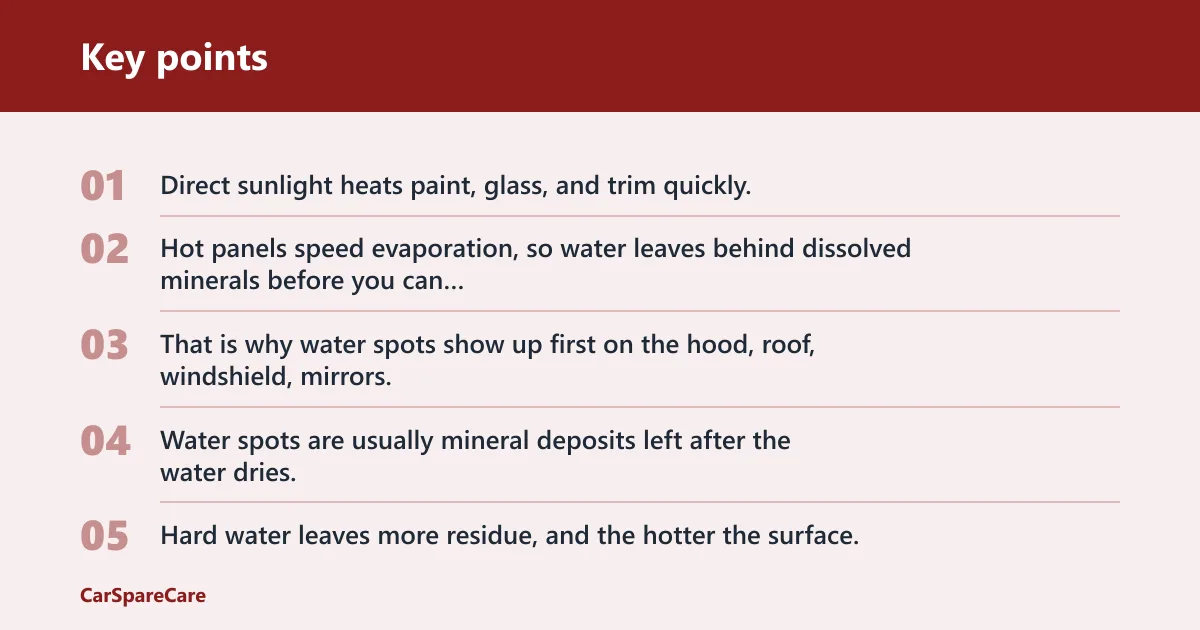


Direct sunlight heats paint, glass, and trim quickly. Hot panels speed evaporation, so water leaves behind dissolved minerals before you can wipe or rinse them away. That is why water spots show up first on the hood, roof, windshield, mirrors, and dark trim.
Water spots are usually mineral deposits left after the water dries. Hard water leaves more residue, and the hotter the surface, the faster that residue can set. Once deposits dry on a hot panel, removal is harder and may need polishing instead of a simple wash.
Black paint and dark glass are less forgiving because they reveal dried mineral residue faster. Trim can spot too, especially textured black plastic around mirrors, window frames, and wipers. If a panel is too hot to hold a bare hand on for more than a second or two, treat it as a high-risk surface.
Picture a black hood at midday with a light breeze. The rinse water beads, flashes off, and leaves white dots along the front edge before the rest of the car is even washed. The issue is not soap alone. It is heat, wind, and drying speed working together.
Best timing and shade options
The best time to wash in sun is the coolest part of the day, usually early morning or late evening, when panels are not baking under direct light. If you can move the car so one side stays shaded while you work, that buys you more time than full exposure. Light cloud cover helps too, because it slows panel heating.
Partial shade is enough to matter. A garage edge, open carport, building shadow, or even a tree line can let you wash one side while the other side rests. If the sun angle is low, you can sometimes keep working by moving around the car in the same direction the light is moving.
A common first-timer mistake is starting on the roof at noon and finishing with the hood. That order works against you. Start where heat is least severe, then move to panels that dry fastest or show spots most clearly.
When the conditions are still workable
Direct sun is still workable when panels are only warm, wind is light, and water is not especially hard. Keep each section small, dry it right away, and move quickly from wash to rinse to towel. If those three conditions stay under control, you can usually finish without spots.
When the sun is low and the body panels are only slightly warm, a careful panel-by-panel wash can still work well. When the hood, roof, or glass feel hot enough to dry water in seconds, switch to a faster method or stop and cool the car first.
Hot-sun wash checklist
| Step | Maximum dwell time | What to do | Decision rule |
|---|---|---|---|
| Pre-rinse one panel | 30 seconds | Wet the panel, then move on before the water starts flashing dry. | If it dries before the next step, re-rinse immediately. |
| Apply soap or rinseless solution | 60 seconds | Cover only a small section, such as half a hood or one door. | If suds start streaking or drying, stop and rinse now. |
| Wash with mitt | 45 seconds | Use light pressure and one panel only. | If the panel feels hotter than before, shorten the section. |
| Final rinse | 30 seconds | Rinse top to bottom so dirty water does not run over clean areas. | If wind is pushing droplets around, dry the panel at once. |
| Dry the panel | 90 seconds | Blot first, then a light wipe if needed. | If spots begin forming during drying, stop and switch to smaller sections. |
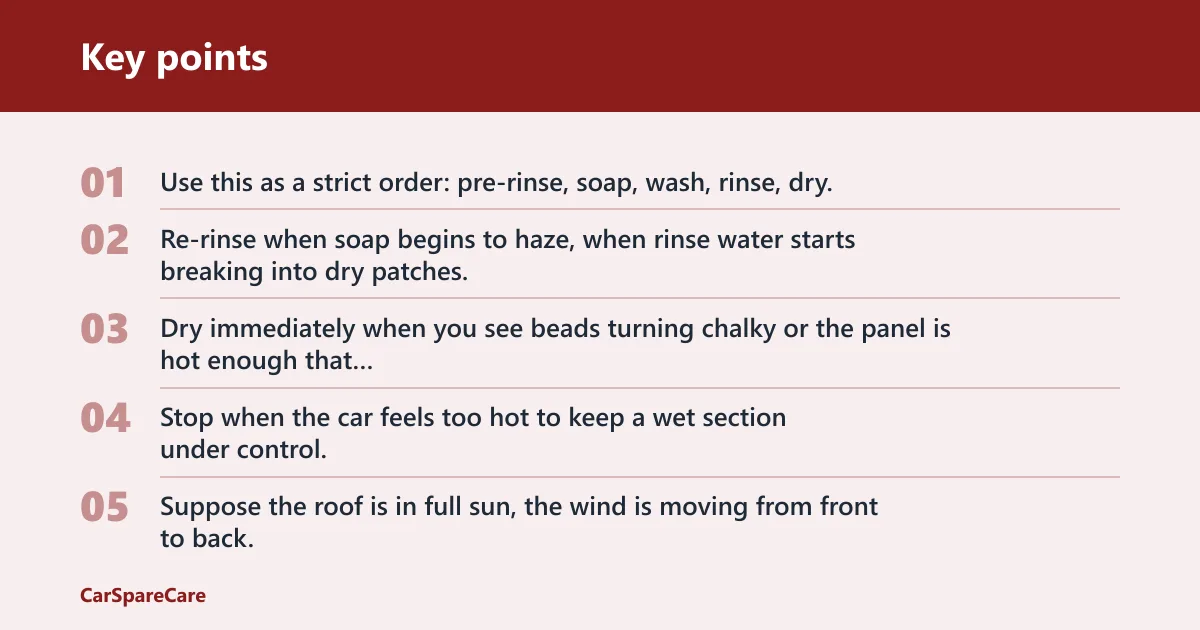
Use this as a strict order: pre-rinse, soap, wash, rinse, dry. Do not stack two wet panels before drying. On hot paint, that is how spots start.
Decision table for hot panels
| Panel temperature | Wind | Water hardness | Exact action |
|---|---|---|---|
| Warm, not hot | Calm | Soft to moderate | Wash one section at a time and dry immediately. |
| Warm, not hot | Light breeze | Moderate to hard | Reduce section size and dry immediately after each rinse. |
| Hot to the touch | Calm | Soft water | Re-rinse as soon as water starts flashing off, then dry immediately. |
| Hot to the touch | Light to steady breeze | Moderate water hardness | Reduce section size and switch to rinseless on the hottest panels. |
| Very hot, drying in seconds | Any wind | Hard water | Stop traditional washing and switch to rinseless, or stop until the car cools. |
| Too hot to keep wet | Any wind | Any hardness | Stop and wait for shade or cooler conditions. |
When to re-rinse, dry immediately, or stop
Re-rinse when soap begins to haze, when rinse water starts breaking into dry patches, or when the panel is still visibly wet but the edges are already drying. Dry immediately when you see beads turning chalky or the panel is hot enough that droplets disappear fast. Stop when the car feels too hot to keep a wet section under control.
Suppose the roof is in full sun, the wind is moving from front to back, and the water supply is hard. That is a bad combination. Shorten the working area to a quarter panel, or stop and wait for cooler conditions. If the same roof is only warm and the air is calm, the panel-by-panel method is usually workable.
Can you wash in direct sun?
Yes, but only if you control panel size, dwell time, and drying speed. Direct sun is workable when the paint is merely warm, the wind is light, and you can dry each section before water dries on its own. It becomes risky fast on hot panels, especially with hard water or dark paint.
Hard water changes the answer quickly. The harder the water, the less time you have before mineral deposits are left behind. Dark paint and black trim also narrow the margin because spotting is easier to see and more annoying to correct.
If the hood or roof is too hot to keep wet, switch methods mid-wash. Move to the shaded side, wash only the cool panels, or use a rinseless wash on the hottest sections. A clean finish matters more than finishing the whole car in one pass.
Signs you should stop or change methods
- Water dries before you can wipe the section.
- Suds leave a faint film after rinsing.
- The panel feels hotter after each pass.
- Wind pushes droplets across clean paint.
- White residue appears on black paint, glass, or trim.
Panel-by-panel wash method
Work one small section at a time so soap and rinse water never sit long enough to spot. A microfiber wash mitt is the right tool because its fibers hold grit away from the paint better than a bare sponge. Rinse the mitt often so it does not drag contamination across hot panels.
Start with the roof, then the glass, then the upper body panels, and finish with the lower panels and wheels. That order keeps dirt from running onto areas you already cleaned. Keep the section size small: one door, half a hood, or one quarter of the roof.
- Rinse the first section.
- Apply soap or rinseless solution to that section only.
- Wash gently with the microfiber mitt.
- Rinse immediately.
- Dry before moving to the next section.
- Rinse the mitt in clean water before the next panel.
The mitt should be rinsed as soon as it picks up visible dirt or after every panel, whichever comes first. In direct sun, that frequency matters because grit plus heat can leave faint drag marks if you keep working too long without cleaning the mitt.
Keep a separate pass for lower panels if possible. Road film is heavier there, so mixing lower-panel grime into upper-panel wash water raises the scratch risk. A clean mitt and a short working cycle are safer than trying to save time.
Dry fast without scratching
A waffle-weave or plush microfiber drying towel works best because it absorbs water fast and helps prevent new spots before the panel dries on its own. On hot paint, blotting is safer than hard wiping. Press the towel onto the panel, lift, and move on before water can leave mineral residue.
Use a second towel for glass if needed. Glass shows spots quickly, and a towel that is already damp can smear residue instead of lifting it. Trim also benefits from a light blot, especially around mirror housings and window seals.
Dry one section at a time. Do not wait for the whole car to be rinsed. The fastest way to prevent water spots is to turn rinse water into dry paint as soon as possible.
Drying aids and quick detailers
A drying aid or quick detailer can add slickness and give you a little more margin on hot panels. Spray a light coat onto the wet section, then dry with the towel using short passes. That can help reduce drag and improve the final wipe on paint, glass, and trim.
Use it as a finishing aid, not a cure for poor timing. If the panel is already drying in the sun, a quick detailer may help the towel glide, but it will not fix mineral spots that have already started to set.
Spot control tools and fallback methods
A hose nozzle with a shutoff and adjustable spray pattern gives better rinse control than an open hose. It lets you stop flow between panels and use a fan spray for rinsing instead of blasting water everywhere. That saves water and makes the wash easier to manage in bright sun.
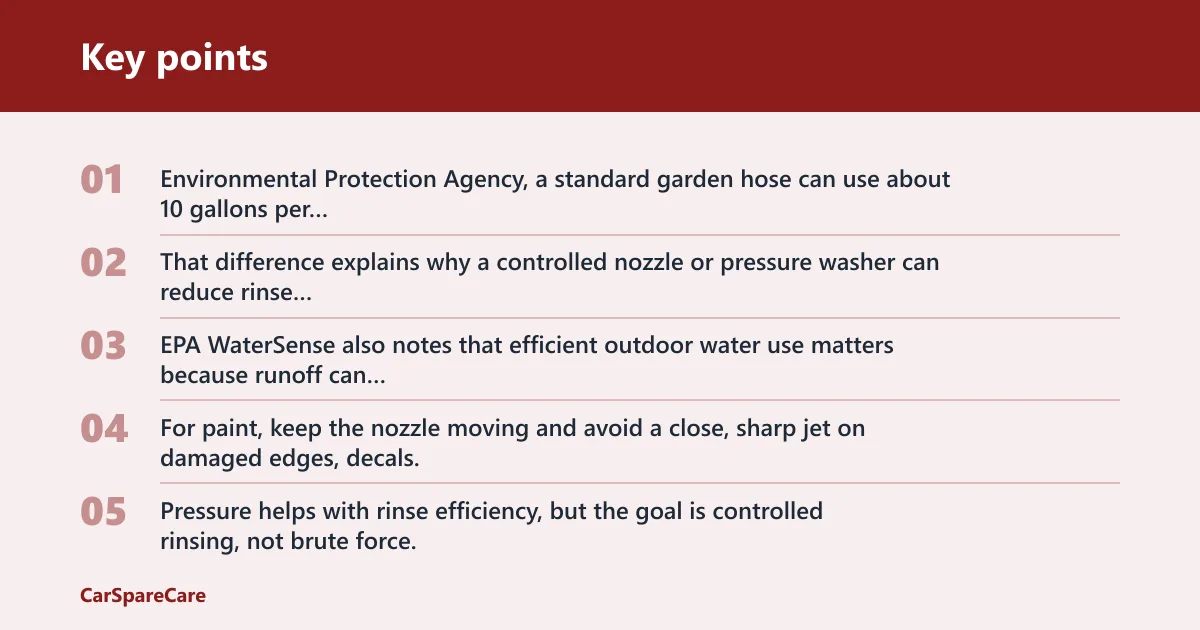
According to the U.S. Environmental Protection Agency, a standard garden hose can use about 10 gallons per minute, and a pressure washer can use about 2 gallons per minute depending on the model and nozzle setup. That difference explains why a controlled nozzle or pressure washer can reduce rinse water use when handled properly. EPA WaterSense also notes that efficient outdoor water use matters because runoff can carry pollutants into storm drains and waterways.
Use safe pressure only. For paint, keep the nozzle moving and avoid a close, sharp jet on damaged edges, decals, or loose trim. Pressure helps with rinse efficiency, but the goal is controlled rinsing, not brute force.
Commercial carwashes are a different setup. In-bay automatic carwashes are one of three basic carwash types. In the cited study, in-bay automatics used 17 to 69 gallons of fresh water per vehicle, with one outlier averaging 111.5 gallons. Conveyor systems used 19 to 45 gallons per vehicle, and the authors said up to 60 gallons would not be unreasonable. Self-serve stations used 12 to 18 gallons per vehicle.
Commercial systems can also recycle water. The cited range was 10 percent to 80 percent. Industry and environmental guidance also emphasize managing wash water so it does not enter storm drains untreated; collected runoff is typically sent to sanitary treatment systems or handled under local wastewater rules rather than released to the street. Driveway runoff can flow into storm gutters and then into rivers, streams, or bays, carrying oil, grease, heavy metals, and other pollutants.
When sunlight is intense and the car is already hot, a rinseless wash is often the better fallback. It uses very little water, works panel by panel, and gives strong lubrication when used correctly. Spray or wipe the solution on one section, clean with a microfiber towel, then dry with a second towel right away. It is especially useful when a traditional rinse would keep leaving spots.
| Method | Spotting risk in direct sun | Speed | Best-use conditions |
|---|---|---|---|
| Traditional wash | Moderate to high if panels are hot | Moderate | Cool panels, light wind, soft water, plenty of shade control |
| Rinseless wash | Lower when sections are kept small | Fast for hot panels | Hot paint, limited water, moderate soil, quick towel drying |
| Pressure washer | Lower for rinsing, not a cure for drying spots | Fastest rinse step | Controlled rinse, hose conservation, careful nozzle use on paint |
What should you use to prevent water spots after washing? A clean drying towel, fast section-by-section work, and a drying aid on hot paint. If the water is hard, the answer is also shorter dwell time. The less time minerals have to sit on the finish, the less likely they are to stay behind.
Frequently asked questions
How to get sun spots off car
Fresh water spots often come off with a gentle wash, drying aid, and a careful wipe if they have not bonded yet. If the marks have already etched into the finish, washing will not remove them. At that stage, paint-safe spot remover or polishing may be needed, especially on black paint and glass.
How do you wash a car in direct sunlight without spots?
Use a panel-by-panel method and keep every wet step short. Rinse one section, wash it, rinse again, then dry it immediately. If the paint is very hot or the wind is drying the panel too fast, switch to a rinseless wash or stop until the car cools. Direct sun is manageable only when you control timing.
What is the best time to wash a car in the sun?
Early morning or late evening is best because the panels are cooler and water dries more slowly. Light cloud cover or partial shade can also help. If you have to wash in full sun, work on the shaded side first, then move as the sun shifts, and keep each section small enough to dry right away.
How do you dry a car fast enough to avoid spots?
Dry immediately after each rinse with a clean microfiber or waffle-weave towel. Blot hot panels instead of scrubbing them. If the towel starts leaving streaks, swap to a drier one. A light drying aid can improve slickness and help the towel pick up water faster on paint, glass, and trim.
Is rinseless wash better for washing in sunlight?
Often, yes, when the panels are hot or the water is hard. A rinseless wash reduces the amount of free water sitting on the car, which lowers spotting risk. It is not magic, though. You still need clean towels, small sections, and immediate drying to keep hot-sun spots from forming.

Hi, I’m Melvin, an automobile engineer with extensive experience in automobile equipment. I currently work for a local automobile firm, where I specialize in the car parts industry. I’ve had the opportunity to collaborate with seasoned inspectors, gaining invaluable hands-on experience that goes beyond just theory.
My passion for automotive care started at a young age, which led me to create CarSpareCare. Through CarSpareCare, I share the knowledge and skills I’ve acquired over the years to help others navigate the world of car maintenance and repairs.
My goal is to provide practical tutorials, essential safety advice, and the latest industry insights so that anyone—whether a beginner or an expert—can confidently tackle their automotive projects.

