

Wash matte paint with a pH-neutral shampoo, plush microfiber mitts, and no wax, polish, or abrasive cleaner; protect it only with a matte-approved sealant or wrap-safe spray, and avoid anything that adds gloss. Glossy products, or grit dragged across the surface, can leave shiny marks that do not wash out. This guide covers safe washing, drying, stain removal, and the least risky protection choices for factory matte paint, matte wraps, and satin finishes.
Why matte paint needs different care
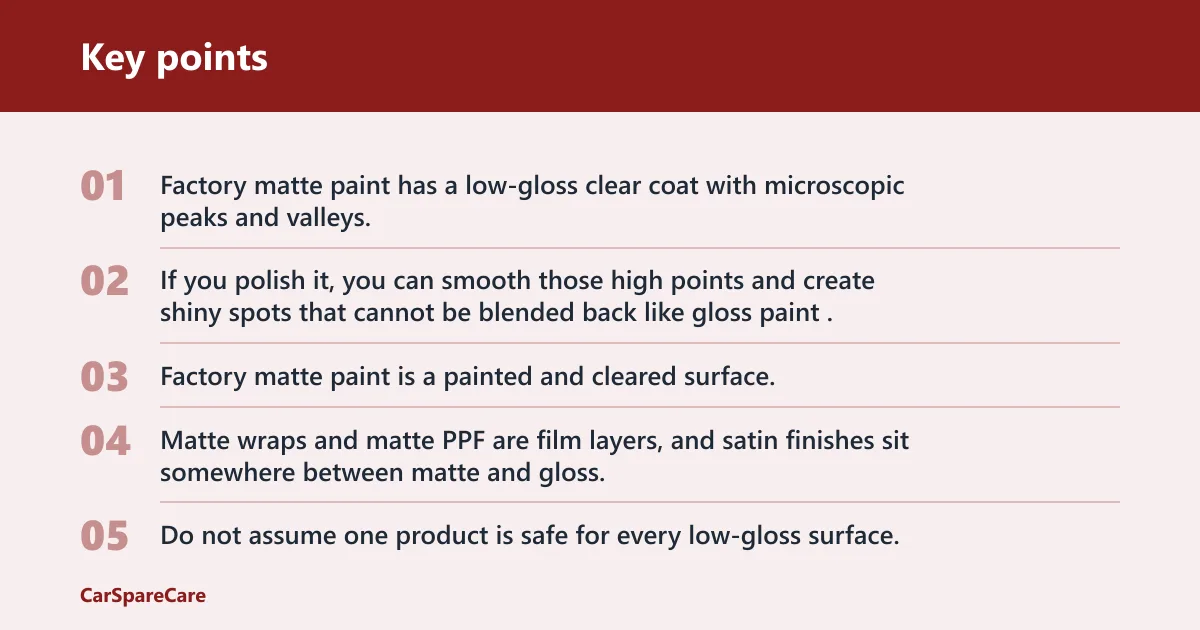


Factory matte paint has a low-gloss clear coat with microscopic peaks and valleys. Those peaks and valleys scatter light, which is why the surface looks flat rather than reflective. If you polish it, you can smooth those high points and create shiny spots that cannot be blended back like gloss paint.
That risk is the first reason to treat matte paint differently from gloss paint. It also explains why the finish shows contamination so quickly. Bird droppings, bug splatter, tree sap, road salt, and water spots stand out fast on matte surfaces, and heat can make the damage harder to clean later.
Factory matte paint, matte wraps, and satin finishes are not identical
Factory matte paint is a painted and cleared surface. Matte wraps and matte PPF are film layers, and satin finishes sit somewhere between matte and gloss. The same safe-wash habits overlap, but the do-not-use list is not identical, especially for chemical strength and stain removal.
That difference matters when a stain has already set. A wrap-safe cleaner may be fine for film, while a factory matte clear coat may need a more careful spot treatment or, in damaged cases, a shop evaluation. Do not assume one product is safe for every low-gloss surface.
Why contamination becomes visible so fast
Matte paint does not hide residue well. On a low-gloss surface, a thin mineral film, a dried bug spot, or a salt haze can look worse than on glossy paint because the finish does not reflect evenly. Timing matters as much as product choice.
Picture a hood that picked up bug splatter on a very hot day. If you leave it until the end of the week, the residue can bond more tightly and leave a permanent mark. Quick, gentle cleaning is safer than waiting for a stronger cleaner later.
How do you wash matte paint safely?
Wash matte paint with a lubricated, non-abrasive process using pH-neutral shampoo, a plush microfiber wash mitt, and two buckets with grit guards. Use straight passes, not circles, and rinse each panel right after you wash it. Dry immediately with a microfiber drying towel or an air blower.
- Rinse loose dirt first. Flush dust, road film, and grit off the panel before touching the surface. A strong rinse lowers the chance that a wash mitt drags particles across the clear coat.
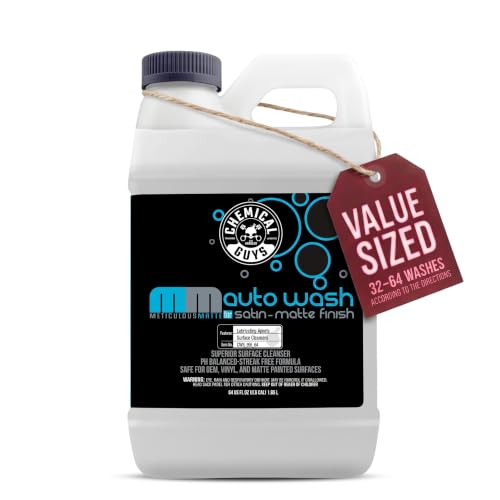
- Mix matte-safe shampoo. Use a pH-neutral car shampoo made for matte or satin finishes, with no wax additives and no gloss enhancers. Follow the label dilution exactly so the wash has enough lubrication without leaving residue.
- Wash with two buckets. Fill one bucket with shampoo and water, and the other with plain rinse water; fit both with grit guards. The wash bucket carries clean suds to the panel, while the rinse bucket releases trapped grit before the mitt goes back in.
- Glide a microfiber mitt. Use a plush microfiber wash mitt, not a sponge or stiff brush. Keep the mitt wet and lightly loaded with shampoo so it slides rather than scrubs.
- Rinse each section immediately. Wash one panel or part at a time, then rinse it right away. This matters on matte paint because dried soap, mineral film, and loosened grime are more visible if they sit on the finish.
- Dry without rubbing. Blot with microfiber drying towels or blow water away with an air blower. Do not press hard or chase droplets with dry pressure, because repeated rubbing can leave marring or visible spots.
A common first-timer mistake is to wash a matte hood last after the water has already dried on the fender and doors. In hot weather, that delay can leave rings or spots that are much harder to remove than fresh runoff.
What products are safe for matte paint?
Safe products for matte car paint are limited to matte-safe, non-glossing cleaners and protection products made for low-gloss surfaces. Start with a pH-neutral shampoo, a plush microfiber mitt, microfiber drying towels, and, if needed, a matte-specific ceramic coating or matte-safe spray sealant approved for the finish.
Safe wash and dry products
Choose a pH-neutral car shampoo that states it is safe for matte or satin finishes and does not contain wax or gloss enhancers. Use a microfiber wash mitt with long fibers, plus dedicated microfiber drying towels. An air blower helps move water out of seams without touching the panel.
Safe water-spot control
Drying fast matters more on matte paint because water spots are easier to see and harder to correct. A clean microfiber towel and a blower are safer than aggressive drying aid products. If your water is hard, washing in shade and drying panel by panel reduces spotting.
Matte paint maintenance decision table
This table helps you decide when washing is enough, when spot cleaning is still safe, and when you should step up to matte ceramic coating or stealth PPF. If the finish has already etched, your options narrow fast.
| Contamination or event | Immediate action | Safe cleaner or tool | Do-not-use list | Escalate to matte ceramic coating or stealth PPF? |
|---|---|---|---|---|
| Light dust, fingerprints, fresh water spots | Rinse, wash gently, and dry right away | pH-neutral matte shampoo, plush microfiber mitt, microfiber drying towel, air blower | Wax, polish, spray wax, abrasive towels, Magic Eraser | No for cleaning alone; consider coating if you want less frequent washing |
| Bird droppings, bug splatter, tree sap | Remove as soon as the panel is cool | Soaked microfiber towel, matte-safe shampoo, gentle rinse | Polish, WD-40, dish soap, scrubbing pads, gloss detailers | Yes if the car sees frequent parking under trees or heavy bug exposure |
| Road salt, winter grime, slush film | Rinse thoroughly, then wash the same day | Two-bucket wash method, grit guards, matte-safe shampoo, blower or drying towel | Automatic brush washes, stiff brushes, wax-based wash products | Yes, especially for daily drivers in salted climates |
| Industrial fallout, brake dust haze, rail dust | Stop if the panel feels gritty; use only matte-safe decontamination approved for low-gloss finishes | Matte-safe cleaner, soft mitt, careful rinse; consult a pro if bonded contamination remains | Clay bars without matte approval, compound, polish, harsh solvents | Yes for coating; PPF is better if the vehicle faces repeated fallout or highway debris |
| Rock chips, repeated scuffs, high-impact wear | Wash carefully and inspect the damaged area | Soft wash tools only; then ask for film options that preserve the finish | Polishing the chip, touch-up that alters sheen, abrasive correction | Yes, stealth PPF or matte PPF is the stronger protection choice |
How do you protect matte paint long term?
Long-term protection for matte paint starts with limiting contamination bonding, not with making the finish shinier. A matte-specific ceramic coating can help by adding hydrophobic and chemical resistance without adding gloss when the product is made for matte finishes. Stealth PPF or matte PPF adds a physical barrier for chips and scuffs.
Choose coating or film based on your climate
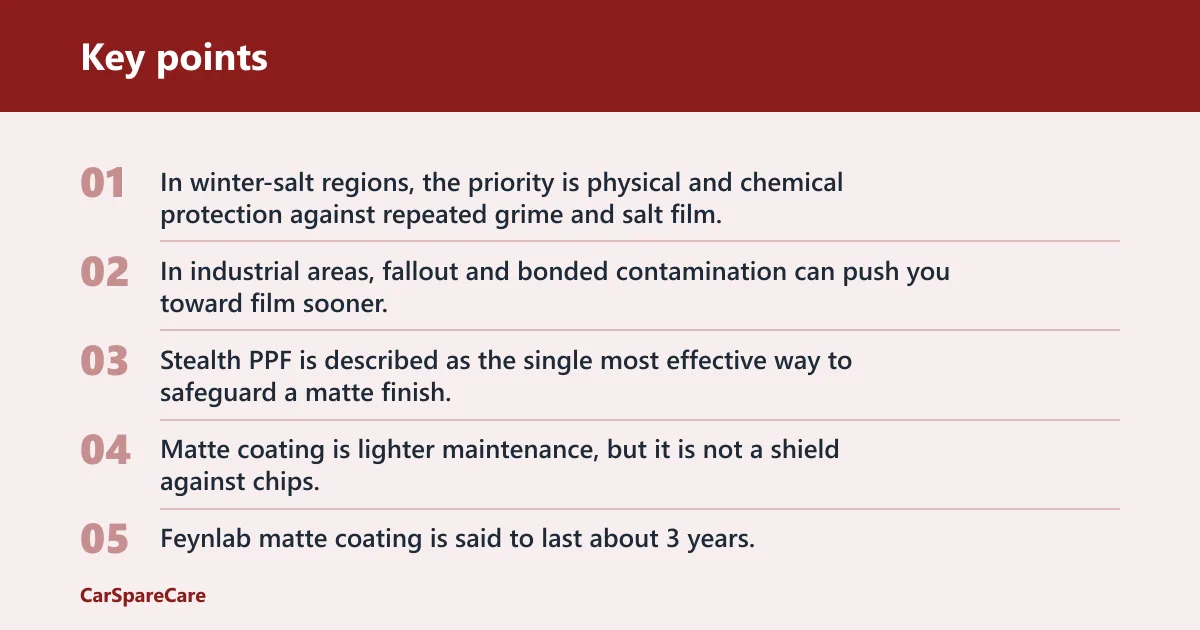
In hot, sunny areas, shade and frequent cleaning matter because sunlight can fade car paint, and heat bakes residue faster. In winter-salt regions, the priority is physical and chemical protection against repeated grime and salt film. In industrial areas, fallout and bonded contamination can push you toward film sooner.
Stealth PPF is described as the single most effective way to safeguard a matte finish. The installed matte PPF mentioned is roughly 6 mil thick and comes with a 10-year warranty, which reflects its role as a barrier rather than a beauty product. Matte coating is lighter maintenance, but it is not a shield against chips.
Feynlab matte coating is said to last about 3 years. That makes it useful when you want easier washing and less contamination bonding, but it still needs regular care and cannot stop rock damage the way film can.
When protection should step up
Step up from simple washing when contamination keeps coming back, when the car is parked under trees, when winter salt is common, or when highway use throws repeated debris at the front end. If the paint already shows etched staining, protection choices should be judged by what will prevent more damage, not by what can “fix” the old mark.
Suppose a commuter parks outside under a tree and gets sap every week. In that case, matte coating may reduce bonding and make cleanup faster, but a front-end matte PPF film can be the better choice if the hood also gets chips from daily highway driving.
What should you avoid on matte paint?
Do not use wax or polish on matte paint. Do not use glossy sprays, abrasive cleaners, or tools that can burnish the surface. Normal wax or polish should never be used on matte paint because polished matte paint becomes shiny permanently.
Products and methods that can damage the finish
- Wax and polish
- Magic Eraser
- WD-40
- Dish soap
- Automatic brush washes
- Gloss-enhancing quick detailers or spray waxes
- Stiff scrub tools, hard sponges, and abrasive pads
These products fail for different reasons. Some add shine, some strip lubrication, and some create surface wear that becomes visible immediately on a low-gloss finish. On factory matte paint, that mistake can be permanent.
Spot cleaners and quick sprays need caution
Do not assume a product labeled “detailer” is safe. If the label promises gloss, slickness, or shine, keep it off matte paint. Even a small trial on a hood edge can leave a different sheen that stands out in daylight.
Frequently asked questions
How do I care for matte car paint?
Care for matte car paint by washing it with a pH-neutral shampoo, a plush microfiber mitt, and the two-bucket method. Dry it immediately with a microfiber towel or air blower. Skip wax, polish, and glossy cleaners because they can change the finish and create permanent shiny spots.
How do I maintain matte car paint?
Maintain matte car paint by cleaning it often enough that grime does not bond, then protecting it with a matte-specific coating or a matte-safe film if the car faces harsh use. In salt, sun, or fallout-heavy areas, maintenance is less about deep correction and more about preventing stains.
How do I wash a matte finish car?
Wash a matte finish car in shade if possible, rinse first, use matte-safe shampoo, and glide a microfiber mitt in straight passes. Rinse each section right after washing it, then dry without rubbing. The goal is to remove dirt without polishing the surface by accident.
How do I clean a matte finish car?
Clean a matte finish car with the least aggressive method that removes the contamination. Light dust, fingerprints, and fresh water spots usually need only a careful wash and dry. Bird droppings, sap, and road salt need faster attention because they bond and stain more easily.
How do I protect matte paint on a car?
Protect matte paint on a car with a matte-specific ceramic coating if you want easier cleaning, or with stealth PPF or matte PPF if you want real impact protection. Choose based on climate and use. Coating helps with contamination; film helps with chips and scuffs.
Can I use wax or polish on matte paint?
No. Wax and polish should not be used on matte paint because they can add shine and permanently change the look of the finish. Once a matte panel is polished glossy, it usually cannot be blended back to the original low-gloss appearance.
How often should I wash matte car paint?
Wash matte car paint about every two weeks, and sooner if it gets bird droppings, bug splatter, road salt, or sap. Washing sooner is safer than waiting because long exposure makes stains harder to remove and raises the risk of etched marks that cannot be corrected easily.

Hi, I’m Melvin, an automobile engineer with extensive experience in automobile equipment. I currently work for a local automobile firm, where I specialize in the car parts industry. I’ve had the opportunity to collaborate with seasoned inspectors, gaining invaluable hands-on experience that goes beyond just theory.
My passion for automotive care started at a young age, which led me to create CarSpareCare. Through CarSpareCare, I share the knowledge and skills I’ve acquired over the years to help others navigate the world of car maintenance and repairs.
My goal is to provide practical tutorials, essential safety advice, and the latest industry insights so that anyone—whether a beginner or an expert—can confidently tackle their automotive projects.

