
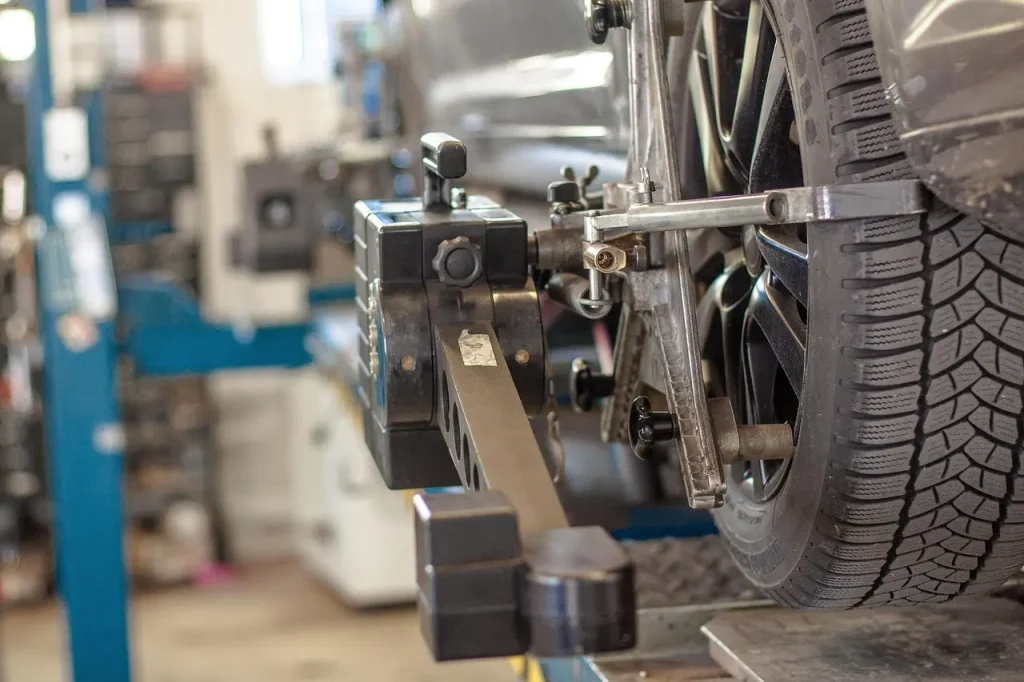
At highway speed, loose steering usually comes from alignment drift or tire instability first; if the wheel has more than about 1 inch of free play before the tires respond, mechanical wear is a likely cause. Ignore it and the car can wander, dart, or wear tires fast. This guide shows how to separate tire, alignment, and steering or suspension play in a quick triage path.
Highway looseness diagnostic matrix


This table separates the symptom you feel from the system most likely at fault. Start with the pattern, then check the first item in that row before moving deeper. That keeps you from replacing parts that are not the real problem.
| Symptom pattern | Most likely subsystem | First inspection step |
|---|---|---|
| On-center dead spot | Steering rack, rack mounting bushings, inner tie rods, or steering linkage | With the engine off, rock the wheel through the first 1 inch of movement and watch for delay at the tires. |
| Lane wander | Wheel alignment, especially toe and caster; also tire pressure or tire mismatch | Check front tire pressure and compare left-to-right values, then inspect tread wear and size match. |
| Speed-dependent looseness | Alignment drift, tire instability, wheel bearings, or suspension play that shows up under load | Inspect tires for uneven wear, belt separation, and loose wheel bearings before deeper steering checks. |
What causes steering to feel loose at highway speed?
Loose-feeling steering at speed usually comes from one of three places: the tires are not tracking cleanly, the alignment lets the car drift, or a worn part adds free play in the steering path. The symptom matters, because on-center dead spot, wander, and darting point to different checks.
On-center dead spot
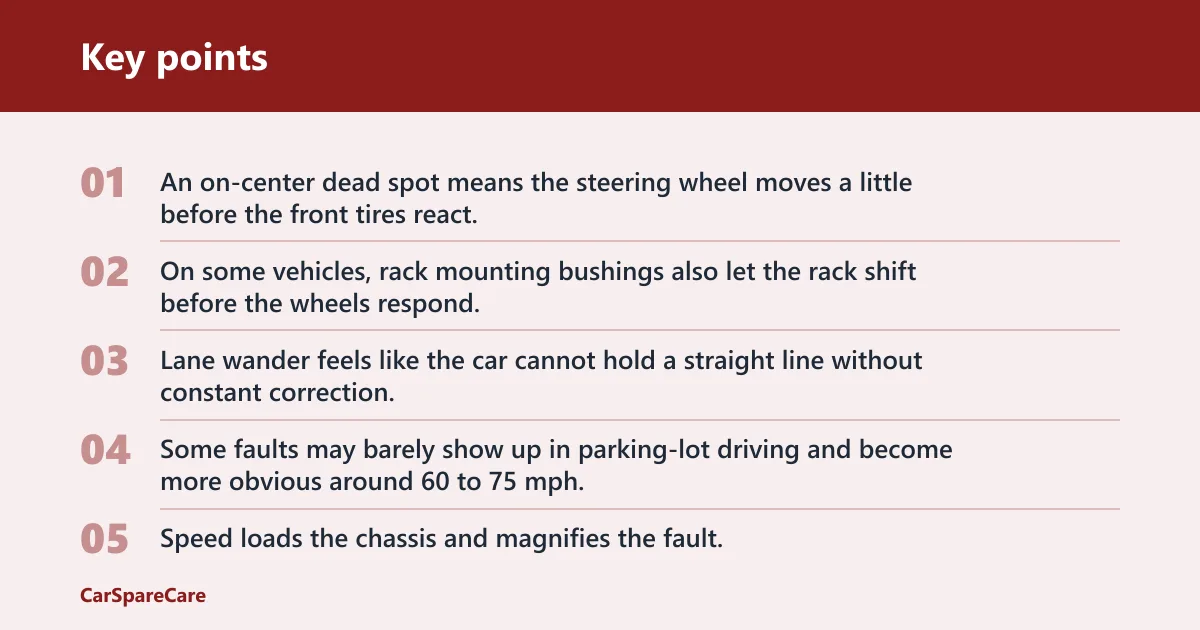
An on-center dead spot means the steering wheel moves a little before the front tires react. That points toward play in the steering gear, inner or outer tie rods, or steering linkage. On some vehicles, rack mounting bushings also let the rack shift before the wheels respond.
Lane wander
Lane wander feels like the car cannot hold a straight line without constant correction. Alignment is high on the list here, especially toe and caster, but tire pressure mismatch or uneven tire wear can make the same car feel unstable even when the steering parts are tight.
Speed-dependent looseness
Some faults may barely show up in parking-lot driving and become more obvious around 60 to 75 mph. That usually means a part moves under load, such as a control arm bushing, ball joint, wheel bearing, or a tire with internal damage. Speed loads the chassis and magnifies the fault.
What loose steering feels like at speed
Loose steering can mean a dead spot, a wandering lane position, a pull to one side, or a darting correction after small road inputs. Those are not the same symptom. A vibration in the wheel can come from tires or bearings, while actual play shows up as delay before the front wheels answer.
A common first-timer mistake is to call every highway correction “loose steering.” Say your car drifts left on a crowned road, but the wheel has no free play and the tires are matched. That points more toward alignment or road camber than a worn steering rack.
Pull versus darting
A pull is a steady drift to one side. Darting is a quick change in direction after a groove, bump, or lane seam. Pull often traces back to alignment, tire pressure, or a tire fault on one side. Darting can point to caster imbalance, a separated tire belt, or a loose steering component.
Vibration versus play
Wheel shake is not the same as looseness. Vibration often comes from tire balance, bent wheels, separated belts, or wheel bearings. Play means the steering wheel or front suspension moves before the tires do. If there is both shake and play, inspect for a mechanical fault before assuming balance alone.
What should you inspect first?
Check front tire pressure and tire condition before any deeper steering check. That is the fastest way to rule out the most common highway-stability faults without a lift. If the car still feels vague after that, move to tie rods, ball joints, bushings, and the steering rack.
Check front tire pressure. Use the door-jamb specification, not the sidewall maximum. Compare the left and right front tires; a mismatch of even a few psi can change straight-line tracking and make the car feel nervous at speed.
Inspect tire condition. Look for uneven wear, cupping, sidewall damage, and tread that looks newer on one axle than the other. Uneven wear can make the steering feel vague, and a separated belt can cause a sudden dart or wobble.
Confirm tire match. Check size, model, and tread pattern on the front pair. A mismatched tire or a large tread-depth difference can change how each side grips the road, which can feel like loose steering at highway speed.
Road-test the symptom. Note whether the car wanders, pulls, or has a dead spot on center. That description tells you whether to focus on alignment, tire instability, or mechanical play in the steering path.
Suppose the front left tire is 6 psi low and the car drifts left on the interstate. If the wheel still has firm on-center response after inflation, that points toward tire pressure or alignment rather than a worn steering rack. Change one thing at a time so you can separate the fault.
Uneven wear and belt separation
Uneven wear matters because the tire itself can steer the car. Feathered edges can make the wheel feel busy. A separated belt is different; it can create a thump, sway, or a sudden change in direction, and it should be treated as a tire safety issue rather than an alignment issue.
Mismatched sizes or tread patterns
Two front tires that differ in size, construction, or tread depth can follow the road differently. That is especially noticeable at highway speed, where small differences in grip become constant corrections. If the car recently received one new tire, compare its size code and tread pattern to the other side.
Tie rods and steering linkage wear
Tie rod ends control toe at the wheels, so wear here often feels like wander or a loose on-center area. Inner tie rods can create hidden slop inside the rack end, while outer tie rods more often show play right at the wheel end. Some vehicles also use an idler arm and center link.
Inner versus outer tie rods
Outer tie rod wear usually shows up as visible play at the steering knuckle. Inner tie rod wear can hide behind the boot and still let the wheel move slightly before the tire changes angle. Both can cause highway looseness because toe control is the job they perform.
Idler arm and center link
Not every vehicle uses rack-and-pinion steering. On systems with an idler arm and center link, joint wear can add free play through the whole steering path. That extra movement can feel worse at speed because the steering wheel correction has to pass through more worn joints.
How linkage play shows up at the wheel
Linkage wear often feels like a soft delay when the wheel crosses center. The steering may not feel heavy, just vague. If the steering wheel moves about an inch or more without a matching tire response, the linkage or rack should be inspected closely.
Raise the front wheels. Support the vehicle safely and keep the front tires clear of the ground. That unloads the steering and suspension enough to reveal play that road load can hide.
Rock each wheel. Grip the tire at the 3 and 9 o’clock positions and move it in and out. Any clunk or visible shift can point to tie rods or steering linkage wear, depending on the vehicle layout.
Watch the tie rod ends. Have a helper move the wheel while you look at the inner and outer ends. Movement at the joint, not just tire deflection, is the sign that the part is worn.
Can worn ball joints or control arm bushings cause wandering?
Yes. Ball joints and control arm bushings can cause wander because they let the wheel move under load instead of staying in one place. Ball joints support steering and suspension movement, while control arm bushings control where the wheel sits as the car accelerates, brakes, and changes lanes.
Ball joint play under load
Ball joints are load-bearing suspension joints. When they wear, the wheel can move vertically or horizontally in a way that changes steering feel and can add clunks over bumps. At highway speed, that movement can make the car feel light or hard to place in a lane.
Control arm bushing movement
Control arm bushings can be rubber or hydraulic. When they wear, the control arm shifts under braking, cornering, or wind load, which changes wheel location and caster effect. The result is often instability rather than a pure steering-wheel dead spot.
Picture a front-wheel-drive sedan that tracks straight at 25 mph but wanders every time it reaches 70 mph on a crowned road. If the control arm bushings are cracked and the ball joint has measurable play, the wheel can move enough under load to make the steering feel loose even if the rack is fine.
How alignment changes highway stability
Alignment can make a car wander even when no part is visibly loose. Toe controls straight-line tracking, while caster controls self-centering and highway stability. If the alignment is off after suspension work, the steering may feel vague even though the wheel itself has little free play.
Toe and straight-line tracking
Toe is the angle that tells the tires whether to point slightly inward or outward. Too much toe-in or toe-out can make the car hunt from side to side. Even a small toe error can make the steering wheel feel busy at highway speed.
Caster and self-centering
Caster angle helps the steering return to center after a turn. More positive caster usually improves straight-line stability and on-center feel. If caster is low on both sides, the car may feel light and need constant correction.
Cross-caster imbalance
Cross-caster means one side has a different caster angle than the other. That can make the car pull and can also change how stable it feels while cruising. The driver may keep correcting because the steering does not self-center evenly left to right.
When alignment is the main issue
If the steering is tight with no clunking or visible play, but the car wanders or pulls after suspension work, alignment is a strong suspect. That is especially true if tire wear is even and the symptom began right after a tie rod, strut, or control arm repair.
How do you tell if the steering rack is worn?
A worn steering rack often shows up as on-center free play, uneven response side to side, or a dead spot that appears before the wheels move. Rack mounting bushings can add similar symptoms by letting the rack shift in its mounts. That can look like an alignment fault at first.
On-center free play
If the steering wheel turns a noticeable amount before the front wheels respond, the rack or its connected joints are suspect. A common rule of thumb is that more than about 1 inch of steering-wheel movement before tire response deserves a mechanical check.
Rack mounting bushings
Worn rack bushings let the housing move in the subframe. That adds a soft delay and can mimic toe change because the rack shifts before the tie rods do. The symptom is often more noticeable during quick lane corrections or on a crowned road.
When rack wear mimics alignment issues
Rack wear can feel like poor alignment because both can cause a vague on-center feel. The difference is that alignment changes the way the car tracks, while rack wear adds actual free play in the steering path. If the steering has clunking or a measurable dead zone, do not blame alignment alone.
Steering looseness and wheel bearings
Wheel bearings can mimic loose steering because a hub with play lets the wheel tilt slightly under load. That movement can change toe and camber enough to feel like a steering problem. Bearing noise is helpful, but some bearings loosen before they get loud.
Hub play checks
With the wheel lifted, grasp it at 12 and 6 o’clock and rock it. Movement there can point to a wheel bearing or ball joint, depending on the vehicle and the direction of play. Compare both sides; one loose hub often stands out against a tight one.
How bearing noise can mislead diagnosis
A humming bearing may tempt you to focus on noise alone. But a noisy bearing can also be tight, while a worn bearing can be quiet and still move. That is why a lift test matters more than sound when you are chasing steering looseness.
What a lift test can reveal
A proper lift check can separate hub play from tie rod or steering rack play. If the wheel moves at 12 and 6 but not at 3 and 9, a wheel bearing or ball joint may be more likely than a tie rod. If the movement is at 3 and 9, the steering path is the first place to look.
Is loose steering dangerous to drive with?
It can be. Loose steering becomes unsafe when there is measurable play, clunking, or a part that can shift under load. A mild alignment problem is usually not an emergency, but any symptom that makes the car dart, change lanes unexpectedly, or clunk should be inspected before more driving.
Stop driving sooner if the steering wheel has a large dead zone, the car wanders badly at speed, or a separated tire belt is suspected. Those conditions can get worse quickly. If the car still tracks straight and the issue is mild, schedule an inspection soon rather than continuing to guess.
Frequently asked questions
How do I know if it’s tires, alignment, or steering parts?
Start with tire pressure and tread condition. If the tires are sound, look at whether the car wanders, pulls, or has a dead spot on center. Wander points toward alignment; a dead zone points more toward tie rods, rack wear, or linkage play.
Can bad tie rods make the steering feel loose at speed?
Yes. Worn inner or outer tie rods can create slop in the steering path and make the car wander or feel vague on center. Because tie rods control toe at the wheels, wear there often shows up as constant correction on the highway.
Can low tire pressure make steering feel loose?
Yes. Low pressure changes tire shape and grip, and a left-to-right mismatch can make the car drift or feel unstable. Check both front tires first, then compare them to the door-jamb specification. If the car still feels vague after inflation, keep diagnosing.
Can uneven tire wear cause loose steering on the highway?
Yes. Uneven wear can make the tires follow the road differently, which feels like wander or a nervous steering wheel. Severe wear, cupping, or a separated belt can also create darting or vibration, so damaged tires should not be ignored.

Hi, I’m Melvin, an automobile engineer with extensive experience in automobile equipment. I currently work for a local automobile firm, where I specialize in the car parts industry. I’ve had the opportunity to collaborate with seasoned inspectors, gaining invaluable hands-on experience that goes beyond just theory.
My passion for automotive care started at a young age, which led me to create CarSpareCare. Through CarSpareCare, I share the knowledge and skills I’ve acquired over the years to help others navigate the world of car maintenance and repairs.
My goal is to provide practical tutorials, essential safety advice, and the latest industry insights so that anyone—whether a beginner or an expert—can confidently tackle their automotive projects.

