

Yes—bad shocks or struts can cause braking instability, especially if the nose dips hard, the tires skip over rough pavement, or the car pulls only during braking; if stopping feels loose at highway speed, inspect suspension and brake hardware, not just pads. I have seen worn dampers stretch stops, kick ABS on early, and hide a tire or alignment fault that keeps coming back. This guide shows a symptom map and test-drive checks to separate shock, brake, tire, alignment, and other suspension faults.
Can bad shocks cause braking instability?

Yes. Bad shocks do not create braking force, but they can reduce tire contact and make the car feel unsettled when you slow down. A shock absorber is a mechanical or hydraulic device designed to absorb shock impulse, control spring movement, and keep tires pressed to the pavement. When damping fades, the body moves more, grip varies, and stopping gets less predictable. (en.wikipedia.org)
What changes when damping is weak
Worn shocks can increase weight transfer under braking, which pushes extra load onto the front axle and can unload another wheel at the wrong moment. Poor shocks can let a wheel hop or unload, reducing grip. Less grip means less effective braking, especially on rough roads. That is why bad shocks can make a vehicle less stable under hard braking.
What bad shocks can and cannot do
Bad shocks can lengthen stopping distances when the tires lose contact with the road. They can make the pedal feel normal while the car still feels nervous or floaty. They cannot fix a weak caliper, warped rotor, or contaminated pad, and they do not directly create braking force. If the pedal is soft, low, or pulsating, the brake system moves higher on the list.
How to tell shocks from brake faults

The cleanest split is by symptom pattern. Brake faults usually show up as pedal changes, grinding, heat smell, pull that follows brake application, or a steering shake tied to rotor or caliper problems. Suspension wear more often shows body motion, bounce, dive, or wandering that appears with braking and also on rough pavement or during lane changes.
Symptom map: pull, shudder, pulse, bounce, and wander
| Symptom during braking | Most likely bucket | Why it points there |
|---|---|---|
| Hard nose dive with a loose, bobbing stop | Likely shocks or struts | Weak damping allows excess weight transfer and body motion |
| Pull only when the pedal is pressed, especially with heat or noise | Likely brakes | Caliper drag, pad wear, rotor problems, or a sticking slide can steer the car under braking |
| Shudder or pulse through the pedal and wheel | Likely brakes | Rotor thickness variation or ABS activity is more likely than shocks alone |
| Wander before and after the stop, worse on broken pavement | Likely steering/suspension overlap | Control arm bushings, ball joints, alignment, and worn shocks can all contribute |
| Brief wheel hop on rough braking surfaces | Likely shocks or struts | Wheel contact changes from moment to moment, reducing grip |
When the brake system is the more likely cause
If the car pulls only under braking and the pull tracks one direction every time, start with the brake system on that corner. A dragging caliper, uneven pad friction, contaminated friction material, or a rotor problem often makes a car drift in a repeatable way. A bad shock usually makes the car feel unstable, not just biased to one side.
When suspension wear is the more likely cause
If the car also wanders at highway speed, bounces after a stop, or feels busy over rough pavement, suspension wear moves up the list. Worn shocks may make a vehicle wander at highway speed. If the front end feels light, chatty, or twitchy while braking, look at shocks, struts, bushings, ball joints, and alignment together.
What are the symptoms of bad shocks when braking?
The usual signs are nose dive, extra bounce after the stop, wheel hop on rough roads, and a stop that feels less planted than it should. A noticeable nose-diving front end can point to worn shocks or struts. The driver may not feel a dramatic pull, but the chassis motion tells the story.
Nose dive, bounce, and unsettled stops
What does nose dive mean when braking? It means the front of the vehicle pitches down hard as weight transfers forward. Worn shocks can cause excessive nose dive during braking. On taller vehicles, that movement is easier to notice because the body has more height to swing through and the steering can feel light during the pitch.
Wheel hop and brief loss of grip
Wheel hop matters because braking depends on the tire staying in contact with the road. Bad shocks can reduce tire contact with the road during braking. On rough asphalt, patched lanes, or washboard surfaces, the tire can unload for a moment, then bite again. That repeated grab-release feel often sounds like a suspension problem because it is one.
How load and road surface change the symptom
The symptom often gets worse on rough roads, downhill grades, speed humps near stops, and when carrying passengers or cargo. Trucks and SUVs are more sensitive to body motion because they sit taller and transfer load more noticeably. A lightly loaded vehicle may hide the issue; a full cabin or trailer can make it obvious.
Can worn shocks make a car pull when braking?
Yes, but usually indirectly. Worn shocks can contribute to a pull if one corner loses tire contact more than the others, or if the wear is paired with alignment, bushing, or tire problems. A pull that happens only during braking still demands a brake inspection first, because calipers and pads more often create a true side bias.
How to read a braking pull
If the pull starts as soon as the pedal comes down and repeats on every stop, suspect brake hardware, tire differences, or alignment that shifts under load. If the car tracks straight at light braking but drifts or wiggles when the road is rough, the suspension side of the car is more suspicious. The pattern matters more than the feeling alone.
Can bad shocks make braking longer?
Yes. Worn shocks may cause longer stopping distances when tire contact becomes inconsistent. The brakes can still be strong, but the tire cannot transmit all that force if it skips or unloads. That is most obvious on rough pavement, in rain grooves, or when the suspension is already near the end of its travel.
Why grip drops before brake force does
Braking force lives at the tire contact patch. If the tire is light on the road, the system loses the friction it needs to slow the car efficiently. Uneven tire wear lowers traction too, so an old shock problem plus poor tires can make the stopping distance noticeably worse than either issue alone.
Can bad shocks trigger ABS intervention?
Yes. ABS may intervene more often if a wheel bounces or loses contact with the road. That does not mean the ABS is faulty or that the brakes are bad. It often means wheel speed is changing unpredictably because the tire is unloading, then reloading, as the suspension moves over the surface.
ABS and inconsistent wheel contact
ABS reacts to a wheel that appears to slow too fast compared with the others. If a tire hops on a rough stop, the system can interpret that as a lockup risk and pulse the brake pressure. That is why a bad-shock car may feel like ABS is “coming on early” on bumpy roads, while the real problem is contact, not hydraulics.
Electronic stability control and chassis motion
Electronic stability control depends on tire contact and chassis control. If the vehicle pitches, rolls, or hops too much, the system may intervene more often because the tires are not following the road as predictably. A warning light is not required for the symptom to be real. Sometimes the only clue is a stop that feels nervous and busy.
What else can feel like bad shocks during braking?
Several adjacent parts can copy the feel of worn shocks. Control arm bushings can allow fore-and-aft movement under braking and create wander or a delayed pull. Ball joints can add looseness or steering movement. Wheel alignment can contribute to pull or instability, and it often coexists with shock wear rather than replacing it.
Control arm bushings
When bushings are soft, torn, or separated, the wheel can shift as braking loads build. That creates a change in toe or caster feel right when the car should be steady. I have traced this more than once to a corner that moved under load, not to the damper itself.
Ball joints
Ball joints can create looseness, clunking, or wander during braking if wear is advanced. They matter because they are part of the steering and suspension pivot path. A worn joint may not show itself on a smooth road, then get obvious when the nose dips and the front geometry is loaded hard.
Wheel alignment
Alignment does not usually create bounce, but it can make a brake pull feel worse. A front-end that is already off can react badly when the car weight transfers forward. If one tire is worn unevenly, that also changes grip and can make braking feel one-sided even when the brakes themselves are serviceable.
One-minute braking-instability checklist
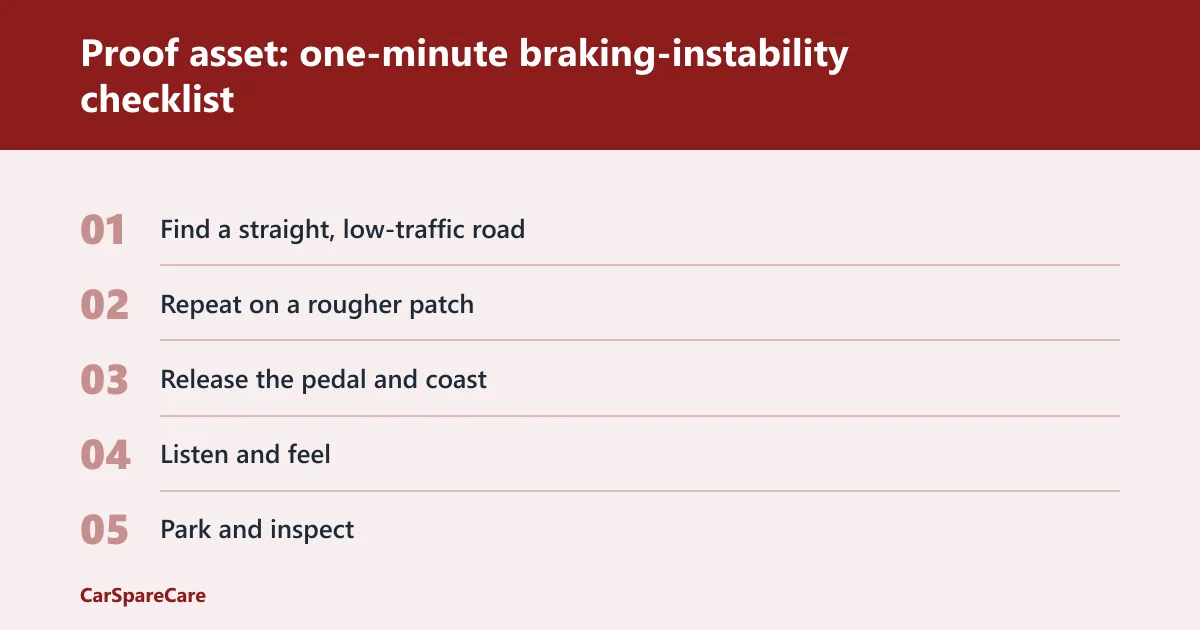
This checklist groups symptoms into three broad buckets. Start with the simplest road test, then confirm with visual checks under the car. If the result is not clear, the problem may sit in more than one bucket, which is common on older vehicles or vehicles with worn tires and suspension parts.
- Find a straight, low-traffic road. Brake gently from 30 to 40 mph and note whether the car dips, pulls, shudders, or stays level.
- Repeat on a rougher patch. If the instability gets worse on broken pavement, wheel hop or unloading is more likely.
- Release the pedal and coast. If the car wanders without braking, the issue may lean toward shocks, struts, bushings, ball joints, or alignment.
- Listen and feel. Grinding, scraping, or a pedal pulse points more toward brakes or ABS than shocks alone.
- Park and inspect. Look for leaks, uneven tire wear, and visible damage at the corners.
Bucket 1: likely shocks or struts
Choose this bucket when the stop includes hard nose dive, extra bounce after release, wheel hop on rough pavement, or a stop that feels loose without strong pedal symptoms. Oil leakage on the shock body is a common worn-shock clue. If the front end keeps bobbing after the car stops, that is a strong suspension clue.
Bucket 2: likely brakes
Choose this bucket when the pedal pulses, the car pulls the same way every time, grinding appears, or the steering wheel shakes mainly during the stop. Brake issues can mimic suspension problems, so this bucket deserves direct inspection of pads, rotors, calipers, slides, hoses, and tire condition.
Bucket 3: likely steering or suspension overlap
Choose this bucket when braking instability comes with highway wander, uneven tire wear, clunks, or motion that changes with road texture. That points toward overlap between shocks, struts, bushings, ball joints, and alignment. This is the bucket most people miss, because the car feels “sort of” brake-related while the real fault is shared.
Under-vehicle visual cues
Look for wet oil on the shock body, torn dust boots, broken springs, uneven tire wear, cracked bushings, and obvious play at the wheel end. Any visible fluid on the shock or strut deserves attention. If one corner sits lower, bounces more than the others, or shows fresh wear where the tire meets the road, that corner deserves priority.
When the problem is more urgent on trucks and SUVs
Trucks and SUVs can sometimes feel less stable sooner because taller body motion can make braking pitch and roll more noticeable. Rear load transfer matters more when passengers, cargo, or a trailer are aboard. If the rear feels light, steps sideways, or chatters under braking, do not ignore it. That setup can move from annoying to unsafe quickly.
Stopping with passengers, cargo, or a trailer
A vehicle that feels marginal when empty may become obviously unstable when loaded. After a repair, it is smart to repeat the road test with the usual load in place. That is the closest way to see whether the shock, strut, tire, or alignment problem is actually fixed under the conditions that expose it.
Red flags that mean do not drive far
Do not keep driving if the car has severe pull, repeated bouncing after a stop, grinding, fluid leaks from a shock or brake area, a brake pedal that sinks or feels wrong, or any stop that feels unpredictable enough to force steering correction. Those symptoms move past diagnosis and into safety risk.
How to know what to repair first
Start with the cheapest and fastest checks, then move to the parts most likely to explain the symptom. Quick visual inspection comes first, then brake inspection, then shock or strut testing, then alignment, then related suspension wear. That order keeps a worn tire or sticking caliper from being blamed on shocks, and it avoids paying for alignment before worn parts are found.
Practical repair priority
If the brake pedal, pads, or rotors are clearly suspect, fix those before chasing suspension parts. If the stop is stable but the body bounces, the shocks or struts move higher. If the car pulls and wanders, inspect both systems together. The best diagnosis is the one that matches the symptom path, not the most obvious worn part.
Frequently asked questions
How do I know if shocks or brakes are causing instability?
Use the symptom pattern. If the pedal pulses, grinds, or the car pulls the same way every time, brakes are more likely. If the body dives hard, bounces, or hops on rough pavement, shocks or struts are more likely. If both are present, inspect both systems and include tires, alignment, bushings, and ball joints.
What does nose dive mean when braking?
Nose dive means the front of the vehicle pitches downward when you press the brake pedal. A noticeable nose-diving front end can point to worn shocks or struts. It is a body-motion clue, not a proof of failure by itself. If the dive is paired with bounce or wheel hop, the suspension case gets stronger.
Are bad shocks dangerous when stopping suddenly?
Yes, especially if the tires are already worn or the road is rough. Bad shocks can make the car less stable under hard braking, and that can increase stopping distance or trigger ABS more often. The danger rises when the vehicle also pulls, wanders, or shows brake warning symptoms at the same time.

Hi, I’m Melvin, an automobile engineer with extensive experience in automobile equipment. I currently work for a local automobile firm, where I specialize in the car parts industry. I’ve had the opportunity to collaborate with seasoned inspectors, gaining invaluable hands-on experience that goes beyond just theory.
My passion for automotive care started at a young age, which led me to create CarSpareCare. Through CarSpareCare, I share the knowledge and skills I’ve acquired over the years to help others navigate the world of car maintenance and repairs.
My goal is to provide practical tutorials, essential safety advice, and the latest industry insights so that anyone—whether a beginner or an expert—can confidently tackle their automotive projects.

