Check a serviceable flooded lead-acid battery only when the plates are exposed or the electrolyte sits below the split ring; top up with distilled water until it just covers the plates by about 1/8 to 1/4 inch, or to the fill marker. Low water can overheat the plates, cut capacity, and end the battery early. This guide shows how to identify a flooded battery, read the level correctly, top up safely, and tell when low water means the battery is failing.
How do you tell a non-sealed battery from a sealed one?
A non-sealed battery is usually a flooded lead-acid battery with removable caps, flip tops, or a strip cover over individual cells. Do not open AGM, gel, or maintenance-free batteries labeled sealed, VRLA, or no-maintenance. If the case has no service caps, leave it closed.
Look for a row of six cell openings on a 12V battery. Many serviceable batteries also have a fill line, split ring, or vent well inside each opening. If the battery is marked sealed, or the top is one solid case without access points, it is not the right type for a water check.
Why flooded lead-acid batteries are the only type you should open
Flooded lead-acid batteries contain liquid electrolyte and lose water through normal use and charging. That is why they need level checks. AGM and gel batteries hold the electrolyte in a different form and are not topped up with water. Opening them can damage the case and shorten life.
Quick signs that the battery should stay closed
- No removable caps, flip tops, or strip covers.
- Batteries labeled AGM, gel, VRLA, sealed, or maintenance-free should generally not be opened.
- A smooth top with no cell access points.
- Cracks, swelling, or leakage on the case.
What safety steps should you take before opening the caps?
Wear safety glasses and chemical-resistant gloves before opening any battery cap or vent. Work with the engine off, the battery cool, and the area well ventilated. Keep sparks, cigarettes, and metal tools away from the top of the battery. Venting can release acid mist.
Basic prep before you start
- Park the vehicle, switch off the engine, and remove the key.
- Let the battery cool if the car has been driven or charged recently.
- Put on eye protection and acid-resistant gloves.
- Wipe loose dirt from the top so debris does not fall into the cells.
- Open the caps only as needed, one cell at a time.
Picture a battery that has just come off a long drive in hot weather. The case may feel warm, and the electrolyte can expand after charging. That is why a hot battery is a poor time for a final fill. Check it cool, then top up carefully if needed.
How do you check battery water level cell by cell?
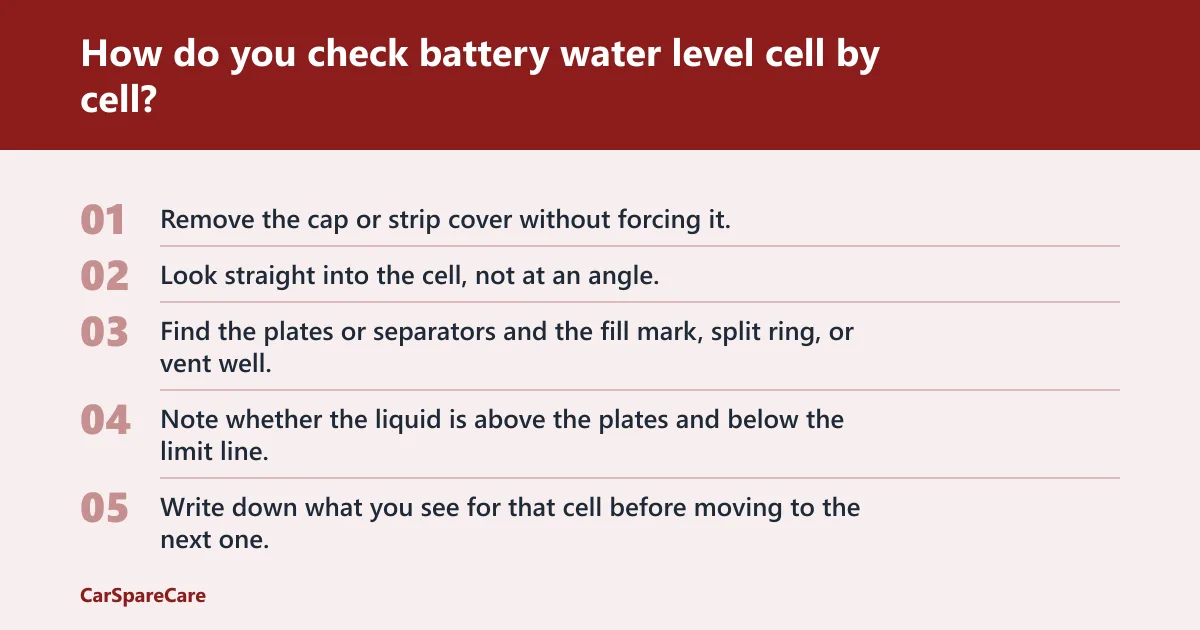
Open each cap or vent carefully and inspect one cell at a time. In a 12V battery, there are usually six cells. The electrolyte should cover the plates and sit below the vent well or fill line if the battery has one. Record each cell separately so one weak cell does not hide in the group.
Step-by-step visual check
- Remove the cap or strip cover without forcing it.
- Look straight into the cell, not at an angle.
- Find the plates or separators and the fill mark, split ring, or vent well.
- Note whether the liquid is above the plates and below the limit line.
- Write down what you see for that cell before moving to the next one.
| Cell | Level seen | Plates exposed? | Fill mark respected? | Action |
|---|---|---|---|---|
| 1 | Below plates / even with plates / above plates | Yes / No | Yes / No | Top up / monitor / replace |
| 2 | Below plates / even with plates / above plates | Yes / No | Yes / No | Top up / monitor / replace |
| 3 | Below plates / even with plates / above plates | Yes / No | Yes / No | Top up / monitor / replace |
| 4 | Below plates / even with plates / above plates | Yes / No | Yes / No | Top up / monitor / replace |
| 5 | Below plates / even with plates / above plates | Yes / No | Yes / No | Top up / monitor / replace |
| 6 | Below plates / even with plates / above plates | Yes / No | Yes / No | Top up / monitor / replace |
A common first-timer mistake is checking only one cell and assuming the rest match. They often do not. One low cell can point to a bad section, a charging issue, or a battery near the end of service.
How much water should go in a car battery cell?
Fill only until the electrolyte covers the plates and then stop below the vent well or fill line. A common rule of thumb is to keep the level roughly 1/8 to 1/4 inch above the plates, while the battery’s own marker should take priority. Never fill to the brim.
Why overfilling after charging causes trouble
Electrolyte expands after charging and during warm weather. If a cell is filled to the top, the liquid can push out through the vents, leaving acid residue on the case and nearby parts. That spill can corrode terminals and nearby metal. A lower fill before charging is safer than an overfull cell.
What should you use to top up a car battery?
Use distilled water as the usual choice for topping up flooded lead-acid batteries. It limits mineral contamination and is the standard fluid for flooded lead-acid batteries. Tap water is only an emergency fallback when distilled water is unavailable and the battery would otherwise run dry.
Why tap water is a poor routine choice
Tap water can contain calcium, magnesium, iron, chlorine, and other dissolved minerals. Those contaminants can build up inside the cells and shorten battery life. Water quality varies by region, so the risk is not the same everywhere. Distilled water avoids that problem.
When tap water is an emergency-only fallback
If a battery is exposing plates and distilled water is not available, clean tap water is better than leaving the plates dry for hours or days. Treat that as a stopgap, not a routine fill. Plan to inspect the battery again and replace it if low level keeps returning.
What does a low water level mean for battery health?
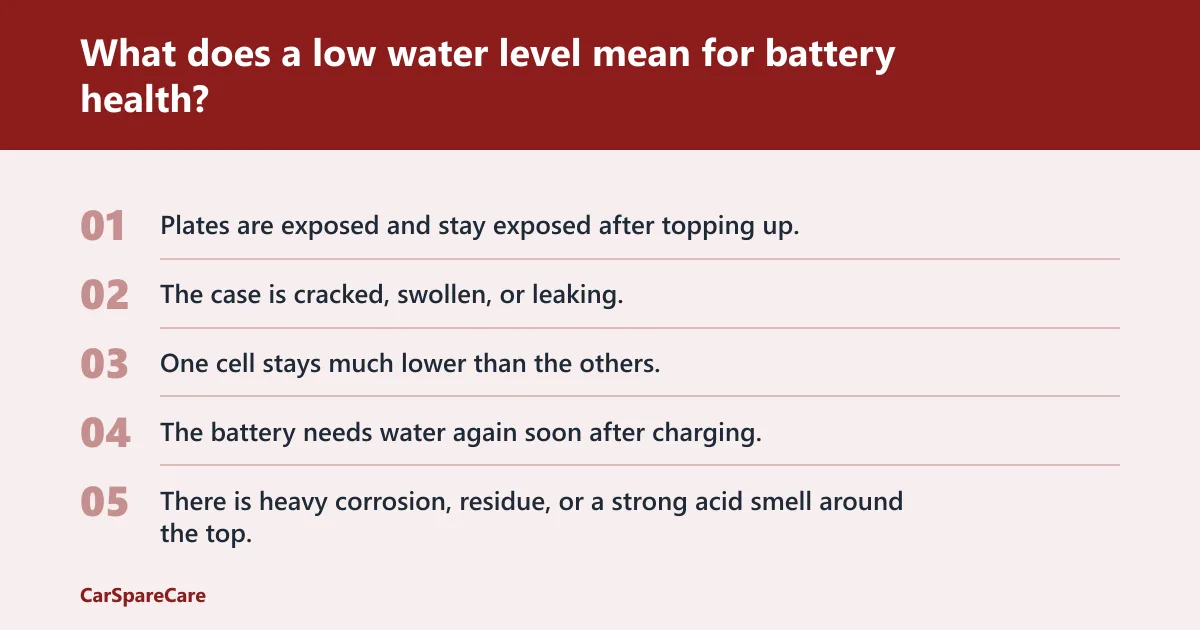
Low electrolyte can expose the plates, increase internal heat, and accelerate damage. If the level drops again after charging, the battery may be overcharging, aging, or losing water through a fault. A cracked, swollen, or leaking battery should be replaced rather than refilled.
Normal low level versus a failing battery
If the level is only slightly low in one or more cells, a distilled-water top-up may be enough. If the same battery keeps dropping after a proper charge, the charger or vehicle charging system may be overcharging it. Repeated loss is a warning sign, not just maintenance.
Suppose a 12V battery in a sedan shows one cell just below the plates and the others near the fill line. After topping up and charging, that same cell is low again a week later. That pattern points away from simple evaporation and toward battery wear or a charging problem.
Warning signs that mean replacement is the better choice
- Plates are exposed and stay exposed after topping up.
- The case is cracked, swollen, or leaking.
- One cell stays much lower than the others.
- The battery needs water again soon after charging.
- There is heavy corrosion, residue, or a strong acid smell around the top.
Checklist: how to inspect, record, and decide what to do next
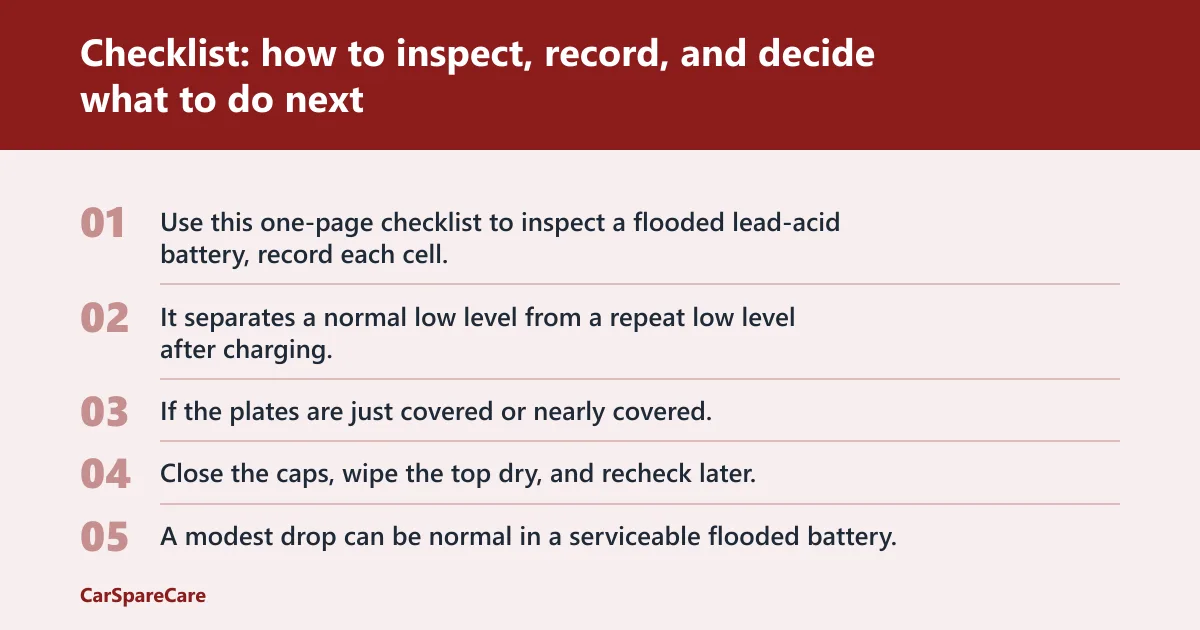
Use this one-page checklist to inspect a flooded lead-acid battery, record each cell, and choose the next step. It separates a normal low level from a repeat low level after charging, and from damage that means the battery should come out.
| Inspection step | What to look for | Decision |
|---|---|---|
| 1. Identify battery type | Removable caps, flip caps, or strip cover on a flooded lead-acid battery | If sealed, stop and do not open |
| 2. Wear PPE | Safety glasses and acid-resistant gloves | Proceed only when protected |
| 3. Check each cell | Liquid covers plates and stays below vent well or fill line | Record each cell separately |
| 4. Decide on fluid | Distilled water is available | Top up only what is needed |
| 5. Recheck after charging | Level stays normal | Normal low level path |
| 6. Watch for repeats | Same cell drops again after charging | Repeat low level path |
| 7. Look for damage | Crack, leak, swelling, or exposed plates that return | Replace battery |
Decision path 1: normal low level, top up and recheck
If the plates are just covered or nearly covered, add distilled water until the level sits just above the plates and below the fill mark. Close the caps, wipe the top dry, and recheck later. A modest drop can be normal in a serviceable flooded battery.
Decision path 2: repeated low level after charging
If the same cell goes low again after a proper charge, it may be more than routine maintenance. The battery may be overcharged, aging, or failing internally. A hydrometer or voltmeter can help separate a low state of charge from low water, but those tools are optional for a basic visual check.
Decision path 3: exposed plates, leak, or damaged case
If the plates are exposed, the case leaks, or the battery is cracked or swollen, replacement is the safer choice. Do not try to fix a damaged case with water alone. Clean any residue after closing the battery if it remains in service, but do not ignore structural damage.
What are the warning signs of a low battery electrolyte level?
Low electrolyte often shows up as visible plates, uneven cell levels, corrosion around the caps, and reduced cranking power. A battery may also run hot during charging or need water more often than it should. One weak cell can drag the whole battery down.
How hydrometer or voltmeter readings fit in
A hydrometer checks electrolyte specific gravity, and a voltmeter checks battery voltage. Both can help tell whether poor performance comes from low water, low charge, or deeper battery wear. They are useful tools, but they do not replace the visual check of the plates and fill line.
How often should you check a non-sealed battery?
Check a serviceable flooded battery about once a month in normal use, and more often in hot weather, heavy charging, or short-trip driving. Heat and frequent charging speed water loss. A battery that loses water quickly deserves closer attention because repeated topping up is not normal forever.
Is it safe to open a car battery cap?
It is safe only when the battery is a flooded lead-acid type with removable caps, the engine is off, the battery is cool, and you are wearing eye and hand protection. Open each cap carefully because venting can release acid mist. Do not force a cover that resists removal.
Frequently asked questions
How do I check battery water level in a non-sealed car battery?
Open each service cap on a flooded lead-acid battery and look directly into the cell. The electrolyte should cover the plates and sit below the vent well or fill line. Record each cell separately, because one low cell can reveal a fault that the others hide.
What fluid should I use to top up a car battery?
Use distilled water. It is the standard top-up fluid for flooded lead-acid batteries because it avoids the minerals found in tap water. If distilled water is not available and the plates are exposed, tap water can be used only as a temporary emergency measure.
Can I use tap water in a car battery?
Not as a routine choice. Tap water can contain dissolved minerals that collect inside the battery and shorten service life. Use distilled water instead. Reserve tap water for emergencies only, when the alternative is leaving the plates dry until proper water is available.
Do all car batteries have removable caps?
No. Only serviceable flooded lead-acid batteries have removable caps or access strips. AGM, gel, and many maintenance-free batteries are sealed and should not be opened for a water check. If there are no caps or the label says sealed, leave the battery closed.
What happens if a battery water level is low?
Low water can expose the plates, raise internal temperature, reduce capacity, and shorten battery life. If the level falls again after charging, the battery may be overcharging or nearing failure. Repeated low levels are a warning that topping up alone may not solve the problem.

Hi, I’m Melvin, an automobile engineer with extensive experience in automobile equipment. I currently work for a local automobile firm, where I specialize in the car parts industry. I’ve had the opportunity to collaborate with seasoned inspectors, gaining invaluable hands-on experience that goes beyond just theory.
My passion for automotive care started at a young age, which led me to create CarSpareCare. Through CarSpareCare, I share the knowledge and skills I’ve acquired over the years to help others navigate the world of car maintenance and repairs.
My goal is to provide practical tutorials, essential safety advice, and the latest industry insights so that anyone—whether a beginner or an expert—can confidently tackle their automotive projects.