
Test the battery first: about 12.6 volts resting and at least 9.6 volts during a common 10-second load test; with the engine running, charging voltage usually reads about 13.8 to 14.7 volts. Miss those numbers and you can replace the wrong part, then still end up with a no-start. This guide shows how to test the battery, alternator, belt, and wiring with the same three measurements and simple load checks.
How to test the battery first
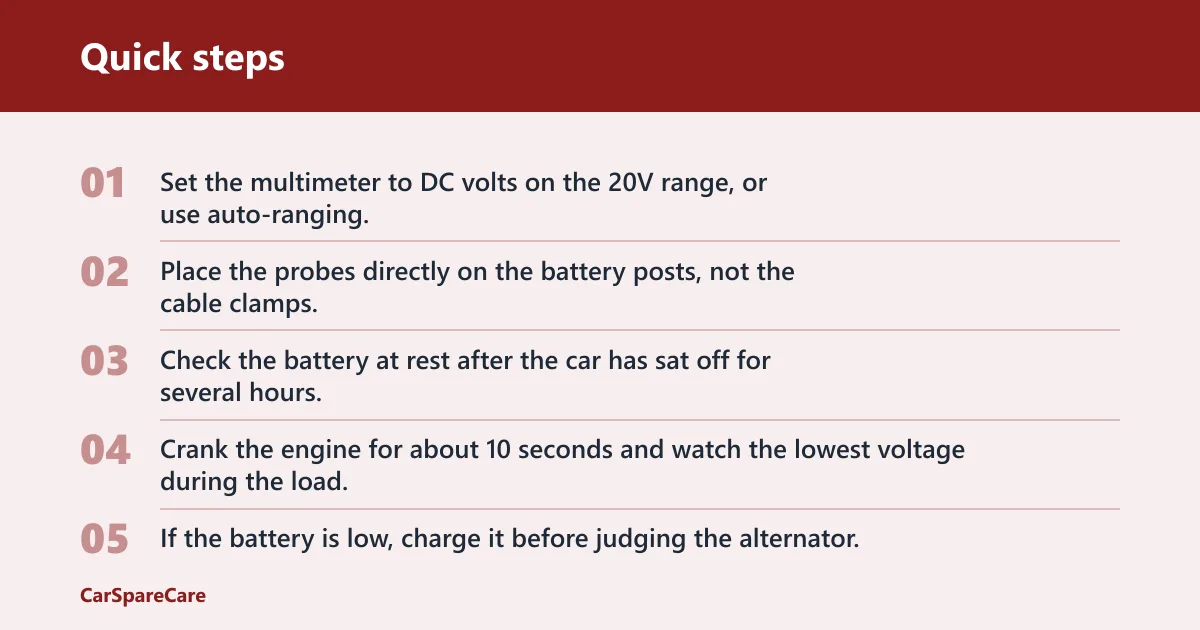
- Set the multimeter to DC volts on the 20V range, or use auto-ranging.
- Place the probes directly on the battery posts, not the cable clamps, and read to tenths of a volt.
- Check the battery at rest after the car has sat off for several hours; about 12.6 volts indicates a fully charged 12V lead-acid or AGM battery.
- Crank the engine for about 10 seconds and watch the lowest voltage during the load. A battery that drops below about 9.6 volts may be weak, sulfated, or high-resistance.
- If the battery is low, charge it before judging the alternator; a weak battery can pull system voltage down and distort later readings.
What you’ll need
- Digital multimeter with DC volts mode and tenths-of-a-volt display
- Safety gloves and eye protection
- Access to the battery, serpentine belt, tensioner, and alternator
- Optional OBD-II scan tool for charging-system codes and voltage command data
- Basic hand tools if terminals or covers need to be moved for access
How to test the alternator next
Start the engine and read charging voltage at the battery terminals; most vehicles are commonly around 13.5 to 14.8 volts, though smart charging systems may vary. Then repeat the check with headlights, blower, rear defrost, and other loads on. If voltage stays in range, the alternator and regulator are more likely fine than failed.
- Start the engine and let it idle with all accessories off.
- Measure voltage at the battery posts again; note whether it rises above resting voltage and stays stable.
- Turn on headlights, cabin blower, rear defrost, and A/C fan, then recheck. A healthy charging system should stay near the normal charging range instead of dropping back toward resting battery voltage.
- Raise engine speed to about 2,000 rpm and watch for a steady reading, not a brief spike that falls away.
- If the vehicle uses smart charging, compare the reading with scan-tool battery voltage or command data before calling it a fault.
How do you check belt and wiring?
Inspect the belt and tensioner before replacing anything electrical. A slipping, glazed, loose, or noisy belt can cut alternator output even when the alternator itself is good. Then check battery terminals, cable tightness, and grounds; voltage drop at the cables can mimic a weak alternator and give a false low-voltage reading.
- Look for belt glazing, cracking, fraying, or wet contamination on the serpentine belt.
- Watch the tensioner with the engine running. If it bounces, sits near the stop, or the belt squeals under load, treat that as a drive problem first.
- Measure voltage from the alternator case to battery negative, and from battery positive to the alternator output stud, while the engine runs with lights on. High drop points to wiring or ground loss.
- Clean corrosion and tighten loose terminals before repeating the test.
Battery alternator decision table
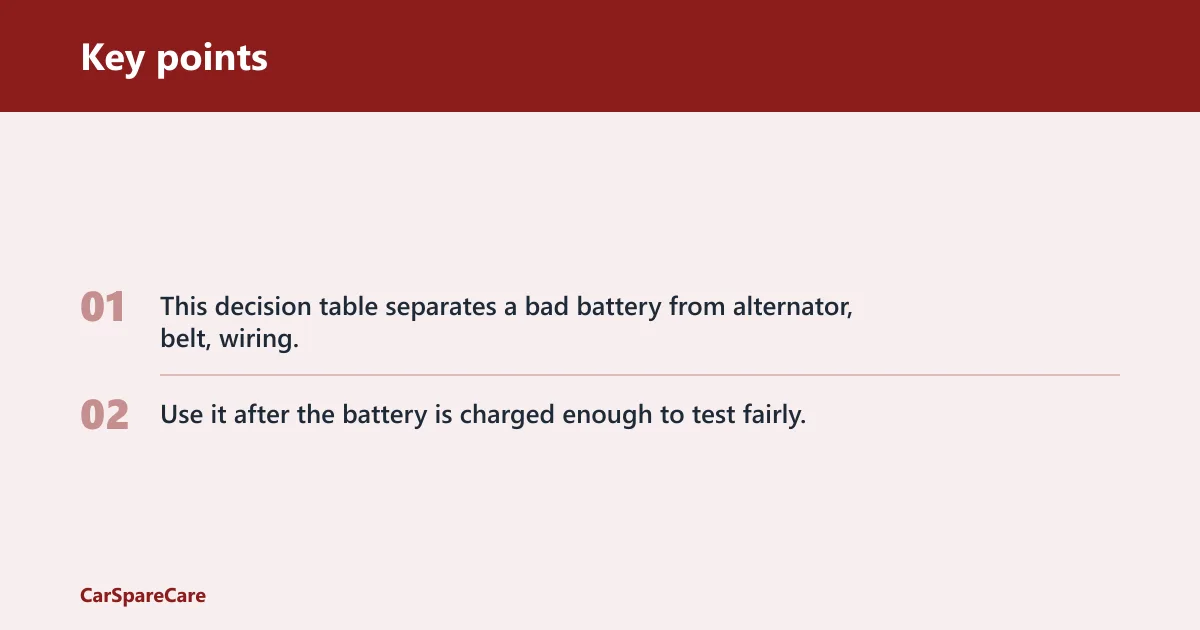
This decision table separates a bad battery from alternator, belt, wiring, and ground faults using the same readings. Use it after the battery is charged enough to test fairly.
| Scenario | Expected reading or clue | Likely fault | Do not replace yet |
|---|---|---|---|
| Engine off | About 12.6V for a fully charged battery; 12.2V or lower suggests low state of charge | Weak or discharged battery, possible sulfation or age-related internal resistance | Do not replace the alternator yet if the battery is simply discharged |
| Cranking | Stays at or above 9.6V during a 10-second load test | Battery weak under high current load if it falls below that threshold | Do not call the alternator bad from a bad cranking result alone |
| Idle no-load | Usually 13.5V to 14.8V at the battery | Low reading can point to alternator, regulator, belt slip, wiring loss, or ground fault | Do not replace the alternator until belt and voltage-drop checks are done |
| Idle with electrical load | Voltage should stay near the normal charging range and not sag sharply | Alternator output limit, weak belt drive, poor connection, or undersized charging response | Do not skip cable and ground checks if voltage drops only with load |
| High-rpm check | Voltage should rise slightly or stay stable, not jump far above normal | Regulator fault if over 14.8V; weak charging if it stays low under speed | Do not assume a fixed 14V reading on smart charging systems |
| Abnormal belt or noise conditions | Squeal, glazing, looseness, or tensioner flutter with electrical load | Belt slip or tensioner fault, which reduces alternator drive | Do not replace the alternator before correcting the mechanical drive fault |
What do the readings mean?
A battery that fails rest or cranking tests is likely the first problem. A battery that passes but the running voltage stays low shifts suspicion to the charging system, belt drive, wiring, or grounds. If voltage is normal at idle but the car still dies later, suspect parasitic draw rather than a charging fault.
Separate a weak battery from a bad alternator
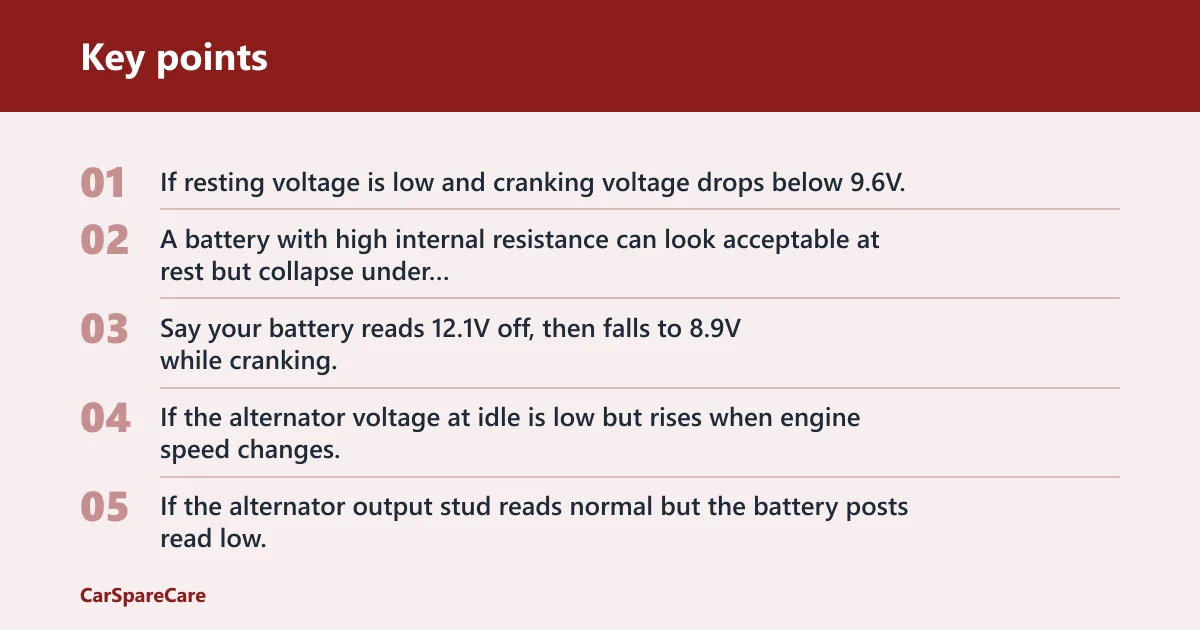
If resting voltage is low and cranking voltage drops below 9.6V, charge the battery and retest before blaming the alternator. A battery with high internal resistance can look acceptable at rest but collapse under starter load. Say your battery reads 12.1V off, then falls to 8.9V while cranking; that points to battery weakness first, not an alternator failure.
Separate belt, wiring, and ground faults
If the alternator voltage at idle is low but rises when engine speed changes, inspect the belt and tensioner first. If the alternator output stud reads normal but the battery posts read low, the loss is in the cables, terminals, or grounds. Suppose the alternator case-to-battery-negative drop is high with the rear defrost on; that points to a ground path problem.
Use scan-tool data as a secondary check
An OBD-II scan tool can confirm charging-system or battery-related codes and, on some vehicles, show requested voltage or generator command. Use it after the meter checks, not instead of them. If the scan tool shows a command that is below 14 volts on a smart-charging vehicle, that can be normal system strategy rather than a failed alternator.
Common mistakes
Do not test only at rest and call the battery good. A rest reading can miss a battery that fails under load. Do not replace the alternator before checking belt slip, cable resistance, and grounds. And do not read every vehicle as if it must hold a fixed 14-volt charge; smart systems often vary output on purpose.
Another common mistake is ignoring the battery when the alternator is the suspected problem. A weak battery can pull the whole system down and make a healthy alternator look bad. If the vehicle starts after charging but dies again after a short drive, that pattern may point to a drain after shutdown rather than a charging failure.
Picture a sedan that idles at 13.9V with no load, then drops to 12.4V when the blower and headlights come on. If the belt squeals at the same time, the next step is belt and tensioner inspection, not alternator replacement. The noise is part of the diagnosis.
Frequently asked questions
How do you test an alternator and battery together?
Check the battery at rest, then during cranking, then with the engine running at idle and under load. Use the same multimeter on the battery posts for all four readings. That sequence separates a weak battery, a charging fault, and a belt or wiring issue without removing parts.
How do you check battery and alternator with a multimeter?
Set the meter to DC volts, place the probes on the battery terminals, and read to tenths of a volt. A healthy battery is about 12.6V at rest, and charging voltage usually sits around 13.5V to 14.8V when the engine runs. Recheck with accessories on.
How do you test an alternator on the vehicle?
Leave the alternator installed, start the engine, and measure voltage at the battery posts while the engine idles and while electrical loads are on. Then raise rpm to about 2,000 and confirm that output remains stable. Add a belt inspection and voltage-drop check for a full diagnosis.
How do you know if the battery or alternator is bad?
If the battery fails the rest or cranking test, start there. If the battery passes but running voltage stays low, look at the alternator, belt drive, wiring, and grounds. If the vehicle starts and later dies after sitting, a parasitic draw is also worth checking.
What voltage should the battery show with the engine off and running?
With the engine off, a fully charged 12V lead-acid or AGM battery is usually about 12.6V. With the engine running, most vehicles should show about 13.5V to 14.8V at the battery, though some smart-charging systems vary outside that fixed window at times.
Can you test an alternator without removing the battery?
Yes. In most cases you should test it with the battery installed because the battery is part of the charging system and acts as a buffer. Use the battery posts for your meter probes, then add a loaded idle test and a higher-rpm check before drawing a conclusion.

Hi, I’m Melvin, an automobile engineer with extensive experience in automobile equipment. I currently work for a local automobile firm, where I specialize in the car parts industry. I’ve had the opportunity to collaborate with seasoned inspectors, gaining invaluable hands-on experience that goes beyond just theory.
My passion for automotive care started at a young age, which led me to create CarSpareCare. Through CarSpareCare, I share the knowledge and skills I’ve acquired over the years to help others navigate the world of car maintenance and repairs.
My goal is to provide practical tutorials, essential safety advice, and the latest industry insights so that anyone—whether a beginner or an expert—can confidently tackle their automotive projects.