

If your car blows cold air with the heater on, check two paths first: coolant flow if a heater hose stays cold, or an HVAC blend door if both heater hoses are hot but the vents are not. Ignoring it can leave you without cabin heat and can hide low coolant or overheating problems. This guide shows the fastest symptom-based checks to separate cooling-system faults from HVAC-door faults.
How to narrow down the cause

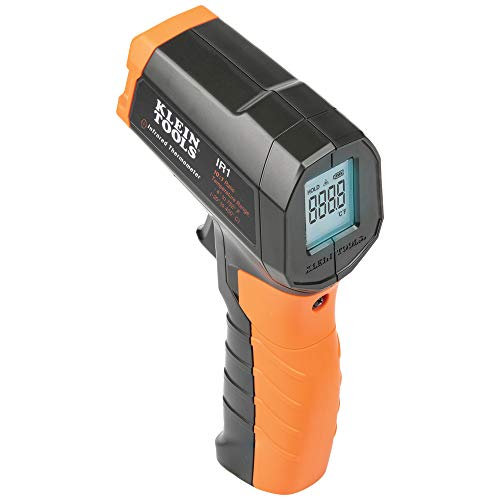
The quickest way to sort this out is to decide whether the engine is making usable heat and whether the HVAC system is sending that heat into the cabin. Low coolant, a thermostat stuck open, air in the cooling system, a clogged heater core, or a blend-door fault can all leave you with cold vents, but they fail in different ways.
Start with coolant and engine temperature
Check the coolant reservoir only when the engine is cool. The level should usually sit between the MIN and MAX marks when checked cold. Low coolant is a common cause of cold heater air, and low coolant can also introduce air into the system. A low level often points to a leak rather than a one-time drop.
The engine should reach about 200 Fahrenheit or 90 degrees in normal operation. If the temperature gauge stays low or sits below its usual mark, a thermostat stuck open is a strong suspect. A thermostat that sticks open can keep the engine too cool for cabin heat.
Separate heater-core faults from HVAC faults
The heater core uses hot engine coolant to warm the air that enters the cabin. If it is clogged, the system may give weak heat or cold air at the vents. If it is leaking, you may notice a sweet smell inside the cabin or wet carpet, often near the passenger footwell.
HVAC faults live on the air side, not the coolant side. Broken heater flaps or blend-door actuators can cause no heat even when the cooling system is fine. On some vehicles, a fault can set diagnostic trouble codes. In that case, the problem may be electric or mechanical, depending on the design.
What to check in order
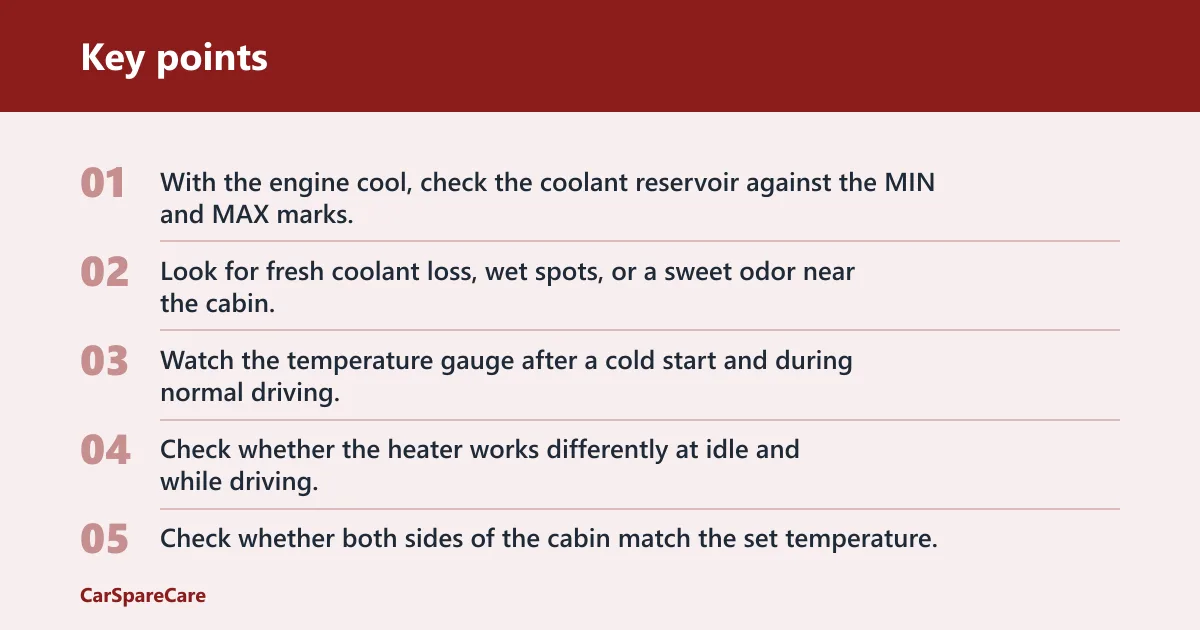
- With the engine cool, check the coolant reservoir against the MIN and MAX marks.
- Look for fresh coolant loss, wet spots, or a sweet odor near the cabin.
- Watch the temperature gauge after a cold start and during normal driving.
- Check whether the heater works differently at idle and while driving.
- Check whether both sides of the cabin match the set temperature.
- If the issue started after repairs or a coolant top-off, think about trapped air and a possible bleed.
Say your sedan blows warm air on the highway but turns cold at a stoplight. That pattern can point to coolant circulation, low coolant, or air in the system rather than a dead heater core. Suppose the temperature gauge also stays lower than normal. A thermostat stuck open becomes much more likely.
For powertrain context, gasoline and diesel engines usually rely on engine coolant flow for cabin heat. Hybrids may use electric pumps or control strategies that change how fast heat arrives. EVs do not use engine coolant heat for cabin warmth in the same way; many use electric heaters or heat pumps, so a cold cabin can point to a different system path than a conventional engine car.
Could a bad thermostat be the cause?
Yes. A thermostat that sticks open can keep the engine from reaching working temperature, and that lowers the heat available to the heater core. The clue is usually a low or stuck-low temperature gauge rather than a normal gauge with no cabin heat.
What a stuck-open thermostat looks like
A thermostat stuck open lets coolant flow too early and too often through the radiator. The engine may stay too cool, fuel economy may drop, and cabin heat can stay weak. If the gauge never reaches its normal place after a reasonable drive, the thermostat moves up the list.
Do not confuse this with a hot-running engine. If the gauge climbs too high, treat that as an overheating warning and stop driving. Overheating can damage the engine quickly, and it is not only a heater issue.
Why the gauge matters
The gauge gives you a quick clue about whether the engine is making enough heat for the heater core. If the needle or digital display stays below normal, the cabin may never get warm enough. If the gauge swings high or warning lights appear, the problem is more urgent than a comfort issue.
Heater-core symptoms and checks
The heater core can clog or leak. A clogged heater core usually shows up as weak heat, uneven heat, or vents that stay cold even after the engine is warm. A leaking heater core can add a sweet smell, fogging, or damp carpet to the picture.
Clogged heater core signs
A clogged heater core can stop the entire heating system from working properly. You may get heat that fades, one heater hose that feels much cooler than the other, or a cabin that warms only at certain engine speeds. A flush may help if the restriction is mild.
Leaking heater core signs
A leaking heater core often adds odor and moisture to the symptom list. The cabin may smell sweet, windows may mist up more than usual, and the carpet or under-dash insulation may feel damp. If the leak is severe, coolant level drops and heat may come and go with the reservoir level.
A common first-timer mistake is assuming any sweet smell means a radiator leak under the hood. If the smell is strongest inside the cabin and the passenger carpet is wet, the heater core becomes a stronger suspect than the radiator.
Cold air symptoms matrix
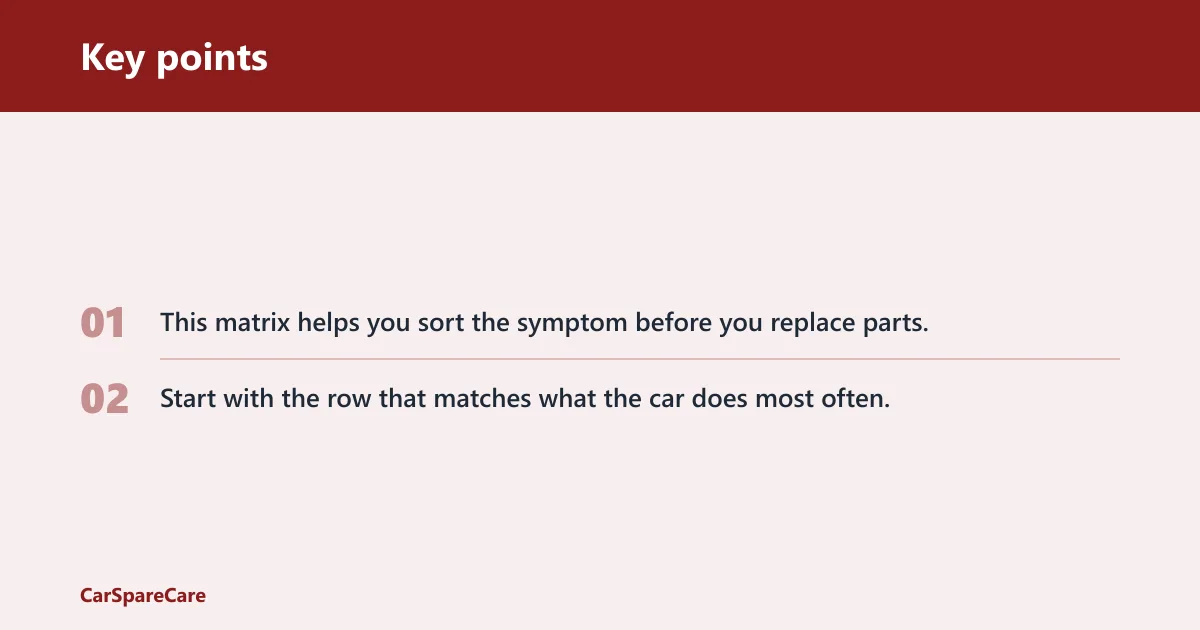
This matrix helps you sort the symptom before you replace parts. Start with the row that matches what the car does most often, then use the quick check to decide whether you are looking at coolant flow, air in the system, or an HVAC control issue.
| Symptom | Likely cause | Quick check | Severity | Next step |
|---|---|---|---|---|
| Cold only at idle | Low coolant, air in the system, weak circulation, or a heater-core restriction | See whether the temperature gauge stays normal and whether heat returns above idle | Moderate; can become serious if overheating starts | Check coolant level when cool, inspect for leaks, then bleed the system if needed |
| One side cold | Blend door or actuator fault | Compare left and right vents at the same setting | Usually moderate | Check HVAC controls and actuator calibration, and scan for codes on vehicles that support it |
| Sweet smell inside cabin | Heater-core leak | Look for fogging or wet carpet near the passenger side | Moderate to high | Stop adding coolant blindly, confirm the leak source, and plan heater-core diagnosis or repair |
| Temperature gauge stays low | Thermostat stuck open | Watch whether the engine ever reaches normal operating temperature | Moderate | Inspect the thermostat before replacing heater parts |
| Overheating plus cold air | Low coolant, air pocket, or cooling-system leak | Check reservoir level and any warning lights | High | Stop driving if the gauge is hot; cool the engine, then inspect for leaks and trapped air |
| Heat returns after topping off coolant | Low coolant with possible leak or air pocket | See whether heat fades again over the next few drives | Moderate, but recurring loss is a warning | Look for the leak source and bleed the system after the repair |
Why does one side blow cold air?
One side cold and the other side warm usually points to a blend-door or climate-control fault rather than a coolant problem. That is especially true if the engine reaches normal temperature and both heater hoses feel hot. Some vehicles may also set diagnostic trouble codes when the actuator fails.
Blend doors, actuators, and control type
Blend doors control how much heated or cooled air reaches each side of the cabin. The actuator that moves the door may be electric or mechanical. If the door sticks, the system can send warm air to one side and cold air to the other, even with good coolant flow.
Some HVAC systems use cables, some use vacuum, and many newer ones use electronic actuators. A fault in the control head, a broken cable, or a failed actuator can mimic a mechanical heater problem. That is why vent pattern matters so much.
When to suspect a control issue
If both heater hoses are hot but the vents disagree, do not start with the water pump or heater core. Start with the temperature knobs, mode changes, and any self-calibration procedure the vehicle uses. On vehicles with scan-tool access, actuator codes can help narrow the exact door or motor.
Why does heat return only while driving?
Heat that comes back at road speed usually means coolant circulation or air movement changes with engine speed. Low coolant, trapped air, or a heater-core restriction can all show this pattern. A fault that is only active at idle is less likely to be a full HVAC door failure.
Idle-only cold air and coolant flow
At idle, coolant flow can be weaker and trapped air can settle in the heater core. If the cabin warms up once you raise engine speed or start driving, that supports a circulation problem. Low coolant is often the first thing to check because it can starve the heater core of hot fluid.
Air in the cooling system after repairs or coolant loss
Air in the cooling system can create airlocks and stop hot coolant from reaching the heater core. This often follows low coolant or recent repairs. Bleeding the cooling system may be needed after the cause of the coolant loss is fixed, or the cold-air complaint can return.
Low coolant can also let air enter the system in the first place. That means a top-off may bring heat back for a day or two without fixing the root cause. If the level drops again, treat it as a leak until proven otherwise.
What to do if your car heater is blowing cold air?
Start with the simplest checks in the safest order. Check coolant only when the engine is cool, verify the gauge reaches normal temperature, and see whether the problem changes with vehicle speed or with one side of the cabin. That pattern tells you which system to inspect next.
Practical next steps
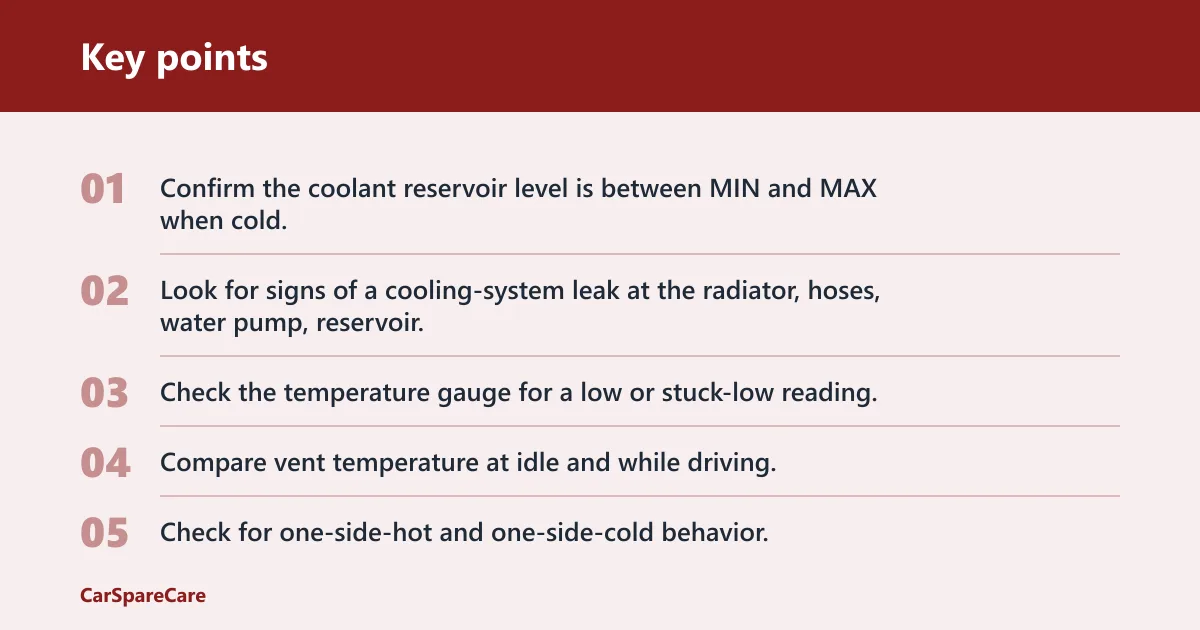
- Confirm the coolant reservoir level is between MIN and MAX when cold.
- Look for signs of a cooling-system leak at the radiator, hoses, water pump, reservoir, or heater core.
- Check the temperature gauge for a low or stuck-low reading.
- Compare vent temperature at idle and while driving.
- Check for one-side-hot and one-side-cold behavior.
- If coolant was recently added or repairs were done, bleed trapped air if the vehicle procedure calls for it.
Do not open a coolant cap while the engine is running or hot. Pressure and boiling coolant can cause burns. If the gauge shows overheating, stop driving and let the engine cool before any inspection.
Owner-level cost usually follows the system that failed. A coolant top-off is the cheapest first check. A bleed or pressure test comes next. Thermostat, heater-core, or blend-door repairs are more involved because they require diagnosis before parts come off the car.
Frequently asked questions
Can low coolant make the heater blow cold air?
Yes. Low coolant is a common cause of cold heater air because the heater core needs hot engine coolant to warm the cabin air. Low coolant can also pull air into the system, which can make the problem come and go until the leak is found and repaired.
Can a stuck thermostat cause no heat in the cabin?
Yes. A thermostat that sticks open can keep the engine too cool for cabin heat. If the temperature gauge stays below normal and the heater never gets properly warm, the thermostat is high on the list. A thermostat that fails closed is different and can cause overheating instead.
What does a bad heater core smell like?
A leaking heater core often makes a sweet smell inside the cabin. You may also see fogging on the windows or wet carpet, often near the passenger side. A clogged heater core may not smell at all; it usually shows up as weak or uneven heat instead.
Why does my car heater work only while driving?
That pattern usually points to coolant circulation, trapped air, or a heater-core restriction rather than a simple control problem. At road speed, flow and heat transfer can improve enough to restore cabin warmth. If the temperature gauge stays normal, check coolant level and look for an air pocket or leak.
Why is one side of my car blowing cold air when the heat is on?
One side cold and one side warm usually points to a blend door, actuator, or climate-control fault. That symptom is less consistent with low coolant, because coolant problems usually affect both sides. On some vehicles, the fault can set codes that help identify the failed door or motor.

Hi, I’m Melvin, an automobile engineer with extensive experience in automobile equipment. I currently work for a local automobile firm, where I specialize in the car parts industry. I’ve had the opportunity to collaborate with seasoned inspectors, gaining invaluable hands-on experience that goes beyond just theory.
My passion for automotive care started at a young age, which led me to create CarSpareCare. Through CarSpareCare, I share the knowledge and skills I’ve acquired over the years to help others navigate the world of car maintenance and repairs.
My goal is to provide practical tutorials, essential safety advice, and the latest industry insights so that anyone—whether a beginner or an expert—can confidently tackle their automotive projects.

