

Replace a serpentine belt at about 60,000 to 100,000 miles, or sooner if it is cracked, glazed, frayed, or contaminated. Shut the car down now if the belt is squealing, slipping, or doing a poor job of charging, steering, or cooling. Ignore it, and you can lose battery charging, power steering assist, or coolant circulation fast. This guide shows when to replace the belt, how to spot tensioner or idler pulley faults, and when you can wait versus act now.
What the serpentine belt does
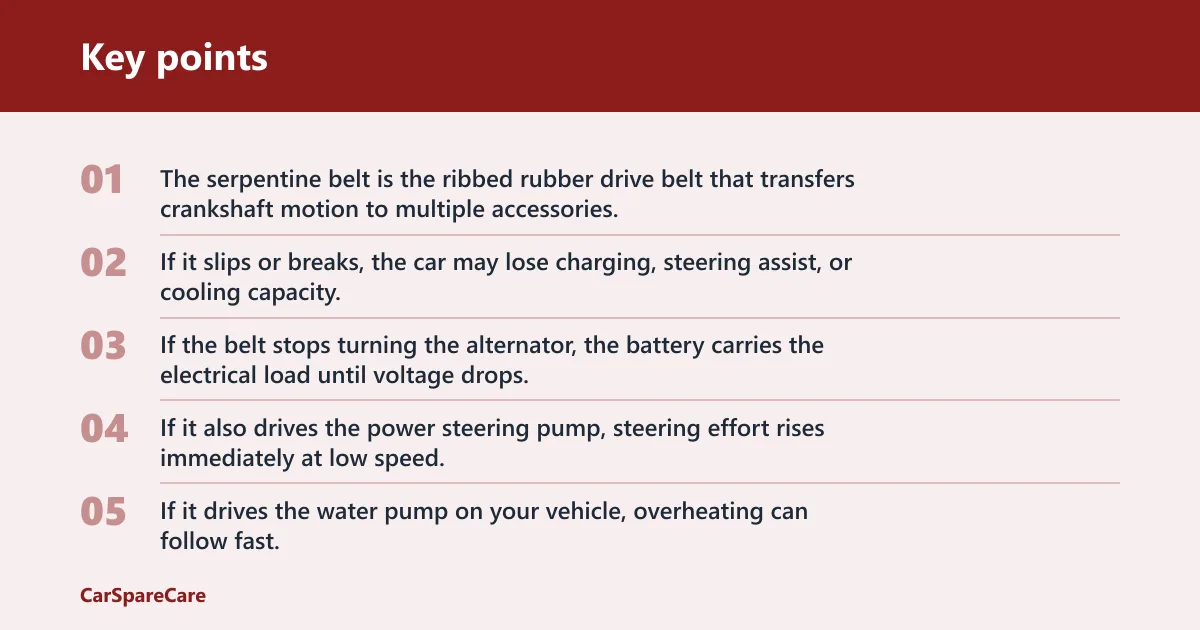


The serpentine belt is the ribbed rubber drive belt that transfers crankshaft motion to multiple accessories. On many engines it drives the alternator, power steering pump, air-conditioning compressor, and sometimes the water pump. If it slips or breaks, the car may lose charging, steering assist, or cooling capacity.
Layout matters. Transverse engines, tight engine bays, and some hybrid accessory layouts can make access harder and change the routing path. Some vehicles can keep running for a short time after a belt failure, but warning lights and symptoms can appear quickly.
Why a break can strand the car
If the belt stops turning the alternator, the battery carries the electrical load until voltage drops. If it also drives the power steering pump, steering effort rises immediately at low speed. If it drives the water pump on your vehicle, overheating can follow fast.
When should you replace it?
Most manufacturers list a serpentine-belt interval in miles and years, though the exact number varies by vehicle, belt material, and driving conditions. A common replacement window is about 60,000 to 100,000 miles, though some belts last longer and severe-service use can shorten life. The owner’s manual gives the exact interval for your vehicle.
Severe service shortens life
Frequent short trips, long idling, dusty roads, heavy accessory use, and oil or coolant contamination all age a belt sooner. Heat also matters. A belt that looks fine at lower mileage can still need replacement early if the ribs are hardened, glazed, or contaminated.
Use the owner’s manual
Check the maintenance schedule and the belt inspection notes for your exact engine. Some schedules specify inspection at every service and replacement only when wear appears, while others call for a mileage or time interval. Follow the shorter of the two if both are listed.
Belt replacement decision table
| Symptom observed | Likely cause | Action |
|---|---|---|
| Fine cracks across the ribs, glazing, or frayed edges | Belt wear | Book soon; safe to monitor only if the belt is quiet and far from the service interval |
| Missing ribs, chunking, or visible cord | Belt wear | Stop driving now and replace immediately |
| Squeal on cold start that fades after a few seconds | Tensioner or belt slip | Inspect now; book soon if charging and steering stay normal |
| Persistent squeal under load, especially with A/C on | Tensioner, pulley, or belt slip | Book soon, or stop driving now if the noise grows or systems weaken |
| Belt walks toward one edge or looks off-center | Tensioner or idler pulley tracking issue | Inspect now; stop driving now if the belt looks ready to jump |
| Battery light, rising coolant temperature, or heavy steering after noise starts | Serious belt slip or failure | Stop driving now and replace immediately |
What to watch for on inspection
Look at the belt with the engine off and cool. You want cracks across the ribs, a shiny or glazed surface, missing rib chunks, fraying at the edges, and signs of contamination from oil or coolant. Any of those can justify replacement, especially if mileage is already high.
Noise patterns matter too. A brief squeal at startup often points to a weak tensioner or a belt that has lost grip on a cold pulley. A steady chirp, wobble, or rumble points more toward a pulley problem.
- Cracks across the ribs, glazing, or frayed edges: book soon if the belt is still quiet.
- Missing ribs, exposed cord, or pieces missing from the belt: stop driving now.
- Oil or coolant on the belt: inspect the leak source and replace the belt if contamination is significant.
- Wandering belt edge or visible tracking: inspect now for pulley alignment or tensioner problems.
Cracks, glazing, and fraying
Cracks across the ribs suggest age and heat cycling. Glazing means the running surface has become shiny and hard, which reduces grip. Fraying, edge wear, and missing ribs are stronger signs that the belt is near the end of service life.
Oil, coolant, and edge wear
Oil or coolant on the belt can soften rubber and shorten life quickly. Edge wear often points to a routing problem, a misaligned pulley, or a weak tensioner that lets the belt wander. Cleaning the source matters as much as replacing the belt.
Say your belt has small cracks across several ribs but no noise yet, and the car has 92,000 miles on it. That usually fits a schedule-soon replacement, not an emergency. If the belt has a missing rib and the battery light comes on at idle, that is generally a replace-now situation.
Belt, tensioner, or pulley?
A worn belt is only one cause of noise. The belt tensioner keeps tension on the belt with a spring-loaded or hydraulic design, and a weak unit can cause squeal, slippage, and poor tracking. An idler pulley guides the belt path, and worn bearings can create noise or wobble that feels like belt failure.
How a weak tensioner acts
A weak tensioner may let the belt flutter, especially at idle or when the A/C compressor loads the system. The belt can squeal even if the ribs still look usable. If the tensioner arm moves excessively or snaps back slowly, inspect or replace it with the belt.
How a bad idler pulley acts
An idler pulley should spin smoothly with no roughness. If it feels gritty, wobbles, or makes a dry bearing sound, it can ruin a new belt quickly. Noise from a bad pulley often changes with engine speed and may sound like a chirp or growl rather than a pure squeal.
When the belt is only part of the problem
Replace the belt alone only when the belt shows wear but the tensioner and pulleys run smoothly, stay aligned, and do not make noise. Replace more than the belt when the tensioner feels weak or a pulley bearing is rough. Fixing one worn part while leaving the others in place often means repeating the job soon.
Replace belt and tensioner together?
Many owners replace the tensioner or idler at the same time as the belt because the parts age together and access is already open. That does not mean every job needs extra hardware. Mileage, age, noise, and the feel of the pulley bearings should decide the call.
When to replace belt only
Choose belt only when the mileage is moderate, the belt is the only worn part, and the pulleys spin smoothly. This is common when the belt has visible cracking or glazing but the tensioner stays firm and the pulley bearings feel normal. Keep the old hardware only if it still passes inspection.
When to replace belt plus hardware
Replace the belt plus the tensioner or idler when the belt is old, noise is present, or the tensioner no longer controls slack properly. If the belt has high mileage and the tensioner has never been changed, the extra part can prevent a repeat repair. This is especially sensible on engines where access is difficult.
| Condition | Replace belt only | Replace belt + tensioner/idler |
|---|---|---|
| 40,000–70,000 miles, no noise, smooth pulley spin | Yes, if wear is visible | Usually no |
| 80,000+ miles, no record of prior replacement | Possible | Often smart to inspect and consider hardware |
| Squeal at startup or under load | Only if belt is clearly worn | Often yes, because tensioner or pulley may be the cause |
| Rough pulley, wobble, or weak tensioner arm | No | Yes |
How to replace a serpentine belt
Replacement is straightforward on some engines and awkward on others. A long-handled wrench, breaker bar, or dedicated serpentine belt tool is often needed to rotate the tensioner and release belt tension. Before removal, find the routing diagram and confirm the path on the vehicle itself.
Find the routing diagram. Look under the hood, in the owner’s manual, or in a repair database for the exact belt path. Routing varies by engine layout, and even one wrong loop can leave an accessory unloaded or the belt misaligned.
Inspect the pulleys first. Check the tensioner and idler pulleys for wobble, rough spin, and damaged grooves. Replace faulty hardware before installing a new belt, because a bad bearing can ruin the new belt quickly.
Release the tensioner. Fit the correct tool on the tensioner and rotate it far enough to slacken the belt. Use controlled force and keep hands clear of pinch points. On some vehicles, access is tight enough that the right tool makes the difference between a clean job and a struggle.
Route the new belt. Follow the diagram exactly and leave the easiest-to-reach pulley for last if that helps. Make sure every rib seats in every grooved pulley and that the belt edge does not ride off a flange.
Recheck alignment. Rotate the engine by hand if the service manual calls for it, then inspect the belt path again. Start the engine and watch for wandering, chirping, or a belt that tracks off center.
Picture a transverse four-cylinder with a tight engine bay and the alternator tucked close to the frame rail. The belt itself may be inexpensive, but the labor to reach the tensioner can be the hard part. On that layout, replacing a noisy idler while the belt is off can avoid paying for the same access twice.
Frequently asked questions
Is it easy to replace serpentine belt?
It can be easy on some engines and awkward on others. Tight engine bays, hidden tensioners, and long accessory drives make the job harder. If access is poor or the routing is complex, the difficulty rises quickly even though the part itself is simple.
Where to get a serpentine belt replaced
You can have it replaced at a dealer, independent repair shop, or chain service center. If the belt is still functional but aged, ask for an inspection of the tensioner and idler pulley too. That helps avoid paying for a second visit if one of those parts is the real problem.
When should a serpentine belt be replaced?
Replace it at the mileage and age listed in your owner’s manual, or sooner if it shows cracks, glazing, fraying, missing ribs, or contamination. Many vehicles fall in the 60,000–100,000-mile range, but severe service can shorten that interval. Wear always overrides a generic mileage target.
What are the signs a serpentine belt is going bad?
Common signs include squeal, cracks across the ribs, glazing, frayed edges, missing rib chunks, and contamination from oil or coolant. If the belt drives the charging system poorly, the battery light may come on. If it drives the water pump on your vehicle, temperature can rise too.
Can I drive with a squealing serpentine belt?
You should not treat a persistent squeal as harmless. Brief startup noise can be a warning sign, but ongoing squeal may mean slip from a weak tensioner, worn belt, or bad pulley. If charging, steering, or cooling performance drops, shut the engine down and inspect it.
What happens if the serpentine belt breaks
If the belt breaks, the accessories it drives stop working. That can mean loss of charging, heavy steering, and possible overheating if the water pump is belt-driven on your vehicle. The car may still move for a short time, but continuing to drive risks a strand or engine damage.
Should I replace the tensioner at the same time?
Replace the tensioner at the same time if it is weak, noisy, or slow to apply tension. Many owners also replace it when the belt is high mileage and access is already open. If the tensioner is smooth and firm, belt-only replacement can still make sense.
How much does serpentine belt replacement cost?
Cost varies by vehicle, engine layout, and whether you replace related hardware. A belt-only job is cheaper than a belt plus tensioner or idler pulley, but extra parts can be better value if the labor to reach them is the same. Tight layouts usually cost more in labor than the part does.
On simpler engines, belt-only replacement is often a reasonable DIY job with basic hand tools and room to reach the tensioner. On cramped transverse layouts, hidden tensioners, spring-loaded hardware, or seized pulleys can make shop service the smarter choice because the access and tooling matter more than the part price.

Hi, I’m Melvin, an automobile engineer with extensive experience in automobile equipment. I currently work for a local automobile firm, where I specialize in the car parts industry. I’ve had the opportunity to collaborate with seasoned inspectors, gaining invaluable hands-on experience that goes beyond just theory.
My passion for automotive care started at a young age, which led me to create CarSpareCare. Through CarSpareCare, I share the knowledge and skills I’ve acquired over the years to help others navigate the world of car maintenance and repairs.
My goal is to provide practical tutorials, essential safety advice, and the latest industry insights so that anyone—whether a beginner or an expert—can confidently tackle their automotive projects.

