
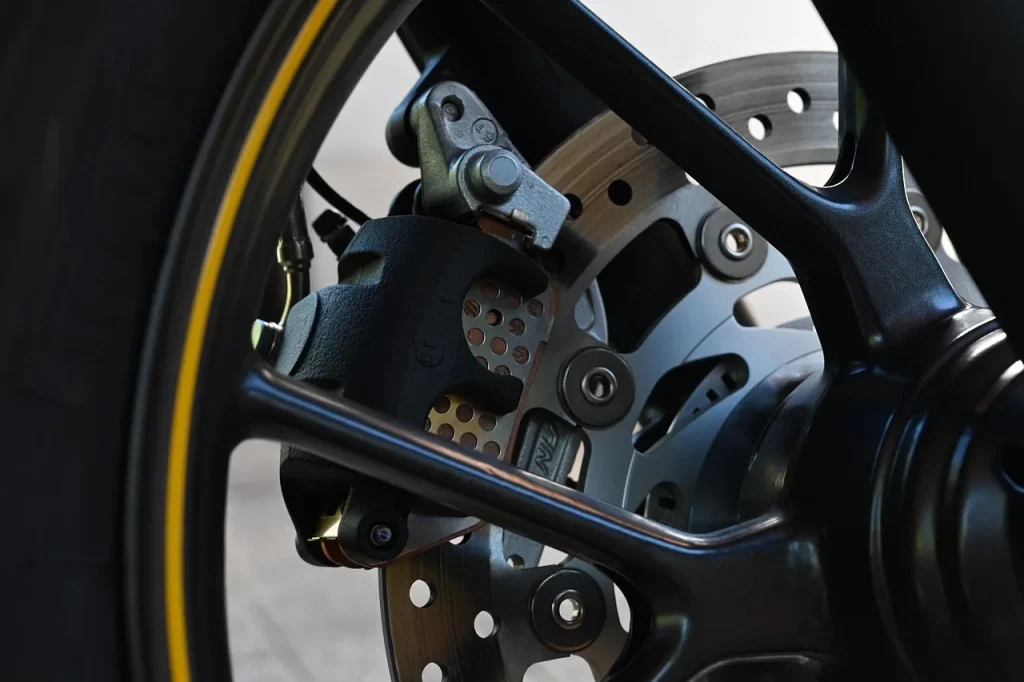
Brake fluid near one wheel often points to a leaking caliper, hose, bleeder screw, hard line, or rear wheel cylinder; if the pedal feels soft or the fluid level drops quickly, do not drive it. Ignoring it can cut braking force sharply, damage pads and rotors, or cause total brake failure. This guide shows how leak patterns reveal the source, what each part looks like, and when the car needs a tow.
This guide is part of our Power steering and brake problems series.
How to tell brake fluid from other leaks
Brake fluid near a wheel is usually clear to yellowish, sometimes amber or colorless, and it feels oily rather than watery. Brake fluid can be hard to spot because a small leak may leave no visible puddle, especially if it dries on suspension parts or inside a wheel.
What brake fluid looks and feels like
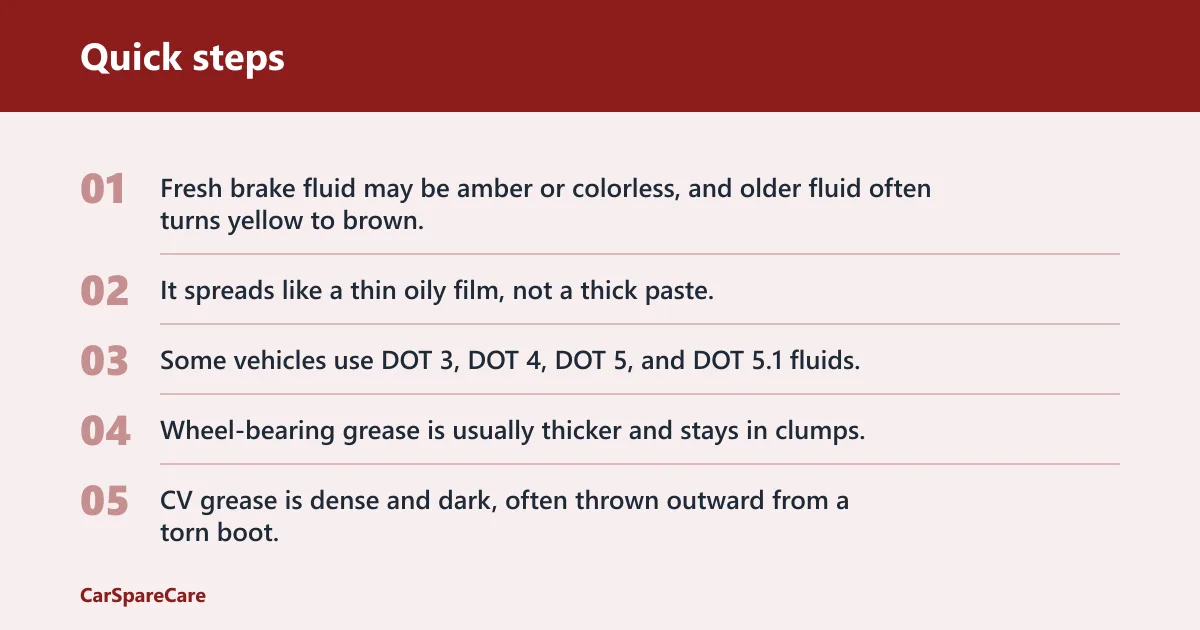
Fresh brake fluid may be amber or colorless, and older fluid often turns yellow to brown. It spreads like a thin oily film, not a thick paste. Some vehicles use DOT 3, DOT 4, DOT 5, and DOT 5.1 fluids, but DOT 5 is silicone-based and not interchangeable with most systems, and the leak pattern near the wheel matters more than the label on the cap.
How brake fluid differs from grease, oil, and road grime
Wheel-bearing grease is usually thicker and stays in clumps, often flung around the inside of the wheel in spots. CV grease is dense and dark, often thrown outward from a torn boot. Differential oil smells sharp and appears farther inboard, not at the caliper or backing plate. Brake fluid is thinner and often shows up at a fitting, bleeder, hose crimp, or wheel cylinder.
Say your front wheel has a wet streak on the back side of the rim and the brake fluid reservoir is low. That pattern points more toward a caliper, hose, or bleeder leak than wheel grease, which usually sits closer to the hub or suspension joints.
What puddle location near a wheel can tell you
Location matters. Wetness at the inside of the wheel often points to a caliper or wheel cylinder. Fluid at the back of the tire can come from a brake line or hose that leaks before the fluid reaches the caliper. Wet backing plates on drum brakes usually point to a wheel cylinder.
What parts near the wheel can leak brake fluid?
Several wheel-end parts can leak brake fluid: the brake caliper piston seals, the bleeder valve, the banjo fitting, the flex hose, the hard line, and the rear wheel cylinder. A leak can come from corrosion, worn seals, loose fittings, or damage after brake work.
Brake caliper piston seals and bleeder valve
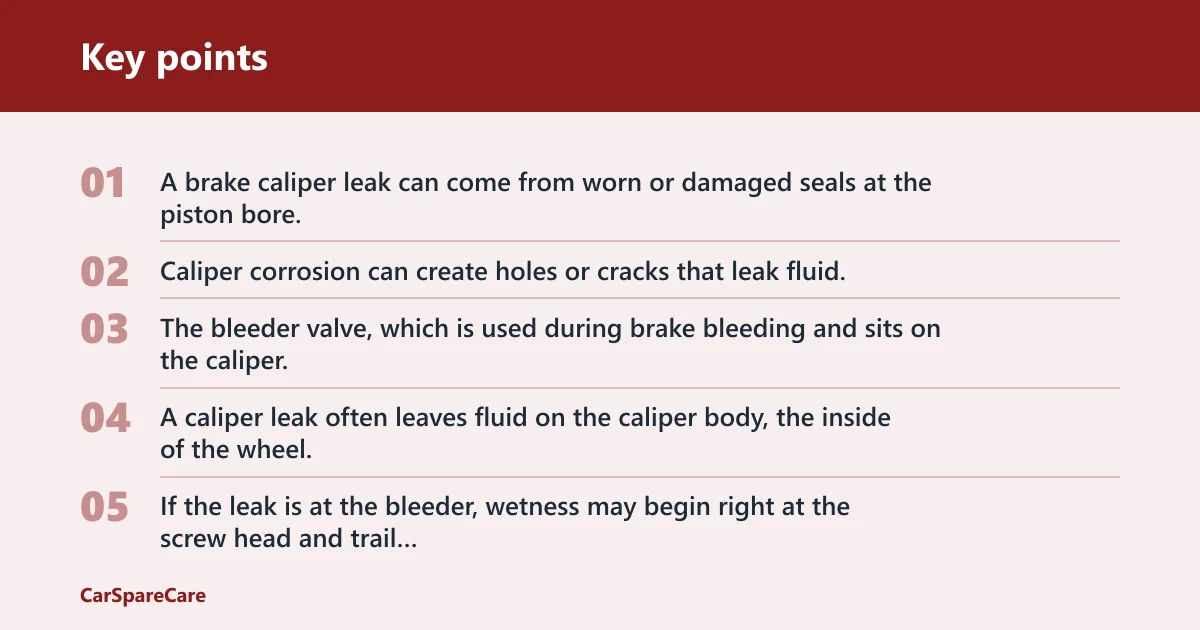
A brake caliper leak can come from worn or damaged seals at the piston bore. Caliper corrosion can create holes or cracks that leak fluid. The bleeder valve, which is used during brake bleeding and sits on the caliper, can leak if it is loose or damaged.
A caliper leak often leaves fluid on the caliper body, the inside of the wheel, or the back of the tire. If the leak is at the bleeder, wetness may begin right at the screw head and trail downward.
Banjo fitting, flex hose, and hard line sections
The brake line is a high-pressure hydraulic line that connects the system from the body to the wheel end through hard line and flex-hose sections. It can crack, fray, or hole near the wheel, and a damaged brake line can leak before fluid reaches the caliper. A banjo fitting can also leak if the sealing washers are damaged or the bolt was not tightened correctly.
Line leaks often wet the hose, the hose-to-caliper joint, or the section clipped near the strut or trailing arm. Hose failures may leave a damp, bulged, or softened section. After recent brake work, a nicked seal or cross-threaded fitting is a common reason for leakage.
Rear wheel cylinder and nearby ABS hydraulic parts
Rear drum brakes commonly use a wheel cylinder inside the drum. If it leaks, fluid can collect inside the drum, soak the shoes, and show up at the inside edge of the tire or backing plate.
Suppose a rear wheel has a damp backing plate and a low fluid warning on the dash. That points more toward a rear wheel cylinder or nearby hydraulic issue than a tire problem.
Why is my brake fluid leaking near one wheel?
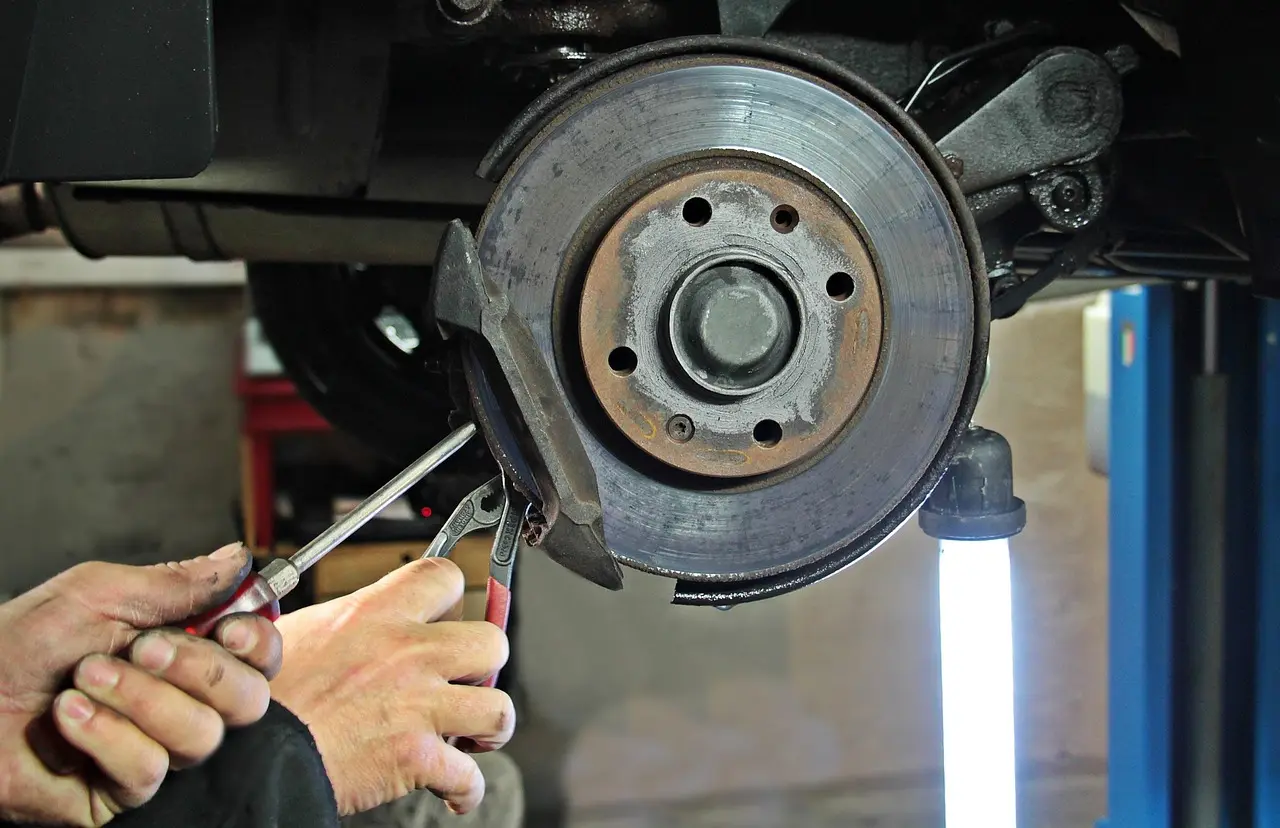
One-wheel leaks usually mean the failure is local, not at the master cylinder. On front disc brakes, the usual suspects are the caliper piston seals, the bleeder valve, the banjo fitting, or the flex hose. On rear disc systems, the leak often sits at the caliper or hose near the trailing arm. On rear drums, the wheel cylinder is the main part to check first.
Front disc brake leak patterns
Front disc leaks often show up as fluid on the caliper body, wetness behind the rotor, or a streak down the back of the tire. A hose-to-caliper joint leak can leave fluid at the fitting while a caliper piston seal leak often leaves a broader wet area around the piston bore. Corrosion around the caliper can also open a crack or hole.
Rear disc brake leak patterns
Rear disc leaks can look similar to front leaks, but the wetness may collect near the trailing arm or axle area before reaching the wheel. A failed caliper, hose crimp, or line section can all wet the same zone. If the leak is closer to the axle tube than the wheel face, the hard line deserves close attention.
Rear drum brake leak patterns
Rear drum leaks usually point to the wheel cylinder. Fluid may be found inside the drum, on the backing plate, or at the inside edge of the tire. Because the leak is inside the drum, the first clue may be brake shoe contamination rather than an obvious puddle on the ground.
Brake fluid leak symptoms you should watch
Brake fluid loss often shows up as a soft or spongy pedal, a pedal that travels farther than usual, reduced braking force, or a warning light on the dash.
Soft or spongy pedal feel
A soft pedal often means air has entered the system or fluid is escaping somewhere. The pedal may feel compressible at the top of its travel, then improve after pumping. That is a sign of lost hydraulic pressure, not a normal condition to ignore. (Thedrive)
Pedal dropping toward the floor
If the pedal keeps sinking while you hold steady pressure, treat it as a serious fault. That can happen when fluid escapes quickly, when a seal fails, or when the master cylinder can no longer hold pressure. A pedal drop is a stronger warning than mild softness.
Brake warning light and ABS light
A brake warning light or ABS light can come on with low fluid or a system fault. Low brake fluid is a warning sign of system loss and needs immediate inspection. If a light appears together with a changing pedal feel, stop driving and inspect the car before moving it again.
Wheel-End brake fluid leak map
| Leak location | Likely failing part | Residue appearance | Pedal symptoms | Urgency |
|---|---|---|---|---|
| Front disc: caliper body or behind rotor | Caliper piston seals or caliper corrosion | Wet caliper face, fluid on inside of wheel, streaks on back of tire | Soft or spongy pedal, longer stopping distance | Do not drive if fluid is dripping or pedal drops |
| Front disc: bleeder screw area | Bleeder valve loose or damaged | Wetness centered at bleeder head, runs downward | Possible gradual pedal softness | Do not drive if wetness is active or fluid level falls fast |
| Front disc: hose-to-caliper joint or line near wheel | Banjo fitting, flex hose, or hard line leak | Wet hose crimp, damp fitting, spray on suspension | Reduced hydraulic pressure, pedal travel increases | Do not drive if the leak is active or the brake light is on |
| Rear disc: caliper, hose, or trailing-arm area | Caliper seals, hose crimp, or hard line section | Fluid near axle area, wet caliper, streaks on wheel inner face | Soft pedal, pedal going lower, reduced braking | Do not drive if the pedal changes or a drip is visible |
| Rear drum: inside drum or backing plate | Rear wheel cylinder | Wet backing plate, soaked shoes, fluid at inside tire edge | Pedal may feel low or spongy | Do not drive if the drum is wet or the warning light is on |
| Near wheel with ABS unit nearby | ABS hydraulic component seal failure | Wet hydraulic block, fluid tracing from module area | Brake and ABS lights may appear together | Do not drive if warning lights and pedal change happen together |
How to inspect the leak without guessing
Start at the reservoir and master cylinder, then trace the line, hose, and fitting path to the wheel. Look for the wettest point, not just the lowest point. Brake fluid can travel along a part and drip somewhere else, so you need to follow the residue back to its source.
- Check the reservoir level in the engine bay and note whether the warning light is on.
- Inspect the master cylinder for wetness around the seals and outlet area.
- Follow the brake line from the body to the wheel, checking hard line sections for rust, cracks, or holes.
- Look at each hose crimp and fitting for dampness or spray.
- Inspect the caliper body, bleeder screw, and banjo fitting.
- For rear drum brakes, remove the drum if you have the proper tools and mechanical experience, then check the wheel cylinder and backing plate.
The order matters because a leak can start upstream of the wheel. If the master cylinder reservoir is low but the wheel looks dry, the leak may be at a line or ABS component hidden higher up.
Brake fluid absorbs water over time, and low fluid can let air into the brake lines. That is why a small leak can turn into a pedal problem before a puddle appears. Brake fluid leaking from normal wear is still a fault that needs repair, not a top-off.
Can you drive with brake fluid leaking?
If the leak is only a small damp spot and the pedal still feels normal, the car still needs immediate inspection. If the fluid is actively dripping, the pedal is soft, or a warning light comes on with a change in pedal feel, towing is usually the safer call.
Small dampness versus active drip
A damp fitting or light film on a caliper suggests the leak may be early, but it is still a fault. Active dripping means fluid loss is ongoing, and the braking system may lose pressure quickly. The faster the fluid level drops, the less margin you have.
When towing is the safer call
Do not drive if the pedal sinks, if the brake warning light is on with a changed pedal feel, or if fluid is visibly dripping near the wheel. A tow is also the safer choice if the leak is at a wheel cylinder and the drum is soaked, because contaminated shoes can reduce braking even after the leak slows.
Why topping off is only a temporary step
Topping off the reservoir does not fix the leak. It only hides the low-fluid warning for a short time. The failed part still needs to be found and repaired, and any air in the lines must be removed before the car is safe to use again.
Frequently asked questions
Is brake fluid leaking from a caliper or brake line?
If the wettest point is on the caliper body, bleeder, or piston area, the caliper is the likely source. If the line, hose crimp, or fitting is wet before fluid reaches the caliper, the brake line is more likely. Trace the wet trail back to the first damp connection.
What causes brake fluid to leak out by the back tire?
On rear disc brakes, a caliper, hose, or hard line near the trailing arm can leak. On rear drum brakes, the wheel cylinder is the usual source, and fluid can appear at the inside edge of the tire or on the backing plate. Corrosion and disturbed fittings are common causes.
How will brake fluid leakage show up?
It may show up as clear to yellowish fluid near the wheel, a soft or spongy pedal, longer stopping distance, or a brake warning light. Some leaks leave no puddle at all. If the pedal changes or the fluid level drops, treat it as an immediate repair issue.
Why is my brake fluid low?
Low brake fluid often means there is a leak, though worn pads can also lower the reservoir level slightly as caliper pistons extend. If the level drops quickly, assume leakage until proven otherwise. Low fluid can let air into the brake lines and reduce hydraulic pressure.

Hi, I’m Melvin, an automobile engineer with extensive experience in automobile equipment. I currently work for a local automobile firm, where I specialize in the car parts industry. I’ve had the opportunity to collaborate with seasoned inspectors, gaining invaluable hands-on experience that goes beyond just theory.
My passion for automotive care started at a young age, which led me to create CarSpareCare. Through CarSpareCare, I share the knowledge and skills I’ve acquired over the years to help others navigate the world of car maintenance and repairs.
My goal is to provide practical tutorials, essential safety advice, and the latest industry insights so that anyone—whether a beginner or an expert—can confidently tackle their automotive projects.

