
Yes, but only if wear is severe enough to create runout or cupping. If the shake starts mostly around 40–70 mph and changes little with brake pedal pressure, tire balance is often considered more likely than brake hardware. Ignoring it can waste money on the wrong parts and leave a real brake fault unfixed. This guide shows how to separate tire wear, tire balance, and brake hardware by symptom location and a simple test order.
Recognizing vibration symptoms and sources
Yes. Uneven tire wear can make the tire roll unevenly, so braking forces act on a surface that is no longer round and uniform. That irregular contact can create shake, buzz, or steering movement when the brake pads clamp the rotor and load the tire harder.
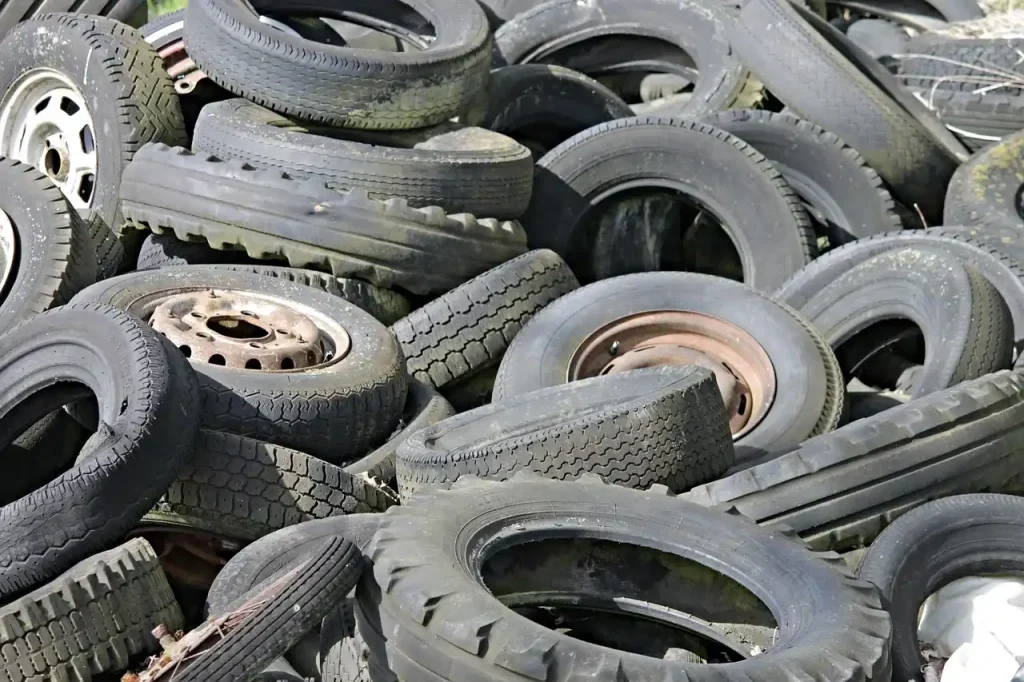
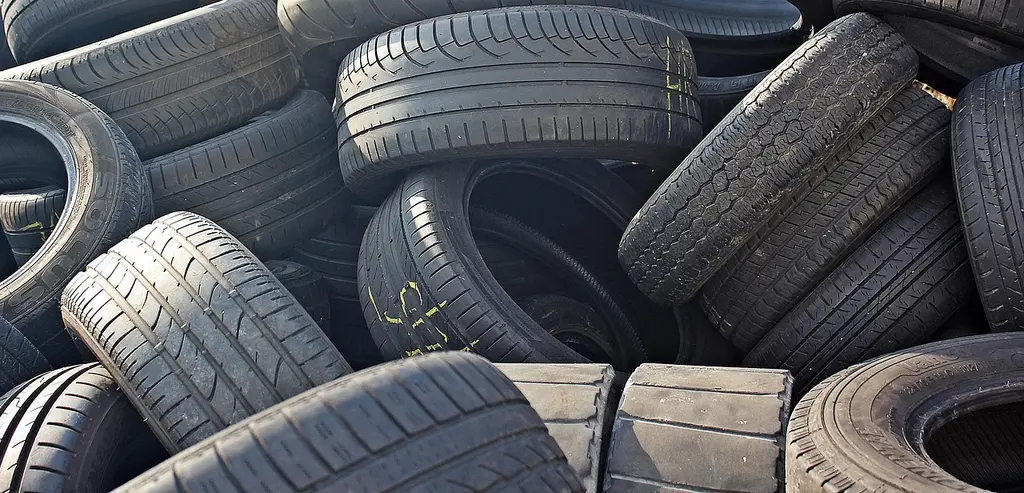
The pattern matters. Bald spots, patchy wear, edge wear, and cupping can all change how the tread contacts the road. Uneven wear can also affect steering and braking, and the symptom may show up more at higher speeds or under firmer braking.
What vibration location tells you
Where you feel the vibration is a useful clue. Steering wheel shake often points toward the front axle, while seat vibration often points toward the rear. Brake pedal pulsation points more directly to brake hardware, especially rotor runout or pad issues.
If the car pulls left or right while braking, do not jump straight to tires. Pulling often points to brake force imbalance, tire pressure differences, alignment, or a suspension problem that is letting one wheel carry load differently.
Vibration decision table
| Symptom | Likely cause | Next check | Likely repair |
|---|---|---|---|
| Vibration only while braking | Brake rotor runout, uneven brake pad wear, or uneven tire wear that becomes noticeable under braking load | Check brake pedal feel, measure rotor runout with a dial indicator, and compare pad thickness on both sides | Resurface or replace rotors, replace worn pads, correct any tire issue found |
| Vibration at all speeds | Severe tire wear, tread separation, bent wheel, or suspension looseness | Inspect tread for bald spots, cupping, or edge wear; check wheel condition and suspension play | Replace damaged tires or wheels, repair worn suspension parts |
| Steering wheel shake | Front tire problem, front wheel imbalance, front rotor runout, or front suspension wear | Road test, then check front wheel balance, rotor runout, tie rod ends, and control arm bushings | Balance wheels, service brakes, replace worn front-end parts |
| Brake pedal pulsation | Rotor runout or rotor thickness variation more than tire wear alone | Measure rotor runout with a dial indicator and inspect pad contact pattern | Resurface or replace rotors; replace pads if uneven or worn |
| Pulling left or right | Alignment problem, brake drag, tire pressure difference, or a stuck caliper | Check toe, camber, caster, tire pressures, and brake caliper action | Alignment correction, brake service, pressure correction |
| Vibration after tire rotation or new tires | Problem moved with the wheel, or the tire change exposed a brake or suspension fault | Compare the symptom by wheel position before and after the swap | Balance the affected wheel, inspect alignment, brakes, and suspension |
How to separate wear from balance
Tire balance and uneven tire wear are different problems. A balance issue usually shows up at certain speeds, and it is often most noticeable over 30 MPH. A worn tire can also shake, but it tends to do so because the tread is no longer contacting the road evenly.
Balance is corrected by adding wheel weights or servicing the wheel. Wear is corrected by finding why the tread became uneven in the first place. Misalignment, improper rotation, and incorrect tire pressure are common causes of that wear.
When brakes are the real cause
Brake rotor runout can mimic a tire problem because it creates a pulsating brake pedal and steering wheel shake during braking. That is why a shop should measure rotor runout with a dial indicator instead of guessing from the road test alone.
Brake pads deserve separate attention. Uneven pad wear or uneven pad material can create inconsistent friction, and that can feel similar to rotor symptoms. A brake inspection should include pad thickness, pad surface condition, and rotor condition on both sides of the axle.
Say your steering wheel shakes only when you slow from highway speed to a stop, but the car feels smooth at a steady cruise. That pattern points more toward the front brakes than the tires, especially if the brake pedal also pulses. By contrast, a constant buzz at 45 MPH that barely changes when you touch the brake pedal points more toward balance or tire damage.
- Inspect each tire for bald spots, patchy wear, edge wear, cupping, and tread separation.
- Check inflation pressure on all four tires while they are cold.
- Review rotation history and whether the symptom changed after a rotation or tire replacement.
- Road test for speed dependence, location of shake, and brake-pedal feel.
- Check wheel balance if the vibration tracks with speed more than braking.
- Inspect brakes for rotor runout, pad thickness, and uneven pad wear.
- Check alignment angles, then inspect suspension and wheel bearings if the fault remains.
Could alignment or suspension be behind it?
Yes. Toe, camber, and caster control how the tire sits on the road, and a fault in those angles can create uneven wear and pulling. Tire wear problems often come from poor alignment or worn suspension, so alignment is part of the path, not the final answer.
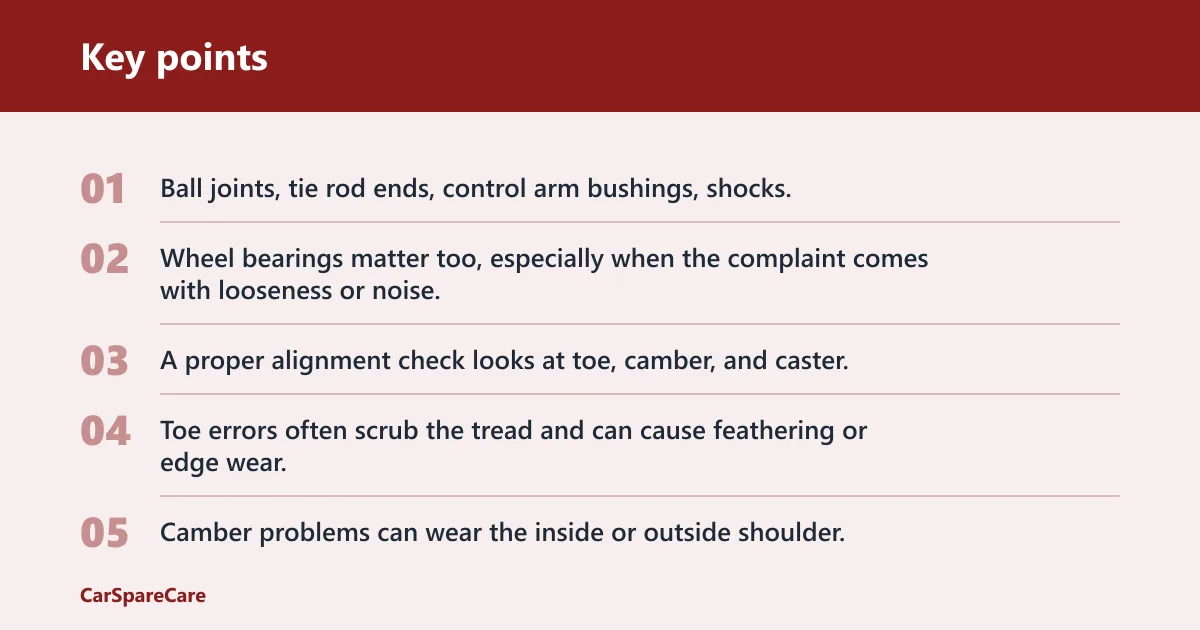
Suspension parts can also amplify vibration. Ball joints, tie rod ends, control arm bushings, shocks, and struts can let the wheel move enough to worsen braking shake. Wheel bearings matter too, especially when the complaint comes with looseness or noise.
What a shop should measure or inspect
A proper alignment check looks at toe, camber, and caster. Toe errors often scrub the tread and can cause feathering or edge wear. Camber problems can wear the inside or outside shoulder. Caster problems can affect straight-line stability and the way the vehicle reacts under braking.
For the suspension, the relevant check is not a vague visual scan. The parts should be checked for play, torn bushings, loose joints, and leaking or weak dampers. If the wheel can move too much, brake vibration can feel worse than the underlying fault really is.
Picture a front-wheel-drive car with the front tires wearing on the inner shoulders and the steering wheel tugging right during braking. That combination makes alignment and front suspension more likely than a simple balance issue. On a rear-wheel-drive vehicle, a seat shake that changes after rear tires are moved to the front can help localize the bad wheel or tire position.
What to inspect after rotation or new tires
If the vibration changes after rotation, the problem may have moved with the tire or wheel. That tells you the fault can be in the tire itself, the balance of that assembly, or the way that position interacts with the brakes or suspension. New tires do not rule out rotor runout, alignment issues, or worn suspension parts.
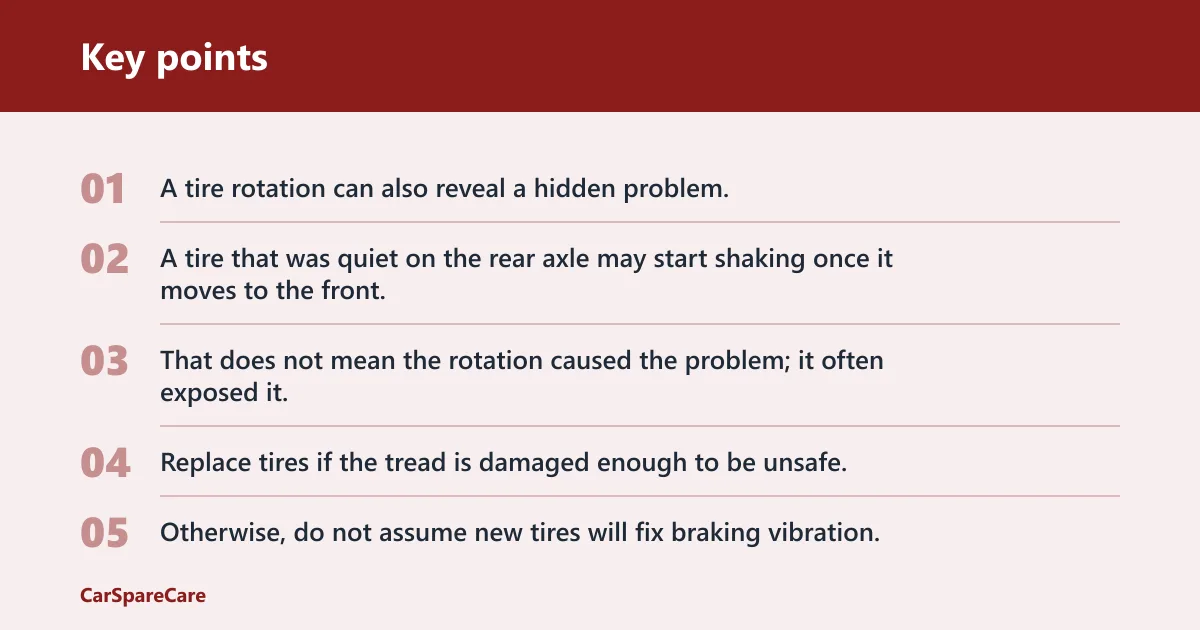
A tire rotation can also reveal a hidden problem. A tire that was quiet on the rear axle may start shaking once it moves to the front, where the steering wheel can transmit the symptom more clearly. That does not mean the rotation caused the problem; it often exposed it.
Should you replace tires first?
Replace tires if the tread is damaged enough to be unsafe, especially if bald spots appear in the middle or sides. Otherwise, do not assume new tires will fix braking vibration. If the root cause is alignment, brake hardware, or suspension wear, the new tires may wear the same way again.
Correct tire pressure matters too. Underinflation and overinflation can both contribute to uneven wear, and that wear can later become vibration. Pressure checks are part of prevention, not a cure for a brake fault.
Prevention that actually helps
Rotate tires every 5-7 thousand miles. Keep inflation correct, repair tire damage promptly, and get alignment checks when wear starts to drift off pattern. Those steps reduce the chance of bald spots, patchy wear, and edge wear turning into shake.
That same routine also helps isolate future faults faster. If the tires are maintained and the vibration still appears only during braking, the brake side of the diagnosis moves up the list quickly.
Frequently asked questions
Can unbalanced tires cause vibration when braking?
Yes. Unbalanced tires can cause vibration when driving and braking, but the symptom is usually speed-related rather than brake-only. If the shake is strongest above 30 MPH and changes little with brake pressure, balance is more likely than rotor runout or pad wear.
Will low tire pressure cause vibration when braking?
Low tire pressure can contribute to uneven wear and irregular road contact, and that can feed vibration while braking. It is not the only likely cause, though. Check pressure first, then look for wear patterns, balance issues, and brake hardware if the symptom persists.
Can overinflated tires cause vibration?
Yes. Overinflated tires can wear the center of the tread faster, which can create an uneven contact patch. That can contribute to shake, especially if the wear becomes severe enough to act like a runout problem. Pressure correction alone may not solve the symptom if wear is already advanced.
What can cause vibration when braking?
Common causes include brake rotor runout, uneven brake pad wear, uneven tire wear, wheel imbalance, alignment faults, suspension wear, and wheel bearing problems. The best clue is whether the vibration appears only during braking, at a certain speed, or with a steering pull or pedal pulsation.
Why does my steering wheel shake when braking?
Steering wheel shake during braking often points to the front brakes, especially rotor runout, but front tire wear and front wheel balance can also do it. If the wheel shake comes with pedal pulsation, brake inspection should come before replacing tires. If it follows speed more than braking, balance moves higher on the list.
Should I replace tires if they are vibrating?
Replace tires if they have bald spots, tread separation, or wear severe enough to fail inspection. If the tires are only out of balance or the vibration began after rotation, balancing or wheel service may be enough. If the brake pedal pulses, do not skip brake measurements.

Hi, I’m Melvin, an automobile engineer with extensive experience in automobile equipment. I currently work for a local automobile firm, where I specialize in the car parts industry. I’ve had the opportunity to collaborate with seasoned inspectors, gaining invaluable hands-on experience that goes beyond just theory.
My passion for automotive care started at a young age, which led me to create CarSpareCare. Through CarSpareCare, I share the knowledge and skills I’ve acquired over the years to help others navigate the world of car maintenance and repairs.
My goal is to provide practical tutorials, essential safety advice, and the latest industry insights so that anyone—whether a beginner or an expert—can confidently tackle their automotive projects.

