Fix loose car seat covers by finding the cause first: loose straps, weak anchors, missing clips, or the wrong size, then retighten, reroute, or add anti-slip backing; replace the cover if fit is poor. Loose covers can bunch, slide while driving, and expose seats to wear. This guide shows how to diagnose the fit problem and fix it by seat type.
What you’ll need
- Elastic straps and hooks
- Clean cloth
- Vacuum
- Optional anti-slip pad
- Vehicle manual for airbag notes
- Small flashlight for under-seat routing
- Trim tool or gloved fingers for tucking fabric
Why do seat covers slip?
Seat covers often slip for one or more common reasons: the cover size may be off, the routing under the seat may be loose, the upholstery may be dusty or slick, or the elastic may have stretched. Universal-fit covers often depend on straps, hooks, and hem tension instead of a model-specific shape, so they may fit differently from vehicle-specific covers.
If a rear cover is meant for a 60/40 split bench, the seam should align with the center fold rather than sit across it. The cover will pull to one side each time the seatback moves. In that case, the issue is alignment, not just tension.
Wrong size or seat shape mismatch
Universal-fit seat covers can fit many vehicles, but larger or strongly shaped seats can make them look loose even when installed correctly. Bucket seats, deep bolsters, and benches with armrests or split backs need the right pattern. Custom-fit covers usually reduce wrinkling because they depend on exact model matching.
Loose routing under the seat
Elastic straps and hooks must pass under the seat frame and pull straight, not twisted. Avoid seat tracks, airbag wiring, occupancy-sensor wiring, and other under-seat hardware when routing or tightening the straps, and do not let the straps rest on trim or moving parts. If the straps sit on carpet trim or cross each other, they lose tension and the cover creeps forward. A loose under-seat path is one of the fastest causes to check first.
Dust, moisture, or slick upholstery
Anti-slip backing generally works best on clean, dry upholstery. Dust, spilled drink residue, and damp fabric reduce grip. Neoprene covers often use anti-slip backing and are used for sweat management, but even that backing loses hold if the seat surface is dirty.
Wear in elastic or seams
Elastic straps can loosen over time, and seams near cutouts can stretch. That is common after repeated removal, washing, or heavy daily use. Polyester covers may need retensioning after washing, especially in budget universal sets.
Loose seat cover diagnosis matrix
Use this matrix to match the symptom to the likely cause before you tighten anything. It separates universal-fit and custom-fit problems, and it also shows where bucket seats, split benches, and slippery upholstery change the fix.
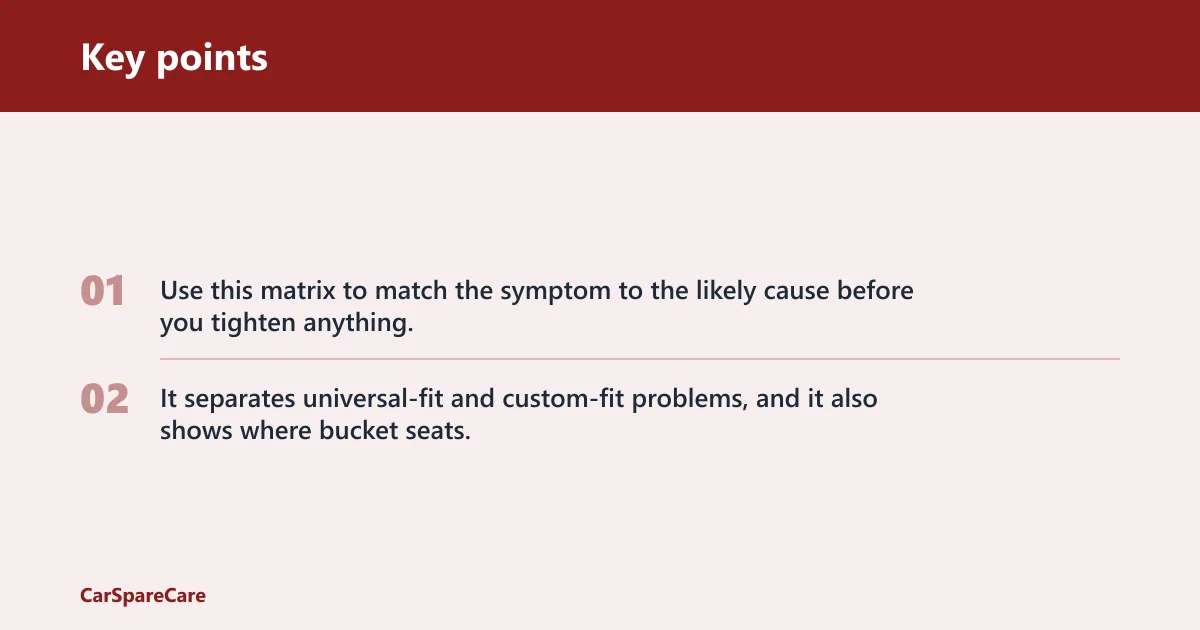
| Symptom | Likely cause | Universal vs custom-fit | Bucket vs bench | Dry vs slippery upholstery | Fastest fix | Replace instead when |
|---|---|---|---|---|---|---|
| Seat back sags | Wrong size or weak upper tension | More common on universal covers | Bucket seats show it first | Worse on slippery fabric | Re-seat the top edge and tighten the upper straps | The cover cannot stay centered after retensioning |
| Cover slides forward | Loose under-seat routing | Common on universal-fit covers | Both, but deeper buckets slip faster | More likely on dusty upholstery | Reroute straps under the seat frame | Straps no longer hold tension |
| Fabric bunches at the sides | Seat shape mismatch | More common on universal covers | Bucket side bolsters cause it often | Dry or slippery both can show it | Re-align the cover and smooth the side panels | Wrinkles remain after alignment |
| Rear cover pulls across the middle | Split-seat seam out of line | Both, but fit-critical on universal | Bench only, especially split layouts | Not mainly surface-related | Match zippers and seams to the 40/60, 50/50, or 60/40 split | The cover has the wrong split pattern |
| Headrest opening sags | Cutout placed after fastening | Both | Both | Not mainly surface-related | Realign the headrest cutout before securing straps | The opening is cut for a different seat shape |
| Armrest section wrinkles | Armrest cutout misaligned | More likely on universal covers | Bench with armrest or center fold | Not mainly surface-related | Refit the cover with the armrest opening centered | The cover lacks the right cutout |
| Cover still slips after tightening | Dusty seat or worn elastic | Both | Both | Common on dusty seats | Clean the upholstery and add anti-slip backing | Elastic no longer rebounds |
| Edge lifts near the seat airbag zone | Wrong cover design or bad routing | Both | Both | Not mainly surface-related | Stop and check the product’s airbag compatibility marking | It blocks or crowds the side airbag area |
How do you tighten the fit?
Start by refitting the cover squarely, then align every cutout before you pull any strap tight. That order matters because a cover that starts crooked keeps pulling itself out of shape. Universal-fit covers usually need this sequence more than custom-fit ones.
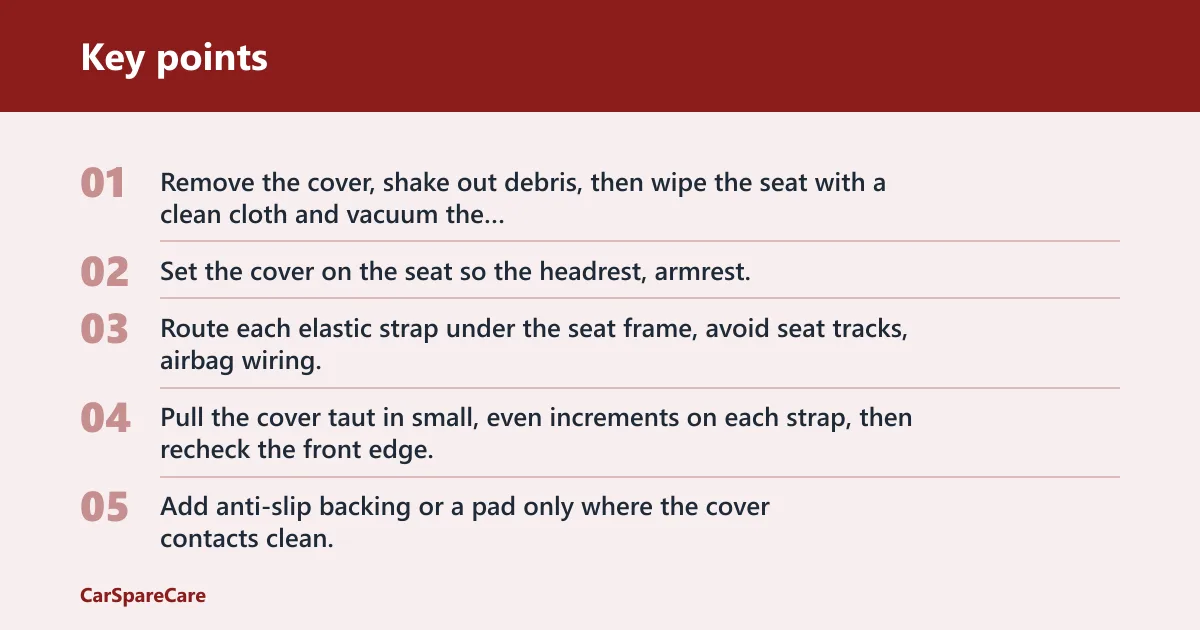
- Remove the cover, shake out debris, then wipe the seat with a clean cloth and vacuum the seams.
- Set the cover on the seat so the headrest, armrest, and split-seat openings line up before fastening.
- Route each elastic strap under the seat frame, avoid seat tracks, airbag wiring, occupancy-sensor wiring, and other under-seat hardware, and hook it to a secure anchor point on the seat frame or a manufacturer-provided attachment point before tightening it without twisting the strap.
- Pull the cover taut in small, even increments on each strap, then recheck the front edge, side bolsters, and backrest.
- Add anti-slip backing or a pad only where the cover contacts clean, dry upholstery and only if the fit still slides.
- Close the door, sit in the seat, and confirm the cover stays secure while parked before you drive.
Some universal covers include elastic straps and hooks, and some sweatproof covers add anti-slip backing. A common first-timer mistake is to pull one strap fully tight while leaving the opposite side loose. That creates a diagonal wrinkle and can make the cover feel worse.
Suppose a driver has a polyester universal set on a bucket seat, and the cover bunches after washing. Retensioning the straps and re-centering the side seams may solve it if the elastic is still sound. If the hem stays loose after that, the set may be past its useful fit range.
Split bench, bucket seat, and cutout checks
Rear seat covers often fail because the split pattern does not match the vehicle. Some universal covers fit 40/60, 50/50, and 60/40 split bench layouts, but the seams and zippers still need to line up with the actual fold. Headrest and armrest cutouts must also be positioned before you lock the straps down.
Common mistakes
Most loose-cover problems come from installation errors, not from damage alone. The main traps are twisted straps, ignored split-seat seams, blocked airbag zones, and trying to force grip onto a dirty seat. Fix those first, because add-on grippers will not make a poor fit safe or stable.
- Twisting elastic straps under the seat, which reduces tension and can make the hooks slip free.
- Pulling the straps tight before the headrest and armrest cutouts are lined up.
- Ignoring 40/60, 50/50, or 60/40 split alignment on rear bench covers.
- Using foam inserts or grippers on dusty upholstery and expecting them to hold long term.
- Covering a side airbag zone with a design that is not marked for airbag compatibility.
Foam or gripper pads can help on clean, dry seats, but they are support items, not a cure for the wrong pattern. If the cover is too large, the pad only hides the problem for a while. Clean the seat first, then use the pad as a last adjustment.
When should you replace it?
Replace the cover when the elastic is stretched, the seams are torn, or the fit stays loose after correct routing and retensioning. You should also stop adjusting it if the shape mismatch keeps creating bunching on side bolsters, split-seat seams, or armrest openings. Persistent movement is a fit failure, not a tightening failure.
- Check for stretched elastic, cracked hooks, torn seams, or a split hem near the attachment points.
- Confirm model compatibility again, including bucket-seat shape, split bench layout, side airbag compatibility, and whether the cover is approved for seats with side airbags and seat-mounted controls or sensors.
- If the cover still shifts after a clean re-install, replace it with a custom-fit or better-matched universal cover.
- For rear seats, choose a design sold for split seats if the vehicle uses a split bench.
Custom-fit seat covers usually fit better than universal covers because they are cut for the vehicle. If the current cover is universal and the seat has deep bolsters or a complex center section, replacement is often the cleaner fix.
Side airbag compatibility matters here. Some seat covers are designed to be compatible with side airbags, and the product description should state that clearly. If the cover blocks that zone or the label is missing, do not keep tightening it into place.
Frequently asked questions
Why do car seat covers keep sliding?
Sliding usually comes from loose routing, dusty upholstery, weak elastic, or a cover that does not match the seat shape. Anti-slip backing works best on clean, dry fabric and can lose grip on dusty surfaces. If the cover shifts every time you get in, the fit is too loose for the seat.
How do I keep universal seat covers from bunching up?
Keep the cover centered before you tighten the straps, then smooth the side panels over the bolsters and recheck the cutouts. Universal-fit covers often need more adjustment because they rely on straps, hooks, and elastic hems. If bunching stays at the same edge, the seat shape may be outside the cover’s fit range.
Can I use foam or grippers to stop seat covers moving?
Yes, but only as a support, not a fix for a poor fit. Foam or grippers work best on clean, dry upholstery and are less useful on dusty or damp seats. If the cover is too large, the add-on may slow movement without solving the real mismatch.
When should I replace a loose seat cover instead of fixing it?
Replace it when the elastic is worn out, the seams are damaged, the cover does not match a split bench or bucket seat, or it still slips after a proper refit. Replace it immediately if the design interferes with a side airbag zone. Repeated tightening will not cure a bad pattern.

Hi, I’m Melvin, an automobile engineer with extensive experience in automobile equipment. I currently work for a local automobile firm, where I specialize in the car parts industry. I’ve had the opportunity to collaborate with seasoned inspectors, gaining invaluable hands-on experience that goes beyond just theory.
My passion for automotive care started at a young age, which led me to create CarSpareCare. Through CarSpareCare, I share the knowledge and skills I’ve acquired over the years to help others navigate the world of car maintenance and repairs.
My goal is to provide practical tutorials, essential safety advice, and the latest industry insights so that anyone—whether a beginner or an expert—can confidently tackle their automotive projects.