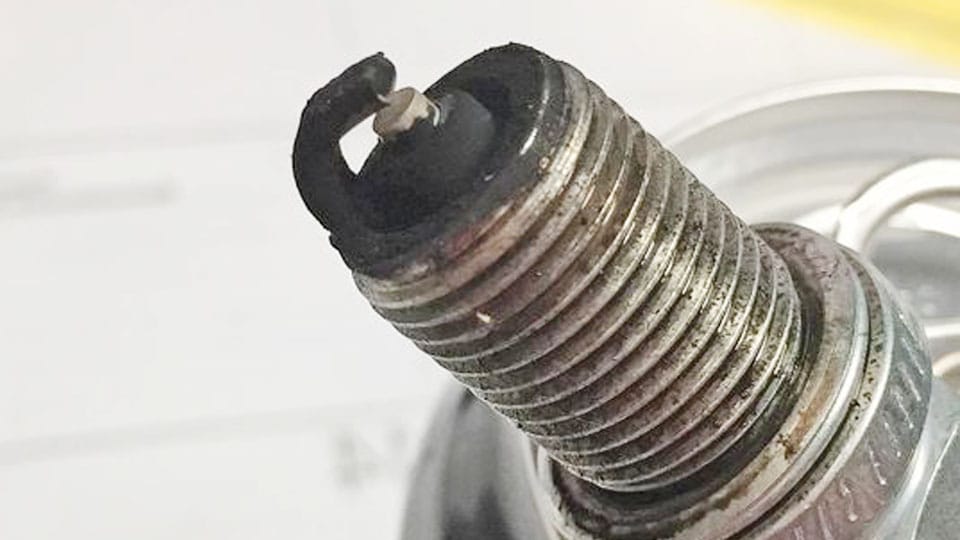
Match the OEM spark plug material and electrode design unless the engine manual or coil-on-plug system clearly allows a different spec; platinum can suit many higher-mileage intervals, while iridium is often chosen for finer electrodes and longer service life (OEM service manual; NGK/Denso application guidance). Wrong choice can mean misfires, rough idle, or short plug life. This guide compares iridium and platinum spark plugs by ignition design, replacement interval, and fitment.
| Decision factor | Iridium | platinum spark plugs | Winner |
|---|---|---|---|
| OEM fitment match | Strong when the vehicle was designed for iridium; common on many newer vehicles (OEM service manuals; NGK/Denso catalog guidance) | Strong when the manual calls for platinum, especially single-platinum or double-platinum designs (OEM service manuals; Autolite/NGK application notes) | Tie |
| Service interval target | 80,000–100,000 miles typical in many OE applications, but the exact interval is application-specific and can be shorter or longer (OEM service manuals; NGK/Denso service-life guidance) | About 60,000 miles is common for many platinum applications, though some OE schedules specify different intervals depending on engine and plug family (OEM service manuals; Autolite/NGK catalog notes) | Iridium |
| Fine-wire electrode design | 0.4–0.6 mm center electrode is common in fine-wire OE designs; the smaller tip helps firing but is more sensitive to handling and gap adjustment (NGK/Denso technical docs; manufacturer gap-adjustment warnings) | 0.6–0.8 mm center electrode is common in many platinum designs; it is generally less delicate than fine-wire iridium, but still must follow the listed spec (OEM service manuals; Autolite/NGK docs) | Iridium |
| Waste-spark compatibility | Works when the exact OE spec calls for it; some waste-spark applications use iridium by design (OEM manual; Delphi ignition references) | Double platinum is built for this system because both electrodes wear more evenly in reverse-polarity firing (OEM manual; Delphi ignition references) | platinum spark plugs |
| Cost over one ownership horizon | Higher upfront cost, often better if you want a longer interval or the OE part is already iridium (parts catalog/OEM schedule) | Lower upfront cost, better if the car is sold or serviced sooner and the OE schedule supports platinum (OEM schedule; catalog guidance) | Depends on interval |
Fitment priority and total cost over your ownership period
Iridium wins when the engine was engineered for a fine-wire plug and you want the longest sensible replacement interval. platinum spark plugs win when the manual specifies platinum, the ignition design does not need a fine-wire tip, or the ownership horizon is shorter than the extra service life would justify (OEM service manual; NGK/Denso/Autolite application guidance).
OEM fitment comes first
Material alone does not decide the better plug. The ignition system, heat range, reach, thread size, seat type, and electrode design all need to match the vehicle’s OE listing or a clearly equivalent replacement (OEM service manual; NGK/Denso catalog instructions).
Say your owner’s manual lists a double-platinum plug for a waste-spark system. Swapping in a random iridium plug may work only if that exact iridium part number is listed as compatible. If it is not, the safer choice is the specified platinum design (OEM manual; Delphi ignition references).
Ownership horizon and cost per mile
Iridium often costs more at the counter, but the right comparison is cost over the miles you plan to keep the car. If the OE schedule and catalog support a long interval, the extra upfront cost can be justified by fewer replacements (OEM service manual; NGK/Denso application guidance).
platinum spark plugs make more sense when the vehicle will be sold sooner, the annual mileage is modest, or the engine’s spec does not call for a fine-wire center electrode. Price alone is not the metric to use (OEM schedule; Autolite catalog guidance).
What changes between plug materials?
The key differences are center electrode diameter, firing voltage, erosion resistance, and how each plug handles wear at the ground electrode. Iridium uses a fine-wire center electrode and a very high melting point, while platinum uses a thicker tip and sits in the middle of the price range (NGK/Denso technical references; SAE/ignition reference materials).
Center electrode diameter and firing voltage
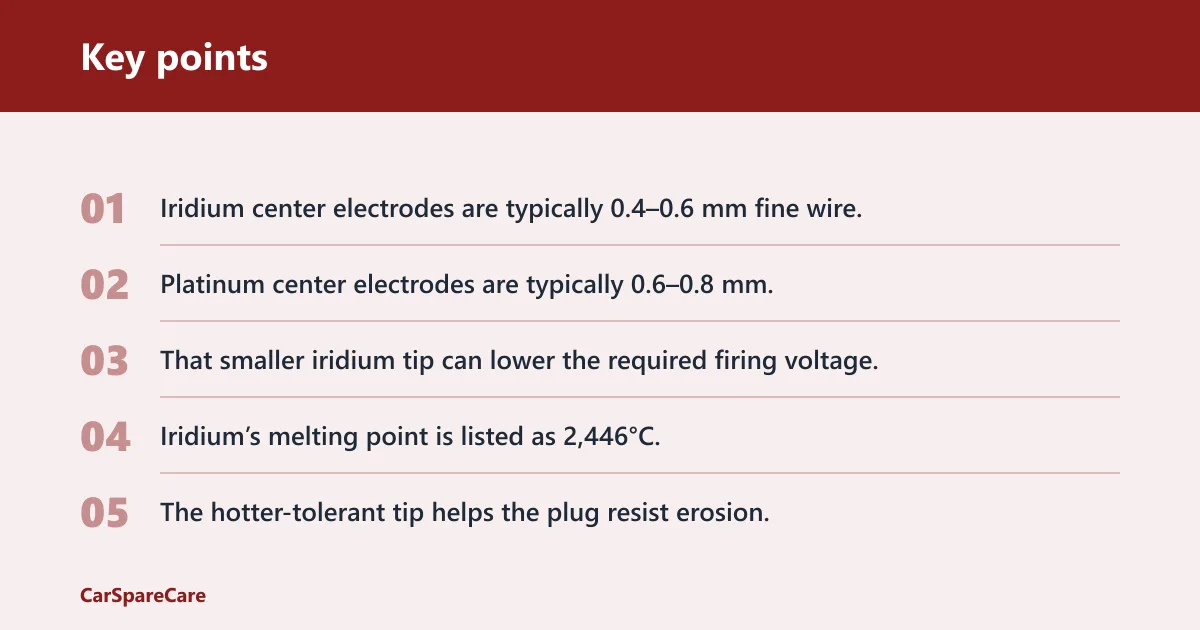
Iridium center electrodes are typically 0.4–0.6 mm fine wire. Platinum center electrodes are typically 0.6–0.8 mm. That smaller iridium tip can lower the required firing voltage, which matters in ignition systems designed around a sharper arc (NGK/Denso technical docs; OEM service manual).
Iridium’s melting point is listed as 2,446°C, while platinum’s is listed as 1,768°C (materials reference data from NGK/Denso technical literature). The hotter-tolerant tip helps the plug resist erosion, but the advantage only matters when the rest of the ignition design matches it.
Erosion resistance and service life
Iridium is described in manufacturer literature as much harder than platinum, which helps it hold its shape over long service intervals (NGK/Denso product literature). Its typical service interval is often listed at 80,000–100,000 miles in many OE applications, but the exact interval depends on the engine and part number, not the material alone (OEM service manual; catalog guidance).
platinum spark plugs are commonly listed around 60,000 miles in many applications, though some OEM schedules and catalog listings place certain platinum designs higher or lower. That spread is why the vehicle listing matters more than a generic material label (OEM service manual; Autolite/NGK catalog guidance).
Ground electrode wear and reverse-fire effects
Double platinum uses platinum on both electrodes. That matters in waste-spark systems, where one firing event uses the center electrode in a normal direction and the paired event can wear the ground electrode more aggressively because the polarity alternates (Delphi ignition references; OEM service manual).
Reverse-fire wear means the electrode that normally acts as the ground side gets used as the firing side on the companion cylinder. In teardown-style diagnostics, a common clue is uneven rounding or accelerated erosion on the side that takes the reverse-polarity event. Double platinum reduces that mismatch because both ends have platinum wear resistance (Delphi ignition references; OEM service manual).
Double platinum or iridium?
Double platinum is the better match when your engine uses waste-spark ignition and the OE listing calls for platinum on both electrodes. Iridium is the better choice when the exact OE part is iridium, especially if the engine is designed for a fine-wire tip and a long interval. The winner is determined by system design, not by material prestige (OEM service manual; Delphi ignition references; NGK/Denso catalog guidance).
Single platinum versus double platinum
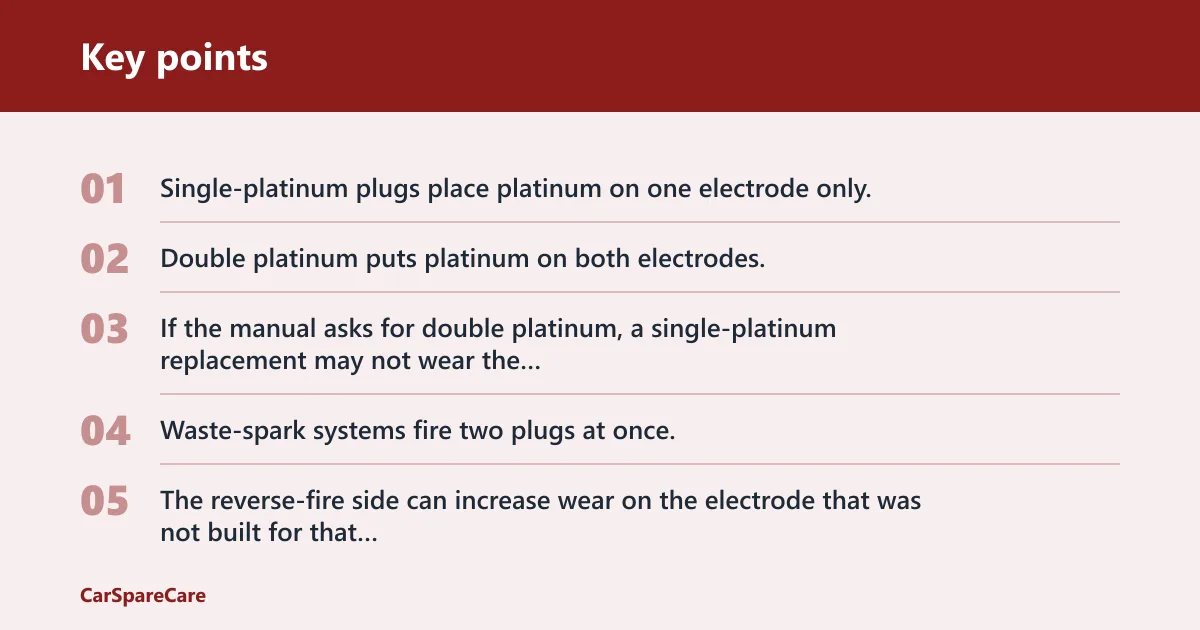
Single-platinum plugs place platinum on one electrode only. Double platinum puts platinum on both electrodes, which is the important detail in systems where polarity and wear direction alternate (OEM service manual; Autolite/NGK application notes).
That difference is easy to miss. If the manual asks for double platinum, a single-platinum replacement may not wear the same way over time, especially in waste-spark applications (Delphi ignition references; OEM service manual).
Why double platinum matters in waste-spark systems
Waste-spark systems fire two plugs at once, and one of those sparks fires in reverse polarity. The reverse-fire side can increase wear on the electrode that was not built for that role (Delphi ignition references; SAE ignition reference materials).
Double platinum is specifically relevant here because both electrodes have platinum, so the plug tolerates that alternating wear pattern better. That is why “platinum” and “double platinum” should never be treated as the same thing (OEM service manual; Delphi ignition references).
When iridium still fits a waste-spark application
Some waste-spark applications specify iridium as the OE replacement. In those cases, the ignition system does not rule iridium out; the exact part number does the deciding (OEM service manual; NGK/Denso catalog guidance).
Use the OE listing, not a blanket rule. If the catalog shows iridium for that engine code, it can be the correct match even in a waste-spark system (OEM manual; catalog guidance).
Which plug matches your ignition system?
Different ignition systems place different demands on the spark plug. Coil-on-plug systems often benefit from OE iridium designs, waste-spark systems may call for double platinum or iridium depending on the engine, and older distributor-based systems are not automatically a reason to move away from the factory plug spec (OEM service manual; SAE/Delphi ignition references).
Coil-on-plug systems
Coil-on-plug systems often use fine-wire iridium from the factory because the spark event benefits from lower required firing voltage and long service life. If the car was built with that setup, staying with the specified iridium plug is usually the cleanest choice (OEM service manual; NGK/Denso application guidance).
That does not mean every coil-on-plug engine needs iridium as an upgrade. It means the OE design often expects it (OEM service manual).
Waste-spark systems
Waste-spark systems are where double platinum becomes especially relevant. The paired electrodes see alternating wear, so a plug built with platinum on both ends can better match that duty cycle (Delphi ignition references; OEM service manual).
Iridium can still be correct here if the engine’s OE replacement is iridium. The warning is simple: do not assume every waste-spark engine wants platinum only because reverse-fire wear exists (OEM service manual; NGK/Denso catalog guidance).
Electronic distributor ignition and older distributor-based systems
Electronic distributor ignition and older distributor-based systems need the plug type the engine was designed around. Many older engines were built for copper plugs, so platinum is not always an automatic upgrade and iridium is not always an automatic gain (OEM service manual; Autolite application guidance).
If the manual specifies a particular platinum plug, follow it. If it specifies another material, do not swap by habit (OEM manual).
Spark plug gap and fitment
Gap matters because it changes how easily the spark jumps from center electrode to ground electrode. Fine-wire plugs can be more sensitive to gap changes, and the wrong reach or heat range can cause drivability problems even when the thread fits (OEM service manual; NGK/Denso installation instructions).
Gap adjustment sensitivity
Iridium fine-wire electrodes are fragile enough that most manufacturers say not to adjust them. Some iridium plugs can be adjusted carefully if the maker allows it, but the rule is to follow the part-specific instruction sheet (NGK/Denso manufacturer warnings; OEM instructions).
platinum spark plugs are generally less delicate, but they still should not be forced out of spec. A bad gap can cause misfire, rough idle, or hard starting (OEM service manual; Autolite/NGK instructions).
Manufacturer warnings for fine-wire tips
The fine-wire tip is there for a reason. Bending it can damage the electrode or alter the firing edge, which defeats the point of buying iridium in the first place (NGK/Denso warnings).
A common shop-level diagnostic pattern is a plug that runs fine at idle but starts to misfire under load after a material downgrade or improper gap change. That kind of failure often traces back to the plug not matching the ignition design, not to the plug being visibly broken (OEM service manual; Delphi/NGK reference guidance).
Heat range and thread reach mistakes to avoid
Wrong heat range or thread reach can cause more trouble than choosing iridium versus platinum. A plug that is too hot can overheat; a plug that sits too far into the chamber can interfere with combustion or piston clearance (OEM service manual; NGK/Denso catalog instructions).
If the engine calls for a specific OE part number, match that first. Material comes second (OEM service manual).
Iridium vs platinum by ignition system and ownership horizon
Use this table as a decision path, not a universal ranking. The same plug can be right in one engine and wrong in another, even if both are four-cylinder gasoline engines (OEM service manual; NGK/Denso application guidance).
| Ignition type | OEM fitment risk | Recommended plug type | Expected service interval | Upgrade or downgrade warning |
|---|---|---|---|---|
| Coil-on-plug | High if you ignore the OE listing | Iridium when specified by the manufacturer | 80,000–100,000 miles when that is the application target (OEM schedule; NGK/Denso catalog data) | Do not switch to platinum just because it is cheaper |
| Waste-spark | High if you confuse single platinum with double platinum | Double platinum or OE iridium, depending on the engine code | 60,000 miles for many platinum applications; longer for OE iridium (OEM schedule; Autolite/NGK data) | Do not assume all waste-spark systems want platinum only |
| Electronic distributor ignition | Moderate | Match the OE specification exactly | Application-dependent | Do not upgrade by material alone |
| Older distributor-based system | Moderate to high if the engine was designed around copper | Match the factory spec; many older engines were not built around platinum or iridium | Application-dependent | Do not assume a premium plug is automatically better |
Reading the
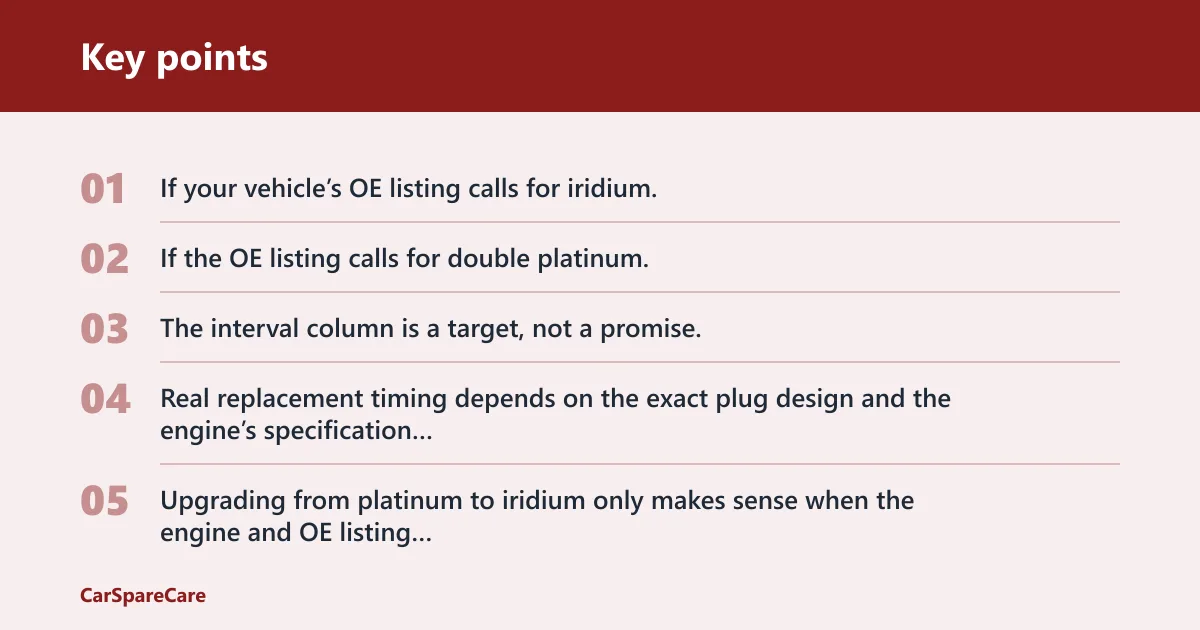
If your vehicle’s OE listing calls for iridium, that is the preferred match even when the system is waste-spark or coil-on-plug. If the OE listing calls for double platinum, use that instead of single platinum (OEM service manual; catalog guidance).
The interval column is a target, not a promise. Real replacement timing depends on the exact plug design and the engine’s specification (OEM service manual; NGK/Denso/Autolite guidance).
Upgrade and downgrade warnings
Upgrading from platinum to iridium only makes sense when the engine and OE listing support it. Downgrading from iridium to platinum can shorten the service interval or change the way the plug handles wear, and in some load-sensitive engines it can show up as earlier misfire under acceleration or highway load (OEM service manual; Delphi/NGK guidance).
If you need a quick rule, use this one: do not trade away OE design for a different material unless the catalog explicitly says the swap is valid (OEM manual; catalog guidance).
Service interval targets from 60,000 miles to 100,000 miles
platinum spark plugs commonly target about 60,000 miles in many applications. Iridium commonly targets 80,000–100,000 miles in many OE applications, but the catalog and service manual control the final number (OEM service manual; NGK/Denso/Autolite references).
That gap matters if you are planning long ownership. If you expect to keep the car past 80,000 miles, the longer interval can reduce repeat labor. If you will not, the cheaper OE-platinum option may fit better (OEM schedule; catalog guidance).
Can you swap iridium for platinum?
You can swap iridium for platinum only when the OE listing, part number cross-reference, and ignition design all allow it. If the manual names platinum, use platinum; if it names iridium, use iridium. A random material swap can change gap behavior, wear rate, and service life (OEM service manual; NGK/Denso/Autolite cross-reference guidance).
When the swap is safe
The swap is safest when a parts catalog lists the exact substitute for your engine code and ignition system. That means the heat range, reach, seat, and tip design all match the application (OEM service manual; catalog guidance).
If the listing does not say the swap is valid, do not guess.
When the swap changes performance or longevity
A material swap can change how quickly the center and ground electrodes erode. It can also change the voltage needed to fire the plug, which matters in a marginal ignition system (SAE ignition references; OEM service manual).
That is why some cars feel fine with the wrong plug for a while and then start showing misfires later. The problem is often wear, not immediate failure (OEM service manual; Delphi ignition references).
When to match the exact OE part
Match the exact OE part whenever the vehicle is under load-sensitive operation, the ignition system is specific about polarity, or the manual gives a single approved plug family. The closer the engine is to stock, the less reason there is to improvise (OEM service manual; Delphi/NGK guidance).
Picture a compact sedan with a coil-on-plug engine that specifies iridium and a 100,000-mile interval. Installing a cheaper platinum plug may fit physically, but it may no longer match the intended service life or electrode design (OEM service manual; NGK catalog guidance).
Choose the right plug
Choose Iridium if your engine was designed for it, your replacement interval target is 80,000–100,000 miles, or the OE part is a fine-wire plug that the catalog keeps as the factory match. Choose platinum spark plugs if the manual calls for platinum, the engine does not need a fine-wire iridium tip, or the ownership horizon makes the longer-life premium less useful (OEM service manual; NGK/Denso/Autolite guidance).
- Choose Iridium if: the OE part number is iridium, the engine uses a fine-wire center electrode, or you want the longest interval that the application supports.
- Choose platinum spark plugs if: the manual specifies platinum, the car uses a middle-price OE plug, or the engine does not need a fine-wire tip.
- Choose double platinum if: the engine uses waste-spark ignition and the OE listing calls for platinum on both electrodes.
- Choose neither by price alone if: the reach, heat range, or gap spec does not match the engine.
Frequently asked questions
Platinum vs iridium spark plugs which is better
Neither material wins in every engine. Iridium is better when the vehicle was designed for a fine-wire plug and a long service interval. platinum spark plugs are better when the OE listing calls for platinum, the ignition design does not need iridium, or the ownership horizon makes the extra cost less worthwhile (OEM service manual; NGK/Denso application guidance).
Which is better double platinum or iridium spark plugs?
Double platinum is better in waste-spark systems that were specified for platinum on both electrodes. Iridium is better when the engine’s OE part is iridium and the design calls for a fine-wire center electrode. The better choice follows the ignition system, not a universal hierarchy (OEM service manual; Delphi ignition references).
Can you use iridium spark plugs instead of platinum?
Only if the vehicle’s OE listing or parts catalog approves that exact iridium part number. A direct swap can change gap behavior, required firing voltage, or service interval. If the manual says platinum, do not assume iridium is an automatic upgrade (OEM service manual; NGK/Denso cross-reference guidance).
Are iridium spark plugs better than standard?
They can be, but only in engines designed for them. Iridium’s fine-wire center electrode and long service life make sense in many modern applications. In an older engine that was not specified for iridium, the material may bring little benefit (OEM service manual; NGK/Denso application guidance).
Why are iridium spark plugs better?
They are better in the right application because the fine-wire center electrode helps arc initiation, the required firing voltage is often lower, and the material resists erosion well. That lets many applications target 80,000–100,000 miles when the manufacturer designs the ignition system around it (OEM service manual; NGK/Denso literature).
What happens if I use the wrong spark plug type
You can get misfires, rough idle, harder starting, or shortened plug life. The risk rises when the heat range, reach, gap, or electrode design does not match the engine. In some cases the plug may fit physically and still be the wrong part, and the complaint may only appear under load or after the electrodes wear unevenly (OEM service manual; Delphi/NGK guidance).

Hi, I’m Melvin, an automobile engineer with extensive experience in automobile equipment. I currently work for a local automobile firm, where I specialize in the car parts industry. I’ve had the opportunity to collaborate with seasoned inspectors, gaining invaluable hands-on experience that goes beyond just theory.
My passion for automotive care started at a young age, which led me to create CarSpareCare. Through CarSpareCare, I share the knowledge and skills I’ve acquired over the years to help others navigate the world of car maintenance and repairs.
My goal is to provide practical tutorials, essential safety advice, and the latest industry insights so that anyone—whether a beginner or an expert—can confidently tackle their automotive projects.